Damascus: Tourists, Artists, Secret AgentsReloading ImagesThe Green Box/Prince Claus Fund Library
In 2008, representatives of Reloading Images, a loose network of research-oriented artists from Syria and elsewhere, gathered to delve into the psychic depths and urban spaces of Damascus. The product of that ten-month journey is a self-proclaimed “collective narrative” that positions the artists as secret agents, limning an imagined Damascus by way of cryptic collages, coded language, and palimpsestic texts. The results add up to more of a sketch than a map, a conversation without a conclusion. “We were fascinated by the secret society of Bataille and his Surrealist friends,” they write. “We wanted to imitate the rituals of the Acéphale, reading de Sade in the forest, romanticizing orgies and sacrifice. We almost slaughtered a lamb, but winced in the decisive moment; the animal ran away, leaving us behind, ashamed, silent, and sheepless.”
New Geographies 1After ZeroHarvard University Press, 2009
According to the inaugural issue of the journal New Geographies, “zero” represents the flattened landscapes to be paved over by so-called “new cities” (Norman Foster’s Masdar in Abu Dhabi, Rem Koolhaas’s Gateway City in Ras Al Khaimah); the emissions goals of progressive design; the amount of context often afforded cosmopolitan mega-developments; and the quantity of resources now available to realize forward-thinking architectural plans. After Zero, then, considers what might follow our current state of crisis, and what might replace the modes of thinking and building that got us there. The discussion lacks programmatic constraints and is pleasantly digressive, running from Keller Easterling’s analysis of the proposed Africa Optical Network, which would encircle the entire continent with a submarine fiber optic ring; to Thomas Campanella’s exploration of China’s “suburban revolution”; to Yasser Elsheshtawy’s exploration of the history and context of Abu Dhabi’s recent development surge, the “Arabian tabula rasa.” The result is a web of theories, proposals, arguments, and critiques, none of which tell us where after-zero may lead us, but all of which, cumulatively, offer an array of paths forward. It will be intriguing to see where this Harvard-based journal takes its readers when it tackles the “landscapes of energy,” the subject of its next issue, to be published this winter.
Perspecta 41Grand TourEdited by Gabrielle Brainard, Rustam Mehta, and Thomas MoranMIT Press, 2009
In the eighteenth century, elite young Englishmen set out on a standard itinerary across Western Europe to learn about art, architecture, and music and to hobnob with the ruling classes of foreign locales. The trip, known as the “grand tour,” came to play an integral role in the education of aristocrats and lay a foundation for the cultural tourism of the future. Perspecta 41, the latest issue of the cult student-edited journal of the Yale School of Architecture, uses the idea of the grand tour as its overarching theme and its point of departure for a meditation on why architects travel. The issue aims to counter the current barrage of globalization hype in urban discourse by taking a step back and (re)inserting personal nuance into the very idea of architectural travel.
In these pages, Denise Scott Brown and Robert Venturi share their experiences with foreignness and marginality; Peter Eisenman and Edward Burtynsky reflect on their personal travels; and Rem Koolhaas, perhaps the ultimate architect-traveler, is challenged critically, though conventionally, by Esra Akcan. Photographer Ramak Fazel takes us through the mechanics of his road trip to every capitol building in the continental United States, Ljiljana Blagojevic writes on the tumultuous history of Milorad Pantovi’s Belgrade Fairgrounds, and Sam Jacob reflects on tourism architecture via the Villagio Mall in Doha. Jeffrey Inaba of C-Lab shares his plan to save Venice. Essays are broken up with photo-stories—the Venturi, Scott Brown home with all its tchotchkes — images, and short texts, including excerpts from Yuichi Yokoyama’s wordless graphic novel Travel and a series of his laconic observations on it: “A mass of rocks is visible on the mountaintop. The landscape seems to symbolize something. A new house can be seen at the foot of the mountain.” Excellent.
China Safari: On the Trail of Beijing's Expansion in AfricaSerge Michel and Michel Beuret with photographs by Paolo WoodsNation Books
While the West has been divorcing itself from much of Africa over the last twenty years — America’s blundering intervention in Somalia’s civil war has remained fresh in the minds of politicians, and myriad intractable social and economic problems have made investors queasy — China has been, in the words of Michel and Beuret, “making waves across much of what was long considered a stagnating continent.” Their survey of China’s booming business throughout Africa shows an ascendant superpower anxious to turn a profit wherever it can.
It’s not just oil China is after; its minions are developing land, building real estate, setting up manufacturing firms, mining ore, and building highways. In Cameroon, “there’s hardly a single aspect of the country’s life that hasn’t been upgraded, replaced, or otherwise improved by Chinese intervention.” The draw of the nearly $100 billion traded between the two regions is apparent in the authors’ numerous portraits of Africa-bound émigrés, who are willing to trade the increasingly unattainable goal of making it in China’s cities for the promise of a few hundred extra dollars per month in a land that is strange, but becoming less so.
Cairo PortfolioA Public Space #9Edited by Brian T Edwards
In “Bordering the Marvelous,” Mohamed Al-Fakhrany’s contribution to this special supplement to the New York literary quarterly, three nervy kids from the slums — Farawla, Naeema, and Awad — eke out a living selling drugs on the Nile Corniche, until one is arrested for the crime. Rather than abandoning the characters or narrating their fates, the author invites the reader to investigate: “Why don’t you picture it, or find out, for yourself? Go to the Corniche… Beside the hotel… Try it… Shout: ‘Farawla… Naeema… Awad…’”
Edwards, the author of Morocco Bound: Disorienting America’s Maghreb, from Casablanca to the Marrakech Express, has compiled a highly specific, if limited, sampling of Cairene literary and artistic currents. Omar Taher’s introduction, translated by Edwards, situates a generation of Cairenes in the maw of global pop culture and Egyptian TV, soccer stars and the last half-century’s innumerable historical traumas. Those who came of age in this era contend with a globalized world fraught with the restrictions of the Egyptian state and society; they are not only products of the age, but children of images. The numerous footnotes provided by Edwards and Amina Mohamed turn the brief essay into a kind of primer on the twentieth-century history of Egypt, and an apt preface to what follows: Al-Fakhrany’s story; an interview with the veteran documentarian-turned-filmmaker Ibrahim El Batout (Eye of the Sun) about censorship and the future of independent film in Egypt; a story by Muhammad Aladdin; and a comic by Ahmed El-Aidy.
The Novel of Nonel and VovelBy Oreety Ashery and Larissa SansourCharta, Milan, 2009
Oreet Ashery is Israeli, Larissa Sansour, Palestinian, and for outside observers, they acknowledge in the foreword, there’s nothing more appealing than such a dialogue: “A mutually extended olive branch is about as sexy as it gets.” Their graphic novel aims to address “the problematic nature of the very kind of dialogue we — as collaborating artists from opposite sides of the divide — are in some shape or form engaging in.” The artists, both now based in London, worked on the book under alter egos, Nonel and Vovel, names taken from rapid-fire, typo-laden Skype conversations between the pair. The subjects in their comic strips and photo-stories are caricatures of hardworking artists with noble intentions, presided over by the Lab Man, who gives them the option to swap their fruitless efforts as artists for the chance to become Palestine-saving superheroes. Each chapter is designed by a different artist persona, taking in quizzes, questionnaires, cut-out dolls, and knowing Facebook exchanges, as well as more traditional drawings and illustrations. Ashery and Sansour then handed over the second part of the story to the writer Søren Lind and the more usual traditional comics illustrator Hiro Enoki, as a final self-destruct on the part of the artist-as-hero. (The book also includes essays by curators Reem Fadda, on the ‘Palestine Question’, and Nat Muller, who contributes a proposal to the Venice Biennale for the “2212 Intergalactic Pavilion”.) There could be fewer photos of Nonel and Vovel (or is it Ashery and Sansour?) at play in London, and at times the commentary slips into beyond-character earnestness, but this is a playful, beguiling book; keep an eye open for what Ashery and Sansour do next.
Bidoun Projects has had its hands full this fall and winter. In October we manned our usual booth at the Frieze Art Fair in London, while in New York we hosted a night of film screenings in collaboration with publishing culture-hero Semiotext(e), presenting outsider visions of Morocco — from Michel Auder’s ode to Warhol muse Viva’s foiled trip in 1971, to Mohamed Ulad-Mohand’s examination of Paul Bowles, the superlative expat.
A few days later, we launched our fall issue and previewed our winter issue at The Kitchen with gallerist Tony Shafrazi narrating Moogambo, his operatic epic 1976 artist’s book/novella, even as Gini Alhadeff and Hampton Fancher recreated the magic of their first encounter (memorialized in our last issue). There were cowboy films from Iran and professional whistlers, too, along with tunes by Children, the duo of Fatima Al Qadiri and Shayne Oliver.
In November, we teamed up with Cabinet magazine to present a rare screening of Shahr e Ghesse (City of Tales), the 1972 film version of the 1967 Iranian play, and hosted an idiosyncratic Performa event by artist Ahmet Ogüt remembering the late Armenian-Turkish journalist Hrant Dink. The performance involved a blind painter and a dark, dark room.
Also in November, at Abu Dhabi Art, we launched an unprecedented resource room and library with collected bookish ephemera from the likes of Istanbul-based art publisher BAS or our comic partners in crime, Samandal, from Beirut. The resource room will also host rare recordings from around the world drawn from BubuWeb, Bidoun’s iteration of avant-garde cult media site UbuWeb. Our hope is that Abu Dhabi will be the first of many stops for this important work in progress.
And finally in December, we opened a show entitled NOISE at Beirut’s Sfeir-Semler Gallery that aimed to explicate (or perhaps complicate) what it means to be exhibiting art in and around the Middle East. The show, which runs through February at the massive Beirut space, includes a text piece by Lawrence Weiner that runs along the gallery’s windows facing the Dora Highway. On the roof, a large neon sign by Vartan Avakian spelled out SFEIR-SEMLER in Devanagari script, advertising the previously unmarked building to the large immigrant Asian population in the old Armenian neighborhood below. Also included are photorealist works by Steven Baldi, a sculptural installation by Alessandro Balteo Yazbeck and Media Farzin, a piece of wall taken from the Tony Shafrazi Gallery by Babak Radboy, new photographic prints and sculptures by Walead Beshty, a ping-pong table by Rayyane Tabet, polaroids and a film by Haris Epaminonda, videos by Yoshua Okon, and paintings by Mounira Al Solh and Bassam Ramlawi. Also making her exhibition debut was gallerist Andrée Sfeir-Semler, as herself.
DubaiAbraaj Capital Art PrizeOngoing until March 2010
This September saw the results of the second year of the art prize founded by investment firm Abraaj Capital: artists Hala Elkoussy, Marwan Sahmarani, and Kader Attia are now working on major new projects to be unveiled at the Middle East’s largest fair, Art Dubai (March 17–21, 2010). Upon completion, the works will become part of Abraaj’s corporate collection. The prize is designed to facilitate artists from the MENASA region (Middle East, North Africa, and South Asia) in working with international curators to realize new work that pushes their practice beyond its usual boundaries. Hala Elkoussy has teamed up with Amsterdam-based curator Jelle Bouwhuis to propose Room of Myths and Legends, described as “an unexpected, itinerant wing to the non-existent Museum of the City of Cairo.” Besides the artist’s usual practice of creating spaces crammed, salon-style, with landscape photos, portraiture, video, and so on (one example being On Red Nails, Palm Trees, and Other Icons–Al Archief (Take 2), at Sharjah Biennial 9), Elkoussy is working on a panoramic mural made up of panels that reference “propaganda murals” in their style and compositional hierarchy.
At the announcement of the prize winners in Dubai on September 6, curator Mahita El Bacha Urieta, who has worked at the Sharjah Biennial and Abu Dhabi’s TDIC and is now based between Beirut and London, thanked the committee for acknowledging the unfashionable medium
of painting, and for encouraging expressionist painter Marwan Sahmarani to develop a new direction in his work. Their joint proposal is for a domed room of fresco-esque scenes that reference key works by Michelangelo and Rubens. Finally, Kader Attia, with curator Laurie Ann Farrell, is working on a typically astute quip of a sculptural work that should have particular resonance with Gulf audiences. Following a six-month period of gestation, the finished works
will be revealed with all the fanfare associated with the Dubai fair in March. Works by the 2009 winners — Nazgol Ansarinia, Kutlug Ataman, and Zoulikha Bouabdellah — were exhibited at the Dubai International Financial Center before touring to the Museum of Arts and Design in New York in September 2009. Meanwhile, given the general paucity of state funds for the arts in the MENASA, and despite the global downturn, it’s hoped that other Gulf-based companies will join Abraaj in collecting and commissioning new work.
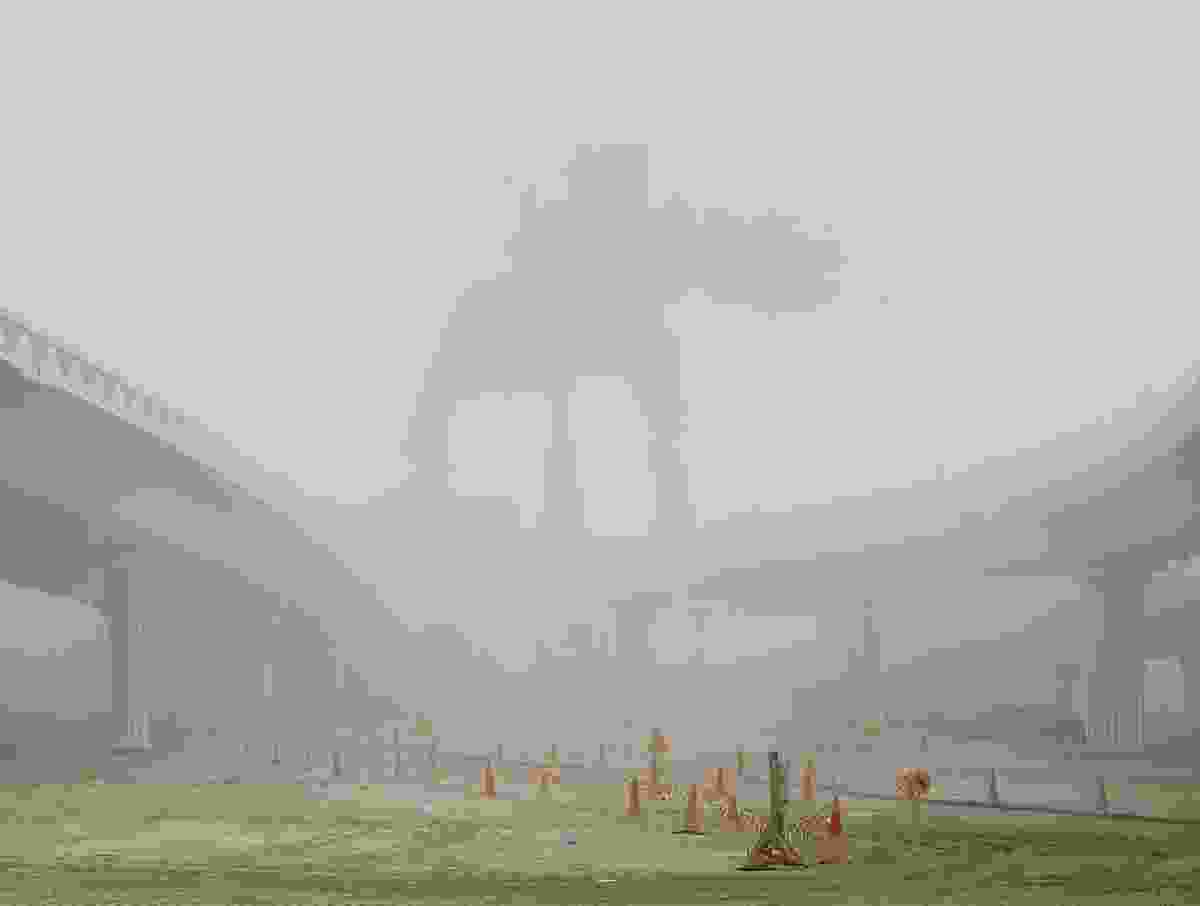
Cedric Delsaux, At Brouillard, 2008. Courtesy the Empty Quarter Gallery
DubaiCedric Delsaux: The Dark LensThe Empty QuarterDecember 1–31, 2009
The Empty Quarter is the first specialist photography gallery in the Middle East. Backed by Saudi photographer Reem Al Faisal, with Elie Domit as director/curator, they opened at the nadir of Dubai’s downturn in March 2009 and have somehow weathered the economic storm with a series of diverse, quality exhibitions and book releases. The gallery occupies a slickly designed space in the DIFC Gate Village — alongside the Farjam Collection, Artspace, Cuadro, and, of course, Prada, Vivienne Westwood, Villa Moda — that nevertheless gestures toward the independent. It welcomes UAE graduates alongside Magnum veteran Eve Arnold and experimental photographer Mohammadreza Mirzaei, for example.
December’s artist Cedric Delsaux won the Kodak prize for landscapes and architecture with his Star Wars on Earth series in 2005; here he continues the exploration into (real) landscapes and (mythic, nostalgic) sci-fi by turning to Dubai’s dust, detritus, and commercial sheen. Working with Attakus Star Wars statues and George Lucas’s special effects model makers, the images are perhaps a tongue-in-cheek tribute to Dubai’s former status as a futuristic, otherworldly, “master of the universe” city-state; as the emirate reconsiders itself post-crunch, this witty series appears apt and timely.
DubaiBidoun Workshops: Writing About ArtThe Shelter and other venuesJanuary 14–16 and each month to June 2010
Aiming to kickstart an informal art school tradition in Dubai, Bidoun Projects, the magazine’s curatorial sister organization, presents a six-month course of workshops and lectures in 2010, looking specifically at writing about art. Both visiting and locally based artists, curators, and readers are known to bemoan the lack of considered critique in the Gulf’s general and, more specifically, arts-related media: They’re more likely to read the gallery’s press release reproduced umpteen times than read original criticism. And with a growing number of touring exhibitions and international events in the vicinity, demand for informed arts writers far outstrips supply. Covering both the practicalities and intellectualisms of critique, the series starts with a weekend get-together in January, and continues once a month until June, and pits a bevy of budding UAE-based writers against a clutch of visiting and local critics. Keynote presentations are combined with discussions and visits to exhibitions and events, while Bidoun and guest editors build on the course activities by discussing, one-on-one, the participants’ reviews each month. The course is taught in both Arabic and English, at Bidoun’s UAE base, the Shelter in Al Quoz 4, besides other venues; for further information and updates, check bidoun.com, or email Bidoun Projects’ Dubai coordinator Alia Al-Sabi (alia@bidoun.com).
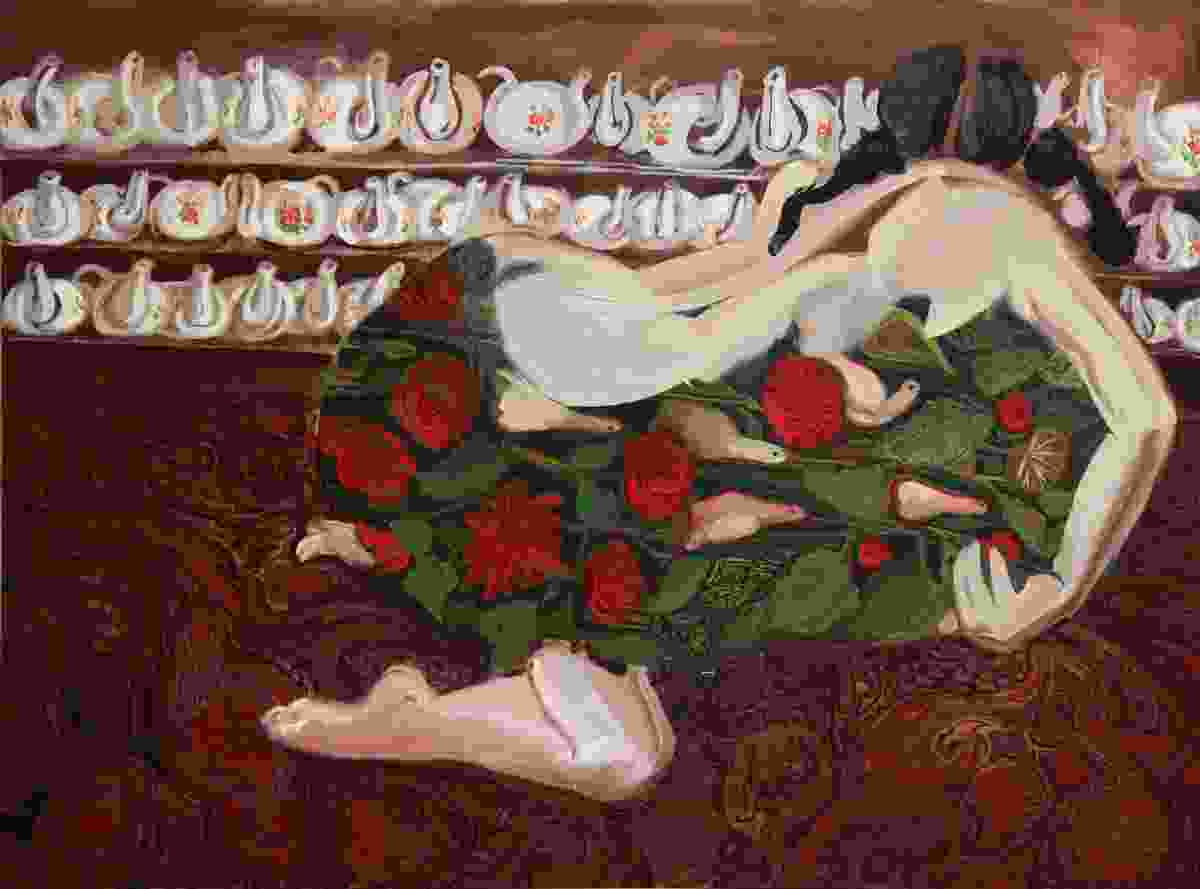
Rokni Haerizadeh, Chiniye Gole Sorkhi, 2009. Courtesy the artist and B21 Gallery
Painter Rokni Haerizadeh is a darling of the Gulf’s commercial art world and consistently included in international group shows of Iranian contemporary artists. And yet he has managed to ride this wave while keeping his practice resolutely individual. Over the years, his work has gradually become less concerned with mythic stories and poetry, and more documentary in style. Resident in Dubai (along with his brother, the photographer Ramin) since spring 2009, his new works contemplate Iran from afar, dwelling on both the events that led to his exile (Revolutionary Guards break into collector’s house and they call the party Devil Worshippers’ house, a monumental diptych) and the pre- and post-election fever that swept Iran. At the time of writing, he’d completed seventy small-scale works on paper for Fictionville, a series that documents the protests as experienced through the international media, specifically the window of a TV screen. “This has become the only way to look at my country, through a medium used for entertainment,” he told Bidoun. “You follow the disaster for a while, and then make your day.” Now a resident of the new tower blocks of the Jumeirah Beach Residences, Dubai’s gaudy beach life has also caught his attention, while other series take George Orwell’s Animal Farm and the death of John Lennon as departure points.
New YorkRomanticide: Love, Loss and Co-dependency in Art and Cultural PoliticsOngoing until April 2010New York University Abu Dhabi (Various Locations)
Frequent Bidoun contributor Clare Davies has curated a series of panel discussions aimed at exploring the territory of making art in the Middle East, in the context of “an arts infrastructure dominated by the rhetoric of nation-building, the promise of private wealth, and the priorities of humanist agendas.” The series, which takes place at NYUAD’s USA campus, says Davies, explores the roles that artists play in interpreting nation-building and humanitarian initiatives, while endowing them with intellectual currency. This fall saw Tirdad Zolghadr, Ayreen Anastas, and Boris Groys examine the enduring affair between contemporary art and human rights, and Bilal Khbeiz and Sadik Jalal Al-Azm discuss the plight of the Arab intellectual. Winter-spring events will include a performative talk by Alexandria Contemporary Arts Forum and Manifesta curator Bassam El Baroni (January 27); historian Omnia El Shakry on “Dense Objects and Sentient Viewings” (February 10); and artist and Bidoun editor Hassan Khan with “The Shape of the Argument,” an attempt by the artist “to come to terms with a vague realization of something that might equally be the product of a growing consciousness or the platitude of a self-serving delusion” (March 10). The series is rounded off with “Fortune-teller: Reflections on the Future of Arts, Education and Economy in the Middle East,” debated by Mishaal El Gergawi, of the Dubai Arts and Culture Authority Project, and the political economists Kiren Aziz Chaudhry and Saskia Sassen (April 7). Bidoun is a partner in the project, part of a series of events aimed at enriching discussion around themes in the region, around the opening of the NYU campus in Abu Dhabi, scheduled for December 2009.
CAMP, Edgware Road, 2009. Courtesy the artists
LondonEdgware Road: The Centre for Possible StudiesThe Serpentine GalleryOngoing
The Serpentine takes London’s iconic Edgware Road as its point of departure in an ongoing multidisciplinary project that will involve artist projects, symposia, and collaborative filmmaking endeavors. Operating out of a headquarters enigmatically called “The Center for Possible Studies,” this project will also aim to engage local residents, shop owners, and others who intersect and interact with this storied road, which has come to host multiple immigrant communities over the decades. Among the project’s participating artists are Mumbai-based collective CAMP (whose pirate radio project was at the last Sharjah Biennial), Susan Hefuna, Khalid Abdalla, Hiwa K, no.w.here, and Ultra-red. Highlights of the initiative include CAMP’s Block Study, a collaboratively edited and annotated archive of histories of one block of the Edgware Road. Bringing together contemporary zoning laws, future plans, and the past lives of buildings, the study plans to uncover both the residents’ relationships to cinema and the place of Edgware Road in a broader global cinematic imaginary.
Hazmig Khaniguian, Courtesy of 98 weeks
Beirut98weeks Project SpaceMid-November, 2009
Beirut-based collective 98weeks opens a new space this fall in the city’s Mar Mikhael neighborhood. Inaugurating the space with the results of a one-month-long research project and workshop, the collective will continue to take the city as one of its central concerns and inspirations. In the past, 98weeks, initiated by cousins Mirene and Marwa Arsanios, has invited artists Francis Alÿs and Lara Almarcegui and critic Cuauhtémoc Medina, among many others, to lead workshops and think about spatial practices — how contemporary art can both be born of and occupy any given locale, and the various lives it may have. Planned for the project space are talks, workshops, screenings, reading groups, and more.
Kara Walker, Testimony: Narrative of a Negress Burdened by Good Intentions, 2004. Courtesy the artist and Sikkema Jenkins & Co.
BeirutAmericaBeirut Art CenterOctober 21, 2009–January 16, 2010
America represents an attempt to come to terms with the United States as a possible model of civilization. What does “America” mean in the world’s collective unconscious? Neither accusatory nor celebratory, the purpose of the exhibition is to reflect on mythologies that have constituted and perpetuated the idea of America, while also considering the ways in which America has been both imagined and imaged by Americans and non-Americans alike. The show features sixteen works by artists of different nationalities and backgrounds, living inside and outside the United States, among them Naji Al-Ali, Ayreen Anastas and Rene Gabri, Ziad Antar, Joseph Beuys, Wafaa Bilal, William Eggleston, Mounir Fatmi, Jenny Holzer, An-My Lê, Matt McCormick, Julia Meltzer and David Thorne, Melik Ohanian, Catherine Opie, Greta Pratt, Martha Rosler, and Kara Walker.
CairoAssume the PositionTownhouse Gallery of Contemporary ArtDecember 6, 2009–January 16, 2010
This group show takes as its starting point the loss of focus, distraction as diversion. The offstage moment becomes central, the minor player becomes the star, the prop the protagonist, the interior monologue the script. In some works, selected by curator Nikki Columbus, the artist inserts herself to create a disruption: Croatian artist Sanja Iveković attracts the attention of police by pretending to masturbate on her balcony; American artist Jill Magid’s romantic city tour is filmed entirely by surveillance cameras. Other artists reframe events through different means: Egyptian photographer Osama Dawod captures G8 protesters on a pee break, while American David Levine re-crops performance art documentation to show only the onlookers— staring off into space, sleeping, talking among themselves. Guy Debord’s iconic spectators, transfixed in their 3D glasses, have been replaced by actors and audiences who continually turn away.
Earth of Endless SecretsBy Akram ZaatariPortikus, Galerie Sfeir-Semler and the Beirut Art Center2009
Akram Zaatari’s Earth of Endless Secrets is an artwork, a project, an exhibition, and now a book. Documenting fifteen years of artistic practice, this gorgeously produced publication is neither a retrospective nor a mid-career survey but rather a collection of four carefully composed, exhaustively researched ruminations on a single theme: the complex representation of geographic territories that have been subjected to episodes of occupation and withdrawal. Clustered around four video works, from 1997’s All Is Well on the Border to 2007’s Nature Morte, the books explores politically fraught landscapes from the former security zone in South Lebanon to the hotly contested Shebaa Farms. Zaatari’s material ranges from objects literally pulled from the ground to interview transcripts, buried letters, cherished snapshots, documentary photographs, and more. Exploring both physical and psychological modes of archeological excavation, Zaatari’s works here probe the experiences of men who signed up to fight for a cause when they were teenagers, only to find themselves adrift as adults, their guiding ideologies shattered, their movement in ruins, their cause lost. As such, Earth of Endless Secrets pensively probes the relationships between occupation and resistance, narrative and fragmentation, lover and fighter, desire and fear, pursuit and escape, heroism and human frailty.
Kidnapping MountainsBy Slavs and TatarsBookworks, 2009
Released in tandem with their Netwerk Center for Contemporary Art show, the collective Slavs and Tatars’s Kidnapping Mountains begins with the Caucasus Mountains and extends throughout Eurasia and beyond, constructing an odd history as fragmented as the regions’ inhabitants. Kidnapping Mountains, published by Book Works, functions as an expanded catalog of Slavs and Tatars’s various strategies of jocular didacticism, including reproductions of their posters, slogans, and songs. The book illustrates the muscular battle of wills involved in the highly contentious staking of a regional identity. Slavs and Tatars inform the more recent history of the 2008 South Ossetia War by culling from the Caucasus regions’ ephemeral and perennial histories. They personify the Caucasus Mountains as the subject of their narrative, using the term “Caucasian” as a battleground, “wresting the immanent complexity of the name from its extinguished usage,” through tactics of linguistic and graphic subversions that play between flippancy and dead seriousness.
Three years after Robert J. Flaherty’s seminal anthropological documentary Nanook of the North, a trio of American filmmakers, two of whom would continue on to make King Kong, took on Iran with a similar naturalist adventurism in the film Grass: A Nation’s Battle for Life. The disintegration of the Ottoman Empire in the wake of World War I functioned as a conceptual entry point for Merian Cooper, Ernest Schoedsack, and Marguerite Harrison to forge unabashedly into the Middle East, traveling to southern Iran in 1923 to follow the Bakhtiari tribe in an effort to preserve them in celluloid.
Bahman Maghsoudlou comprehensively recounts the making of Grass in his book Grass: Untold Stories, informing the sparsely documented history of the film with biographical and diaristic information, gleaned from correspondence and autobiographical sources. Beginning with America’s entry into World War I, Maghsoudlou reconstructs a temporal narrative of the three filmmakers’ world-spanning travels, among which the journey to Iran that produced Grass becomes secondary. Grass: Untold Stories carries the imperative of an extensive historical document, though it’s imbued with the pulp-like nature of two men and a woman following the path of a migratory Iranian tribe with adventurous rather than strictly anthropological motivations. Maghsoudlou compiles a cohesive narrative of early cinematic production follies and 1920s adventurism through Cooper, Schoedsack, and Harrison’s wartime and postwar activities, culminating in the production of their overlooked documentary film.
Support StructuresEdited by Céline CondorelliSternberg Press, 2009
How much ink has been spilled over the role of those anonymous administrative or curatorial or bureaucratic — or simply ancillary — characters who contribute to the production and exhibition of artwork but never sign their names to it? Not nearly enough, according to Support Structures, which bills itself as a manual for those operating in this ill-defined terrain. According to author-editor Céline Condorelli, the book “represents an effort to draft and construct a supporting structure for the creation of support’s discourse, to house other forms of support structures, and to revive… a particular way of engaging in and with subjects in a desire towards emancipation.”
That’s a lot of “support,” you might say. This reviewer had never noticed the gaping hole where a rich discourse should be; Support Structure, the collaborative project leading up to the publication of this book, has been filling in the holes and fleshing out the meaning of the role since 2003. In this age of artists whose production models are often the collective or the factory — and who often do little more than provide concepts, outlines, directives, and supervision — it makes sense for the overlooked technicians and mechanisms that actually fabricate artwork and usher it into the world to garner some critical consideration. Support Structures grants them that — and then some. Support, it suggests, is marginalized because doing so reinforces the myth of the autonomous art object.
Besides the introductory texts by Condorelli, the book consists of numerous works — lists, essays, manifestos, rants, complaints — that elucidate and embody the slippery subject. The selections comprise an ambitious, if willfully uneven catalog of what support can be: primers on social practice (Rirkrit Tiravanija), documentation of anti-gentrification street art, a conversation about the meaning and possibilities of humanitarian intervention (Rony Brauman and Eyal Weizman), and a meditation on the position of the frame in the history of painting (Jean-Claude Lebensztejn). “Any attempt at defining support,” Condorelli writes, “would entail a position external to the subject, and… there can be no discourse on support, only discourse through support.” Here it is.
We’ve been talking about doing an issue about the market for so long that the boom went bust before we got around to it.
When Bidoun started out, there were no art magazines in the Gulf, no art fairs or auction houses; galleries hardly existed. What did exist was a burgeoning group — not yet a community — of young artists, with few venues for showing their work and little or no place to talk about it, let alone critique it.
Six years later, there are auction houses and art fairs and prizes. There is another Middle Eastern art magazine, Canvas, and it has a TV station (with incredible set design by Zaha Hadid). For many artists from what some without irony call MENASA (sadly, not a space program), the problem is no longer a dearth of opportunities, but the kind of opportunities on offer.
In “Identity Bazaar”— a folio’s worth of rants assembled by Bidoun ranter-in-chief Hassan Khan — a gang of four artists and curators analyze, bemoan, disdain, and pity contemporary art institutions and the “ethnic turn” in curatorial practice (in an “arts and culture from the Middle East” magazine, no less). Accompanying their words are a selection of photographs that document Forms of Compensation, a project in which twenty-one iconic modern and contemporary artworks were counterfeited by workers from the mekaniki district of Cairo. The results are pretty funny, but they are also strangely uncanny in their stilted articulation of the originals. In this way, they echo the local bazaars, where such mutant clones as OK1 by Oalvin Klein, Y-5, Abidas, and Shanel abound.
This language of marketing is nothing new. In “Arabia on the Turkey,” Adam John Waterman tells the tale of Elkader, Iowa, a small farm town named for an early nineteenth-century Algerian revolutionary — and a pawn in the great game of cultural diplomacy even today. Lawrence Osborne’s short story “Hungry Ghosts” tells a tale of life and death in the gambling palaces of Macau. Gini Alhadeff’s lovely essay “Pleasure for the Eyes” suggests the indispensability of ornament, which we moderns tend to think is beneath, or at least behind, us.
In “Lord of the Drone,” Alexander Keefe recovers the life and legacy of the great Indian singer and tambura player Pandit Pran Nath, a key but underappreciated figure in the 1970s art underground. Alexander Provan’s “The Golden Compass” profiles another set of dreamers, the Murabitun — a wildly ambitious Sufi sect that plans to destroy the world-capitalist system not with bombs or swords, but with a gold-backed currency.
Lodged between a ceramic goldfish and a brick garnished with kale and cherry tomatoes, you’ll find the gilded pages of what might be the world’s first Kuwaiti comic book, Fatima Al Qadiri and Khalid al Gharaballi’s Mahma Kan Althaman (“Whatever the Price”) — the hermaphroditic lovechild of Moogambo, The Real Housewives of Atlanta, and a 1970s Italian fotonovela.
Farhad Moshiri, the Iranian Andy Warhol of the Arab world, is not the kind of artist you normally read about in this magazine, despite the fact —or perhaps because of it? — that his career, cachet, and controversy in many ways mirror Bidoun’s own. But in the Bizarro World of BAZAAR, he’s not just in our coverage — he’s on the cover, encrusting our logo with Swarovski crystals. All that, and it still only costs $12. WTF!
In January, Bidoun Projects launched a series of art-writing workshops in Dubai, focusing on developing critical debate around contemporary practices. The first lively, weekend-long workshop was attended by over fifty curators, journalists, arts administrators, architects, and students — plus the occasional banker and graffiti artist — and tutored by Hassan Khan, Kevin Mitchell, and Kaelen Wilson-Goldie, while February’s session included a presentation by Shumon Basar. Workshops continue throughout the spring, in addition to one-on-one sessions with the tutors and ongoing exchanges via Facebook. The workshops are presented in partnership with the Dubai Culture and Arts Authority and held at Shelter, our home in Dubai.
Also at Shelter, the Portfolio Project — a rolling monthly showcase for upcoming photographers based in the UAE, curated by Alia Al-Sabi — continues with an exhibition by Sharjah-based Iraqi-Turkish artist Yasmeen Mohammed. Previous participants include Hind Mezaina, Mohamed Somji, and the duo Zeinab Hajian and Aisha Miyuki.
This issue of the magazine is being launched at Art Dubai, now in its fourth year. This year the fair invited Bidoun Projects to be its curatorial partner. We’ve programmed a series of noncommercial exhibitions, commissions, screenings, and educational events, including major new installations by Ebtisam Abdulaziz, and Vartan Avakian; a set of ice sculptures designed by Farhad Moshiri; and, for the third year running, an Art Park in the basement parking lot, full of videos, talks, and performances. We’ve also invited Sophia Al-Maria, Khalil Rabah, and Daniel Bozhkov to act as tour guides. Look out for Bozhkov’s contribution, The Fastest Guided Tour of Art Dubai: “a run through seven acres of creative production in forty-five minutes.” Bidoun Projects’ activities at the fair are kindly supported by the Emirates Foundation.
Also at Art Dubai, Bidoun celebrates the first anniversary of its ongoing collaboration with UbuWeb with screenings and discussions in the Art Park. Recent additions to the BubuWeb stream — accessible from ubu.com, but also from Bidoun’s redesigned and newly functional website, bidoun.com — include the films of Hamlet Hovsepian and Sekai Senso Sengen (Declaration of World War), a joint film project of the Japanese Red Army Faction and the Popular Front for the Liberation of Palestine, produced in 1971 by RAF members Koji Wakamatsu and Masao Adachi.
The Bidoun Library makes an appearance at Art Dubai in March and then travels on to 98 Weeks’ space in Beirut in April, to coincide with the Hay Festival, Beirut39, and Ashkal Alwan’s Home Works Forum. The library is presented in partnership with Abu Dhabi Art; new sections include a focus on the pioneering Iranian state-sponsored book-and-film agency for children, Kanoon.
Meanwhile, in Cairo, a major exhibition of works commissioned by Babak Radboy, overseen by Ayman Ramadan, and executed by an array of artists, hustlers, and auto mechanics (sometimes the same person), is on display at the Townhouse Gallery of Contemporary Art. Forms of Compensation is a series of twenty-one reproductions of iconic modern and contemporary artworks, with an emphasis on sculptures, paintings, and prints by Arab and Iranian artists.
This winter also sees the publication of our second book with the Sharjah Art Foundation, the sequel to Provisions (March 2009), the companion to last year’s Sharjah Biennial 9. The second volume, again coedited by the biennial’s Lara Khaldi, is an innovative response to the “biennial experience”: visiting critics, curators, and artists contributed diaries from their time in Sharjah, while biennial participants sent us projects and interventions on paper that reflect on the UAE and their experiences.
Last, but by no means least, Bidoun celebrates the arrival of a new art director, Andy Pressman of the Brooklyn-based design studio Rumors.
Footnotes in GazaBy Joe SaccoMetropolitan Books, 2009
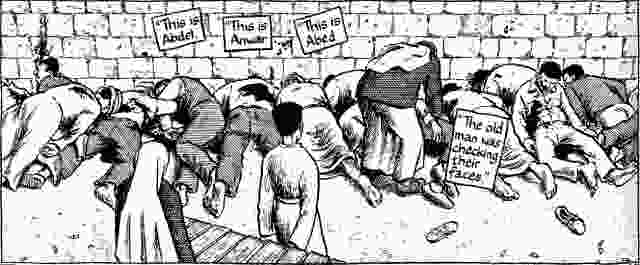
In November 1956, two massacres of Palestinians by Israeli soldiers occurred in the Gaza Strip. As tends to happen, both were almost immediately subsumed, by the Suez Canal crisis and other successive crises in the region. Episodes of comparable horror and greater political import took over the headlines, and the events in Gaza disappeared into the sediment of the conflict. Joe Sacco, the venerable war-reporter-cartoonist, had read about one of the massacres — the shooting of 275 men in Khan Younis — and, on a reporting trip to Gaza in 2001, spoke to some survivors. According to a Hamas senior official whose uncle was among those killed, the episode “planted hatred in our hearts.”
Months later, after the article he had been working on was published (with the part about the massacres excised), Sacco decided to return to Gaza and further investigate what had happened in 1956. The second incident caught his attention as he was doing research: Israeli soldiers had been searching for guerillas in Rafah and called for all men to gather to be screened; the soldiers for some reason panicked and began firing on residents, killing more than a hundred of them. This episode, too, had nearly disappeared, save for a couple of painfully judicious sentences in a United Nations report.
What Sacco has done in Footnotes in Gaza is exhume those two massacres and, in a deftly told and richly illustrated narrative, bring them back to life — not only through the memories of the people who survived them, but through the lives of the many Palestinians who are shaped by them still. Sacco — represented, per usual, as a gangly, fat-lipped, camera-toting blot on the landscape, his eyes concealed by spectacles — roams Gaza in lockstep with his fixer, who arranges interviews and acts as the author’s perennial companion. As in Sacco’s past books, the fixer (this time a native Gazan named Abed) mediates between the reader and the journalist’s subjects: though from the English-speaking upper class, he’s still struggling to make a living. The fixer channels the ambitions and ambivalence of his brethren — the awkward balance between resenting and yearning for the West, despairing and feeling hope for the future. Abed in particular embodies the connection between the daunting accumulation of historical fact in Israeli archives and the reports of the NGOs and the fragmented memories of traumatized Palestinians; through him, Sacco melds the horrors of the past and the deadening life of Gaza in the present.
Sacco makes no attempt to achieve “balance”; there are no statements from the Israel Defense Forces, no equation of human suffering and the exigencies of domestic politics. He focuses on the lives spent in dusty refugee camps and smoke-filled, single-room dwellings, training his eye on the exhausted faces of veteran resistance fighters (though they’re hardly fighting anymore). One of them is Khaled, a militant on Israel’s “wanted list” who has been living underground for years, traveling from safe house to safe house, stopping by his own home every so often to see his wife and son. “The boy insists on being woken up to play with his dad no matter what time he shows up,” Sacco writes, the text floating above a child clad in pajamas who struggles to stay awake while his father regales the journalist with stories of intifadas past. “Khaled’s wife is expecting again,” Sacco notes as their conversation is ending. “Khaled says her relatives encourage her to have more children as soon as possible. They wonder how much longer Khaled has to live.”
Pathos and fact command Sacco’s attention equally; while his writing is unadorned, alternating between the language of historical documents and interviews — save for the occasional authorial interjection — his illustrations illuminate the page, transporting the reader from rubble-strewn battlefields to claustrophobic domestic scenes to expansive cityscapes. If Benny Morris’s The Birth of the Palestinian Refugee Problem and the work of Israel’s other New Historians focused attention on the mess of nationalistic narratives around the country’s signature conflicts — 1948, 1967, 1982 — Sacco steers attention toward the calamities whose symbolism is eclipsed by their arbitrariness, and which form the architecture of daily life rather than the spectacles of politics. The massacres he narrates are but two of the manifold roots of the anguish that simmered beneath the stagecraft of the post-Oslo period — episodes that have become such a part of the fabric of life in Gaza that, Sacco notes, even those who lived through them have a hard time distinguishing between them. Those who do remember would just as soon not speak about it, or else they wonder why Sacco is interested in these forgotten historical episodes rather than the suffering of Gazans today.
In the end, Sacco is not quite sure either. The story of the journalist seeking to relate a discrete episode, or a neatly packaged piece of the horror of war, and ending up with a tale that lacks a clear beginning or end, an arc or hook, logic or relief, is not a new one. But whereas for many journalists this personal revelation becomes a cheap hallmark of the war-reporter-turned-author, Sacco allows his characters their own ambivalence, which he records from a slight distance. Of course, that distance, too, diminishes over time. Toward the end of the book, Sacco tells of an interview with a man named Abuh Juhish, who was in Rafah in 1956. He remembers — or chooses to remember — little beyond the fear he felt that day. “Suddenly I felt ashamed of myself for losing something along the way as I collected my evidence, disentangled it, dissected it, indexed it, and logged it onto my chart,” Sacco writes. “And I remembered how often I sat with old men who tried my patience, who rambled on, who got things mixed up… how often I sighed and mentally rolled my eyes because I knew more about that day than they did.” Sacco — young, stolid, and set to leave Gaza the next day — sits across from Abu Juhish — ailing, tearful, and destined to die in Gaza — in silence for a moment before ending the conversation.
On September 20, 2001, President George W. Bush addressed a joint session of Congress. The speech was structured around a series of questions about the terrorist attacks that had occurred nine days earlier — who had conducted them, why they had done so, how the United States would retaliate, and what was expected of Americans. The second of these questions was phrased by Bush as follows: “Americans are asking, ‘Why do they hate us?’”
By “they,” Bush meant “the terrorists.” But the pronoun soon took on a broader meaning as it was appropriated by newspaper columnists. In the 6,791-word essay “The politics of rage: Why do they hate us?” that appeared in Newsweek on October 15, Fareed Zakaria looked beyond the motives of the 9/11 hijackers, to delve into sociological analysis of the countries they came from. Zakaria had become one of America’s most influential middle-brow public intellectuals, through his editorship of Newsweek’s international edition, his CNN world affairs show GPS, and his numerous books. In his essay, he planted the seed of one of the most pernicious ideas of the last decade’s war on terror: the idea of a collective responsibility, on the part of Arabs and Iranians, for the actions of Al Qaeda’s nineteen hijackers.
Zakaria focused not on Al Qaeda, but on the Arab world and Iran, whose dysfunction — the product of failed ideological projects, Western-backed authoritarianism, and resurgent religious reptilianism — had created a culture of visceral anti-Americanism that had culminated in the events of 9/11. “Arabs, however, feel that they are under siege from the modern world and that the United States symbolizes this world.... This is the culture from which the suicide bombers have come,” Zakaria wrote.
“Why do they hate us?” has become, not a question, but an indictment of nearly three hundred million people, the presumed problem behind Islamist terrorism. Like another, closely related, bromide — “They hate our freedom” — it presents a black and white clash of cultures in which “they” are both hostile and victimized, enemies who need to be rescued from themselves. As Zakaria concluded his essay, “If the West can help Islam enter modernity in dignity and peace, it will have done more than achieved security. It will have changed the world.”
Lee Smith, a correspondent for the neo-conservative Weekly Standard and a fellow at the right-wing Hudson Institute, has gathered these poisonous ideas into the underpinnings of his new book, The Strong Horse: Power, Politics, and the Clash of Arab Civilizations. Smith takes “Why do they hate us?” to its ultimate, logical conclusion in a project that is striking for the violence that characterizes it, both in his recommendations — that the United States should fight wars to shape the Middle East, because imperialism is what the natives secretly desire (or at least what is truly good for them) — and in the sentiments that compelled him to write.
“It was hard not to take 9/11 personally,” Smith begins his book. A born-and-bred New Yorker, he was shaken by the attacks, and as they did for many Americans, they awoke in him a curiosity about the Middle East and its sorry state of affairs. Having swallowed the idea that his city’s tragedy was the direct result of an Arab malaise, it was easy for Smith to conclude that “September 11 is the day we woke up to find ourselves in the middle of a clash of Arab civilizations, a war that used American citizens as yet another venue for Arabs to fight each other.”
The title of the book, based on a statement by Osama Bin Laden that “people naturally prefer the strong horse to the weak one,” hints at a Hobbesian view of the natural state of the Middle East, which Smith claims has existed unchanged since even before Islam: a region based on tribalism and hatred of others, in which the biggest tribe — Sunni Arabs — has ruled “by violence, repression, and coercion” for close to fourteen hundred years. Never mind that non-Sunni empires like the Fatimid existed, or that for most of the last four hundred years it was ethnic Turks, not Arabs, who ruled most of the Middle East. Smith quickly dismisses external factors — European colonialism; Zionism; or the considerable military footprint of the United States, defending its strategic and economic interests in the region — to assert that it is “the strong horse principle... that has determined the fundamental character of the Arabic-speaking Middle East, where Bin Ladenism is not drawn from the extremist fringe, but represents the political or social norm.”
The Strong Horse is an explicit apologia, in that it refuses to look at any possible causes of anti-US sentiment that may be rooted in US behavior — such as, for instance, the self-evident fact that Osama Bin Laden is as much a creation of Cold War geopolitics as the product of regional dysfunction. It is not altogether clear that in this Smith was motivated by politics alone; rather, it might have been psychology that pushed him into the monumental intellectual dishonesty of ignoring the region’s recent history. Most of the book dwells on the experiences and personalities Smith encountered in several years of living in the region, mainly in Cairo and Beirut. His accounts are depressing, not only because of the slow agony of a discredited Egyptian regime or Lebanon’s constant turbulence and exploitation at the hands of its neighbors, but also because Smith was apparently never able to keep his meta-narrative of the region far from his human interactions. In Cairo, he went to Pub 28, a small, smoky bar in the upscale Zamalek district. This is how he saw that drinking hole, in a chapter on anti-Americanism:
“It was a melting pot of a different order of anti-Americanism: Americans too young, too confused, or rich to love or respect their own country; and wealthy Arabs, trust-fundamentalists, whose foreign education caused them embarrassment about the civic and moral deficiencies of their native land, a shame they turned into hatred of the world’s center of cultural, economic and political gravity, America.”
What a charming drinking companion he must make. The passage is typical of many of his interactions, and the most mortifying passage in the book may not be one of his grand generalizations about Arabs or Islam, but his description of Lana, an Egyptian woman with whom he becomes romantically involved, but who seems to have been first and foremost a diagnostic tool:
“Unlike those of most Egyptians, Lana’s affections were neither restricted to her family nor so abstractly expansive as to encompass all the umma. She loved Egypt and she loved Egyptians, and criticized and cursed her country and its people — and then despised me for giving her so much room to say whatever she wanted about Egypt.”
At its most promising, Smith’s book could have been a Western liberal’s exploration of Arab dysfunction, something Arabs have been engaged in for some time, from the UNDP’s Arab Human Development Report series and other academic exercises to the works of countless novelists. The British journalist Brian Whitaker’s recent What’s Really Wrong with the Middle East has been one attempt at this. But The Strong Horse is ultimately a simplistic account of the Arab predicament, one based on too fresh a psychological wound, too narrow a worldview, and too superficial and selective an understanding of this complex region to be satisfying.
Considering some of the howlers the book contains, it’s a worrying indictment of the American intelligentsia’s understanding of the Middle East that it has been generally well received, not only in conservative Jewish publications, where Arab-bashing is always welcome, but also in the New York Times and Christian Science Monitor. And what better confirmation of the popularity of Bin Laden’s “strong horse” concept as a prism through which to view American power than that Thomas Friedman — another early adopter of the “Why do they hate us?” trope — used the quote in an April 20 column.
The apotheosis of Zakaria’s “Why do they hate us?” and its epic vision of Arabs at war with a modernity incarnated by America may very well be Smith’s jaw-dropping statement: “The Arabs hate us not because of what we do or who we are but because of who we are not: Arabs.” It is a verdict so final, so total in its vision, that it leaves little room for hope. Such is his disillusionment with the Arabs, a people with whom he apparently finds very little shared humanity. He ends the book with the proposal that perpetual war be America’s foreign policy in the region — at least, as long as Americans have the nerve for it. “There is no alternative, not yet anyway, to the strong horse.”
Last time out, we delved into the business of the art world, a somewhat aerified realm, with its auctions and parties and oh-so-critical discourse. This time we wanted to get our hands dirtier. Mucky, even. So one thing we did was seek out the details — good, bad, and gory — of how work works. What the oil spill in the Gulf of Mexico is doing for beauty salons in America. How the protests in Thailand have affected red-dye manufacturers in Karachi. Why the Iraq War has been a bonanza for health clubs in occupied Baghdad.
The whole BAZAAR business originated on a trip to Dubai, the Las Vegas of the Middle East. Or rather, a trip to the Las Vegas of the Las Vegas of the Middle East. At the Indian mall in the down-market Karama district, the prime real estate belongs to Las Vegas Fashion LLC, a clothing store whose windows are lined with bedoo-rag’d mannequins in b-boy poses.
Fittingly, Adham Alshorafa, the man behind Las Vegas, is the subject of one of the fourteen profiles, interviews, and as-told-to accounts that comprise our portfolio, How’s Business — along with a Chinese language instructor in Cairo, a recycler in Bangalore, a defense contractor in Kandahar, and many more stories from the annals of globalization.
The globe itself is the canvas for Simon Anholt, the reluctant magician of nation branding. In Your Brand Is My Brand, Babak Radboy considers the feedback loop that powers the multimillion dollar business of national identity. Bonus: a ragtag team of amateur nation branders examine brands from across the Bidounosphere, asking the age-old question, “Is that an atom hovering over the I in Israel?”
In the Magazine Bazaar, we discuss the business and pleasure of being a niche magazine, with a quartet of trade publications servicing mercenaries, utility contractors, haunted house owners, and disgruntled artists.
When we first considered doing something on up-and-coming Iranian rock band Hypernova, our interest was in their media celebrity. But what we had envisioned as a tale of political opportunism and ethnic marketing took an unexpected turn when we discovered that the old countercultural dream of rock and roll was actually alive and well and living underground, in the Iranian rock scene from whence Hypernova exploded. Our interview with the band begins on page 42.
Plus: Binyavanga Wainaina on becoming spam. Fatima Al Qadiri on ill-gotten goods. Gary Dauphin on the prehistory of infotainment. Kaelen Wilson-Goldie on the enigmatic art of Mohamed Soueid. The wit and wisdom of the 1982 Kuwait stock market crash. And so on.
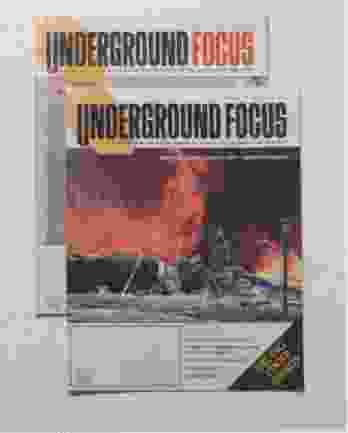
I got a job in college back in 1978 working for a utility contractor for a summer. When I graduated, the same contractor offered me a full-time job. That’s really when I developed a passion for locating underground pipes and cables. Twenty-some years later, I decided to start an underground locating training facility, and about that time I bought Underground Focus, thinking it would be a great complement to the training business.
These days, while other sections of the industry might be contracting, both our training program and the magazine are doing well. We print about fifteen thousand copies, nine times a year. Our readers are everyone from facility owners to excavators, engineers, and the businesses that manufacture underground locating equipment. We cover the entire underground damage prevention industry, and all that goes along with it, from the pipes to the cables that could be damaged during building construction and road repairs.
It’s a pretty small industry overall, but it’s an industry that works to bring order to excavation and hopes to limit the number of accidents that occur when underground utility lines are struck. Some accidents are just inconveniences, like a water line break. Others lead to death and years of litigation. In Toronto in 2003, a backhoe operator hit an unmarked gas line. Instead of breaking at the point of impact, the pipe broke apart further down the line, underneath a building. Eleven minutes later it exploded, killing seven people. It was Canada’s worst natural gas accident.
Let’s go back to the 1950s, when utility cables hung on above-ground poles. Utility maps were basically simple diagrams. They didn’t show location, because you knew where everything was, you could see it with your eyes. It wasn’t until the mid-1990s that mapping guidelines started to be developed. It’s still very much a work in progress, with unmarked utility lines crisscrossing each other across the country. That’s how we ended up with a lot of people in this industry believing in things like witching rods. They hold a set of coat hangers or welding rods in their hands and walk along until the rods either attract or repel from one another. When they do, they think they’ve found the location of the pipe or cable they’ve been trying to find. Imagine grabbing a couple of coat hangers and twisting them so that they form an L shape. Hold them in your hands, and walk.
One of our guys’ wives sits at a computer all day reading Google alerts on digging accidents. We then research the ones we think have the highest educational value or are particularly attention grabbing. Some of the editorial also focuses on my own vision of what damage prevention could be and where I think the industry is headed. Some of it’s what we call “One Word Scoop,” where we throw a question out to key figures in the industry and we publish their responses. We’re now becoming more image-focused, trying to let accident imagery do the heavy lifting of getting people to understand and be aware of what can go wrong and the need to focus on prevention.
We make up our own underground infrastructure terms. It’s not like we’re the world’s sharpest people, creating phrases and all, but a lot of the people who are training in this industry don’t have an electronics background, and they don’t have an electric theory background. They may not know a lot about the pipes and cables, or the construction practices used to put them in, or the materials used to make them. This whole business, this whole damage prevention business, involves stuff you can’t see. It’s weird, people think you can put on x-ray glasses and look below the ground. You absolutely can’t. It’s a blind business, and because it’s a blind business, we try to come up with terms and analogies that help people see what’s going on. People can’t see electromagnetic fields, which is actually what excavators first look for, but they can imagine what “pumpkin-shaped” would look like because they know what a pumpkin is. We also talk about rocks and ponds because we all know what happens when we throw a rock into a pond — we see ripples. That’s basically what’s happening with the electromagnetic fields as they leave underground pipes and cables.
There are two paths this business can go. We can either have more of the same, or we can truly try to change the way prevention is approached. I love my job, and this is the only thing I’m going to do for the rest of my life. I’m fifty years old. I’ve been in the business since I was twenty-three. At this point, what I’m trying to do is to be not only a visionary in the field, but also a catalyst for change. A central part of my mission is to get people to envision what damage prevention could be like if people did more than what the law requires, what their jobs require. I strongly believe that the work I’m doing here is going to result in a legacy of fewer accidents in decades to come.
Daniel Bozhkov doing video research for his artist-led tour of the fair
This past March, Bidoun Projects was the curatorial partner of Art Dubai. We would like to extend a big thank you to all of the artists and curators who contributed to our programs, performances, talks, and exhibitions at the fair.
Among the projects produced were substantial new commissions by Ebtisam Abdulaziz, Vartan Avakian, Farhad Moshiri, and the duo of Shamma Al Amri and Mona Fares, as well as the remaking of Alice Aycock’s seminal 1971 work Sand/Fans. Matt Sheridan Smith and Nikolas Gambaroff produced a version of their collaborative piece Stoop, and Khalil Rabah, Sophia Al-Maria, and Daniel Bozhkov each led highly popular artist’s tours of the artworks and booths throughout the fair. ‘A New Formalism’ was a group exhibition curated by Bidoun that included work by U5, Iman Issa, Mahmoud Khaled, and Hazem El Mestikawy. We also exhibited a version of ‘Forms of Compensation’ (a project featured in our last issue) at a booth within the fair, featuring counterfeits of iconic artworks fabricated in the auto mechanic neighborhood around the Townhouse Gallery in Cairo. Several days later, the same show (with second-wave counterfeits of the same artworks) opened at Townhouse.
The Art Park in the Bidoun Lounge was the place for panels and discussions, and this year we celebrated our yearlong and growing collaboration with UbuWeb, an incredible online resource of avant-garde film and sound, by inviting the site’s founder Kenneth Goldsmith and filmmakers Peggy Ahwesh and Hamlet Hovsepian to present their work in Dubai. We also featured a discussion on artists and libraries courtesy of Banu Cennetoğlu, Vasif Kortun, and Payam Sharifi of Slavs and Tatars, and The Big Idea, a “pitching forum” for new ideas that was packed by young Emirati artists, designers, and entrepreneurs on the opening night of the fair.
Many thanks also to project staff of Tima Ouzden and Badriah Al Khoury, and a dynamic team of interns managed by Bader Saud Bukhari.
We also launched Bidoun Video, an annual touring video program curated by our staff and guests, which at the time of writing is about to screen at Townhouse, as part of ‘Invisible Publics,’ curated by Sarah Rifky (May 23–June 20). This year we’re showcasing four programs: Strike a Pose (Özge Ersoy and Sohrab Mohebbi); Cloudy Head (Bidoun); Hollywood Elegies (Aram Moshayedi); and Exploding Nostalgia (Masoud Amralla Al Ali and Antonia Carver).
The Bidoun Library also continues its peregrinations, from Art Dubai to 98Weeks in Beirut during April. Next stop is the New Museum in New York. June 1 marks the opening of a permanent home for the library at Shelter, our base in Dubai.
The six-month Writing About Art program came to an end in May, with around forty writers from the Gulf and beyond completing this intensive course of seminars and workshops. Managed by Antonia Carver and Hassan Khan, with Ali Al-Sabi, lead tutors included Kaelen Wilson-Goldie, Kevin Mitchell, and Shumon Basar. Guest presenters and artists included Douglas McLennan, Wael Shawky, Clare Davies, Abbas Akhavan, Jeffar Khaldi, Jonathan Shainin, and Murtaza Vali. Thanks to the support of Dubai Culture and Arts Authority (Dubai Culture), the course was offered for free.
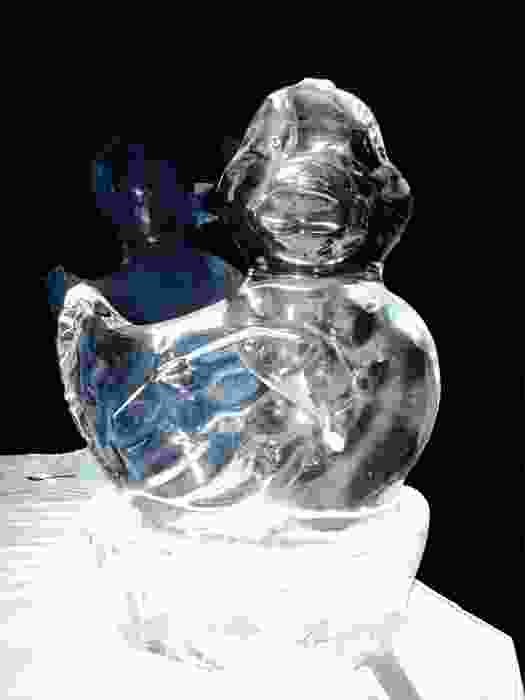
Ice sculpture by Farhad Moshiri, VIP opening night
And as ever, keep abreast of our media archive BubuWeb, our repository for avantgarde media from in and around the Middle East, hosted by UbuWeb (www.ubu.com). Our latest additions to Bubu include rare animations by Iranian artist and Kanoon pioneer Ali Akbar Sadeghi, an early short by Senegalese filmmaker Djibril Diop Mambéty, animations by Indian avant-garde filmmaker Rani Day Burra, and more.
See www.bidoun.com and sign up to our e-newsletter for further news and updates.
Al Manakh 2: Gulf Continued #23Edited by AMO, Archis, Pink Tank, NAiDesigned by Irma BoomArchis
Al Manakh 2: Gulf Continued is the second book installment of the Al Manakh research initiative. While the premier Al Manakh was a canonical foray into Gulf urban studies, Al Manakh 2 focuses on how the region’s major cities are responding to the global economic crisis. Spearheaded by Rem Koolhaas’s AMO and funded entirely by the Abu Dhabi Urban Planning Council, Al Manakh 2 brings together over 140 contributors (including Bidoun’s Antonia Carver, Negar Azimi, and Alia Al-Sabi) from around the world. The result is a dense 536-page collection of essays and interviews. The book is illustrated, characteristically, by elaborate information graphics, pie charts, architectural renderings, and maps, and designed by lauded Dutch book designer Irma Boom. Al Manakh 2 profiles six cities in five countries (UAE, Bahrain, Qatar, Kuwait, and Saudi Arabia), while four chapters provide thematic axes. “Crisis and Crises” takes on the lives of the economic crisis in the Gulf. “Vision” explores structural plans concerning connectivity, infrastructure, energy, and water. Within the “Cohabitation” chapter, Al Manakh examines the integration of culture in cities and the particular dynamics of urban living. Finally, “Export Gulf ” illustrates that export is not only about products and models but also about the effects and new forms of influence. Al Manakh 2: Gulf Continued picks up where its predecessor left off, providing for an invaluable document and resource for anyone engaged with the life of this swiftly evolving region.
John & Jane Toll-FreeAshim Ahluwalia83min, Color, 2005
Ashim Ahluwalia’s film John & Jane Toll-Free is not a documentary in the conventional sense. Through its observational and poetic gaze, it explores the critical context of a globalized outsourcing call center market between India and the US, while introducing a unique filmmaking practice outside of the studio system in India today. Like other contemporary international filmmakers such as Michael Winterbottom or Jia Zhangke, who explore the gray zone between fiction and documentary, Ahluwalia creates a unique cinematic experience that goes beyond the traditional classification of film genres — an innovative approach that was barely acknowledged by film critics at the time of its initial release, but which audiences now have a chance to see with this new DVD.
John & Jane’s settings are call centers, workers’ homes, and the newly developed townships of Greater Bombay, where reality manufactures fiction, and vice versa. The six employees of a single call center all take on aliases whose alter egos eventually merge into their private lives. The workers, under pressure from American supervisors to perform without errors of enunciation or pronunciation during long shifts at the center, are all striving for individual goals outside it — from wealth or religion to skin color or simply an American way of life abroad.
Shot on 35mm in just thirteen days by K. U. Mohanan and Avijit Mukul Kishore, the stunning visual conception, musical score, and sound design create a mesmerizing space for international audiences to experience and reflect upon what globalization means in daily life — in this case, from the other side of the telephone. Ahluwalia used live recorded sound from call center operations recorded during preproduction and shooting (for which he faced serious legal issues during the preparation of the cinematic release, as most of the callers could not be identified afterward to give permission). The legal process is another indication of how Ahluwalia approaches his filmmaking — between the space of the traditional and the nonconventional.
The distinction between fiction and reality is harder to define today than ever, and Ahluwahlia's film is highly aware of that. John & Jane narrates beyond the borders of time, space, and cultures — and as such, demands new strategies of criticism and marketing. The film screened only one week in the cinemas of Bombay, and later aired on HBO in the US in 2007, before finally finding distribution through re:frame, a company that operates between documentary and experimental films. Ashim Ahluwalia’s fiction film Miss Lovely (produced by Future East Film) was shot in 2009 in Bombay and is currently in postproduction.
— Mario Pfeifer
Letters From Fontainhas: Three Films By Pedro CostaCriterion Collection2010
This March, the seemingly infallible DVD distributors Criterion Collection released a long-awaited boxed set of three previously impossible-to-see-films by Portuguese director Pedro Costa: Ossos (1997), In Vanda’s Room (2000), and Colossal Youth (2006). The three films form a hypnotically shot and paced trilogy in Fontainhas, an area of slums outside Lisbon. In all three films, Costa lived and worked with members of a largely immigrant community in the neighborhood, several of whom appear from film to film, and none of whom are professionally trained actors.
The director’s painstakingly controlled process of shooting numerous takes of the same loosely scripted scenes — until he gets just the right casual, detached quality from his subjects — still has something in common with documentary, but its practiced lines take on the quality of the hyperreal. The result is an uncategorizable portrait of a community that, unfolding over the three quite different films, is spare to the point of brutality, but is contravened at nearly every step with simultaneous moments of beauty.
The release is significant not only for giving audiences the opportunity to become familiar with these landmark works by Costa, but also for the exceptional “extras” for which Criterion has become known. The four-DVD set includes conversations between Costa and filmmaker Jean-Pierre Gorin about Ossos and Colossal Youth; a video essay by photographer Jeff Wall on Ossos; All Blossoms Again, a feature-length documentary on Costa, Colossal Youth, and the director’s relationship to Fontainhas; two short films by Costa; and a booklet of essays by critics Cyril Neyrat, Ricardo Matos Cabo, Luc Sante, Thom Andersen, and Mark Peranson.
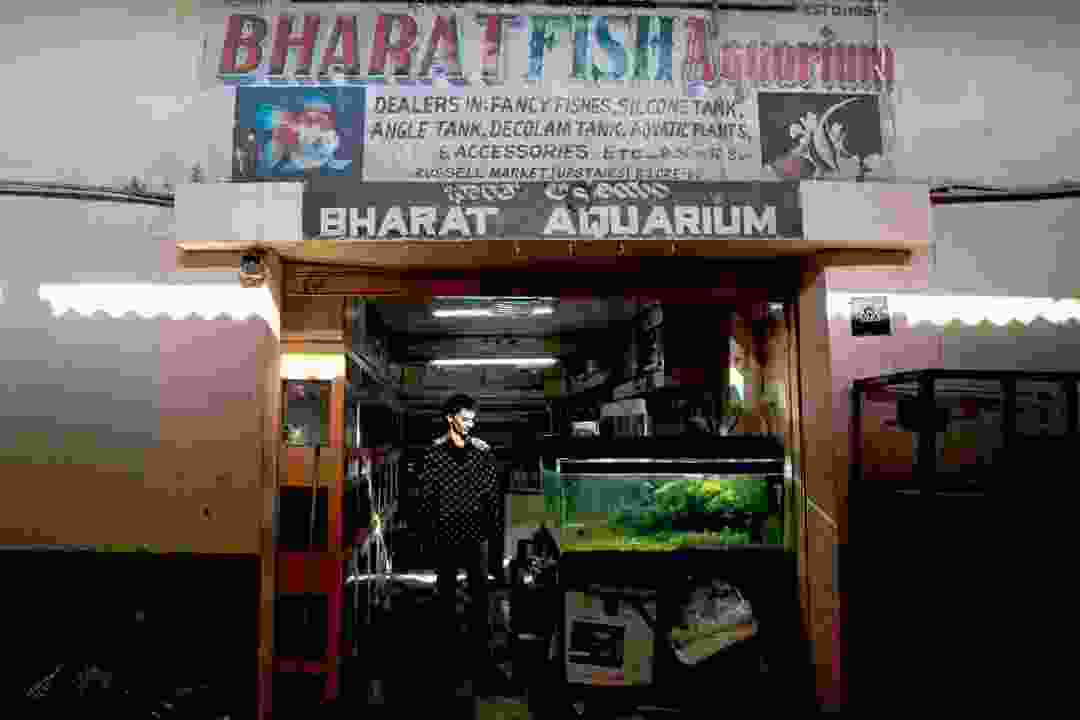
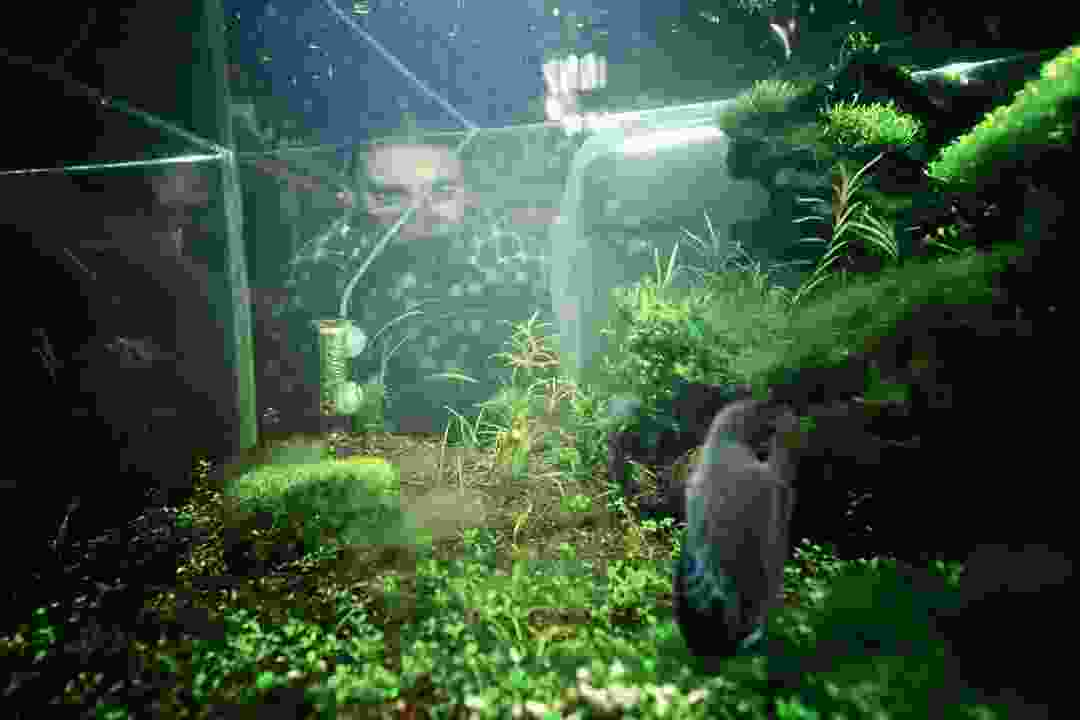
Abdul Raheem sits on an ancient swivel chair next to an aquarium.
His father died three months and three days ago. A tilted, perhaps ill, discus fish swims in a stark-lit tank. Raheem’s shop is on the second floor of the eighty-three-year-old Russell Market building in Bangalore, isolated from the bustle of vendors and shoppers below.
I ask him about the recession. “Business is terrible,” he says. “We are struggling, but managing. It is our love for the fish that makes me do this.”
He tells me that business fell by exactly 88 percent after the rightwing BJP government came to power in April. “They make sure people cannot spend on fish or other things,” he says. Then he begins to tell me about his grandfather, a onetime railway-ticket collector who in 1954 decided to follow his passion and start Bharat Fish Aquarium.
“My grandfather was a great man: wild birds would come and sit on his hand. Wild birds, I swear! No one can do that now.” And the customers return. “We have customers coming back to us for thirty years! I get calls at 3am from my customers sometimes, for a house visit. Who will go except for us?”
According to Raheem, this aquarium was the first in Bangalore. “For many years, it was the only option. We had film stars, politicians, and even police commissioners,” he says. “The assistant police commissioner, Mr. Ashok Kumar, is my best friend now. He buys fish from me only. Please feature him in your article. He will be very happy. He is a good man.”
Raheem plunges his fingers into a tank and snaps them, beckoning several swordtails from the depths of the green water and toward the surface. “They only think of money, those other fish fellows,” he says. He, on the other hand, stores pictures of his fish on his iPhone. He peels off the protective screen to show me portraits of discus fish. “Nokia is nothing compared to this,” he says.
Raheem’s three brothers run other aquariums in the city; he runs his grandfather’s store because he was the favorite. “My grandfather liked me very much,” he says. “I even got sent to Damascus to work at the water company in 2001. They love Indians there. They invited me to dinner every day. But I didn’t go, because I wanted to prove myself. I cleaned tanks and maintained the pH. My water after I treat it is better than Bisleri mineral water! They challenged me to breed angelfish. They said it was impossible to breed them in cold temperatures, but I did! Later, they took others from Chennai to help them. But they could not do what I did.”
I ask him why he came back.
“Home is home, no?” he responds. A customer walks in, and Raheem tells him that the discus fish cost seven thousand rupees. And that they are not for sale. There isn’t another customer in sight. I ask Raheem why he continues with the business. “My grandfather started it, my father just died, so I have to continue,” he says.
“Also,” he pauses. “We are only paying five hundred rupees a month for this old government building — the old corporation rates — whereas you have to pay fifteen to twenty-five thousand rupees a month in a mall.”
Does he want to open up shop in a mall? “I have had some offers,” he says. But he is not like the fish sellers in the mall. “They will never be able to breed angels in low temperatures.”
Besides, “who else feeds their discus fish goat heart?” he asks. “You have to clean it carefully so that they can digest it easily. Not even one small piece of fat should remain, otherwise the fish will fall sick. Tell me, which mall fellow will feed his discus fish goat heart?”
Hakim Belabbes, Stills from In Pieces, 2009. Courtesy HAK Films
Throughout Hakim Belabbes’s latest film, Ashlaa (In Pieces, 2009), members of his family ask him why he insists on trying to make films.
It’s a fair question. A career as an independent filmmaker often entails a lifetime of personal and financial instability. The quest for financing is a purgatory. If you should manage to shoot something and finish it, distribution and profit sharing suck. There’s a brief glow of attention as the film is seen. Then you go back out and start again from scratch. So why make movies at all? Ashlaa poses this question alongside questions of life and death.
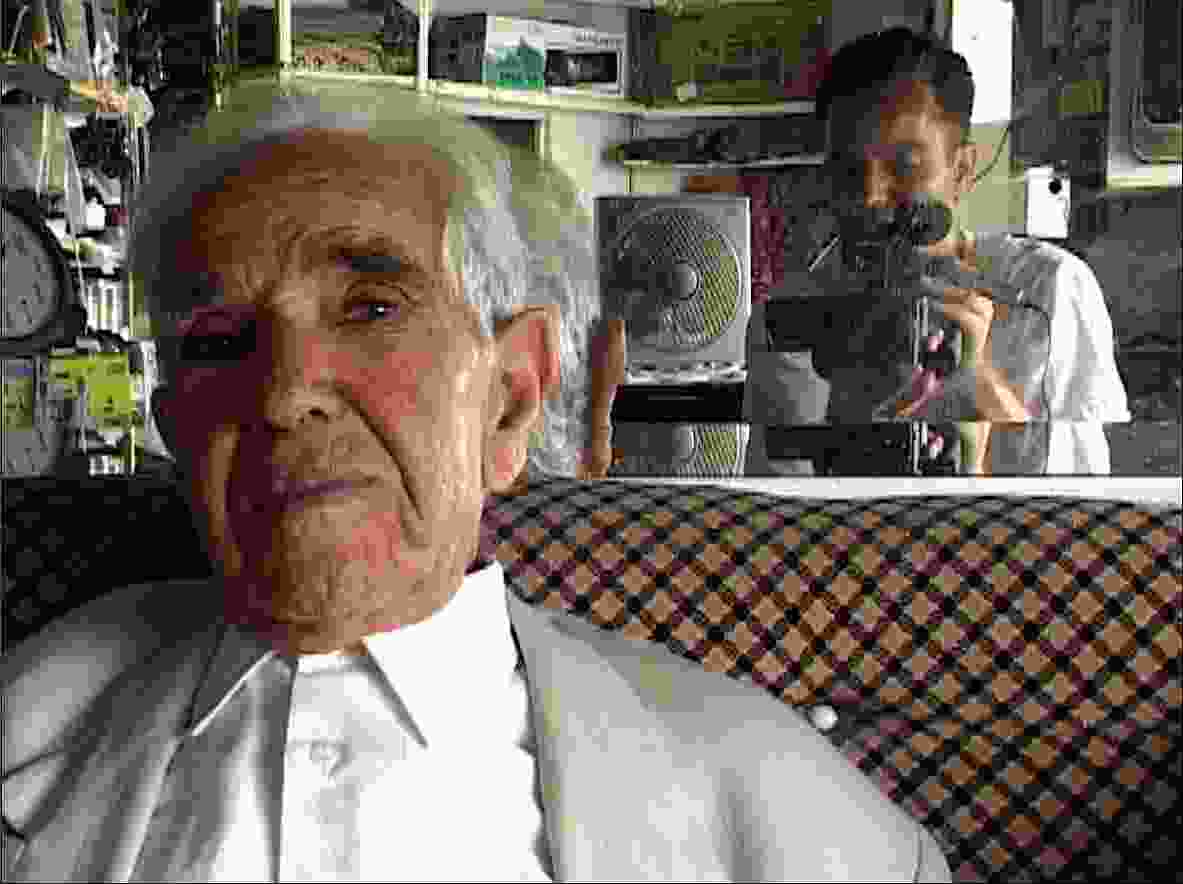
Belabbes grew up as one of twelve children in Boujad, a small town at the edge of Morocco’s Atlas Mountains, where his father Hamid ran a number of struggling businesses, including the town cinema. In an interview, the elegant silver-haired patriarch sits calmly in a barbershop chair, his son visible in the mirror behind him. After lamenting a lifetime of hard work, Hamid proceeds to deliver a browbeating that would resonate with the first generation of any and all diasporas: “You moved to America twelve years ago, and what do you have to show for it? You say you want to make films. But all you do is wait around for millions and waste your own money on airplane tickets. What you’ve done is zero. The most important things, you haven’t done yet.”
The director’s mother, sitting in a courtyard, preparing food, laughs at his filmmaking fixation. “You must be possessed, I’ll get you some incense.” But she sounds a similar theme. “It could take twenty years to make your film. A wife and children come with their own good fortune. Then you’ll be able to make your film.”
Those conversations were shot during a trip home in the 1990s. But Ashlaa proceeds from that trip to more recent footage, marking an interval during which the Chicago-based teacher and filmmaker got married, had a child, and, at last, made his films, including Khahit errouh (Threads, 2003), the story of an old man returning to his hometown to die, and Hazihi al-ayady (These Hands, 2008), an existential portrait of the town’s artisans, as documented by a local university professor.
Ashlaa, a fiercely intimate film, centers on Hamid Belabbes. Ten years after their encounter in the barbershop, father and son reunite. Frail and immobilized by illness, Hamid sits as a barber gives his fragile skin what may be his last shave. As Hakim makes the rounds of his extended Boujadi family, the neighbors’ houses are alive with rites and rituals.
A very old, very poor man squats on the street to make his ablutions with a small tin of hot water, then reenters a tiny one-room apartment to pray alongside his wife, who sits mute and distant on the floor. Yet another old man lies in a squalid house, resigned to death, talking with his friends. “I never hurt anyone.” His best friend agrees, then turns quietly to the camera. “I think he’s done. He’s had it.”
A father speaks of a son’s sudden disappearance thirty years earlier, the pain still fresh, as his surviving sons listen. Then one of them speaks haltingly of his own imprisonment and torture. The 1970s were Morocco’s dictatorial “years of lead,” and both cases can be assumed to have involved political repression. The son apologizes, unable to continue. The father asks his wife for a mirror so he can shave, and she reproaches him. How he can bring himself to look in the mirror? She hasn’t seen her own face since their son vanished.
Elsewhere, a tiny boy all dressed in white is circumcised. He howls, and the camera doesn’t blink (although you may). Equally graphic is the birth of Belabbes’s daughter Maya, caterwauling into her mother’s arms. Later Maya undergoes her own baptism ritual, awash in henna, after a sheep is sacrificed in the family courtyard before the wide eyes of “the little Americans” among the grandchildren.
Viewers unfamiliar with Moroccan family life might gape at the contrast between the seeming brutality of these everyday rituals and the sophistication, wisdom, and charm of the Belabbes family. Ashlaa takes its time, capturing the richness of their language, the startling articulacy of the elders, the tentative theology of the children, and their frequent, easy laughter.
How does a family stay afloat amidst a flood of rainwater, blood, tears, and disappearances? There’s hardly time for Hakim to show his father a few frames from his films before Ashlaa gathers to its inevitable climax — the dying itself elided by a shot of thunderous skies — as we see Hamid’s gravestone carried out of the house and to the graveyard, where the family, in shorts and t-shirts, piles stones and spreads palm fronds. A sister recounts a dream.
Three more years pass before Belabbes, his mother, and his camera return to visit the grave. It’s a scene of great delicacy, and the last, save for an epilogue from out of time — shot decades earlier, the night before eighteen-year-old Hakim left home for university, in which he says goodnight, and goodbye, to his father.
How do we go on, when everything around us — lives, words, memories — seem to be forever disappearing? Why make films? For Belabbes, as for Beckett, language itself seems the only answer. The language of film, though fragmentary and flawed, carries the dead forward, allows the living to carry on.
George Russell lives in Huntsville, Texas, otherwise known as the “City of Death,” the execution capital of the US. Russell is a vocal opponent of the death penalty, and owner of three green cemeteries: burial grounds with “no chemicals, no embalming, and no big bronze caskets.” When I first called him, the sixty-five-year-old entrepreneur and cultural ecologist yelled back in a heavy Texan accent, asking if he could call me back — he was out riding on his tractor and could barely hear me. Tall and distinguished-looking, with sparse silver locks, Russell is the founder the Universal Ethician Church, which practices a new religion devoted to defending “God’s biosphere” from human greed and ignorance. The first of his green burial grounds, the Ethician Church Cemetery, was opened in 2003.
Russell is also the webmaster of www.slumberpartytheater.com and the founder of both the Educational Video Network, which creates instructional media for teachers and schools, and Gothic Films, a production company that makes horror movies, including Long Pig (2008) and Naked Horror (2010). He appears in both films as the nefarious church leader Preacher Man. Russell says these films contain deep philosophical undertones, which he fears audiences might not always understand amid the gore and the nudity.
In 1968, I was 175 miles from the nearest telephone, in Toledo District, British Honduras — now Belize — working on a PhD in cultural ecology. We had a 1968 Ford Bronco, one of the very few internal-combustion vehicles in that whole area. Fuel had to be hauled to the village in fifty-five-gallon drums. The local people were a mix of cultures: East Indian; old Southerners who’d escaped from the post–Civil War South; and the Garifuna, black Caribs descended from slaves whose ship ran aground there in the 1700s. But they were all British-educated, and although they lived in grass shacks with dirt floors, they thought it would be really impressive — first class — to have their loved ones hauled to the cemetery in a brand new Ford Bronco instead of on the backs of relatives.
The cemetery happened to be in a rain forest: magnificent trees dripping with orchids, howler monkeys squealing, parrots flying — an absolute paradise. Normally, they would just dig a hole in the ground. Within a matter of hours, the bodies begin to be recycled back into nature, as microorganisms consume and reconstitute them. The loved one becomes part of a bird or a butterfly or a monkey or a tree. Our bodies are nothing more than recycled material, the things we’ve consumed, the container that transports our minds. I found this wonderful. I wished we could do it this way back home.
When I got back to Texas, I was busy with my family, raising four children and running my business, the Educational Video Network, which develops educational materials for schools. I bought a beautiful house near a place called Pool Creek, which is full of alligators and egrets. One day I was peeing off the balcony — which every American should have the freedom to do — killing the azaleas and looking at all that open space behind my house. I realized that eventually it would all be developed. Someday, there’d be a bunch of houses back there; I’d take a pee and, twenty minutes later, there’d be a knock on my door. And it’d either be some poor old crone who hadn’t had any loving in about forty years, trying to hop in the sack with me, or it’d be a fourteen-year-old girl with two big, burly cops who’d put me in cuffs and haul me away to the hoosegow. So I called up the realtor and said, I need to buy 10 acres over there so I can piss in peace for the rest of my life.
I found out that the owner of the land was Charles Hurwitz, an investment titan. He was willing to sell, but those 10 acres were connected to another 990 acres. I wrote a check and bought the whole thing for $2.2 million. Then, in 2000, I bought another thousand acres. I realized that this could be the green cemetery I’d always imagined. It took three years to cut through all the red tape, but we started burying people there in 2003. It was the first green cemetery in Texas, and only the third in the country.
Today I have three cemeteries spread across two thousand acres. One is habitat for the red-cockaded woodpecker, an endangered species. Another is a rock peninsula in Lake Livingston, where pelicans live. It has Catahoula boulders that are thirty million years old. The land was inhabited by Native Americans for twelve thousand years, until they were extirpated by Mr. White Man. The third cemetery is savannah.
I buried my mother in the second one. She chose the spot and watched her grave being dug, which she found to be exciting. We put a temporary wooden box down there so that, when the time came, we could just lift the lid and slide her in. When she finally died, we wrapped her in a blanket and loaded her into the back of my pickup truck. We let the dogs jump in and say goodbye to her. Then we wrapped her in a quilt and covered her with Spanish moss, as she had wanted. And then everyone grabbed a shovel. It was a really simple, sweet ceremony. But so many people around here in the Below-the-Bible Belt are filled with hate, and they were saying, “Why would you treat your mama like that?” They don’t get it. “Shouldn’t you have had the $25,000 bronze coffin?” No! I did what my mama wanted, and that $25,000 can send a grandkid to college.
I have capacity here for twenty to thirty thousand people, but I don’t do any advertising; people find me on the Internet. I can’t say the economy is affecting me — there was never much money in the first place. But more people should be thinking about going green in death. The average cost of a burial in America is close to $7,000. It costs us about a third of that. Since we’re a nonprofit, we just ask for a donation. I’ve got gravediggers who will prepare the site, and a hearse to carry the body if you don’t want to do it yourself. I’ll officiate for free. And we take anybody here: Christians, Muslims, atheists, Wiccans, Jews — anybody.
I don’t support cremation. It wastes fossil fuel, and releases toxins into the air. And I definitely don’t support traditional burials, with all their embalming chemicals and concrete vaults. Green burial is what we do here, but, really, the best option is the sky burial, where you just leave a body out and let nature take care of it, as the Zoroastrians in India have done for thousands of years. I’ve been working with the Zoroastrians here — a fellow from Houston — to design a Tower of Silence where we can lay out the bodies, but that might cost upwards of $100,000.
If you read Matthew 23, you’ll see that Jesus despised hypocrisy, organized religion, public prayer, and all other kinds of stuff. So if you can get past that goofy psychosexual pervert Paul and the others who in my opinion destroyed Christianity, you’ll see a simple guy who was very sophisticated intellectually, who traveled the world and brought back revolutionary ideas to Old Testament Judaism, which was really filled with hate — characters like Moses, who was a genocidal pedophile. I too always wanted to be a revolutionary who says, “Look, let’s simplify this.” The Universal Ethician Church only has one rule, which is the opposite of the Golden Rule. I personally know some high-level politicians who like to have their asses slapped. So, say I like my ass slapped — am I going to do unto you and slap you on the butt? No. The Ethician Rule, instead, is, Do unto others as others would hope that you would do unto them.
Beirut’s contemporary art space The Running Horse celebrates its tenth show — ‘emBODYment’ — with an exhibition by Rasha Shammas, of black and white nudes, focusing on tattoos. A publication from the exhibition is forthcoming.
Mona Hatoum, Witness, 2009, photographed at Art Dubai
BeirutMona Hatoum: WitnessBeirut Arts CenterJune 10–September 9, 2010
Mona Hatoum’s first solo show in Lebanon, at the Beirut Arts Center, features the products of a recent five-week residency in the country. Witness itself is a miniature porcelain rendition of the Place des Martyrs monument in the center of Beirut.
Brittany, FranceFrom Giacometti to MurakamiPalais des Arts, DinardJune 12–September 12, 2010
The town of Dinard, Brittany, follows up the spectacle of last year’s Pinault Foundation–reliant Qui a peur des artistes with From Giacometti to Murakami, a major exhibition of fifty works from leading figures including Ed Ruscha, Richard Serra, Alighiero e Boetti, Lucio Fontana, and Sigmar Polke alongside works from Shirazeh Houshiary, Ramin Haerizadeh, Mona Hatoum, and Farhad Moshiri.
DubaiZoulikha Bouabdellah: Set Me Free From My ChainsGallery Isabelle van den EyndeJune 14–August 15, 2010
Zoulikha Bouabdellah’s Set Me Free From My Chains opens at the Dubai gallery with a series of large-scale calligraphic neon works.
DubaiI. U. [Heart]The Third Line galleryJune 23–July 29, 2010
The Third Line Dubai stages an exhibition, I. U. [Heart], on the phenomenon of Iran-US relations and the Iranian diaspora in the Emirates.
Los AngelesDennis Hopper: Art Is LifeMuseum of Contemporary ArtJuly 11–September 27, 2010
Jeffrey Deitch’s first show as director of MOCA is Dennis Hopper: Art Is Life, curated by artist and filmmaker Julian Schnabel.
The 8th Gwangju Biennale, curated by Massimiliano Gioni, will include works by more than a hundred artists, realized between 1901 and 2010. Titled 10,000 Lives, the sprawling exhibition will be configured as a temporary museum, focusing on our global obsession with images — as portraits, avatars, effigies. The exhibition will reflect on inter-human interconnections and the sheer scale of modern image production and consumption.
BaselArt BaselVarious venuesJune 16-20, 2010
This year’s Art Basel will feature three hundred of the world’s leading galleries, as well as the customary special exhibitions and events, Art Basel conversations, spinoff fairs such as Liste and SCOPE, and all the Campari Bar you can handle.
AmsterdamBint al-Dunya at Amsterdam NoordSeptember 5–December 5, 2010
Mediamatic, Amsterdam, invites Cairene artists — including Osama Dawod and Ayman Ramadan — to relocate from their home base of Egypt to Bint al-Dunya, aka Amsterdam Noord, an impoverished yet spacious neighborhood in Holland, to make work in response to radically different urban conditions. Coordinated by Nat Muller.
Seoul6th Media City BiennaleSeptember 7–November 17, 2010
The 6th Media City Seoul Biennial will coincide with the Gwangju Biennale. The joint curatorial team of Fumihiko Sumitomo (Museum of Tokyo), Clara Kim (REDCAT), and Nicolaus Schafhausen (Witte de With) have selected a roster of works from media artists including Tarek Atoui, Yael Bartana, Walid Raad, Jimmie Durham, and more.
LondonSlavs and Tatars: Friendship of Nations: Polish Shi’ite ShowbizCalvert 22September 2010
Bethnal Green’s recently opened space is devoted to the exhibition of Eastern European and Russian contemporary art. This exhibition is from the polemical collective Slavs and Tatars.
New YorkNew Photography 2010Museum of Modern ArtSeptember 29, 2010–January 10, 2011
MoMA features four artists, Roe Ethridge, Elad Lassry, Alex Prager, and Amanda Ross-Ho, whose photographs draw from images in print media, television, and cinema.
It’s a testament to the uncanny sense of immediacy that Elias Khoury’s White Masks creates that it seems impossible that it should have been written nearly three decades ago. (Although newly translated into English, the novel, Khoury’s first, appeared in Arabic in 1981.) There’s nothing dated about White Masks. Because it’s told so close to the ground, the emotion feels universal, timeless; the violence that sets the story in motion, and that inflects the myriad lives that crowd their way into the book, seems completely contemporary. All this, despite, or perhaps because of, Khoury’s signature style, the grand swirling of characters, the digressions and stories within stories, the lack of resolution.
Khoury’s unnamed narrator (and likely authorial stand-in) is a sociology graduate and would-be journalist who, “owing to ‘prevailing circumstances,’” can’t find a job as a writer. He whiles away his days working at a travel agency, issuing the odd ticket and staring blankly at his computer. One morning, he comes across a newspaper headline, “Dreadful murder in the UNESCO district.” He grows obsessed with the case, perhaps in part because the tortured body is found near the statue of Habib Abi Shahla, one of the primary architects of Lebanon’s independence. The deceased was an ordinary postal worker named Khalil Ahmad Jaber. “Although I tried, I couldn’t place the man’s name, but I seemed to remember that I had come across him somewhere,” explains the narrator. That Khalil Ahmad Jaber is almost certainly no one of great import — not a rebel fighter, an intellectual of any renown, or even somebody’s lover — makes White Masks all the more affecting: lives like his will never be remembered. “This is no tale,” Khoury writes, at the beginning and at the end.
Our narrator sets out to collect any information he possibly can about Jaber. These “documents” make up the majority of the book. Jaber, it seems, was last seen tearing down the posters of martyrs pasted on city walls, even though, or perhaps because, his own son, a promising boxer, had recently been killed in combat. As the narrator shifts from interview to interview — with Jaber’s bewildered wife and bitter daughter, an embattled building caretaker who tried to help him on the street, and a maimed combatant who met him for only ten minutes — the book turns into a series of testimonies. For this reason, much of it reads like conversation rather than prose, with all the repetitive and, at times, tedious patterns of speech. “Oh, Lord, Lord, this is it, the final reckoning, the Day of Judgment, the day we always feared and expected... and now it has come,” Jaber’s wife Noba begins. “And now, dear God, how do you expect me to manage — me a poor widow, all alone? What will people say?... The devil take them!... Forgive me, God!”
Khoury once explained to the literary magazine Banipal that a writer, for him, is “someone like a storyteller, a hakawati, or a narrator in the Maqamat or in the Thousand and One Nights. The writer is only a medium. He is a medium between the direct experience of life and the imaginary, between memory and the future, between the written and spoken language, between the possibilities of language itself.” I would have preferred more writer in this book, less medium. But Khoury’s style does propel us into each of these lives at an appealingly brisk pace, not only because we wish to discover who killed Jaber — who tortured him, shot him, and left his body in a trash heap — but because of the desperation with which they recount their hellish realities. We also wish to know what will happen to each of them; their personal experiences provide a tiny snapshot of the total disintegration of a society: families are displaced, fathers killed, women raped, honor corrupted. Though we hear some details of Jaber’s life from his wife, Jaber himself becomes almost incidental to the story.
Of those characters, Fahd Badreddin, the leftist fighter, emerges as the most dazzling, his chapter the most novelistic of the bunch. Fahd met Jaber for all of ten minutes, and clearly their relationship serves only to draw a connection between the fighter and death. Jaber’s “smell was the worst thing about him,” Fahd explains. “That smell, oh, the smell was so awful, like the smell that time on the mountaintop, so faraway....” Jaber’s smell reminds him of his own brush with death. He recalls how he lost an eye in the mountains, witnessed the unjust killing of an enemy, and returned from a Madrid hospital unable to continue with the struggle. The party suggests Fahd become part of a propaganda film, and from this Khoury spins pitch-perfect parodies of leftist propaganda.
“The cinema is such a fabulous thing,” says a pretty woman, trying to persuade Fahd to participate, “the way it can lend grandeur to events. Imagine, for instance, a sequence on Tel al-Zaatar. Women, children, wailing and sobbing, the camera panning from face to face, zooming in on this cute kid with large black eyes and curly hair who’s picking his nose; the kid is totally unaware of what’s going on, as if he were unseeing, unhearing. Now wouldn’t that be fabulous?”
“Yes, that would be very powerful, it’d be really great.”
“And imagine... just think in what original ways we could portray death! Let’s assume, for instance, that we’re filming a corpse somewhere in the old downtown: the corpse is surrounded by overgrown weeds and grasses and a high earth embankment. The camera rolls silently, stops at the corpse, then cuts to a wild flower growing among the weeds. Wouldn’t that be absolutely beautiful?”
This passage demonstrates another aim of Khoury’s project — to render death not only at its most grotesque, but at its most inconsequential. Unlike the beautiful corpse shrouded in flowers, Khalid Ahmad Jaber is simply dead.
The three wore beards and donned Arab dress to avoid appearing conspicuous to the townspeople, few of whom had ever seen a Westerner.
Ahlan Wasahlan. Jeddah: Saudia Airlines, 1978
Arabic personal names and place names are spelled according to a system used by Aramco, which closely follows a generally accepted system of transliteration from Arabic to English. The system does not always represent the spelling or pronunciation of the Arabic original with complete accuracy, as Arabic contains letters and sounds for which no equivalents exist in English. Furthermore, pronunciation of Arabic varies from region to region.
A Pocket Guide to the Middle East. Washington D.C: Armed Forces Information Service, Department of Defense, 1969
The relationship between states and companies was, in general, one of uneasily starched blackmail. The Arabs, for the time being, wanted Western technical help anyway; the companies, it need hardly be said, wanted the oil.
Islam Inflamed. James Morris. New York: Pantheon, 1957
We use the latest Western technology. And we back it with over twenty years of experience working in progressive, developing countries.
For all applications, large or small, we can supply everything needed to do the job — the engineering, the hardware, the on-site installation, the maintenance, the operator training.
If water is precious to you, contact us.
Advertisement for Metito. Ahlan Wasahlan. Jeddah: Saudia Airlines, 1978
The movement is one of the glaring historical proofs which falsifies the concept of materialistic interpretation of history and that of the dialectics of materialism according to which economics is recognized as the cornerstone of social structure and a social movement is considered a reflection of class struggle. The materialists’ belief that all roads end with the fundamental requirement, i.e. food, does not hold water in the present context.
Tell the American People: Perspectives on the Iranian Revolution. David H. Albert. Philadelphia: Movement for a New Society, 1980
Air-conditioned trailers and helicopters have replaced the tents and camel caravans of Aramco’s early oil explorers. A few of the men who range the desert still cultivate beards, but most face the day clean shaven.
As Saudi workers grew more skilled through the company’s training programs, the number of Italians gradually declined.
The Energy Within: A Photo History of the People of Saudi Aramco. Kyle L. Pakka. Dhahran: Saudi Aramco, 2006
By the end of 1933 there were eight oilmen living in Saudi Arabia, counting Bill Lenahan, the liaison man in Jiddah. The small contingent stationed on Saudi Arabia’s eastern shore could merely nibble at the 320,000 mile concession area — and wait for word of the airplane that was promised them.
Aramco Handbook: Oil and the Middle East. Dhahran: Aramco, 1968
The Dhahran Theater Group originated in 1949 and attracted would-be thespians from across the company: engineers, drillers, pipe layers, refinery workers, secretaries and housewives participated in a wide variety of performances. The group, still active today, builds its own sets, installs lighting, paints scenery and plays its own music.
The Energy Within: A Photo History of the People of Saudi Aramco. Kyle L. Pakka. Dhahran: Saudi Aramco, 2006
If the phony Arab was having trouble, so was the camel.
Lassie and the Shabby Sheik. George Elrick. Racine: Whitman, 1968
I don't think Skype is a proper way to take a photo. I can't even imagine how you'd do it.
—Reza Aslan
Friends,
We set out to do something different this issue. To boldly go where no Bidoun has gone before.
Careful readers of this space might object that we say this every issue. They’re right. Over the past year we’ve been trying to revisit a lot of our assumptions about what a Middle Eastern art and culture magazine should be. We’ve talked more openly about the art market and our semiprecious stock in it. Sensitive to the charge that our righteous obscurity has blindsided our coverage of contemporary events, we devoted an issue to original reporting. Just last issue we unleashed a vast slew of stereotypical images all over our pages, suspending deeply held taboos on sex, the veil, Israel, and so on.
But this is it — the final frontier. (One of them, at least.) This time we’re taking on the paper pushers and the do-gooders, the experts and the engineers, the advocates and the doctorates. The ones who squeeze from the bottom of the tube. Or, as we’ve delicately termed them, SQUARES.
You might object to the name — squares does have a slightly negative connotation. We thought about calling the issue visionaries, actually. But another magazine beat us to it, as you can see from the cover. And we wanted to avoid one obvious pitfall in talking to people doing awesome things to change the world — that is, fall for their pitch. We wanted to know their stories, sure, but we also wanted to understand the drudgery. To go backstage and see how and where the sausages of change are made — in Damascene college dormitories and South Korean Internet cafés; on homemade desktop computers and handheld devices and beat-up laptops exhausted by one million PowerPoint presentations and speckled with Post-it notes; on marathon Skype meetings, and in the conference rooms of 2.5-star hotels in Virginia, where tables are laden with little flags, name tags, and millions of gallons of Evian.
The twenty-odd people you are about to meet do not have highly developed senses of irony, though most of them have a good sense of humor. There is Salman Khan — Bill Gates’s favorite teacher — a polymathic goofball and education innovator whose secret dream is to create an apocalypse-proof bunker for human knowledge. There is Naif Al-Mutawa, a Kuwaiti businessman and father of five who fights for truth, justice, and the Islamic way via his superheroic comic creations, The 99. There is Alex Mamytov, an activist trying to make Kyrgyzstan safe(r) for transsexuals, and Nazanin Afshin-Jam, a beauty queen who uses her celebrity to fight the Iranian government over the (disturbingly topical) issue of child executions. And there is the late Nader Khalili, an architect inspired by Rumi to create the perfect habitat for impoverished humanity.
Speaking of Sufis, Sheikha Fariha al-Jerrahi — leader of a band of American dervishes, who in another life made possible some of the most ambitious artworks of the twentieth century — is the subject of our most in-depth profile. But don’t neglect the birdwatcher and the space bureaucrat, the Syrio-Vulcan video game designer and the talk show host, as well as the band of world-music megastars on a mission. Last but not least, a brief history of the lingua franca of squaredom — Esperanto.
You will note a few things about the look of this issue. For one thing, the color green, and the computers, pioneering what we like to think of as perfectly fine art photography: the Skype portrait. For another — the drawings! Scores of them, an outpouring of original art that responded to an open call for illustrations on our Facebook page.
These practices were less an attempt to be true to the zeitgeist (though this crowdsourcing thing is working out great) than it was to find a mode of production appropriate to the theme. How best to picture things that don’t lend themselves to being pictured, people who are not defined by their appearance? We didn’t want to beautify or stylize things that had been chosen precisely not for their beauty or style — even the former Miss Canada, for whom beauty pageantry is merely a means to an end.
This past September we launched our fall issue, LIBRARY, and inaugurated our storefront space with an ice cream social at 47 Orchard Street. LIBRARY, with its collectible cover (each one sporting a unique photograph — get one now, if you haven’t already), also made a big splash at the Frieze Art Fair in London, where editor Negar Azimi moderated a panel on art and politics, and where it was announced that longtime Bidoun collaborator Yto Barrada had been named Deutsche Bank Artist of the Year for 2011.
Meanwhile in Cairo, a version of the Bidoun Library opened at the Townhouse Gallery on October 12 to great fanfare. Contributing Editor Hassan Khan programmed two talks, one by historian Khaled Fahmy on the politics of the archive in Egypt and another by curator Bassem El-Baroni, on the zeitgeist of Egyptian visual culture. Coincidently, Azimi represented the Bidoun Library at a conference on archival practices, also at the Townhouse.
In November, Bidoun took the New York Art Book Fair at PS1 by storm. Tiffany Malakooti and Babak Radboy represented the Bidoun Library Project on a panel entitled “Experimental Libraries and Reading Rooms,” while the magazine hosted a party at the Jane Hotel to celebrate the fair’s opening night.
Bidoun’s ongoing transition to not-for-profit status proceeds apace. Look for us at bidoun.org from here on out. Also and furthermore — if you don’t already, please consider subscribing to the magazine. When you buy a copy on the newsstand, you help the newsstand. When you subscribe, you help us. And now more than ever, we can use your help. If you were thinking about giving that special someone a subscription for Ashura or Hanukkah or Christmas or just because, now would be a great time.
This spring Bidoun will once again descend on the Emirates for Art Dubai — the first under the leadership of former Bidoun editor Antonia Carver. As usual, we will be largely responsible for programming film, video, and music in the Art Park below the fair, and generally lending an irresponsible element to the proceedings.
Also this winter, the inaugural fellow of the Bidoun/Delfina New Writing Residency, Rayya Badran, will undertake her research into how popular culture, specifically Western music, is received, lived, and later theorized among different generations in Beirut.
Finally, we’re delighted to welcome two new contributing editors to our Iranian conspiracy team: Aram Moshayedi and Sohrab Mohebbi. Aram lives in Los Angeles where he is assistant curator of the Gallery at REDCAT and a doctoral candidate in the department of art history at the University of Southern California. Sohrab is a writer and curator based in Brooklyn, New York. He received his MA from the Center for Curatorial Studies at Bard College and was a founding member of 127 band, Tehran. He is currently a curatorial fellow at the Queens Museum of Art.
Cyprien Gaillard: Geographical AnalogiesEdited by Florence Derieux, Susanne Gaensheimer, Adam Szymczyk, Rein WolfsJRP|Ringier, 2010
“A world atlas against disappearance,” is how French artist Cyprien Gaillard describes his latest project, an appropriation of the (vanishing) medium of Polaroid photography in documenting diverse manifestations of disappearance and decay in the world around us. A compendium of nine-hundred rigorously classified Polaroids, Geographical Analogies recounts stories about devastated concrete landscapes and monuments, architectonic utopias, unfinished holiday resorts, and modernist high-rises, golf courses, and cemeteries. In his own way, Gaillard may temporarily halt the disintegration by freezing these moments in time. Still, it doesn’t take a genius to realize that the forever nature of the photograph is, in fact, an impossible dream.
Lapdogs of the Bourgeoisie: Class Hegemony in Contemporary ArtEdited by Nav Haq and Tirdad ZolghadrContributions by Charlotte Bydler, Neil Cummings, Annika Eriksson, Chris Evans, Liam Gillick, Nav Haq, San Keller, Hassan Khan, Erden Kosova, Dr. Suhail Malik, Marion von Osten, Natascha Sadr Haghighian, Dr. Malcolm Quinn, Tirdad ZolghadrSternberg, 2010
The ongoing collaborative project “Lapdogs of the Bourgeoisie” investigates the hopelessly complicated question of the role of class structure in the production and presentation of contemporary art. Why, the organizers wonder, has class hegemony been so terribly overlooked in the art world? Does socioeconomic status still define an artist’s career — and to what extent does the artist reflect or consolidate these hierarchies? Artists — Hassan Khan and Natascha Sadr Haghigian among them — offer up their own tastes, biases, privileges of access, and attendant anxieties for scrutiny, while San Keller photographs the homes of the artists’ parents — in which, invariably, their children’s artwork is proudly displayed.
Alighiero E Boetti: MappaEdited by Anna FisherText by Jean-Christophe AmmannPublished with Gladstone Gallery, New YorkJRP|Ringier, 2010
Mappa compiles the embroidered maps of the world made by the late Italian artist Alighiero e Boetti (1940–1994), a leading light of Arte Povera who would later drift from the movement. Whether experienced as irreverent commentary on tropes of national self-definition or simply as sumptuous objects, Boetti’s graphic, color-blocked tapestries evoke the medieval tradition of the Mappa mundi. Compellingly, their very outlines were drawn by the changing geopolitical realities of his time — the Cold War and its diverse legacies. The maps themselves, elaborately woven, were made by artisans in Afghanistan and Pakistan, who were in turn free to dictate the scale, texture, and color of the work — in short, to dictate the experience of the work. “I did nothing for this work, chose nothing myself, in the sense that the world is shaped as it is, I did not draw it.”
Solution 186–195: Dubai DemocracyBy Ingo NiermannTranslated from the German by Gerrit JacksonSternberg, 2010
A campy riff on the culture of political and cultural critique, Berlin-based writer Ingo Niermann’s Solution series offers queer elixirs to social problems that are as pressing as they are unbelievable. He has, in the past, called for a radical re-vamping of the German language — or a “Rededeutsch.” He has, too, proposed that the world’s largest pyramid be built in Eastern Germany as a mass-burial site and tourist attraction. In this fifth book of the Solution series, Niermann takes Dubai as a modernist blank slate for urban renewal, reimagining it as the improbably named “Sugar World.” Sugar World, beyond being a global center for treating diabetes, has a population marked by saccharine kindness and is controlled by all manner of totalitarian advertising campaigns. Of course.
You asked me about football? I’ll tell you about football.
The last time I went to Azadi Stadium with my father, it was the famous Esteghlal-Persepolis derby in Tehran. He was red and I was blue. I must have been seventeen. My friend, who was also red, was with us. To this day I cannot understand why his architect, tennis-type dad thought that my father would be able to handle the two of us. The game was at 6pm; we got there at 10 in the morning. We could only find tickets for the upper level, and my dad took us to a more or less neutral zone, basically the tail end of the reds. Red is the color of Persepolis, okay? So we were there all day. The sun was right above our bleachers and our brains had a good boil in the saucepan of our skulls. But honestly, I didn’t mind. Three minutes into the game Edmond Akhtar’s header landed in the back of Persepolis’s net. I started screaming, but the people around us were in deep silence. My dad stood up and slapped me in the face.
I sat down.
A few minutes later, the referee blew the whistle. A penalty kick. Blue’s mid-fielder scored the second goal. I sat there in silence, trying to be respectful. But the game was not over, and when blue scored a third time, I submitted myself wholeheartedly to another slapping. The final score was three to one. My friend, who didn’t want to curse in front of my father, went down a few rows before offering his penis to the mothers, sisters, grandmothers, and aunts of every Esteghlal player in sight. He needn’t have moved; my father was offering his, as well.
I, on the other hand, held on tightly to my penis. We walked out of the main gate, through layers and layers of riot police, ambulances, burning buses, and shattered glass, on an impossible mission to find a ride back home.
But not all of my Azadi adventures had happy endings. In fact, that may have been the only one. For instance, there’s the Iran-Saudi Arabia game that we lost, 1-0. Imagine, losing to Arabestan in Iran! It was a national humiliation. My friends and I were at the gates before dawn and we still couldn’t get tickets for the lower level; people had camped out the night before. When Arabestan scored, the ball rolled out from under the net — there was a hole in the damn thing — and we all thought it was a goal kick. But then the referee gave the signal and the Arabs were hopping up and down.
The whole football federation was a lavatory. Ripped nets and sun-bleached benches, puddle-of-shit toilets, balled-up grass, and muddy penalty areas. On overseas trips, our teams were not allowed to bring backup players or doctors because the plane was full of spies and wives and children of various officials. Players weren’t allowed to leave their camps — they might go chasing prostitutes or get drunk in a bar or seek asylum or whatever. Instead they filled their bags with duty-free mobile phones and smuggled them into the country.
Did I ever tell you about 90? It’s one of the most popular shows on TV. It’s the Iranian Monday Night Football, but it’s not a game. It’s behind-the-scene stories, interviews, locker-room visits, and tart-on-face no-taarof-barred criticism. (Do people say “tart-on-face”?) Everybody watches it. They get up to 1.5 million text messages when they ask people to give their opinion on various league-related events. Officials are always trying to ban it — actually it’s been banned several times in the past. I hear it’s off the air even now, but I’m not sure why. One hears a lot of things.
90 isn’t just for the kind of people who slap their kids in public. A lot of 90 fans don’t even follow football. It’s probably the only TV show where you hear profanity. (The trash talk in Farsi is pretty impossible to regulate.) But people love the host, Adel Ferdosipour. He’s funny and completely no-nonsense and he doesn’t seem to care who he pisses off. Maybe that’s the appeal, really. There’s something liberating about the idea that talking about problems might lead to them actually getting fixed, even if the problem is how to keep cows and sheep from shitting all over the football fields (see page 140).
As we used to say at Azadi Stadium: “Up your ass with a samovar spout!”
2: Attempt to incorporate police and military officers into the ranks of people.
3: The protection of our revolutionary brothers and sisters.
STEPS FOR IMPLEMENTATION
1: Gathering with friends and neighbors in residential streets far from security forces.
2: Chanting in the name of Egypt and the freedom of its people (positive calls).
3: Encouraging residents to join (in a positive fashion).
4: Going out in large groups onto the main roads to gather the largest possible crowds.
5: Marching towards key government buildings (with positive chants and calls) in order to take control of them.
NECESSARY CLOTHING AND DEVICES
1: [Refers to diagram of a protestor’s body.]
2: Goggles — You can buy them from any paints shop.
3: Scarf (kufiyya) — To protect your mouth and lungs from tear gas.
4: Flower — To give to those who confront us and so that we come together in a friendly and peaceful fashion.
5: Spray Paint — So that, if confronted by authorities, we can spray the windshields of the tanks and vehicles to block their vision and halt their movements.
6: Comfortable shoes — For running and quick movement.
7: Rubber Gloves — This helps to protect your hands from the heat of tear gas grenades.
8: A Pot Cover — You can use this as a shield against blows from riot police and rubber bullets.
9: Sweatshirt or Sweater (hooded) — This helps you to keep tear gas out of your face.
GROUP TACTICS
1: After Friday prayer, go out into the streets in orderly lines carrying flowers and roses. Without shouting and without slogans. Walk in orderly lines (as if during prayer), and we will continue until we reach our goals (the most important government buildings in your district).
2: All people must go out into the streets. Security officers can’t bear to shame their mothers, sisters, and children.
3: If security forces prevent us from completing the march, then let’s start some positive chanting, such as “Long Live Egypt” or “Let injustice and corruption fall!” and try to penetrate their blockade.
4: If they start to hit us, the front line must retreat back two rows (calmly). Then the back line must take out their shields and spray paint to penetrate the blockade. Organization is vital.
5: Penetration [of the Security Forces’ blockade] can be accomplished by coordinating how we push [through] their lines. This might be by planning three preliminary pushes with the group, then a fourth and final, most powerful push to catch the Forces off guard.
6: When you start the chanting, it will never end. So it’s best to adhere to one or two chants at the most (simple chants) so that everyone can hear them clearly and repeat them easily.
7: The more the group approaches the Central Security Forces’ ranks, the less able they are to launch tear gas grenades (and thus our effect on them increases)
8: In the event that they do launch tear gas grenades, please stay put and keep calm, because panicking will cause you to inhale more of the tear gas.
9: If you hear the sounds of [tear gas] bombs, don’t run away. Stay in line and simply raise the shield above your head and you will be safe. And always remember that the effects are only temporary.
10: Best case scenario would be for someone from our lines to grab the tear gas grenade and throw it back in the direction of the Central Security Forces. (It is preferable to wear rubber gloves.)
11: The most important thing is to protect each other. Each must watch out for the person next to him in the lines.
12: Often, the Central Security Forces leave small cavities/ openings which permit some small people to pass through. We can exploit this by getting behind them and taking their shields and weapons.
13: Saving your friends is more important than deflecting the Central Security Forces’ blows.
14: Do not break [things] or ruin them.
15: Call out to those throwing explosives to come and join the ranks of liberty.
16: Distribute different tasks among the different lines and ranks.
17: Know that tall buildings can be used as watchtowers to the benefit of the People’s Movement.
18: Do not let any of the police officers infiltrate the group of people. Even if they join the movement, it is necessary to keep them on the outer lines.
19: Do not be negative when it is not to your benefit.
HOW TO DISTRIBUTE AND PUBLISH THIS INFORMATION
1: Please do not use Twitter or Facebook or websites, as all of these are monitored by the Ministry of the Interior.
2: Publish by way of email or printing and photocopying, especially if you are the owner or manager of an office or shop.
3: Don’t betray your country’s people and do not put this information in the hands of any person who works for the military or the police.
The world’s only superpower is public opinion. If the fate of a nation depends on its food then the future is bright for Peru. The capital needs to abandon all traces of English self-deprecation and reticence and get promoting its unique identity to the global willing audience. If China is the muscle of twenty-first century power, then Oz is its brain and bone. India is associated with IT. India is associated with Bollywood. Then you have iconic figures such as Gandhi. It’s not a case of blue jeans versus the Red Army any longer but the power of American culture is still second to none. China has great artists but locks them up. With their pretty Bond-girls, Millennium novels, skinny jeans, indie rock bands, and innovative technological solutions, Swedes have long stood for beauty, mystery, health and modernity. If Freud were alive today, he might help his nation find itself. The Australian way of life — boundless pristine nature, sun-kissed bodies lunging sportily on its beaches, and a world-class foodie culture — seems to sell itself. Some of Norway’s soft power is so soft it’s actually covert. There is an overwhelming sense of enthusiasm outpacing competence. We believe the debate of ideas is the oldest activity that promotes peace and dialogue between people. Turkey on TV is a glamorous, modern, progressive, naughty country. Soft power can come from the creation of iconic cars or the export of populist soap operas that gain tens of millions of viewers across Eastern Europe and the Middle East or the value of the perfect pizza or an exquisite espresso. Once tinged with terror and fascism, Spain is sunny and cool again. It’s all about the past and very little about the future. Like Roger Federer’s backhand of late, Switzerland has been misfiring on the soft power front. The country’s art galleries feel a little tired, too. The great intellectuals were French. You might like the twinkle but the twinkle is not what you would be seeing were it not for the fact it originated hundreds of millions of light years away. Huntsville is known as Rocket City and rocket engines are a cornerstone of the city’s economy and a crucial part of its future. France is let down by its airlines and airports. If in doubt, watch one of Haifa Wehbe’s steamy performances: the explosive diva might be offering an erotic dream, but it is also a dream for more freedom. There is a disconnect between the talent in the UK and those who commission it. Decent airports, famous food, and the world’s best — and classiest — football team. Time to dispatch more peacekeepers to hot zones. What Canada loses on global leadership it makes up for with business brands and female singer-songwriters. Digestifs are taken to the helipad halfway to the jetty, where you lie under rugs and spot shooting stars. Come sunset it’s back to the water for prosecco and prawns on toast before shedding clothes and taking a final dunk at dusk in the Baltic. When it’s time to return, within minutes of setting foot on the mainland, the island experience seems like a dream, distant and intangible; you’re left with only a rejuvenated mind and a pinecone in your pocket to remind you that it really does exist. There is something to be said for being, well, boring.
With our busy daily lives, most of us are merely trying to get enough hours of sleep. But at times, there is a feeling of being left out of the global party that is happening somewhere out there in the night. It’s spring, so let’s get up and go! Let’s find the spots where the nightlife is in full force, where clubs and entertainment venues are packed with booming crowds of the young and young at heart. Nightlife — it energizes with its sense of freedom, entices with its glamour and glitz, and is a prelude for love and romance. Even if its aftermath is disappointment and headaches in the morning, will we not regret it, will we have things to remember and talk about later if we don’t try? So dress up for the occasion and follow our quest around the world.
Venture with Yerevan Magazine into the night of artificial lights and synthesized sounds.
But somewhere, there is a quiet night. Let’s follow the path through Garni Gorge covered by tiny white snowdrop flowers peeking through the melting snow. The only sounds are the wind whistling through the stone arch of the bridge, the neighing of the wild horses grazing by the ancient fortress walls, and the spring night symphony of thousands of invisible birds and insects under the myriad of stars.
Whatever is your preference — partying through the night or gazing at stars, watching favorite movies or playing games with friends at home, dancing in a crowd or dining by candlelight — celebrate your life now, at this very moment.
— From the Editors of Yerevan Magazine, March/April 2012
Dr. Raj Gopal, who, in the early 1970s envisioned a temple for all Hindus in Pittsburgh when the very idea of Hindu immigrants building a temple in the US with their own resources was considered a fantasy, died on March 16 in Coimatore, India. He died suddenly while working on his project for helping tribal people near Ooty. Gopal was born in Coimbatore to a middle-class family. After his BE degree in PSG College of Engineering, he came to the US in 1955 and earned his PhD from RPI in electrical engineering in 1961. Returning to India and getting frustrated, he came back to join Westinghouse’s technology center in Churchill, where his work was filed for many patents.
In mid-1970s the euphoria among Indian immigrants for building an inclusive temple for all Hindus, and Sikhs and Jains evaporated soon after groundbreaking with disagreements over the scope of the project and the nuts & bolts of running the temple. A few mainstream Americans and several non-Hindu Indians, it is noteworthy, were active in this project. Raj Gopal and several others coming from southern India broke away to build a temple of their own. This split culminated in building the Sri Venkateswara Temple. Gopal’s go-getting dynamism was instrumental in getting the bare temple with only the shrines dedicated for worship in record time in Fall 1976. He, with a group of South Indian volunteer friends, worked with the Tirupati temple in India, raised funds under trying circumstances, worked with Penn Hills’ city halls convincing them for a permit for a Hindu temple, and on many other details.
Gopal was also an ambitious entrepreneur. He saw the potential for Indians in the IT industry a decade before its boom in the 1990s. However his business ventures did not take off, partly because he was ahead of the time. In recent years, he went back to Coimbatore where he was active in the construction projects of Amrtanandamayi’s ashram and in guiding students at the PSG Institute of Management. G. Manoharan, who worked with Raj Gopal in the early days of the temple, recalled: “Dr. Gopal was a legend of many dimensions. A brilliant student and a successful engineering manager. He conceived and spearheaded a project establishing a traditional Hindu Temple in the US. A visionary entrepreneur and humanitarian. Loving husband and father of three admirable daughters. A role model.”
**MANOHAR JOSHI, CARDIOLOGIST
1933 to October 24, 2007**
With deep sadness, we record the death of Manohar J. Joshi, 74, cardiologist, of Squirrel Hill, and one of the earliest immigrants from India here. He died on October 24, 2007, after complications from congestive heart problems. Known to his friends and family as Balasaheb, he was born in Sankeshwar, Karnataka, India. He attended the Baroda Medical College in Gujarat. He was fluent in Kannada, Marathi, and Gujarati. Joshi married Shubha Goray in 1962 and came to Pittsburgh in 1965 as a resident at West Penn Hospital. In the mid ’60s, as his father in India was terminally ill, Joshi returned to India to care for his father. He also had a practice in Pune. In 1974, he returned to Pittsburgh as chief resident at Shadyside Hospital. He was highly regarded by his patients and peers alike.
The Joshis were active in the formative years of the Indians’ life here through the India Association of Pittsburgh. Before the community Diwali events became the norm, for over ten years, they hosted a Diwali party for about a hundred people at their home. Shubha Joshi fondly remembers, “… friends and graduate students, many of them from Maharashtra, gathered in our home and celebrated Diwali with sparklers and good food, after which we had music sessions.” Joshi took interest in keeping the Marathi language alive in the US. He and Shubha with others were the founding members of EKATA, the Marathi quarterly, distributed in the US and Canada. Shubha recalled, “The decision to publish this magazine was made in our home.” A longtime friend of the Joshis, Mahendra Mathur of Squirrel Hill, said, “Balasaheb was well-read and well-informed on many topics beyond medicine. It was always a pleasure to talk to him whether it was on history, politics, or economics.” On many occasions, this writer enjoyed the warmth of Joshi and his sense of subtle humor in the company of his friends in his home.
Towards the end, Joshi went back to his spiritual roots and read in the original Jnaneshwari, the twelfth-century Marathi classic on philosophy. Listening to Bhisen Joshi’s Abhangvani gave him immense joy. He enjoyed spending time with his grandsons, Vishal and Kishor. Manohar Joshi is survived by his wife of forty-five years, Shubha, and his daughters, Jui and Saily, both lawyers. Jui lives in Pittsburgh, and Saily in Chicago with her husband, Rajiv and two sons, Vishal and Kishor. A large number of friends and relatives from many parts of the US attended the funeral for Manohar Joshi. The cremation services following Hindu rites were in a brief private ceremony at the Allegheny Cemetery on October 29.
**J BADRI NARAYAN, METALLURGICAL ENGINEER WITH A DISTINGUISHED CAREER
July 18, 1939, to March 3, 2011**
With great sadness, I record the sudden death of J. Badri Narayan, my friend and a longtime resident in the Pittsburgh area, due to cardiac arrest. He died on Thursday March 3, 2011, while working out on a treadmill when he suddenly collapsed and fell down. Born in Chennai, India, Badri was schooled in the Ramakrishna Mission School, and later earned his BS in physics in 1962 from the University of Madras through Loyola College, Chennai. After briefly working in Bangalore, Badri came to Detroit to pursue his engineering education at Wayne State University where he received BS and MS degrees in metallurgy in 1969. Badri was a key player in the early days of Westinghouse Electric Company’s Specialty Metals Plant as it transitioned from Inconel (an alloy of nickel, chromium, iron, molybdenum, and other elements) to Zircaloy (based on zirconium with small amounts of tin and niobium) for making tubes needed for power generation. He worked with customers from all over the world, but his main role was serving customers in Korea and Japan.
Outside of his love for work, Badri was interested in music, theater, and enjoyed walking the dogs in parks in and around Pittsburgh, and volunteering at Sri Venkateswara Temple. He also served as president of the Delmont Lions Club. In a memorial service on Sunday, March 20, 2011, at Sri Venkateswara Temple, a large number of friends and acquaintances gathered reminiscing their interactions with Badri, recalling his helpful nature and his unperturbed and balanced approach to life. Badri is survived by his beloved wife, Vatsala, and his son, Manu, a well known singer and actor.
**JACK KEVORKIAN, TRAILBLAZER ON END-OF-LIFE ISSUES
May 26, 1928, to June 3, 2011**
Dr. Jack Kevorkian, who, by his in-your-face approach brought to the forefront the plight of terminally ill patients’ right to die in dignity when they have no options to live with dignity and autonomy, died in June. He was 83. In the 1990s he brought to the fore the inability (or is it unwillingness?) of our society at large — the medical establishment, the legislature, the clergy, law-enforcement authorities, and the judiciary — to come to grips with the agony of not only terminally ill people, but also their caregivers. Given our compartmentalized lifestyle, people cannot comprehend the sense of deprivation and the deeply personal pain the terminally ill suffer, and the agony of those closely living with the terminally ill taking care of them 24/7. We admire modern medicine for coming up with new procedures, medicines, and gadgets for finding cures for scores of illnesses and extending our productive lives; but in the end, these marvels also simply prolong life without addressing the issues on the basic human dignity and autonomy of patients, and the associated cost. So, it was necessary that Kevorkian used unorthodox approaches to bring the central issues of terminally ill in public discourse. Indeed, his approach was very effective.
As the New York Times said in its obituary to Kevorkian, “In arguing for the right of the terminally ill to choose how they die, Dr. Kevorkian challenged social taboos about disease and dying while defying prosecutors and the courts.” He helped 130 terminally ill people to end their lives. His critics called him Dr. Death. He was convicted of second-degree murder in the death of his last patient. Sentenced to 10 to 25 years in a maximum-security prison, Kevorkian was released after spending eight years in prison after agreeing not to help others to end their lives.
Jack Lessenberry, the Michigan journalist who covered Dr. Kevorkian, wrote in the Detroit Metro Times: “Jack Kevorkian, faults and all, was a major force for good in this society. He forced us to pay attention to one of the biggest elephants in society’s living room: the fact that today vast numbers of people are alive who would rather be dead, who have lives not worth living.” The central issue for which Kevorkian fought is only going to become more acute in the years ahead, with an even more aging population, and reduced government resources available for Medicare for the elderly and Medicaid for the poor. One day, society will even thank Kevorkian for bringing to the forefront the dilemmas and challenges faced by the terminally ill. We are honored to do it today itself. Thank you, Dr Kevorkian.
—K. S. Venkataraman, Editor and Publisher. From The Pittsburgh Patrika: The Quarterly Magazine for the Indian Diaspora since 1995
Seher Shah, Object Relic (Unite d'habitation), 2011. Graphite and gouache on paper, 183cm x 269cm. Courtesy Green Art Gallery
DubaiBrute OrnamentGreen Art GalleryMarch 19–May 5, 2012
Kamrooz Aram’s paintings are as gorgeous and gooey as Seher Shah’s drawings are prim and precise, and yet there is something unexpectedly sinister about them both. A black geometric form appears ready to fall like the blade of a guillotine in Shah’s graphite and gouache on paper Object Relic (Unite d’Habitation), from 2011, all delicate urban grids and dancing flames below. Paint drips like blood from a wound in Aram’s Palimpsest (for Beirut) and Palimpsest (for Twombly), both 2011, except the source here is a smattering of almost sickly floral blooms. Both artists evoke violence in purely formal terms — through slicing or intruding shapes, the appearance of bruised or punctured or pressurized surfaces, or compositional spaces that seem unsettled or knocked out of balance or on the verge of collapse.
It is to curator Murtaza Vali’s great credit that he paired up Aram and Shah in the exhibition, 'Brute Ornament,' for no other obvious reason than to propose an idea — that meaningful tensions arise from the meeting of modernity and tradition when it is cast as a conversation between abstraction and decoration. Vali upends the assumption that modernism simply purged itself of ornament because the decorative was useless and had no function. In the curatorial statement accompanying the show, he argues instead that ornament played an essential part “in the move towards pure abstraction that was modernism’s endgame.”
For Vali, without overdoing it on the biographical or geographical fronts, this allows for a far more complicated, twenty-first century way past postcolonial reading of the art historical relationship between East and West. Both artists have their research and their references down. They knowingly delve into different histories of Western modernity — Abstract Expressionism, Cy Twombly, and Frank Stella for Aram; Brutalist architecture, failed utopias, and Le Corbusier’s Unité d’Habitation housing project in Marseilles for Shah. At the same time, they coax those histories into the same space as decorative traditions that are “culturally specific,” to borrow Vali’s overcautious phrase, Eastern in their allusions to Islamic art and architecture, and, perhaps most importantly, part of a daily practice that is repetitive, labor-intensive, singularly focused, and effectively ritualistic. The old East-West divide thus becomes a mix of back-and-forth movements and migrations, a kind of cross-fader sliding between different approaches to addressing a subject, making a mark, passing the time, and reaching an artistic end.
Indeed, there is a compelling push-me, pull-me quality to the work of Aram and Shah alike. Aram’s oft-repeated pattern of black and white diamonds and triangles appears to fluctuate between foreground and background, forever switching places with flowers, plants, expressive brushstrokes, pools of color, and gestures of erasure, begging the questions, which elements are merely ornamental and which are capable of generating meaning, and could they be one and the same? Shah’s drawings likewise play with the order and breakdown of pale grids, which seem to advance and retreat around bold planes of solid black. Shah counterbalances the heaviness of those forms with the delicacy of her thousands of tiny flagor flame-like shapes, all strung together and swirling alongside curvy lines, suggesting either cloud formations or an explosion’s smoke (described as such, her work sounds like Julie Mehretu’s, but stand in front of Shah’s Emergent Structures triptych or Unit Object series and there’s much more that holds you and sticks in your mind).
With ten drawings by Shah and six paintings by Aram, 'Brute Ornament' not only pursued a commendable theme and raised a vexatious set of questions that go to the heart of modernity’s anxieties about ornament, but it also caught both artists at crucial moments in the development of their respective practices. Shah’s earlier work was as black and white as her current series but the compositions were all crammed and busy, with a surfeit of crosses and crescents and references to the crusades (ongoing, architectural, psychological, and spectacular). Aram’s work, by contrast, has developed a fullness and lushness that was missing from his previous paintings and collages on paper, such as the series 7000 Years, from 2010, which was punchy and graphic and a touch too didactic. Somehow, between Shah paring down and Aram building up, Vali brought them together at exactly the right time.
What, then, of the place? What does it mean for two artists from New York, and before that from Pakistan and Iran, to have a joint show in Dubai? In a way, of course, it was perfect, emblematic of the city’s many diasporic communities crossing paths. Or maybe it was a sign of Dubai’s status as a tangled knot in the threads of travel, trade, asylum, and economic migration that people follow, not without pain or suffering, from one place to another. The faint but deep-sounding resonance between Shah’s pencil-drawn skyscrapers and Shumon Basar’s contribution to the catalogue, an excerpt from his forthcoming novel about Dubai, suggested a sub-theme concerning the city itself, heaped as it is with all manner of East-West, tradition-modernity, pastfuture, and generic-specific anxieties.
More practically, though, 'Brute Ornament' announced the arrival of the Green Art Gallery 2.0. Possibly the oldest of the current crop of commercial art spaces in Dubai — established back in 1995 — Green is, in effect, the Emirati outpost of the Atassi family art business. (The original Atassi Gallery opened in Homs in the 1980s, moved to Damascus in the 1990s, and stood apart from the dubious market creep that characterized the Syrian art scene before the uprisings began in 2011. Run by Mona Atassi, it is still open but for the time being barely functional.) Yasmin Atassi, Green’s current director and daughter of the gallery’s late cofounder, Mayla Atassi, is very second-generation in both her business acumen — first she moved the gallery to the postindustrial Al Serkal Avenue complex; then she took it to Art Basel this year — and her aesthetic vision. 'Brute Ornament' was the first show organized by an outside curator, and it marked the start of a promising new publications program. Dynastic, yes, but it’s not a bad way to draw upon history to create something new.
Kamrooz Aram, Palimpsest (for Twombly), 2011. Oil on canvas, 213cm x 152cm
The title of the third Paris Triennale is intended to evoke the cultural antagonisms of a world that its artistic director Okwui Enwezor declares to be “traumatized by the collapse of distance.” This is standard-issue catalogue-essay rhetoric, but 'Intense Proximity' is also a curatorial schema that brings works from near and far, from the past and today, up against one another — an organizing principle that emphasizes tensions rather than any happy smoothing out of difference c/o globalization. La Triennale’s ambition resides in Enwezor’s elaboration of what he calls a “layered interaction” between art and ethnography. The prolific Haus der Kunst director’s point of departure is the seminal work of French anthropologists of the first half of the twentieth century: photographs by Marcel Griaule and films by Jean Rouch, among other ethnographers, mingle with and sometimes antagonize the art on display. Juxtapositions are harsh, fractures insisted upon.
The first two editions of the Paris Triennale were more or less forgettable. Anachronistically nationalist affairs, their stated ambition was to promote work produced in France or by French artists. As you’ll guess from the title (La force de l’art) and venue (the Grand Palais) of these shows, subtlety wasn’t their MO. With a taste for the large-scale and the mostly male, the second edition sparked an artist-penned petition titled “La faiblesse de l’art,” later published in Le Monde, decrying the sorry fact that only seven of the forty-two participating artists were women.
Abandoning the parochial boosterism of his predecessors, Enwezor’s Triennale is an international show that hopes to pick at “the contradictions inherent in the idea of a national exhibition.” Claude Lévi-Strauss, whose photographs and drawings are included in 'Intense Proximity,' once called anthropology “the handmaiden of colonialism,” and the curator here is of course also invoking the ghosts of French imperialism. Whether considered according to geography or gender, media or age, La Triennale is as balanced a large-scale exhibition as I’ve seen; Documenta and Venice aside, it’s also one of the biggest. The main venue has switched from the Grand Palais to the newly renovated Palais de Tokyo, where well over one hundred artists are included in what is the expanded institution’s inaugural exhibition. While the press material suggests that it’s now one of the largest contemporary art spaces in Europe, this is coy. I’m struggling to think of anywhere, in Europe or beyond, that is similar in size: the refurbishment, which opens up two previously closed floors, roughly triples the exhibition space. Furthermore, away from the Palais de Tokyo, La Triennale also comprises some smartly conceived collaborations with a number of vibrant nonprofits around Paris, including Le Crédac, Les Laboratoires d’Aubervilliers, and Bétonsalon (one stand-out is the latter’s botanical history of colonialism, Tropicomania: The Social Life of Plants).
Initially true to its promise of conflict-as-curatorial-strategy, the early stages of 'Intense Proximity' are closely hung, proceeding via a series of jarring pairings. A bombastic gallery of Sarkis’ works about the bloodied spoils of war is quietly interrupted by Geta Brătescu's delicate works on paper; a gallery of Wifredo Lam drawings from the 1940s is unexpectedly punctuated by some narrative-laden readymades from Jason Dodge. But these sometimes curious, sometimes perverse couplings are pretty much abandoned over the course of the lower gallery. The middle floor, where most of the younger artists are corralled, and the anthropological work forgotten, is — aside from interesting pieces by artists including Walid Sadek, Karthik Pandian, and Lili Reynaud-Dewar — dull and scrappy. In fact, it feels only glancingly connected to the broader thesis of Triennale. The bottom floor, where many of the films are shown, has plenty of strong works — by Clemens von Wedemeyer, Hassan Khan, Ziad Antar, and Jochen Lempert, among others — but proves a challenging space: crumbling concrete, undulating floors. At the same time, the inclusion of around fifteen French artists often seems dutiful rather than necessary: a new installation by Annette Messager is comically out of place, while the selection of her younger compatriots feels only grudging. And while many biennial habits are avoided, there are the apparently prerequisite inclusions: Dan Perjovschi, Rirkrit Tiravanija, Thomas Hirschhorn, Alfredo Jaar — all are in attendance. I’m trying to think of a biennial of recent years that didn’t feature at least one of them.
'Intense Proximity' revisits the troubled fascination between what Enwezor calls “ethnographic poetics” and modern and contemporary art practices. The two most notorious instances of this vexed encounter are of course MoMA’s “Primitivism” in 20th-Century Art: Affinity of the Tribal and the Modern (1984) and Jean-Hubert Martin’s Magiciens de la terre at the Centre Pompidou (1989). Of the former, Thomas McEvilley’s scabrous review-essay, published in Artforum, concluded that “the Museum pretends to confront the Third World while really co-opting it and using it to consolidate Western notions of quality and feelings of superiority.” Perhaps the ensuing controversies meant that this contested terrain remained little explored, even as those two surveys cleared space for shows with their own pointed relationships to “the international,” like Catherine David’s Documenta 10 (1997) and Enwezor’s own Documenta 12 (2002).
In recent years, though, there has been a second wave of critical reassessment of “Primitivism” and Magiciens de la terre (a book on the latter is forthcoming from Afterall), not to mention a renewed engagement with questions of ethnographic poetics and “The Artist as Ethnographer” (the title of Hal Foster’s much-anthologized 1996 essay). For example, Anselm Franke’s 2009 essay “Across the Rationalist Veil,” published in e-flux, considered the “fieldwork” of practicing artists in tandem with the writing of Michael Taussig and Bruno Latour, an enquiry that Franke has since developed into an impressive touring exhibition, Animism (2011–12). Also running concurrently with La Triennale is Les maîtres du désordre at the Musée du Quai Branly (the museum of indigenous art that lies just across the Seine from the Palais de Tokyo), which traces chaos and shamanism from tribal masks to contemporary art. Everyone’s an anthropologist these days.
Enwezor’s catalog essay treads notably similar ground to that of Franke’s essay, though he also flirts with the possibility of aligning contemporary curatorial (rather than artistic) practice with anthropology. He wonders: “Is the curator a co-traveller with the ethnographer in the same procedures of contact and exploration?” Well, not exactly. Flying in for studio visits is hardly the same as trekking from Djibouti to Dakar (as Michel Leiris and Marcel Griaule, both included in La Triennale, did in the 1930s). Enwezor knows this of course, though his question stops short of explicitly criticizing the contemporary curator’s potential entanglement in a quasi-colonial web of exploration, showing, and telling. Like any good anthropologist, he acknowledges the structural asymmetries of his endeavor only to forge right ahead. And the risks of what Enwezor is suggesting are clear: reading anthropological fieldwork as art could mean taking its social facts as speculative forms, and vice versa. While it may be the case that artistic practice has in recent decades aspired to the condition of fieldwork (Lothar Baumgarten’s paradigmatic Fragmento Brasil, 1997–2005, is included here), and that anthropologists are susceptible to what Foster diagnosed as “art envy,” the practical implications of Enwezor’s blurring of the lines between different fields is sometimes ill-considered.
The most awkward example of this comes early on at the Palais de Tokyo, when Tim Asch’s renowned 1975 film of an axe fight in a Yanomami village is installed next to a mirror-plinthed Monica Bonvicini sculpture and a beautiful selection of Ivan Kožarić’s work from the 1970s. The Ax Fight comprises a series of Rashomon-style retellings, whereby the unedited footage is followed by a structural-functionalist analysis followed by a slickly edited final cut (as Asch himself has noted, his deconstructive approach was “a harbinger of postmodernism”). It would be useful to know that Asch’s footage was shot in 1971 (it was specifically produced as a teaching aid for undergrads in New York), the year of the Croatian Spring in Kožarić’s hometown of Zagreb, but the wall labels give zero contextual information. It is difficult to understand how this can be claimed as a “layered interaction” — provocative, perhaps, though only in so much that a violence was done to the assembled artworks. When I visited in May, general reactions to Asch’s film were so visceral that few viewers noticed any of the surrounding art works, and the way in which Enwezor articulates ‘Intense Proximity’ as a curatorial schema often obviates actual critical distance.
After the politeness and curatorial dead-ends of the last editions of the Istanbul and Venice Biennials, such in-built tensions are not unwelcome. But the way in which Enwezor maps his agonistic framework onto the art/ethnography divide often hews close to the mistakes of earlier exhibitions, even as it acknowledges them. This shouldn’t detract from the passages of 'Intense Proximity' that are thrilling, even virtuosic, though the Palais de Tokyo exhibition often wavers between a provisional reassessment and a knowing problematization of past debates. Writing of the opening of the Palais de Tokyo a decade ago, Caroline A. Jones presciently noted that the “exotic amusement” of Paris’s 1900 Exposition Universelle was sublimated into the world’s fair of 1937 — of which the current building is a remnant — “only to return again as the marketing of difference… for twenty-first century subjects of biennial culture.”
Whether the Palais remains true to an ethnographic lineage while trying to disown it is certainly a question for debate. But regardless, many questions are left hanging here, not least: What are the differences between the nomadic anthropologist and the curator or artist that are worth retaining? And what would a committed critique of the contemporary-curator-as-colonial-era-ethnographer entail? Enwezor only flirts with the idea. Susan Sontag, in her 1963 essay on Lévi-Strauss, “The Anthropologist as Hero,” describes a figure who “acts out a heroic, diligent and complex modern pessimism.” In its pessimism, 'Intense Proximity' can feel unusually — even complexly — heroic, but it lacks the tempering trait of diligence.
On ground: Monica Bonvicini, Deflated, 2009. Courtesy the artist and Galerie Max Hetzler, Berlin. On wall: Iva Kožaric, The Blowing Out of Energy, 1977. Collection MSU / Muzej suvremene umjetnosti – Museum of Contemporary Art, Zagreb
My number is XXX and I do not use Skype but I think you can contact me with that and we can talk. I am almost always home except for an errand or two.
The problem is not with XXX. As you said, “XXX is the best” and I have found XXX to be a real breath of fresh air in a profession where that is all too rare. I am the skunk at the garden party and am very sorry it turned out that way. The unedited version of the transcript of the conversation was not really a problem for me. Where the difficulty lies is that in the place I live free speech is simply not an option, in particular the type of speech I engage in — and what you read is exactly the way that I talk, no attempt to prettify it, because truth to tell, the situation is absolutely rotten as is most of the politics and the political elites in the XXX world. Ditto for XXX and his minions though it must be said that XXX brings a lot more sophistication with his game… How else could he be shredding the constitution with assassinations at whim and obliterating XXX without what I always thought was the sacred secular right of a trial by a jury of one’s peers. Enough of that.
My reason for pulling back is quite simple: high tension in the region, XXX being on a war footing, XXX, the authorities here — in addition to their deep-seated paranoia — are fully aware that the XXX for XXX is regime change in one form or another and in that they are absolutely correct, XXX being bent on baiting the XXX into blitzing XXX. I don’t think he will succeed in that, but it is very possible that the XXX on Thursday could be a riposte to the ill-chosen words of XXX making plain that an attack on XXX would be considered an attack on XXX.
I am already at odds with things the way they stand here. As one example, I have been without a passport and any form of identification since the incident involving XXX and my telling the XXX he was in government custody which he was and still is, XXX protestations notwithstanding. The list is longer and the consequences for me have been far more profound but not subject for this missive. My dilemma is this: appearing in any foreign publication, no matter how benign or sanitized, would be sufficient pretext for my being incarcerated and possibly more than that — as I have history of not going quietly into the night, so to speak — the odds are heavily stacked against me but even at this advanced age I simply do not respond well to unjust force, regardless of who the perpetrators may be. Frankly, officialdom does not mean a damn thing to me, in particular when it comes in the form of tyranny.
If you want to send me an edited version of the conversations I had with XXX, I would be happy to read the same. But the issue is that anything printed related to me, however innocuous, would be sufficient pretext for XXX to come poking around or even ask me to show up in their offices which I would reflexively refuse to do and then the real would commence. By all means send it and by all means do call me because somehow I am intrigued by the premise of the Bidoun phenomenon and if it does not work this time around, perhaps there will be other occasions. At the moment however, I am of the opinion that something very much like war is going to take place between XXX and XXX. The obvious truth is that XXX has for long months been engaged in acts of war against XXX but the corporate media is sanitizing all that, knowing full well that XXX is an act of war. Being stuck between two very different types of tyranny tends to make one keep his/her head down and that is what I am into at the moment. Still I would like to hear what you say and read what you edit but it is more than likely that I would still have to decline because I have a life to live, however truncated, and am not inclined to risk what small freedoms I enjoy for a magazine piece that could turn my small world upside down at warp speed. But I do sincerely appreciate your concern. And again the fault is mine alone and not XXX’s. Thank you for taking the time to read this and you are free to call anytime.
—XXX
<div style="text-align: Center">یادداشتهایی از ایران</div>
I was working at the magazine as a fact-checker and my parents no longer considered me a failure, not because they read or admired it, but because when they said its name to friends and relatives it sparkled on their tongues. I still wasn’t a doctor or engineer, but the publication cast a flattering light on them, revealing them to be open minded enough to let me pursue a non-traditional field, yet strict enough to propel me to its most rarefied strata. I liked to name-drop where I worked, too, especially when meeting someone for the first time, though I made a point of not bringing it up until I was asked. For almost two years, things went smoothly. I had insurance and I was making more money than ever before. At work, I checked a lot of the “back of the book” pieces, which often involved going to the movies or reading novels on company time. I would write emails suggesting minor corrections:
Almodóvar’s debut was released in 1980, not 79 as is written, and Penelope Cruz’s character has sex in the first ten, not five, minutes of the film. Screenshots with timings attached.
I would then spend the rest of the afternoon sitting in an armchair by the windows, watching the sunlight arpeggiate the water in the 9/11 Memorial fountains. The magazine was full of loveable weirdos who knew inordinate amounts about cuneiform or animal husbandry and were prone to causing collisions in the hallway because their faces were buried in paper proofs. Many of my colleagues reeked of money: hyphenated names, signet rings, private schools, Prada frames. My family had money, too, though I don’t think I got the job because of my pedigree, but because I spoke Arabic and English without an obvious accent.
Fact checking rewards the kinds of neuroses that can make me intolerable to friends and family. At work, I could chat without embarrassment about why I preferred Mahler’s tenth symphony to his ninth, or about the origins of the fascist accents on the columns at Grand Army Plaza. Still, I knew that certain things fell outside the protection granted by eccentricity, so I pretended my ambient anti-Americanism was ironic, the product of reading too much critical theory in college.
The magazine’s politics were what passes for center-left in the United States. The editor-in-chief once told us that the geographic distribution of our subscribers was nearly identical to Obama’s 2008 electoral map. Wherever I went in New York, I saw white people of nearly every description carrying the magazine’s tote bag around like a talisman, though what they thought they were warding against, exactly, I’m not sure. At work, it was surprising to be surrounded by demonstrably smart people who believed, for example, that Donald Trump’s election was somehow surprising, that meaningful wealth redistribution was beyond the political pale, or that individual human beings, and not systems, were history’s main actors. The operating orthodoxy was that police killings, CIA coups, black site torture, and institutional misogyny were aberrations, deviations from the American norm that would eventually be corrected when the arc of the moral universe, long as it is, finally got around to them.
I insulated myself from this flavor of stupidity by rigorously avoiding news stories, though I knew that one day some Muslims who hated the West would kill some Westerners and I would have to bite my tongue and check some pieces that implied, but never outright stated, that Arabs were predisposed to bloodlust. I hated the West, too. I hated how Westerners were always asking to itemize the bill at dinner, how they never took enough responsibility for, say, inventing fascism and nuclear weapons, or for instigating the Bengal famine. They fought in stilted HR-speak, and shoved bland food into ruddy, clammy faces. My hatred never reached the level of murderousness, though it did put me in a tricky position. I couldn’t “go home” because I had no “home” to go back to; Egypt, where my family lived, was languishing under high inflation and military dictatorship, while the Emirates, where I’d grown up, was a land of indentured servitude. Besides, I wanted to become a novelist, and novelists lived in New York.
The attack happened on a Saturday, while I was at home trying to write a neutral review of a bad novel. As the news unfolded — hang-gliders, pirate Kalashnikovs, a music festival — I abandoned my review and spent the day online. I watched in real time as the consensus congealed; by Sunday morning, everyone seemed to agree that the events of the previous day could only be interpreted as senseless barbarism or perhaps an Iranian plot, but absolutely not as a legible expression of rage by a people the world had left to die. I felt like I was losing my mind. I went to a march with a friend that afternoon and stayed up late writing some of my thoughts, which were published by a smaller, leftier magazine a couple of days later. I was surprised at my own convictions, and I worried that I might have ended what I had come to think of, with an unhealthy dose of self-aggrandizement, as “my career.”
When I next went into work, I kept my headphones on over a pulled-up hoodie so no one would try to talk to me. I was in the middle of checking a difficult piece about fraud in the carbon credits market, anyway, and was prepared to plead busyness as an excuse to avoid idle chit-chat, but this proved unnecessary: people in the hall seemed keen to avoid me. Bombs were already falling in Palestine, the death count mounting by the day. All I could think about was all of the ways that Arabs and Muslims had been fucked over, this century and the last, and how little anyone cared. Across the US, public events that were critical of Israel were being canceled. People were getting fired for expressing demands for a ceasefire or solidarity with Palestine. I thought I might become one of them.
The editor-in-chief came by my desk. He was, my co-workers and bosses always said, a good guy. He really cares about us. They called him Dad. Everyone knew he could make their careers or blacklist them, and they pined for his approval. When he laid people off, he wanted the rest of us to know that it was a very difficult thing for him to do. He said fuck and shit a lot, remembered his employees’ children’s names, and drank cheap Prosecco with us when there was an award or promotion to celebrate. I was certain that he appeared in the dreams of every employee fiscal-quarterly. He told me, once, that he regretted his support for the Iraq war terribly, that it was the biggest mistake of his career. He’d been swept up — you must understand, he said, like I already understood — by the mood of the times.
I started sweating when he sat down, worried that I was about to be fired, though it would have been strange for him to do it right there in front of all my colleagues instead of calling me into his office.
Ish, he said. (I’d adopted the nickname young, when it became clear that Anglophone tongues could not pronounce the letter ‘ayn.) His tone was funereal. How are you?
You know, not good.
It’s just so sad, he said. The glee these people feel about killing. He put his head down and shook it. Your family, are they safe?
I understood then that he was not going to chastise me, that he was seeking common ground with me, the only Arab on the magazine’s editorial staff. I was not untouched by the gesture, though I was pretty sure that he knew my family was Egyptian.
They’re in Cairo, I said, far from the bombing. But we’ll see how things progress in the coming months.
It’s so sad. I don’t understand.Why wouldHamasdo this?
I didn’t understand why he would ask that. It seemed evident to me that “open air prison” was not a metaphor.
I don’t know, I said. To die on their feet, maybe?
He stared at me, appalled. Look, I don’t agree with it, I stuttered. I’m not saying it’s good, I’m just—
That’s really hard for me to hear right now, he said. He stood up and walked away. Later that week, he flew to Israel to write a story about the funerals and the mourning in the kibbutzim and somehow I was not fired.
I stopped checking movie reviews and spent the ensuing months verifying how many people died in Palestine and the ways in which they died, calling people on the phone to ask how, precisely, their relative had been killed. The work fell to me because none of the other checkers spoke Arabic. At first, it seemed important to me that the language we used reflect the horror of what was happening. But I was defeated in trying to secure the most basic changes:
from: terrorist to: militantadd ‘occupied’ before ‘West Bank’from ‘Israeli War of Independence’ to ‘the Nakba’
I wrote up a style guide and circulated it among the checkers and copy editors, though I don’t know if anyone ever used it. I started to feel a target growing on my back and stopped fighting as much. I was exhausted. The work was shredding me, and I was not sleeping well. I stayed up late scrolling Twitter and watching Al Jazeera, the tide of images of destruction and death washing over me, leaving me feeling raw and psychotic. When people asked how I was doing, I laughed. Horrible, I said, like it was a great punchline. Friendly members of the editorial staff informed me that some of my older colleagues were calling me a terrorist sympathizer.
Around four months into the war on Gaza, scholars of genocide were reaching a consensus that what was happening in Palestine was a genocide, the crime of crimes, and I waited for the magazine to say so, too. I tried to talk to the editor-in-chief about using the word in our coverage, but he said he didn’t think it was a genocide. The word’s conspicuous absence led me to suspect that he had prohibited its usage among the editors. This was a notable exception to the accepted epistemology; a few months into the job, I overheard another checker cold call an addiction scholar to confirm that gambling was, in fact, addictive. But I did not have it in me to keep fighting. I justified this to myself by saying that the war machine would not be halted by any linguistic alteration I might make in a magazine mostly skimmed over by American suburbanites while they pooped.
I began attending political meetings in support of Palestine. The people I met at these meetings did not conflate reality with necessity; they believed the world could be made otherwise. In cramped lamplit apartments where we could smoke inside, or high-ceilinged, white-walled Chelsea studios, I would scan the assembled faces and time would stand still. Every hand gesture, every word felt eternal to me, a statue. It was, and I mean this sincerely, transcendental, as though when time started up again these moments would somehow escape the ravages of its passage.
I was assigned, at some point, a piece about a spree of killings and land thefts carried out with impunity in the West Bank since October 7th. The piece mostly focused on a single settlement where a man who had gone to pick olives on his land one Saturday was shot by an off-duty Israeli soldier. His execution had been captured on video. The story included a cast of settlers, anti-occupation rabbis, and West-Bank Palestinians who had spent their lives fearing that their homes would be stolen, and that if they were killed or dispossessed, there would be no recourse for them. I ran into the story editor in the hallway, who said he was having trouble balancing the narrative because all the Israeli characters seemed evil, while all the Palestinians were angels. A long section that documented, without any editorializing, that Palestinian dispossession was an ongoing process that had begun long before October 7th was whittled down to a single paragraph after a series of fights between the editor-in-chief and the story editor on one side, and myself and the freelance writer on the other.
Though the man’s killing had been filmed, a fact checker is obliged to seek comment from any party alleged to have committed a crime. I called the soldier's lawyer. He picked up from a café, where I could hear trance music blasting in the background. The lawyer told me that while, yes, his client did shoot the man picking olives, and yes, the man did die, the Israeli military court found his client not guilty of murder because the man picking olives was a terrorist who was throwing stones. Even though the video did not show the Palestinian man throwing stones, the court said that he was, so he was. QED, his client did not murder anyone, and it would be slanderous for us to say so.
When I got off the phone, I asked another checker whether they minded taking on the remaining settler calls and was relieved when they agreed. For the next two weeks, I called Palestinians living in the village where the execution had taken place. They spoke a rural dialect of Palestinian-Arabic that I had some trouble understanding, so we would talk slowly, over many hours, and exchange voice notes over WhatsApp. The people I spoke to were devout and searching, lost in a way that I found familiar, though they lived at an intensity I know I am too weak to endure. Two of them had been detained, tortured, and anally raped, and I felt ashamed when I asked them to detail their humiliation for me. Several asked me what they had done to deserve this. They said that they prayed every day that everyone, even the settlers who shot their neighbors, would live in peace, with God’s blessings. Between calls, I ducked into the reference library or the bathroom to cry. When I finished checking the piece, I went into the story editor’s office to deliver my notes. I sat in an armchair, facing the back of his head while he entered his changes onto the computer.
When I left the office that day, all I could do was replay the last few weeks in my head. I thought about the traumatic reenactments I had subjected my sources to, to no particular end. Suddenly, I felt a hand on my shoulder, then someone was pushing me, hard. I stumbled against a curb.
You almost got hit by that bus!
I turned around to see one of my co-workers from the magazine. Behind her, the BM4 bus was hurtling through the point of the Church Street intersection where I must have been standing moments before. Still in a daze, I thanked her for pushing me out of the way. I headed to the F train at East Broadway instead of taking the nearer A train, hoping the long walk would clear my head.
The thought occurred from nowhere, like the urge to jump whenever I’m on a balcony: I could quit. At any time, I could just leave. I knew that if I remained on this path — sequencing, down to the last detail, the annihilation of a people, without working to stop it — then facts would become worthless to me. I knew that someday, years or perhaps decades down the line, when half of Gaza was still rubble and the other half Israeli skyscrapers, the magazine would offer a mea culpa. Maybe someone involved would end up considering it the biggest mistake of their career.
I paced up and down the platform, wondering what I would do for money once I quit. I was giddy with the thought that I wouldn’t have to return to that office. I would no longer feel like I had to reflexively couch my beliefs in qualifiers, or listen quietly to repugnant things, pleasantly said. I felt free.