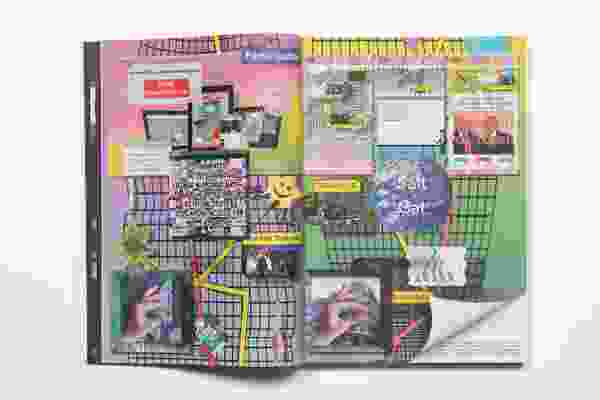
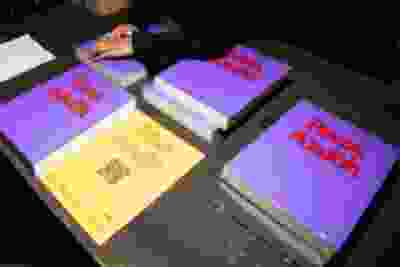
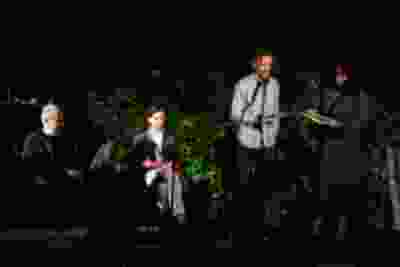
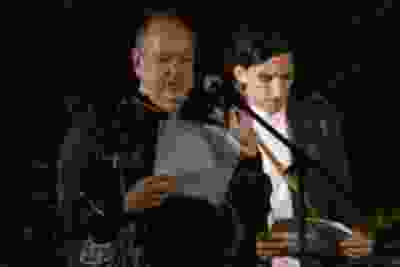
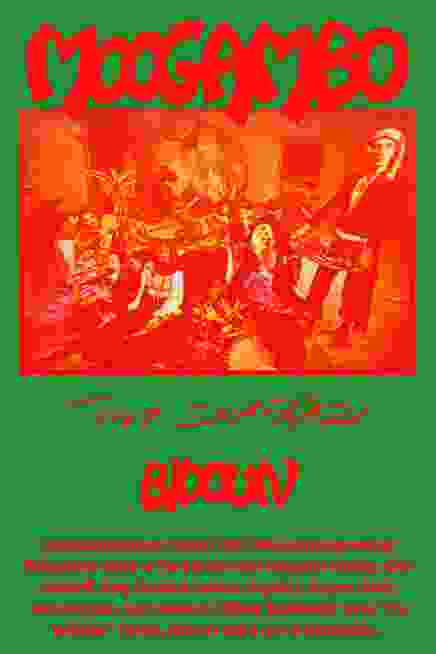
A Protest Against Spaghetti is a new newsletter from Bidoun, an occasion to feature shorter, timelier, more casual content: interviews, as-told-to’s, diaries, recommendations, pictures, moving pictures, mixtapes, listings of Bidounish happenings across the globe, & much else.
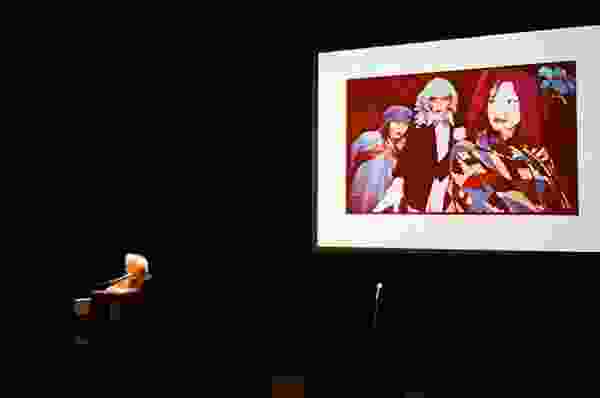
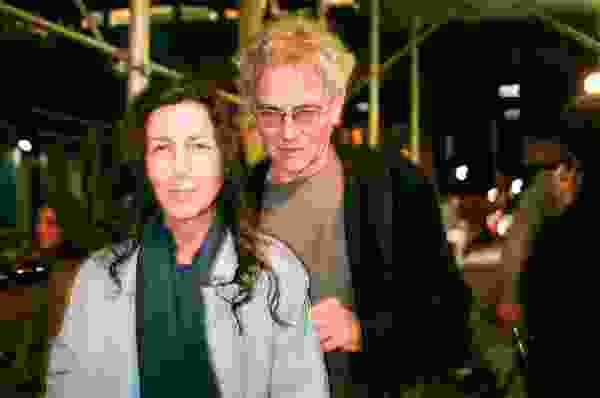
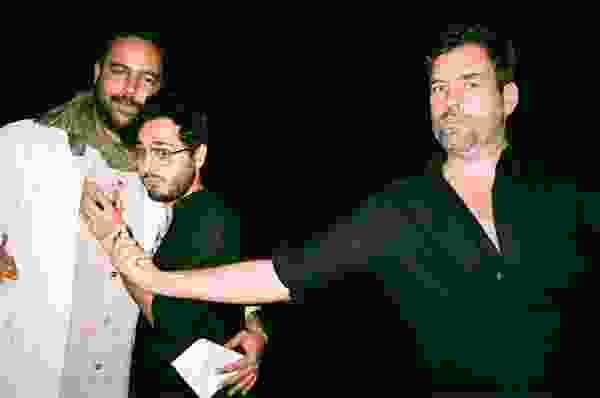
Our inaugural installment features a conversation among three artist-filmmakers with premieres in New York this week — Valentin Noujaïm, whose Defense Trilogy is at the Museum of Modern Art, and the directorial duo of Meriem Bennani and Orian Barki, whose debut feature, Bouchra, plays at the New York Film Festival at Lincoln Center.
Plus Hot Tangents: timely advice on things to read or watch or listen to, this very week.
99 Canal StreetNew York CityFriday, September 26th at 7pm
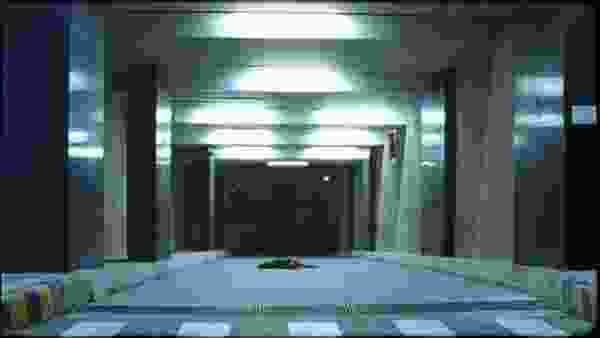
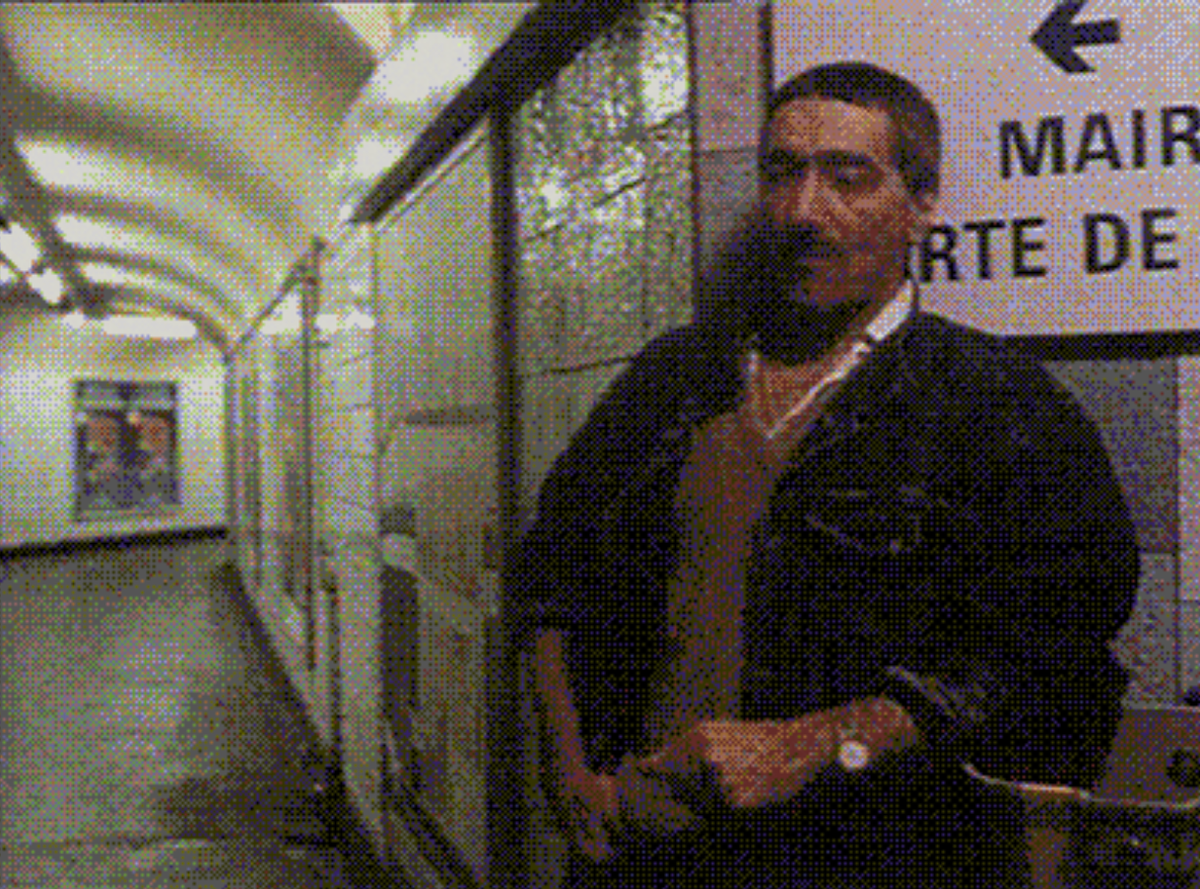
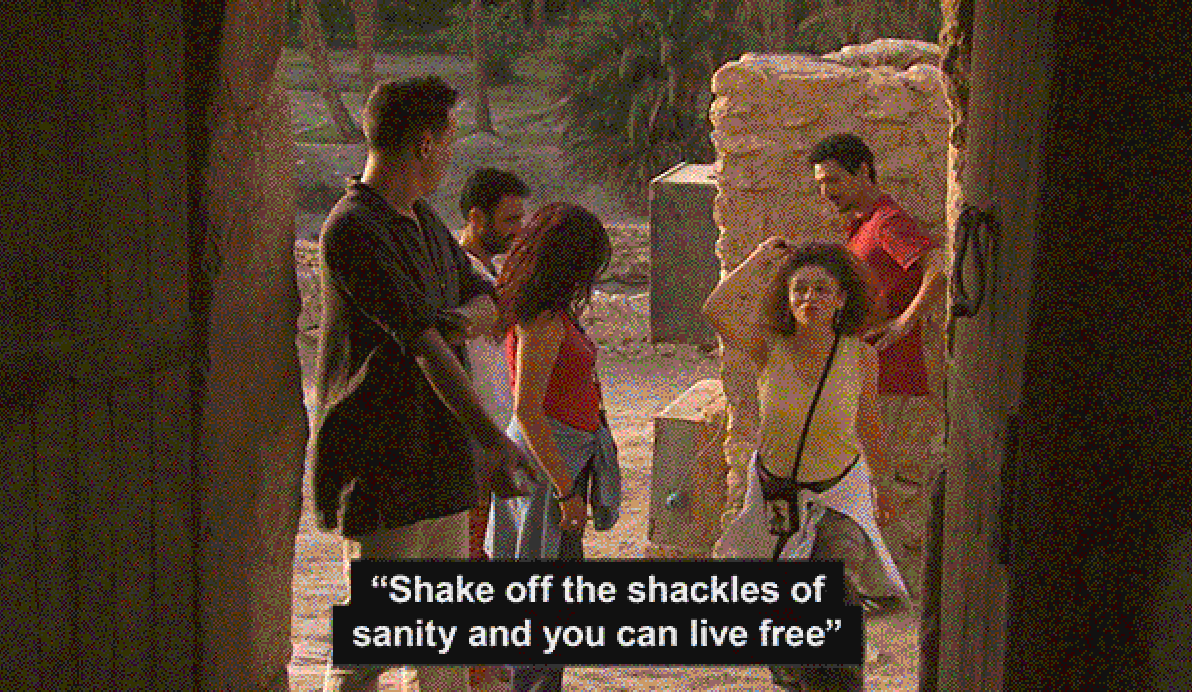
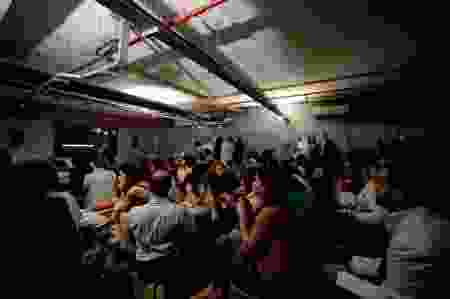
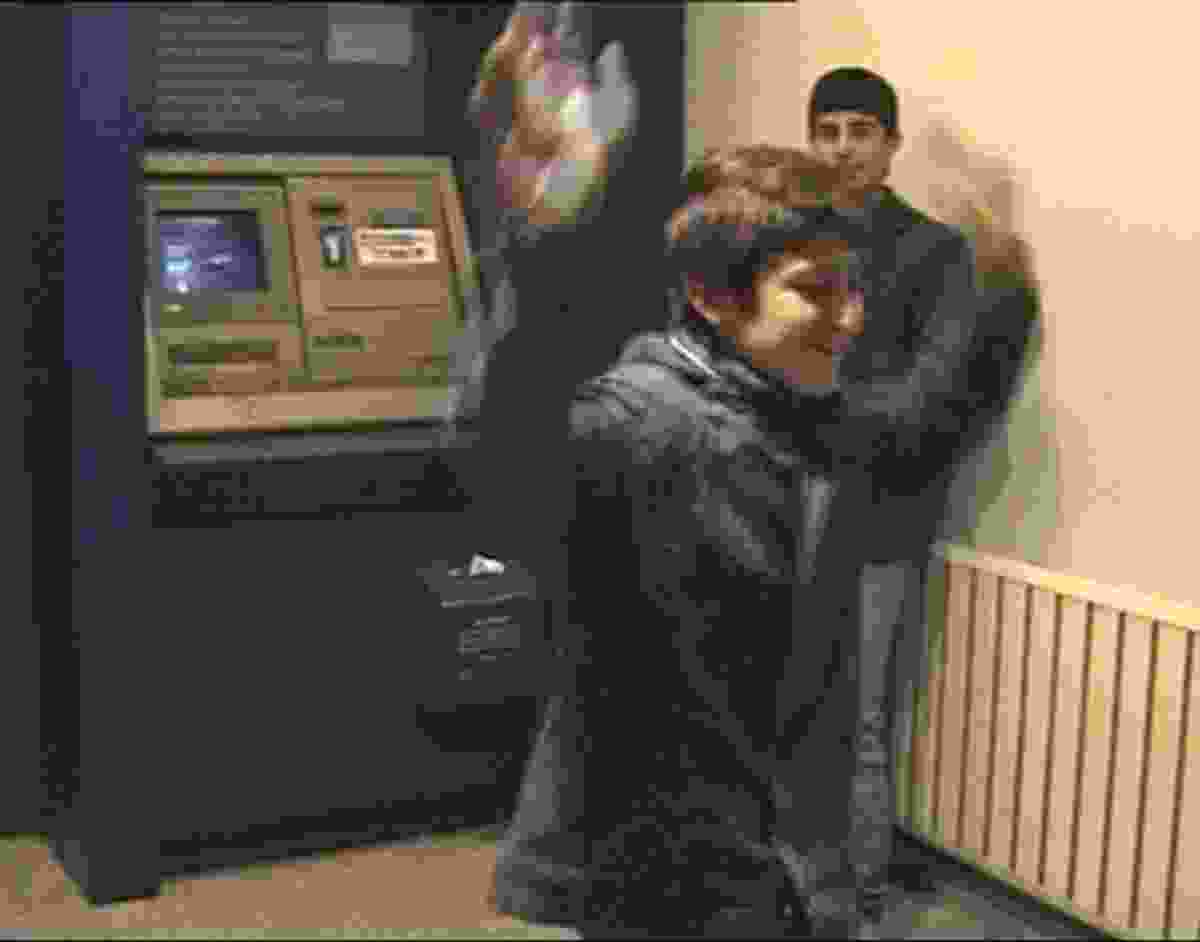
Bidoun and 99 Canal are pleased to present a special screening of Pacific Club, filmmaker Valentin Noujaim's 2022 film about a little-known Paris nightclub that catered to a mostly young, mostly Arab clientele during the 1980s. Set against the backdrop of racism, a heroin epidemic, and the emerging AIDS crisis, Pacific Club is the first in a trilogy of films orbiting around the Parisian business district known as La Défense and its unlikely postcolonial histories. Noujaïm's experimental documentary splices together digital renderings of the venue and its music with reminisces by one club habitue who survived the period.
The screening will be followed by a discussion between Noujaim, writer and curator Adam HajYahia, and writer Perwana Nazif as well as a celebration of Interzone, a monograph published in conjunction with the artist's first institutional solo exhibition, earlier this year at Kunsthalle Basel. The monograph features a text by Nazif and an introduction by Mohamed Almusibli.
Anthology Film Archives32 2nd AveNew York, NYThursday, February 27 at 6:30pm
This rare screening is presented as a prelude to a two-day symposium on the renowned poet, essayist, and visual artist Etel Adnan. Organized by Omar Berrada and Simone Fattal on the centenary of Adnan’s birth, the symposium will take place on February 28 and March 1, at The Poetry Project and Giorno Poetry Systems.
In the 1980s, Adnan regularly traveled with a Super-8mm camera in hand. She visited New York frequently, staying at a friend’s apartment in a high-rise overlooking the East River. While there, she would repeatedly attempt to capture the sun touching skyscrapers’ windows, the geometry of bridges, the marriage of light and water, the movement of barges on the river, the shapes of factory smoke — the oddly meditative poetry of inexorable motion at the immediate edge of city life. The footage was retrieved and digitized three decades later, and edited into a feature-length film, Motion, which premiered at Documenta 13 in 2012.
This is a free screening, however, tickets must be reserved on the Anthology Film Archives website.
Triple Canopy264 Canal Street, Suite 3WNew York, NY 10013February 4, 2025 at 7 pm
Please join us this Tuesday, February 4, in New York for a reading and conversation around Youssef Rakha's new novel, The Dissenters. Rakha will be joined by novelist and Bidoun Contributing Editor Zain Khalid.
The Dissenters (Graywolf Press) is an engrossing and wildly ambitious account of one woman’s seven-decade journey through modern Egypt — an ecstatic collision of sex, politics, love, revolution, and reaction, from the heyday of Nasserism to the Islamic revival to the Arab Spring and its aftermaths.
Read "The Shit," an excerpt from the book, in Bidoun.
Youssef Rakha is a Cairo-based writer. He is the author of 14 books in Arabic and English, including poems, travel writing, essays, and fiction. He has published four novels in Arabic, including Paolo, which was on the long list of the International Prize for Arabic Fiction in 2017. The Dissenters is his first novel composed in English.
This event is co-hosted with Triple Canopy and Graywolf Press.
Bidoun is looking for a part-time editor to work with our core team. The editor will commission, develop, and edit pieces, which may include criticism, reportage, memoir, or interviews. Bidoun works on an average of 1-2 books per year and said editor may be asked to weigh in on these, too. Candidates should have several years of magazine, book publishing and/or newspaper experience. Meticulous research, copy editing, and proofreading skills are required, as is a sense of humor. Bidoun is a small, collectively-run organization; the ideal candidate will be familiar with and invested in the project’s sensibility and mission. Salary will begin at 36K & can grow depending on time and experience. Applicants can be based anywhere, as most meetings happen via Zoom, though Bidoun's core team is located in NYC.
Please send cover letter, CV, and the names and contact information for two referees to info@bidoun.org with subject header “EDITOR.” Review of applications will begin immediately and continue until the position is filled.
Bidoun is committed to a diverse workplace and is an equal-opportunity employer. We will not discriminate against any employee or applicant on the basis of age, color, disability, gender, national origin, race, religion, sexual orientation, or veteran status.
Anthology Film Archives32 2nd Ave, New YorkThursday, September 19 at 7:30 pmSunday, September 22 at 3:30
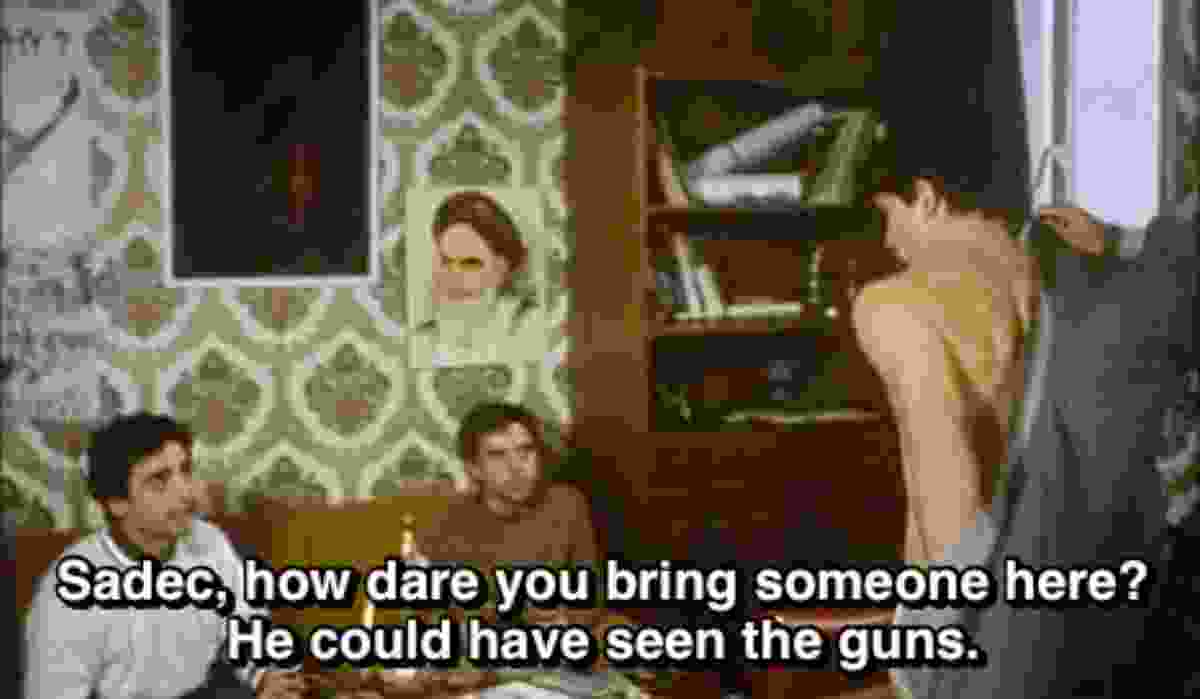
Join us Thursday, September 19 or Sunday, September 22 at the Anthology Film Archives for a very special 35mm screening of Farouk Beloufa’s elliptical political drama Nahla (1979), followed by Jocelyne Saab’s behind-the-scenes documentary On the Set of Nahla (1979)—newly subtitled in English and screening in the US for the first time.
*September 19th screening will be introduced by artist, filmmaker, and progeny, Neïl Beloufa.
NahlaFarouk Beloufa1979, 116 min, 35mmArabic and French with English subtitlesArchival print courtesy Academy Film Archive
Shot in 1978 but set three years earlier in 1975, Nahla follows the intertwined stories of four characters in Beirut at the onset of the Lebanese Civil War. Nahla, a young singer who loses her voice; her sister Maha, a feminist journalist; Hind, a Palestinian activist who provides a channel to the camps and later joins the resistance; and Larbi, an Algerian journalist caught in the tumult. An elliptically structured political drama, Nahla’s narrative linearity is propelled only by real-life political events: the battle of Kfar Chouba, a meeting between Kissinger and Sadat, the assassinations of Maarouf Saad and Saudi King Faisal, and so on. Co-written with Rachid Boudjedra and produced by Radio Télévision Algérienne, Nahla is the product of a distinct 1970s pan-Arab leftist intellectualism which connected Algeria, Lebanon, Palestine, and beyond. With music composed by Ziad Rahbani, who makes cameos in the film.
On the Set of NahlaJocelyne Saab1979, 27 min, 16mm-to-DCPArabic and French with English subtitles
“In the mid-1970s, Algeria was very interested in what was happening in Lebanon, particularly because the PLO headquarters were in Beirut, and the Palestinian issue is a central concern for the Arab world . . . I remember that some senior leaders of the National Liberation Front (FLN) began to wonder if a kind of civil war similar to the one that ignited Lebanon would come to pass in Algeria. I was invited . . . to present my documentary at the Cinematheque of Algiers, which was then a hotbed of global cinephilia . . . I had interesting discussions with Algerian filmmakers, like Farouk Beloufa, who discovered Lebanon through my films. Shortly thereafter, he shot Nahla. . . . Farouk was fascinated by the freedom of speech and movement and the proliferation of ideas of political parties in Lebanon in the seventies.”
—Jocelyne Saab
A behind-the-scenes documentary in which director Jocelyne Saab engages the cast and crew of Nahla in conversations about the film. With Farouk Beloufa, Yasmine Khlat, Ahmed Mehrez, Jocelyne Saab, Youcef Saïeh, Lina Tebbara, and others.
Anthology Film Archives32 2nd Ave, New YorkSunday, June 307:30 pm
Join us on Sunday, June 30 at the Anthology Film Archives for the U.S. premiere of Rahmaneh Rabani and Bahman Kiarostami's Impasse (2023), a microcosmic documentary about rising religious and political conflicts within one Tehrani family. Remarkable for the candor of its conversations, Impasse intimately captures an Iranian domestic discourse rarely seen on film.
Rahmaneh Rabani, Bahman KiarostamiImpasse2023, 89 min, DCPPersian with English subtitles
“Until the age of twenty-two, I was just like the rest of my family, a believer and fully veiled,” says Rahmaneh Rabani, who was raised in an ultra-conservative household in Iran. After a crisis of faith in her early twenties, she diverged from her family’s wishes, especially those of Haj Akbar — the family patriarch — a loyal subject deeply formed by his experiences during the revolution and the Iran-Iraq war. After the death of Mahsa Jina Amini at the hands of Iranian authorities in 2022, Rabani participated in anti-regime protests that shook the country. She also began filming her interactions with her observant family, reigniting old conflicts. Produced in collaboration with Bahman Kiarostami, Impasse captures Rabani’s remarkably direct and emotionally-charged conversations with three generations of her own family — parents, siblings, nieces, and in-laws — most of whom remain steadfastly supportive of the government and its mandatory hijab laws. Impasse offers an intimate, tense, and ultimately moving portrait of Iranian society at a critical juncture.
Rahmaneh Rabani is an artist, filmmaker, and editor. Impasse is her first feature.
Bahman Kiarostami is a Tehran-based documentary filmmaker. His most recent film is Fereydoun in Late Summer.
$14 General Admission / $10 Students, SeniorsTickets available on the Anthology Film Archives website
Museum of the Moving Image36-01 35th AveQueens, NYWednesday, May 87 pm
Join us on Wednesday, May 8 at the Museum of the Moving Image in Astoria where we will be co-presenting a screening of Michel Khleifi’s Fertile Memory (1981) for the opening night of the Prismatic Ground Festival. Recently restored by the Royal Belgian Film Archive, Khleifi’s first film is a visceral, poetic glimpse of everyday life in the occupied West Bank.
The screening will be preceded by a reading from poet Hala Alyan and followed by a discussion with researcher/writer/curator Adam HajYahia.
Khleifi’s second film, the short documentary Ma'loul Celebrates Its Destruction (1984), will be free to stream for the duration of the festival (May 8–12) on prismaticground.com.
Michel KhleifiFertile Memory1981, 99 min, DCPArabic with English subtitles
The first feature length film to be shot in the West Bank, Fertile Memory is a portrait of two Palestinian women whose individual struggles both define and transcend the dispossession that heavily determines their lives. Romia Farah — the director’s aunt — is a widowed grandmother working in an Israeli garment factory. Her tenacious personality fuels a decades-long legal battle to reclaim her expropriated land. Sahar Khalifa is a feminist writer teaching at Birzeit University; she struggles with the double oppression of Israeli occupation and the gendered ostracization and loneliness she experiences after seeking a divorce. Fertile Memory marks a distinct shift in Palestinian filmmaking, from a unified revolutionary cinema, to a capacious reflection of Palestinian society and its many contradictions, landscapes, and temporalities.
Michel KhleifiMa'loul Celebrates Its Destruction1984, 32 min, streaming in HDArabic with English subtitles
Once a year, on “Israeli Independence Day” — also known as Nakba day — the former residents of the destroyed Palestinian village of Ma’loul are permitted to enter the ruins of their birthplace. The village, like countless others, was previously a mixed agrarian community of Muslims and Christians. Today, the churches are used to house cattle and garbage for a nearby kibbutz; the military has built a base; and commemorative plaques and trees planted through the Jewish National Fund obfuscate the landscape for those who once knew it intimately. Ma’aloul intercuts scenes of the villagers communing in remembrance with archival footage, along with a depiction of a Palestinian teacher presenting the history of the creation of the state of Israel to his students, as mandated by Israeli curriculum.
Poets in the inaugural “Gaza Reader” include Maya Abu Al Hayat, Zaina Alsous, Fady Joudah, Mahmoud Darwish, Mosab Abu Toha, Naomi Shihab Nye, Hala Alyan, Mohammed El Kurd, Carolina Ebeid, Noor Hindi, Refaat Alareer, Etel Adnan, Eileen Myles, and many more.
Bespoke maritime flags have been made by the artists Nicole Eisenman and Rosalind Nashashibi.
The Gaza Reader is illustrated with drawings from artists Aml El Nakhala, Hazem Harb, and Adel El Taweel.
Anthology Film Archives32 2nd Ave, New YorkThursday, April 187:30 pm
Join us next Thursday for the seventh installment of our ongoing film series at Anthology Film Archives where we will be screening two documentary-adjacent films about the Lebanese civil war, its aftermath, and its mediation. Borhane Alaouié’s Letter From a Time of Exile, though scripted, is shot like a documentary and often confused for one. While **Akram Zaatari’**s All is Well on the Border deftly deconstructs the genre of post-war resistance hagiography.
Borhane AlaouiéLetter From a Time of Exile1988, 52 min, 16mm-to-digitalArabic and French with English subtitles
Scripted by Najwa Barakat and shot in a pseudo-documentary style, Letter From a Time of Exile presents the stories of four Lebanese men whose lives have taken unexpected turns due to the Civil War: Abdallah, a former militia member; Karim, an unemployed journalist living in Paris; Rizkallah, a car salesman in Brussels; and Nessim, a surgeon who has settled in Strasbourg. Narrated with subtle humor, Letter From a Time of Exile is both a portrait of people in exile, and the cities in which they currently reside.
Akram ZaatariAll is Well on the Border1997, 44 min, videoIn Arabic with English subtitles
Focusing on the Israeli occupation of the South,_ All is Well_ is an early example of Zaatari’s explorations into postwar Lebanese memory culture through the collection of testimonies and documents. Working at Rafic Hariri's Future TV at the time, Zaatari was particularly interested in the ways in which histories of resistance were mediated and exploited in their dissemination; Zaatari centers his own mediation by having genuine testimonies and letters from imprisoned fighters read by actors, revealing their teleprompters and script pages on screen. All is Well is an incisive meditation on the propagation of resistance stories.
$12 General Admission / $9 Seniors and StudentsTickets available at the box office or at the Anthology Film Archives website
Anthology Film Archives32 2nd Ave, New YorkThursday, March 287:30 pm
Join us Thursday for the sixth installment of our ongoing film series at Anthology Film Archives where we will be screening two documentaries from Omar Amiralay: A Plate of Sardines (1998), in which Amiralay and Mohammad Malas visit the ruins of the Golan village of Quneitra, destroyed by the Israeli army in 1974, its only remaining building a former cinema; and The Man With the Golden Soles (2000), where Amiralay wrestles with both self and subject in his precarious portrait of billionaire Lebanese statesman Rafic Hariri, five years before his assassination.
The films will be introduced by writer, editor, and film programmer Hicham Awad.
Omar AmiralayA Plate Of Sardines (or the First Time I Heard of Israel)1998, 17 min, digitalArabic and French with English subtitles
“The first time I heard of Israel, I was in Beirut, the conversation was about a plate of sardines. I was six years old, Israel was two.” In the company of filmmaker Mohammad Malas, Omar Amiralay revisits the ruins of the destroyed village of Quneitra.
Omar AmiralayThe Man With the Golden Soles2000, 54 min, digitalArabic and English with English Subtitles
Amiralay’s portrait of billionaire Lebanese Prime Minister Rafic Hariri was by his own admission a failure: “What I feared would happen had indeed happened…Hariri was now in complete control.” His leftist peers had tried to warn him (“You know very well that power is pernicious”) but Amiralay nevertheless enters into a dialectical struggle with Hariri in a series of one-on-one interviews. Unable to circumvent his subject’s charisma, Amiralay’s adverserial intentions slowly give way to familiarity as Hariri—often referring to himself in the third person—increasingly appears to be directing from in front of the camera. Featuring Elias Khoury, Fawwaz Traboulsi, and Samir Kassir.
$12 General Admission / $9 Seniors and StudentsTickets available at the box office or at the Anthology Film Archives website
Saturday March 9, 6pm264 Canal Street, 3WNew York, NY 10013
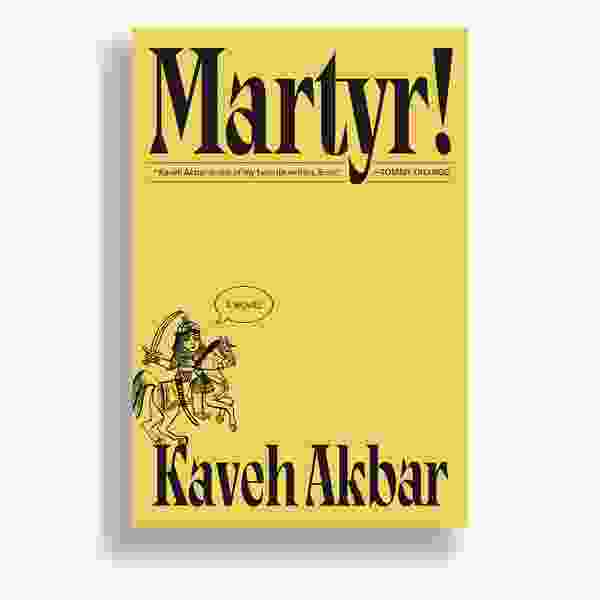
Please join us on Saturday, March 9th, for a reading by poet Kaveh Akbar, author of the acclaimed new novel Martyr!, followed by a discussion with critic Anahid Nersessian.
The painful absurdities and insoluble contradictions that attend the life of the immigrant provide the occasion for Akbar’s debut novel. Martyr! is the story of Cyrus Shams, a young man born in Iran and raised in Indiana by his father. When Cyrus was an infant, his mother was killed aboard Iran Air Flight 655, a passenger flight brought down by a pair of surface-to-air missiles fired by the USS Vincennes, an American Navy cruiser, on July 3rd, 1988. Cyrus, now an alcoholic in recovery, is desperate for his own life to matter. He becomes obsessed with the idea of martyrdom, constantly adding to a file on his computer called BOOKOFMARTYRS.docx...
Anthology Film Archives32 2nd Ave, New YorkThursday, February 227:30 pm
Join us Thursday for the fifth installment of our ongoing film series at Anthology Film Archives, where we will be screening The Man Who Watched Windows (1982), a rarely seen early work from Algerian director Merzak Allouache. A singular and underappreciated film, The Man Who Watched Windows is a tightly-calibrated portrait of a man who does not wish to understand the changing world around him.
Merzak AllouacheThe Man Who Watched Windows1982, 85 min, 16mmIn Arabic with projected English subtitles.
Merzak Allouache’s third film, The Man Who Watched Windows is the story of Rachid, an austere bureaucrat who has just been transferred without warning from the National Archives to the cinema library. The constant motion of post-post-independence 1980s Algerian society displeases him, as does cinema; worse yet, books on cinema—the very idea of which disturbs him. Having dedicated his life to the state, Rachid is so agitated by his transfer that he is driven to paranoia and, ultimately, an act of violence. Print courtesy the CNC (Centre national du cinéma et de l’image animée).
$12 General Admission / $9 Seniors and Students Tickets available at the box office or at the Anthology Film Archives website
Anthology Film Archives32 2nd Ave, New YorkThursday, January 187:30 pm
Join us Thursday for the fourth installment of our ongoing film series at Anthology Film Archives, where we will be screening two artist-made documentaries about survival and resistance in occupied Palestine. Khaled Jarrar’s Infiltrators (2012) captures the myriad ways West Bank residents attempt to circumvent the so-called separation wall, while Jumana Manna’s Foragers (2022) examines Israel’s use of ecological legislation to further alienate Palestinians from their land, food, and culture.
Khaled JarrarInfiltrators2012, 70 min, digital
Artist Khaled Jarrar shadows West Bank residents as they search for ways to bypass the highly militarized Israeli apartheid wall that separates them from Jerusalem. Over, under, or through, with great difficulty and risk, the infiltrators are by turns people who wish to visit relatives in hospitals, religious women trying to reach Al Aqsa, teenage boys tasked with “smuggling” bread, and, most often, construction workers; Palestinian men whose labor will be used to build up the city they are not permitted to enter. Alternating between cigarette breaks, detours, waiting, climbing, escaping, and confrontation, Infiltrators depicts the constant struggle to both survive and resist captivity and occupation.
Jumana MannaForagers2022, 64 min, DCP
Shot in the Golan Heights, the Galilee, and Jerusalem, Foragers employs fiction, documentary, and archival footage to demonstrate the impact of Israeli nature protection laws on Palestinian foraging practices. The restrictions prohibit the collection of wild ’akkoub and za’atar, and have resulted in fines and trials for hundreds of people, exclusively Arabs. While Israel insists the laws are necessary to protect native plants from extinction, for Palestinians they constitute an ecological veil for carceral legislation that alienates them from their land and culture. Though singular in its focus, Foragers illuminates the links between land, food, indigeneity, law, and the quotidian defiance necessitated by life under occupation.
Total running time: ca. 140 min.
$12 General Admission / $9 Seniors and Students Tickets available at the box office or at the Anthology Film Archives website
Anthology Film Archives32 2nd Ave, New YorkThursday, October 267:30 pm
Join us Thursday for the third installment of our recurring film series at Anthology Film Archives, where we will be screening two documentaries about Cairo and its denizens: Youssef Chahine's wry love letter to his adopted city, Cairo, as Told by Youssef Chahine (1991), and the US premiere of a new restoration of Jocelyne Saab’s Egypt, City of the Dead (1977).
The screening will be followed by a discussion with journalist Sharif Abdel Kouddous and writer Hussein Omar, both of whom have family buried in the City of the Dead.
Youssef ChahineCairo, as Told by Youssef ChahineEgypt, 1991, 23 min, 35mmIn Arabic with English subtitles
Commissioned by French television to make a documentary about Cairo, iconic Egyptian director Youssef Chahine chose to mix observational footage with scripted vignettes to produce a mischievously meta film, marked by his characteristic humor, eroticism, and incisiveness. Despite its brevity, Cairo sensitively captures the dusty, chaotic beauty of city life, setting its numerous injustices—poverty, overcrowded living quarters, greedy real estate developers, and the violence of globalization—against the backdrop of the first Gulf War. Refusing the mock-objectivity of reportage, Chahine presents a portrait of the city through his love for its inhabitants.
Jocelyne SaabEgypt, City of the DeadLebanon, 1977, 38 min, 16mm-to-digitalIn Arabic and French with English subtitles
In recent years, the government of President Abdel Fattah el-Sisi has begun to raze large swaths of Cairo’s historic necropolis, a sprawling series of cemeteries where hundreds of thousands of the city’s poorest have taken up residence, squatting inside and around the centuries-old mausoleums, in an emphatic confluence of poverty and death. The destruction of the area, known as the City of the Dead, is both a mass eviction and the latest in Sisi’s assault on Egyptian life in the service of rapid development. Jocelyne Saab’s 1977 film documents the community living inside the necropolis alongside other members of Cairo’s toiling classes. Featuring music from Sheikh Imam and commentary from other leftists, including Lutfi el-Kholi, the screenwriter of Chahine’s The Sparrow (1972). US premiere of 2k restoration completed in 2023 in France and Lebanon by the Jocelyne Saab Association.
$12 General Admission / $9 Seniors and Students Tickets available at the box office or at the Anthology Film Archives website
Anthology Film Archives
32 2nd Ave, New York
Thursday, August 3
7:30 pm
Join us for the second installment of our recurring film series at Anthology Film Archives, where we will be hosting a screening of French-Tunisian filmmaker **Nadia El-Fani’**s low-budget hacker drama, Bedwin Hacker (2003).
In this campy millennium cyber-thriller, culture-jamming hacker Kalt, AKA “Bedwin Hacker,” hijacks European television stations from her Tunisian mountain hideout. With the help of her motley crew of freedom-loving poets, queers, and musicians, she broadcasts cryptic political messages delivered by a cartoon camel. Meanwhile, a French intelligence agent named Julia relentlessly pursues the elusive pirate, with whom she shares multiple romantic entanglements, past and present…
$12 General Admission / $9 Seniors and Students Tickets available at the box office or at the Anthology Film Archives website
B7L9 Art StationBhar LazregLa Marsa, TunisiaJune 22, 6:30 PM
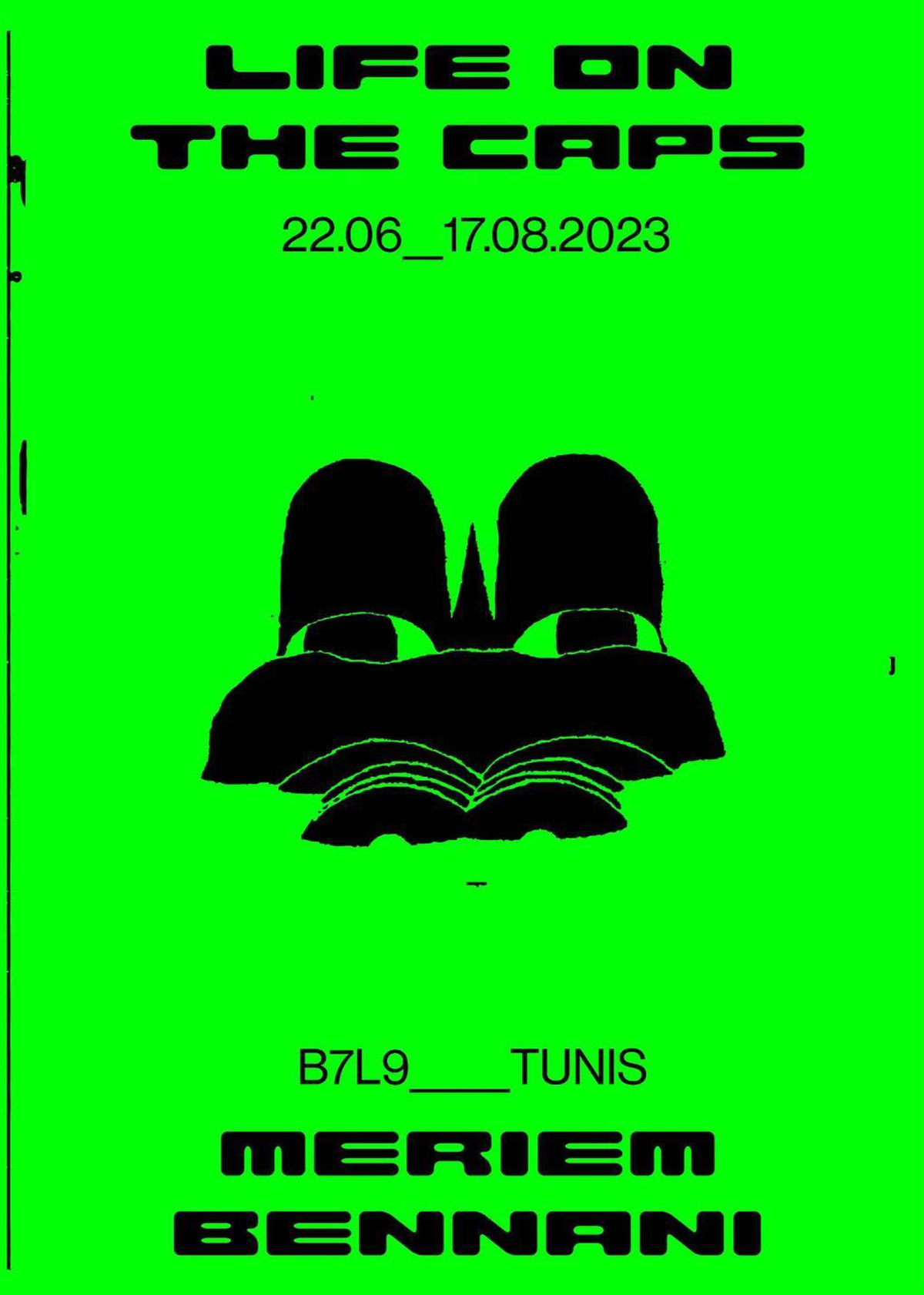
On the occasion of Meriem Bennani’s exhibition Life on the CAPS, to open this week at Tunis’s BL79 Art Station / Kamel Lazaar Foundation, we will be launching a publication of the same name.
The book is the artist’s first comprehensive monograph and includes essays by writers Emily LaBarge and Elvia Wilk, alongside conversations with Omar Berrada, Fatima Al Qadiri, Amal Benzekri, Aziz Bouyabrine, and Bidoun.
The opening and book launch will be followed by a conversation between Meriem Bennani, Negar Azimi, Tiffany Malakooti, and Myriam Ben Salah.
Life on the CAPS, the book, is co-edited by Bidoun’s Negar Azimi and Tiffany Malakooti, and published by The Renaissance Society and Bidoun.
Anthology Film Archives32 2nd Ave, New YorkThursday, June 15, 20237 pm
Join us for the first in an ongoing series of Bidoun-curated screenings at Anthology Film Archives that privilege rare and/or underappreciated films. For the inaugural installment, we’ll be presenting the cult favorite documentary Four Women of Egypt from Egyptian-Canadian director Tahani Rached. Her film will be preceded by The Singing Sheikh, a short by Lebanese director Heiny Srour on the iconic dissident Egyptian folk musician, Sheikh Imam.
The screening will include:
Tahani RachedFour Women of Egypt1997, 89 min, digitalIn Arabic and French with English subtitles
A portrait of four friends in Cairo (Wedad Mitry, Safinaz Kazem, Shahenda Maklad, and Amina Rachid), all born under colonial occupation, and all former political prisoners under Sadat. Despite ideological differences, the women maintain their friendships – sustained by their humor, warmth, commitment to politics, and shared ideals of social justice. Four Women of Egypt is a testament to both friendships and politics that have endured the violence and disappointments of 20th-century Egypt.
preceded by:
Heiny SrourThe Singing Sheikh1991, 11 min, digitalIn Arabic with English subtitlesA rarely-seen documentary on Sheikh Imam, the legendary and frequently imprisoned Egyptian folk musician whose political songs fearlessly indicted the ruling classes.
Total running time: ca. 105 min$12 General Admission / $9 Seniors and Students
Tickets available at the box office or at the Anthology Film Archives website
Godard, Miéville, Hatoum, and Yaqubi at Anthology Film ArchivesNew YorkFebruary 23, 20237:30 PM
Artists Against Apartheid, Bidoun, and Shasha Movies present Jean-Luc Godard and Anne Marie Miéville’s Here and Elsewhere (1976), alongside Mohanad Yaqubi’s Off Frame (2016) and Mona Hatoum’s Measures of Distance (1988).
It has been 45 years since Godard and Miéville made Here and Elsewhere, a filmic essay that has exercised a talismanic power over generations of artists and audiences with its stark, self-critical meditation on cinema’s limitations in representing faraway realities, in this case, the ongoing Palestinian resistance movement of the 1970s.
Screened alongside, Mona Hatoum’s elegiac and epistolary Measures of Distance (1988) and Mohanad Yaqubi’s Off Frame (2016) provide a Palestinian counterpoint, as filmmakers of different generations offer up inspired explorations of word, image, and narrative.
Nicolas MoufarregeMutant InternationalCCA BerlinFebruary 9 - March 19, 2023
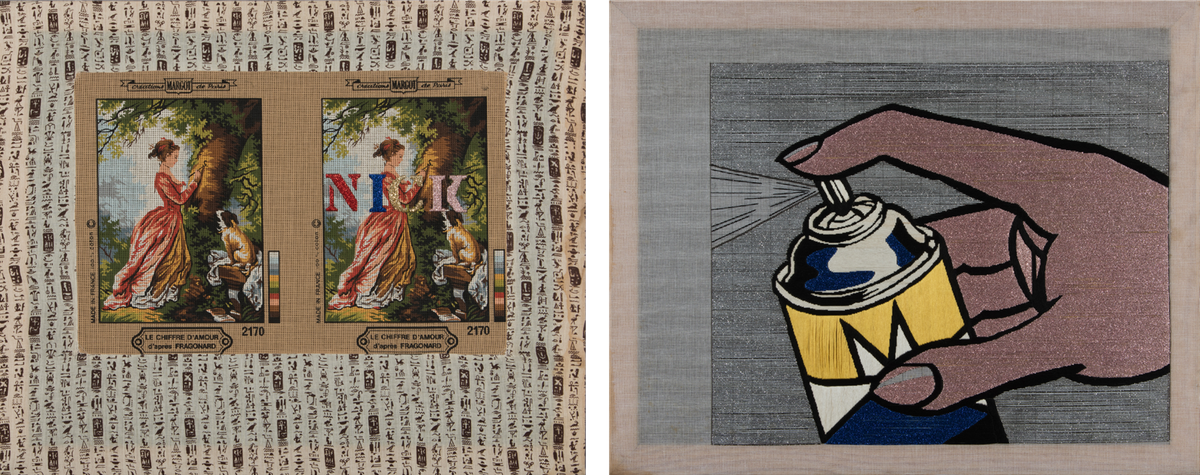
Bidoun and CCA Berlin are pleased to announce Mutant International, an exhibition featuring a selection of works by Egyptian-born Lebanese artist Nicolas Moufarrege (1947-1985) – his first institutional solo exhibition in Germany.
A prodigious visual artist, writer, and curator, Moufarrege made wry, sophisticated, and exuberant work over a ten-year career that spanned Beirut, Paris, and New York. His practice rethought the Western art canon and Levantine weaving traditions through irreverent engagements with painting and sewing, graffiti and collage, Pop and the esoteric. Having launched himself in Beirut in the 1970s, Moufarrege left shortly after the calamitous beginnings of the long civil wars and moved to Paris, where he started producing large, tapestry-adjacent works. He arrived in New York’s East Village in 1981, just as an art scene was coming together amid a handful of crumbling tenements. In that city, he curated unusual, much-talked-about exhibitions, penned high-stakes essays and manifestos, and showed his own unclassifiable artworks. New York is also where he died of AIDS-related complications at the age of 37.
Moufarrege’s sui generis, shape-shifting work remains largely absent from the annals of art history — missing in Lebanon, as well, despite all the illustrious efforts of the last 15 years to make sense of art from the broader Arabic-speaking region. But it is missing, too, from most retrospective looks at American painting in the 1980s or The Pictures Generation. As for the East Village scene which he was so intimately tied to, he has tended to appear as a footnote, a curiosity with a foreign-sounding name.
The concise selection of works — tapestries, embroidered paintings, and drawings — as well as archival documents and ephemera on view as part of Nicolas Moufarrege: Mutant International draws a rich trajectory of artmaking informed by diasporic yearning and queer jouissance, and shaped through a delirious hodgepodge of references spanning Islamic calligraphy, superhero comics, cultures of advertising, and gay erotica.
While Moufarrege’s name all but disappeared following his too-early death, Bidoun and CCA Berlin are committed to bringing attention to his largely unknown body of work, while also using it as a springboard for a broader discussion about art and erasure, queer aesthetics in 20th-century art, and the cultural legacies of the AIDS epidemic.
On March 12, a public symposium organized by Bidoun featuring contributions by Nick Mauss, Michael C. Vazquez, Xandro Segade, and others will offer multiple lenses through which to view Moufarrege’s idiosyncratic oeuvre, in part by speaking to and about the cities in which he lived and worked — storied cosmopolitan enclaves, from 1950s Alexandria to 1960s Beirut, 1970s Paris to 1980s New York.
The works on view as part of Nicolas Moufarrege: Mutant International were selected by Negar Azimi (Bidoun) and Edwin Nasr (Associate Curator CCA Berlin). The exhibition was made possible through the generous support of Mohammed Fakhro, Raghida Ghandour, Ranya Husami Ghandour, Maria Sukkar, Tony Tamer, and Sultan Al Qassemi. Special thanks to Nabil and Hanan Moufarrege, as well as Dean Daderko.
Carnegie Museum of ArtSeptember 24 - April 2, 2023Pittsburgh, PA
Over the past five decades, the artist Fereydoun Ave has assembled a singular collection of modern and contemporary Iranian art inflected by personal history, friendship, sensibility, and circumstance.
On returning to Iran in 1970 after years of education abroad, Ave worked as a curator and designer at Tehran’s Iran-America Society Cultural Center, where he organized groundbreaking exhibitions of Iranian and international artists. Around the same time, he began collecting art with money borrowed from his grandmother. Ave continued to collect over the years, while he moved on to positions at consequential Tehran arts institutions, including the avant-garde Kargah-e Namayesh (Theater Workshop), where he worked as a resident designer, and the Zand Gallery, where he served as Artistic Director.
After the Iranian Revolution of 1979, Ave stayed behind as his compatriots left the country in droves. In the early 1980s he launched 13 Vanak, an independent art space for Iranian artists in a disused garden shed in an iconic Tehran square. The nimble and irreverent exhibitions at 13 Vanak attracted diverse audiences, including, on occasion, befuddled agents of the state. Though 13 Vanak closed in 2009, Ave has continued to mentor successive generations of artists both in and outside Iran.
The relationship between art and life, like history, is messy, impossible to tame. Ave, who is an accomplished artist himself, serves as both subject and cipher of this presentation, a vantage onto the fascinating—and contested—cultural history of 20th- and 21st-century Iran.
The Laal Collection presentation is curated by Bidoun’s Negar Azimi and Sohrab Mohebbi, Bidoun Contributing Editor and the Kathe and Jim Patrinos Curator of the 58th Carnegie International.
The 58th Carnegie International is on view at the Carnegie Museum of Art from September 24, 2022 through April 2, 2023.
A comprehensive book on Fereydoun Ave, edited by Negar Azimi, Aria Kasaei, and Sohrab Mohebbi, is in progress.
Negar Azimi and Sohrab Mohebbi would like to thank those who helped make this presentation possible: Aria Kasaei, Ali Bakhtiari, Rochanak Etemad, Omid Bonakdar, Shaqayeq Arabi, Hormoz Hematian, Alireza Fatehi, Balice Hertling Gallery, Dastan Gallery, Farhad Moshiri, Sohrab Mahdavi, and Roya Khadjavi-Heidari.
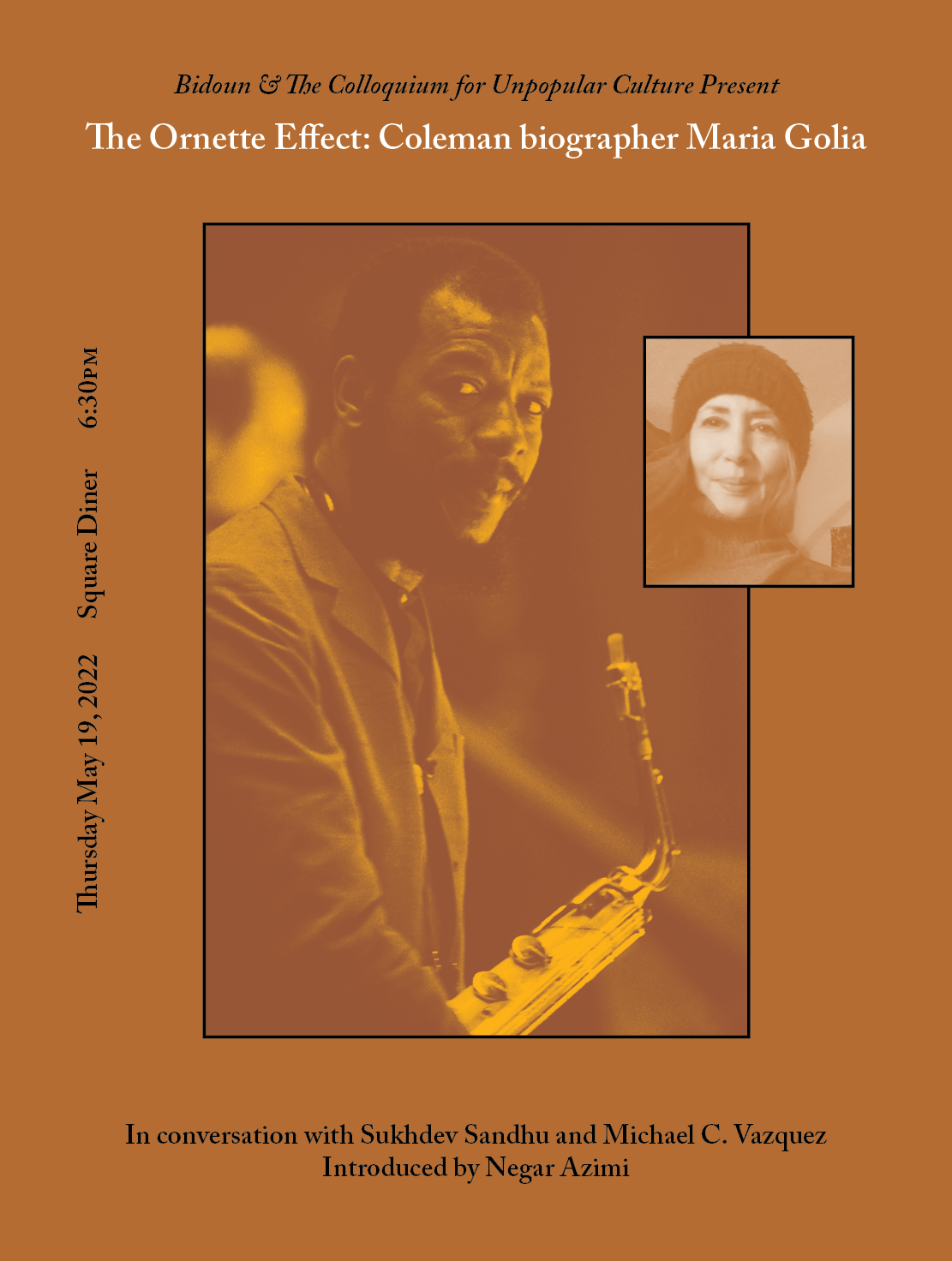
Square Diner33 Leonard StreetNew YorkThursday, May 196:30 PM
Bidoun & The Colloquium for Unpopular Culture Present:
The Ornette Effect: Coleman Biographer Maria Golia in conversation with Sukhdev Sandhu and Michael C. Vazquez. Introduced by Negar Azimi
Maria Golia, a long-time friend of Bidoun, will read an excerpt from her biography of the great American saxophonist and free jazz innovator Ornette Coleman (Ornette Coleman: The Territory and the Adventure, Reaktion Books). To be followed by a discussion on and around tomb-raiding, photography, and objects that fall from the sky.
About Maria Golia: Author of sundry nonfictions, Golia was born in New Jersey prior to the assassinations of John and Robert Kennedy, Malcolm X and Martin Luther King, Marylyn Monroe’s suicide, and the first lunar landing, Former student of neurophysiology, Texas nightclub manager, and tutor of Islamic art and architecture to Kuwaiti royalty. Fellow of the London Institute of Ecotechnics and non-driver. Lifetime interest in the quandaries of a discontinuous reality, singularities, and the exploration of urban and inner space. Residing in Egypt since 1992.
François Ghebaly391 Grand StreetNew YorkSunday, November 14, 20212-4 Pm
François Ghebaly, Bidoun, and After 8 Books invite you to the New York launch of Neïl Beloufa’sPeople Love War Data & Travels at François Ghebaly NY on Sunday, November 14th from 2 to 4 pm.
Neïl Beloufa’s first book-length monograph culls the artist’s zigzag work from 2007 to the present. Beloufa's commitment to making visible the conditions of his art-making is well-known and this book is no exception; it is as generous, transparent, experimental and chaotic as he is.
With readings by Ruba Katrib, Negar Azimi, and a conversation between the artist and Myriam Ben Salah.
Like many of you, we were consumed by news of the August 4 explosion that ripped through Beirut, a city already in the midst of a political and economic crisis of mind-boggling proportions. The need for help remains urgent. We've asked friends and colleagues to send on the names of Lebanese organizations working across multiple sectors that could use donations of all sizes. While this list of both scrappy and long-established groups is by no means exhaustive, it offers a start. Please do consider engaging with one or more of these initiatives; even the littlest amount goes a long way.
Neïl Beloufa & Meriem Bennani in conversation with Myriam Ben Salah
Friday, May 29 at 11 AM PST, 2 PM EST, 8 PM CETZOOM
Artist project… Confinement diary… Quarantine questionnaire… Playlist… Recipe? With museums, galleries, and sundry cultural centers shuttered amid our ongoing pandemic present, artists are increasingly being called upon to become providers of digital content cum entertainment. It’s hard not to be cynical about these appeals, as commissioning institutions scramble to justify their continued existence even as their physical spaces disappear. (Of course, Bidoun does not exempt itself from this legitimate querying of content production in the age of Corona.)
This Friday, May 29 @ 2 PM EST Bidoun presents a live conversation between the artists Neïl Beloufa and Meriem Bennani about the perks and pitfalls of centralized digital platforms for making and experiencing art. Beloufa has long been thinking about the manner in which art is made, circulated, seen. His current project, Screen Talk, is at once a surreal mini-series and a zigzag alternative distribution network. Could the internet, with all its concomitant liberties and limitations, provide a generative platform divorced from stifling vertical hierarchies and institutional agendas? Adapted from a film originally shot in 2014, Screen Talk the mini-series adopts a vaudevillian tone and posture in depicting a world turned topsy-turvy by a strange pandemic. Screen Talk is accessible via an interactive website whose design has been conceived as an artwork.
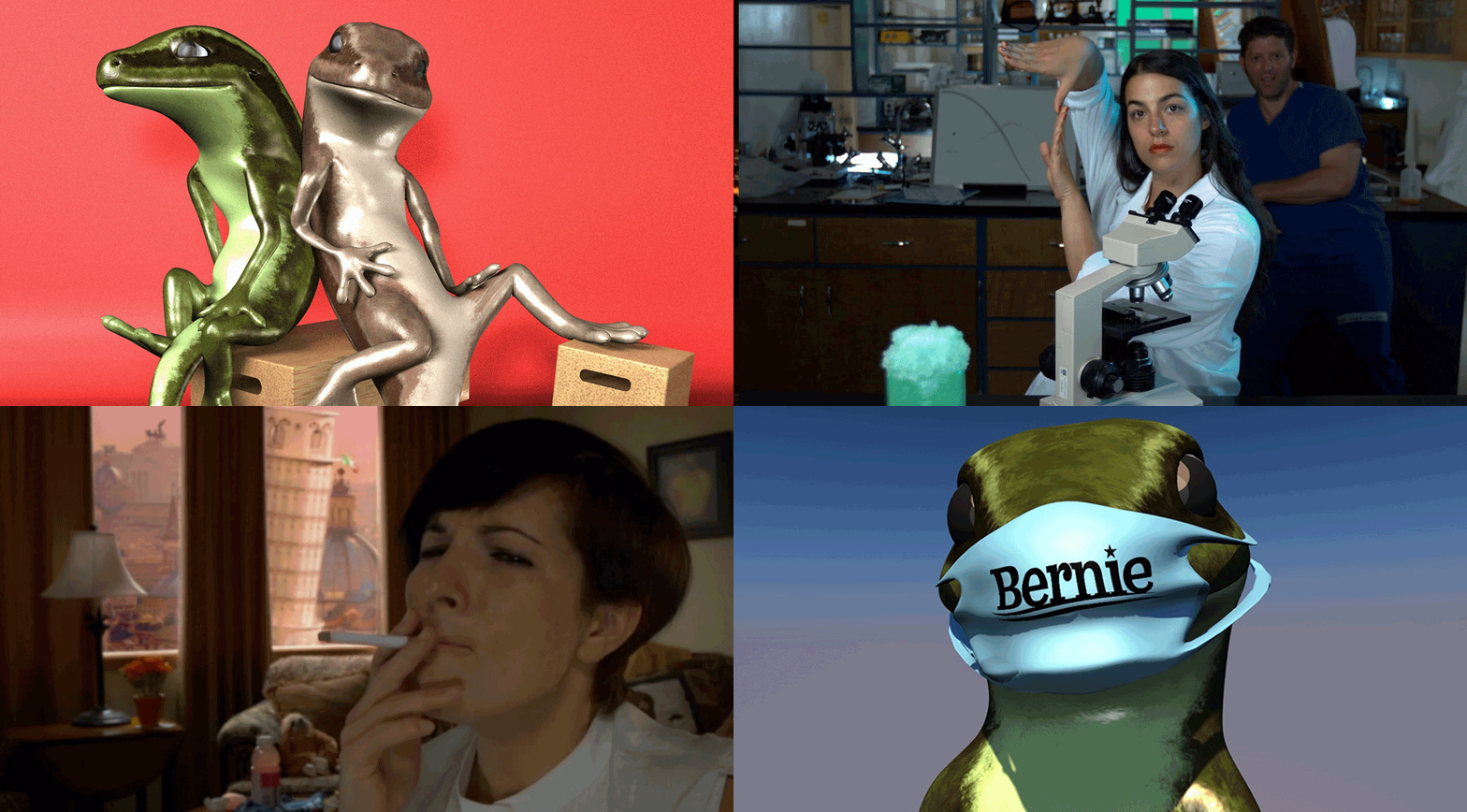
Launched in March and first circulated via Instagram, Bennani’s ongoing animated series 2 Lizards (made with Orian Barki) offers up a moody and hypnotic DIY portrait of how art might begin to make sense of this moment. Each episode follows the humanoid lizards, voiced by the artists, as they slowly absorb the reality—both surreal and true—of life in New York City under quarantine: a land of Zoom birthdays, distracted porn consumption, over-stressed medical heroes, errant gloves, an eerily deserted Times Square.
The artists will be joined in conversation with Myriam Ben Salah, newly appointed Executive Director and Chief Curator of the Renaissance Society in Chicago.
International Mutant:Nicolas Moufarrege in Time and SpaceQueens MuseumSaturday, February 151-5 pm
“The International is a nomadic wanderer, on land and in mind.”—Nicolas A. Moufarrege, “The Mutant International,” Arts Magazine, September 1983
Bidoun hosts a day devoted to the lost-found work of the Egyptian-born Lebanese artist Nicolas Moufarrege (1947-1985). A wildly prodigious visual artist, writer, and curator, Moufarrege made work that remains at once wry, sophisticated, and exuberant in its pursuit of the “idiosyncratic/universal.”
Contributors will speak to and about the cities in which Moufarrege lived and worked—distinct cosmopolitans enclaves, from 1950s Alexandria to 1960s Beirut, 1970s Paris to 1980s New York. These presentations will offer a lens through which to view Moufarrege’s emblematic engagements with painting and embroidery, graffiti and collage, Pop and the esoteric.
The afternoon begins with a talk by artist Nick Mauss, presented with Visual AIDS, and concludes with a conversation among friends and associates from the five-odd years Moufarrege spent at the epicenter of New York’s East Village art scene.
ICA LondonTuesday, July 2 at 6:30 pmWednesday, July 3 at 6:30 pm
As part of the exhibition I, I, I, I, I, I, I, Kathy Acker at the ICA London, Bidoun and the ICA present a two-part program of screenings and discussions centered on the moving-image works of theatre director and filmmaker Reza Abdoh (1963–1995).
Working between Los Angeles and New York in the 1980s and early 90s, Abdoh was a contemporary of Kathy Acker at a time of metastasizing moral panic in the US. Both artists’ work share a particular fascination with taboo (sexual, psychological and societal) and abjection.
On July 2nd, a screening of Abdoh’s only completed feature film The Blind Owl is followed by a discussion between scholar Dominic Johnson and artist Ron Athey, moderated by Bidoun Senior Editor Michael C. Vazquez.
On July 3rd, a screening of short film and video works by Abdoh is followed by a discussion between scholars Elizabeth Wiet and Daniel Mufson, moderated by Bidoun Senior Editor Negar Azimi.
e-flux311 East BroadwayNew York, NY 10002Wednesday, May 29, 2019, 7pm
Join Bidoun Contributing Editor Sophia Al-Maria and Senior Editor Michael C. Vazquez in reading and conversation on the occasion of the publication of Sad Sack (Book Works, 2019), a book of Al-Maria's collected writing. Taking inspiration from Ursula K. Le Guin’s 1986 essay “The Carrier Bag Theory of Fiction” in its nonlinear mode, Sad Sack's essays encompass, among other things, the author's fateful coining of the phenomenon known as “Gulf Futurism,” (zigzag) personal essays that offer up the seeds of her “premature” memoir, The Girl Who Fell From Earth, as well as Al-Maria's experiments in fan-letter fiction – “Dear Tayeb” (Salih), “Dear Kurt” (Cobain), and “Dear Britney (Axis Mundi)” (Spears), among others. New and previously unpublished pieces sit with others originally commissioned by Artforum, Bidoun, e-flux journal, Creative Time Reports, and Serpentine Galleries.
Read Al-Maria's writings in Bidounhere, as well as her curated collection from our archive, entitled “We are TMI.”
Sophia Al-Maria is an artist and writer living in London. She is contributing editor of Bidoun, and guest editor of The Happy Hypocrite – Fresh Hell, issue 8 (Book Works, 2015). Al-Maria’s memoir, The Girl Who Fell to Earth (Harper Perennial, 2012), was translated into Arabic and published by Bloomsbury Qatar in 2015. In 2016 Al-Maria presented Black Friday, her first US solo exhibition at the Whitney Museum of American Art, New York, and was nominated for Film London’s Jarman Award. In 2018, Al-Maria exhibited ilysm at Project Native Informant, London, and was Whitechapel Gallery’s Writer in Residence — her exhibition BCE (Whitechapel Gallery, January – April 2019), draws on a year of performances and readings presented with Victoria Sin. Forthcoming exhibitions include Tate Britain, London (2019), and Julia Stoschek Collection, Dusseldorf (2020).
The Berlin Sessions:Reza Abdoh, Here and Now10 April, 7pmVenue: Café OscarMitte, Berlin
Who was Reza Abdoh (1963-1995), and how does his "urgent regurgitant mission" speak to European performance today? Daniel Mufson, editor of the Reza Abdoh anthology, and Ehren Fordyce, former professor of directing and contemporary performance at Stanford University, will engage with Abdoh's challenging, kinetic corpus in the context of contemporary European and American performance, three decades after Iranian-born theater director's too-early death from AIDS-related causes. Leaning on documentation of Abdoh's plays, Mufson and Fordyce will discuss the novel confluence of formal approaches and thematic concerns that make Abdoh's theater distinctive—and distinctly relevant—today.
Twenty-five years after his final European tour, KW Berlin presents an exhibition devoted to the life and work of Reza Abdoh (1963-1995), the late Iranian-born theater director, writer, and artist, whose work spanned theater, film, and video. Abdoh’s earliest productions, mostly staged in Los Angeles, will be presented alongside the dense and intense yet brisk multimedia plays he created after learning he had HIV in the late 1980s, including Bogeyman, The Law of Remains, and Tight Right White.
On the evening of February 11, actors Tom Fitzpatrick, Tom Pearl, and Tony Torn will present readings from Abdoh’s oeuvre at the Volksbühne, followed by a discussion with fellow members of Abdoh’s dar a luz theater company, including Michael Casselli, Sandy Cleary, Brenden Doyle, Raul Enriquez, and Ken Roht, moderated by critic Daniel Mufson.
Reza Abdoh is curated by Negar Azimi, Tiffany Malakooti, and Babak Radboy of Bidoun with Krist Gruijthuijsen. The original iteration of the show was staged at MoMA PS1 this past summer. A comprehensive monograph edited by Azimi, Malakooti, and Michael C. Vazquez is forthcoming.
Ulises31 E Columbia AvePhiladelphia, PANovember 29, 2018 - July 19, 2019
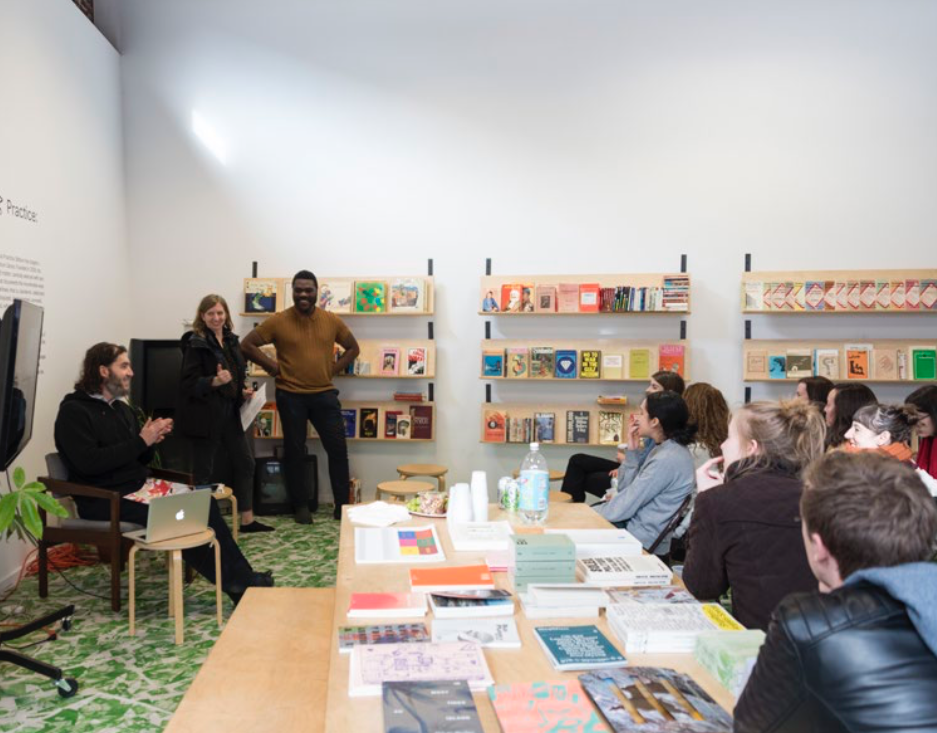
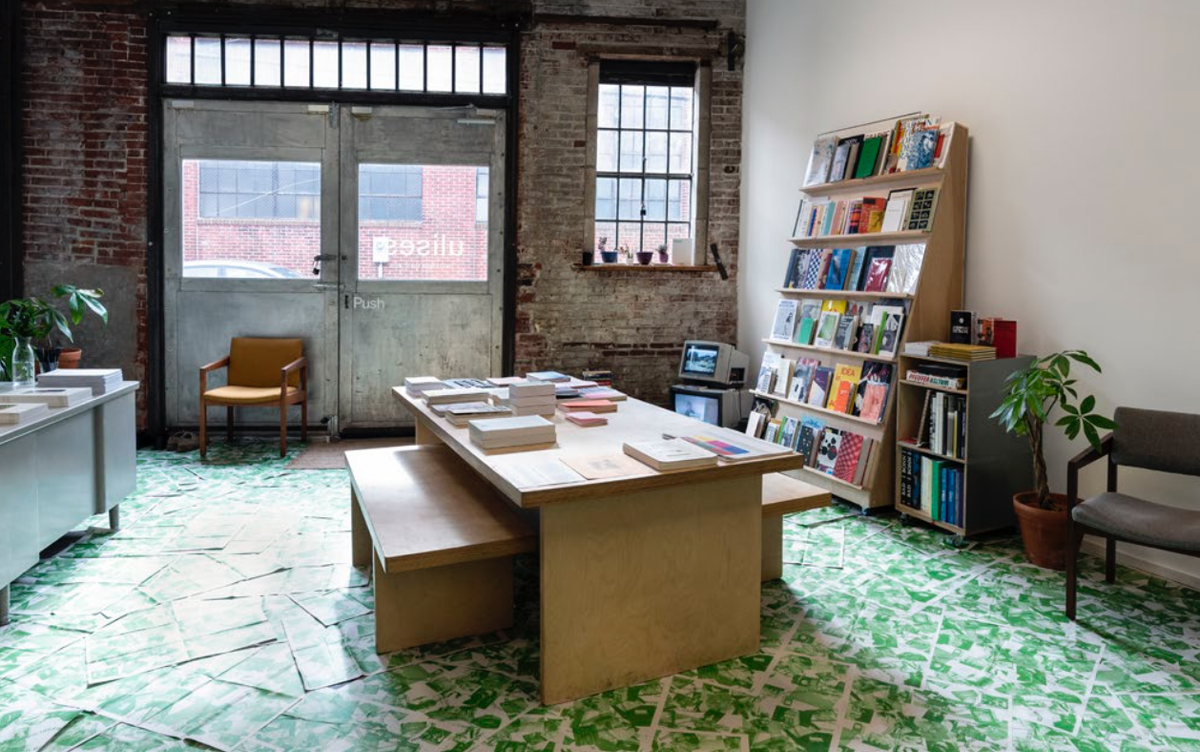
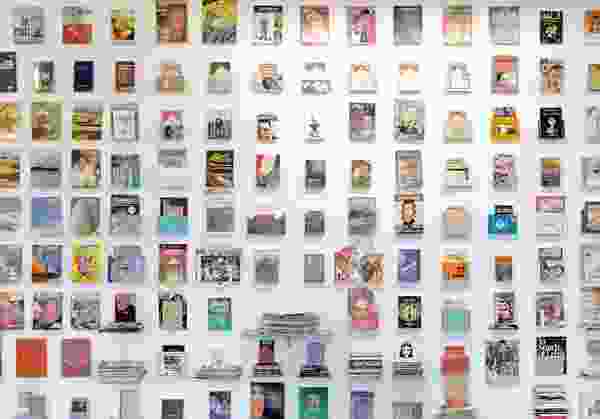
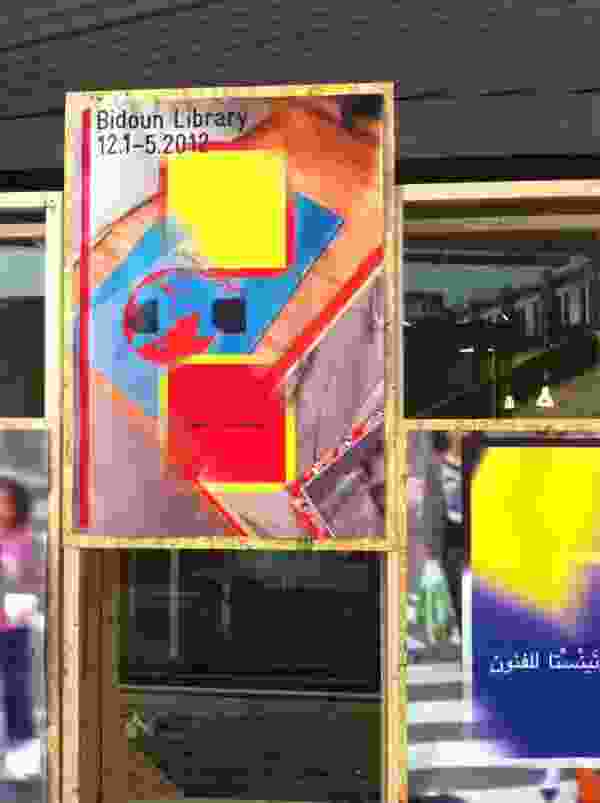
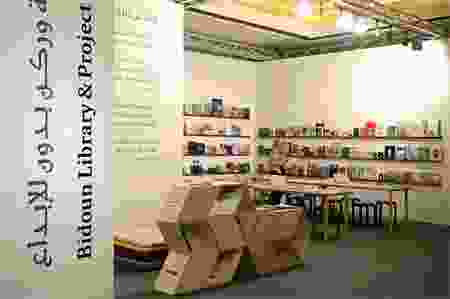
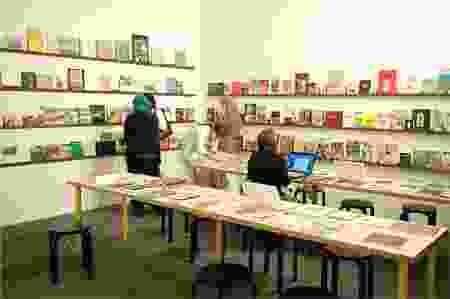
For the third and final installment of the Publishing as Practice series at Ulises, Bidoun staged a partial version of the infamous Bidoun Library. Founded in 2009, the Bidoun Library is a presentation of printed matter, carefully selected with zero regard for taste or excellence, that documents the innumerable ways that people have depicted and defined — that is, slandered, celebrated, obfuscated, hyperbolized, ventriloquized, photographed, surveyed, and/or exhumed — the vast, vexed, nefarious construct known as “the Middle East.”
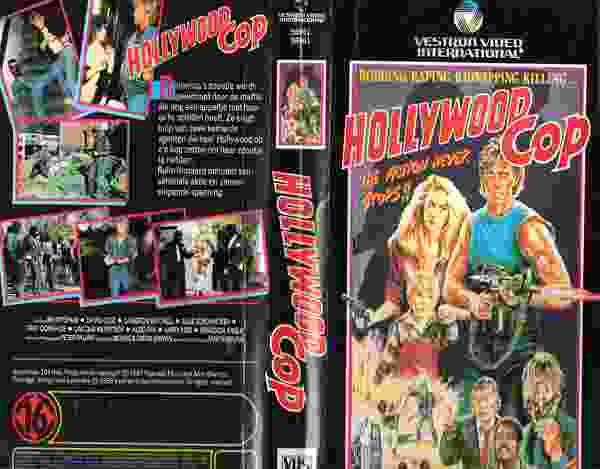
In addition to publications, the library had on view a selection of trailers from the little known genre of Iranian-American “B Movies.” Produced mainly in Los Angeles in the years after the revolution, these resolutely un-canonical (and often un-watchable) low budget films feature mainly American casts with a few Iranian actors. They are the direct descendants of filmfarsi, the vernacular B Movie genre that dominated popular Iranian cinema before 1979, and which employed many of the same directors. Much, if not all, was lost in translation. Some of these films were exported to Asia; others have become cult hits among pulp connoisseurs. Seen together, they shape a schizophrenic picture of what these diasporic directors once imagined the formula for a successful Hollywood action film to be.
Reza Abdoh: Radical VisionsScreening series at The Museum of Modern ArtJuly 14–23, 2018
A polymath and self-described member of “a TV generation,” pioneering Iranian-American theater artist Reza Abdoh voraciously incorporated varied references to music videos, variety shows, film, dance, classical texts, BDSM, and more into his work, with equal parts poetry and rigor. Moving images played an essential role in the artist’s large-scale, interdisciplinary productions beginning in the mid-1980s. In his final working years he also turned to the cinematic form; his second feature remained unfinished at the time of his 1995 death from AIDS-related complications. In conjunction with the retrospective Reza Abdoh, currently on view at MoMA PS1, this series offers insight into the artist’s profound creative energy—films he directed and videos created collaboratively for productions—along with a recent documentary.
Across disciplines, Abdoh confronted themes of transgression, violence, and abjection to speak to social and political upheaval and marginalization in America and around the world—with a demanding yet transcendent effect on cast members, audiences, and future scholars and followers of his work. While his media output was largely envisioned in the context of theatrical mise en scène, experiencing Abdoh onscreen is vital to the rediscovery of this essential creator, whose urgent anger, clarity of vision, and unique voice resonate two decades on.
Organized by Sophie Cavoulacos, Assistant Curator, Department of Film; with Negar Azimi, Tiffany Malakooti, and Babak Radboy, Bidoun; and Klaus Biesenbach, Director, MoMA PS1, and Chief Curator at Large, The Museum of Modern Art
———
Saturday, July 14, 6:00The Blind OwlIntroduced by Tony TornRepeats Thursday, July 19
Reza AbdohJune 3–September 3, 2018Opening June 3, 12-6pmReadings by members of Reza's company, dar a luz, at 5pm
MoMA PS122-25 Jackson AveLong Island City, NY
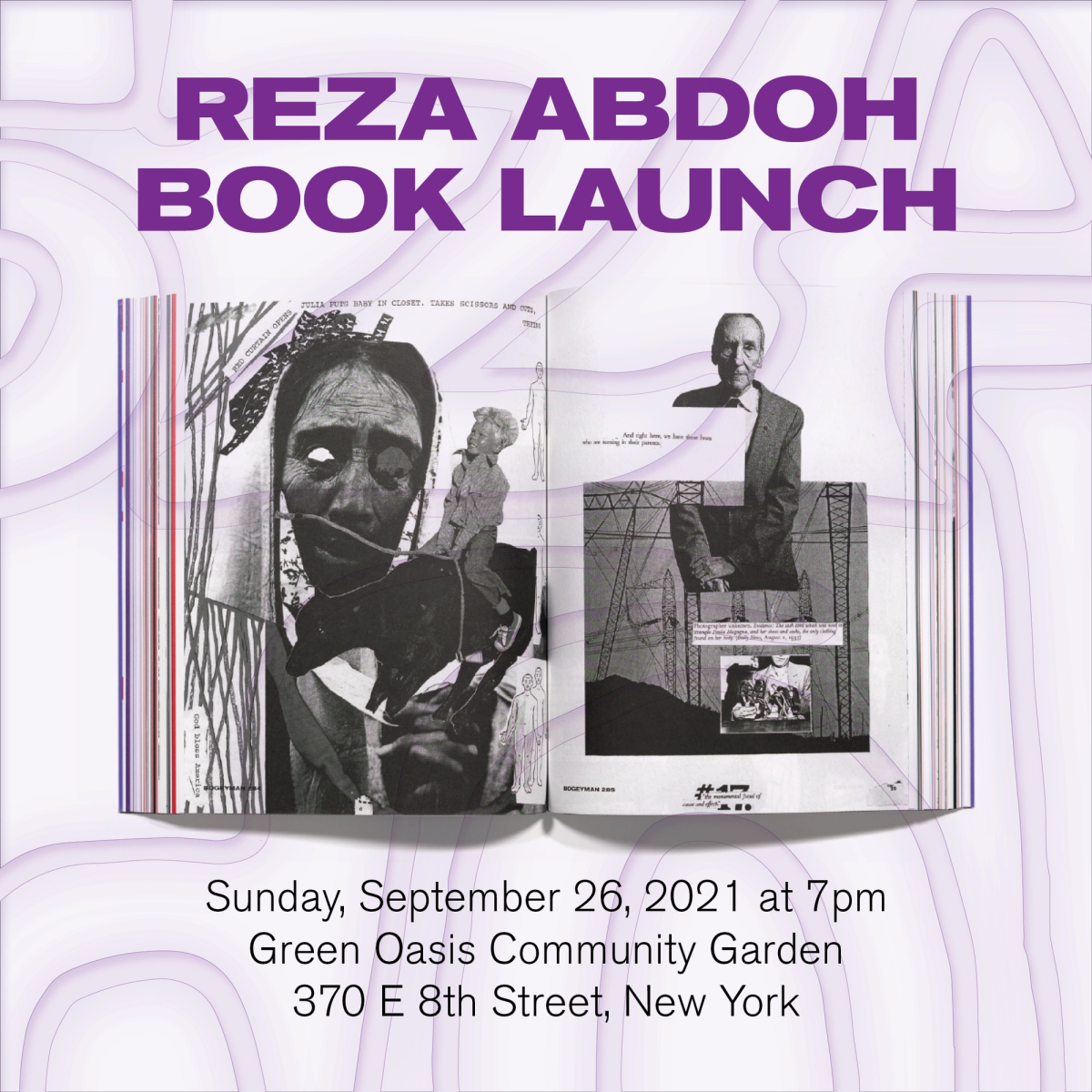
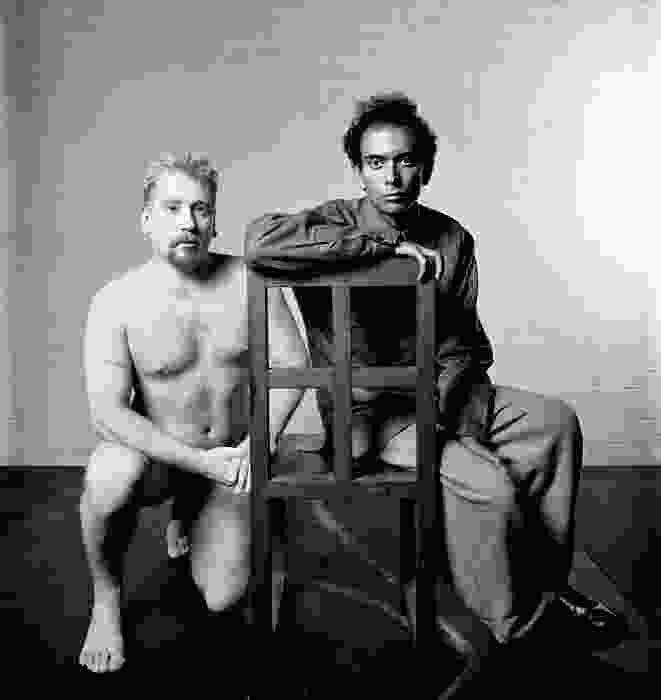
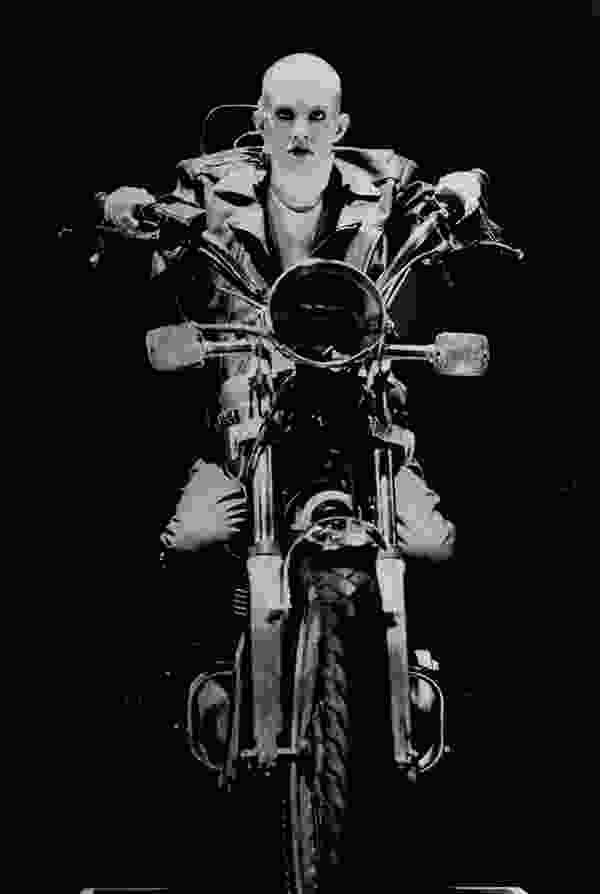
When the Iranian-American theater director Reza Abdoh died of AIDS-related complications in 1995 at the young age of 32, he left instructions that his work should never be performed again. In the ensuing decades, his hallucinatory theatre was hardly seen outside a few VHS tapes passed around experimental theatre circles. The exhibition Reza Abdoh: Bogeyman is the first large-scale exhibition devoted to Abdoh’s life and art.
At 5 p.m., to celebrate the opening of Reza Abdoh, four actors from the artist's original company will reunite in the exhibition galleries to enact selections from Abdoh's plays. Tom Fitzpatrick, Juliana Francis-Kelly, Jacqueline Gregg, and Tom Pearl will read from Bogeyman (1991), The Law of Remains (1992), Quotations from a Ruined City (1994), as well as from an unrealized treatment of the Faust legend, which Abdoh penned in 1986.
Co-organized by Klaus Biesenbach, Director, MoMA PS1 and Chief Curator at Large, The Museum of Modern Art; and Negar Azimi, Tiffany Malakooti, and Babak Radboy for Bidoun.
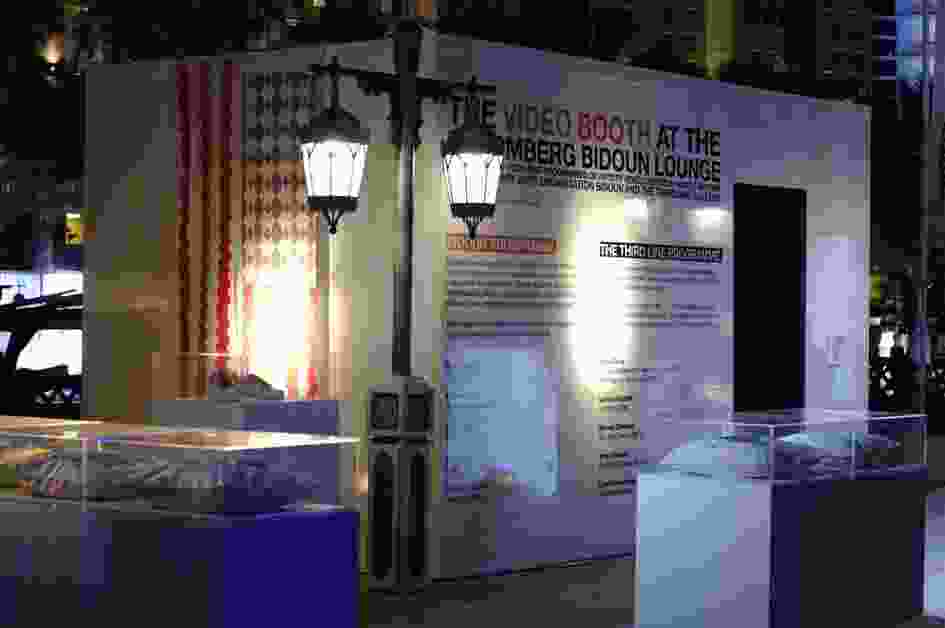
We are pleased to announce Fractures, Nicky Nodjoumi’s first solo exhibition at The Third Line gallery in Dubai, curated by Media Farzin for Bidoun.
Nicky Nodjoumi’s paintings explore the emotional dynamics of contemporary politics. The brushwork is quick, loose, and expressive, although the compositions are carefully worked out well in advance. His protagonists are often men in suits — the uniform of authority — painted against spare backgrounds.
His recent work focuses on breaks, ruptures, and the layering of objects and bodies. He uses found photographs to create collages that repeat the same image with small shifts in scale. A selection of his working sketches and collages, drawn from his personal archive, is also on view. In the final work, bodies are crisscrossed by sometimes violent slicing and fractures — vivid traces of a social reality that has caught up with them.
Though he was only thirty-two at the time of his passing, the Iranian-American theater director Reza Abdoh’s (1963-95) mark on the world of theater was unmistakable. Relentlessly inventive, he pushed his actors — and audiences — to their limits amid ambitious, unusual, disorienting stage sets. Abdoh’s aesthetic language borrowed from fairy tales, BDSM, talk shows, raves, video art, and the history of avant-garde theater. This exhibition, the first large-scale retrospective of Abdoh’s work, will highlight the diverse video works that Abdoh produced for his performances and an installation based on his 1991 production Bogeyman. The exhibition also includes contextual materials reflecting the club scenes in both Los Angeles and New York, the culture wars of the Reagan era, and the AIDS crisis. Abdoh died of AIDS in 1995.
Co-organized by Klaus Biesenbach, Director, MoMA PS1 and Chief Curator at Large, The Museum of Modern Art; and Negar Azimi, Tiffany Malakooti, and Babak Radboy for Bidoun. The exhibition is co-produced with the KW Institute for Contemporary Art in Berlin, where it will be presented from February 8 to April 29, 2019 and organized in collaboration with Krist Gruijthuijsen, Director.
Reza Abdoh (1963-1995) was a renown Iranian-American director and playwright known for his large-scale, experimental theatre productions. When he died of AIDS in 1995 at the age of 32, he was already one of the most compelling figures in American theater. Plays like Bogeyman, Quotations from a Ruined City, and Tight White Right were known for their hallucinatory dreamscapes, ferocious energy, and sheer sensory overload. Abdoh's aesthetic language borrowed from BDSM, raves, talk shows, and the history of avant-garde theater. Twenty years after his passing, his company members, collaborators, friends, and family have come together to create a filmic tribute to his theatrical genius.
Directed by Abdoh's long-time friend and collaborator, filmmaker Adam Soch, this feature-length documentary incorporates rare live performance footage and interviews, providing unprecedented insights into Abdoh's life and his idiosyncratic creative process. Join the filmmaker and original members of Abdoh's company, Dar A Luz, for a discussion preceding the screening.
The writer Jane Bowles passed away too early—in 1973 at the age of 56 after having spent two decades in the Moroccan port city of Tangier. At Tennessee Williams' urging, The New York Times gave her a proper obituary, quoting John Ashbery: "Few surface literary reputations are as glamorous as the underground one she has enjoyed." And yet despite her cultish following, she remains unknown to swathes of readers. The occasion of the Library of America's publication of her collected works offers up a chance to look at her astonishing, antic work anew.
Organized by Bidoun with Negar Azimi, Pati Hertling, Tiffany Malakooti, and Lynne Tillman.
Copies of Jane Bowles: Collected Writings (Library of America, 2017), edited by Millicent Dillon, will be available in the bookshop.
Monday, January 23, 2017, 7pmArtists Space Books & Talks55 Walker Street, New York$5 Entrance
This issue of Bidoun was assembled in Cairo between March and April of 2011. It remains, if nothing else, a true record of an uncertainty — so rare that even those who experienced it can hardly imagine it today.
We're making this Arabic-language version available more than five years later. We had originally hoped to launch it in Egypt, but the moment wasn’t right. We’re still waiting.
Founded in 2001 by a motley group of Tehran-based artists (including Bidoun contributing editor Sohrab Mohebbi), 127 quickly found itself at the vanguard of a progressive cultural moment in Iran. Their music melds Iranian melodies and jazz with an alternative sensibility, and features vocals in both Farsi and English. Part of the early 2000s Iranian rock revival, 127 were more irreverent, more playful, and more performative than their peers. Today, 127 members are dispersed between Tehran, New York, and Los Angeles and despite not having released or performed in years, they continue to yield a heavy influence in Iran and beyond. Join us at Le Poisson Rouge on May 6: Nadaareh nadaareh nadaareh!
127 in concert w/ The Casualty Process
Friday, May 6, 20166pm doors7pm The Casualty Process8pm 12718+$25 General Admission(le) poisson rouge158 bleecker street, New York
{"value":{"_key":"missing---Image:7150","_type":"missing-image","title":"Portrait of Zaha Hadid by Madelon Vriesendorp, 1978"},"isInline":false,"index":0}
Bidoun Contributing Editor Shumon Basar remembers his formative time with visionary architect Zaha Hadid, who sadly passed away on March 31st, 2016.
It’s beyond belief—I’m beyond grief. Zaha Hadid has died? Zaha can’t die. That’s not the blueprint we deserve.
The plan of her life was—surely—that she’d outlive her hero, Oscar Niemeyer, who drew till the age of 104. Or the shape-shifting Philip Johnson, one of her great supporters, who kept reincarnating himself until he was 98. Architects like them don’t retire, because there is no wall between their life and their work. There’s no after to a life of work. There’s just the world before you arrived and the world you want to see during your life. The rest is for eternity.
In an early interview with Alvin Boyarsky, Zaha said, “I almost believed there was such a thing as zero gravity. I can now believe that buildings can float.”
I always assumed she would defy the gravity of death, too. That those whorls of Issey Miyake or Yohji Yamamoto, wrapped around her with mathematical precision, accented by her obsidian, weapon-like jewellery, were more proof—as if it were needed—that she wasn’t really like the rest of us. Even though she was really interested in the rest of us (no one gossiped quite like Zaha).
Her approach—brusque and brutally honest—made a mockery out of the lame, xenophobic, misogynistic essentialism that dogged her in the press. Her name was forever prefixed by the adjectives “Arab,” “Muslim,” and “woman” in a way none of her contemporaries would be prefixed by “Occidental,” “Christian,” and “man.” I think it an insult to her, and to womankind, to refer to Zaha as “the most important female architect in the world.” In this her spiritual predecessor was the Brazilian architect Lina Bo Bardi—whose obdurate work out-toughs the toughest of male Brutalists, but never rhetorically engages gender in its making.
Right now, I’m thinking about our daily life some 20 years ago when I started work at her London studio. It was a converted school; we entered through the “Boy’s Entrance.” I was a fresh graduate. As such, I knew my way around post-structuralism but not much else. I was giddy to be at The Office of Zaha Hadid. I was convinced I’d been accepted into the heart of a living avant-garde. Here, I’d find the spirit of Malevich and Suprematism defiantly alive at the tail end of the 20th century, having survived the cultural wasteland of post-modernism and the pediments of revivalism.
My memories of those few years are vivid: the Broadway-level drama of Zaha’s arrival at the office each afternoon (which made Meryl Streep’s strop in The Devil Wears Prada seem positively quaint). How I never got Zaha’s cappuccino right (I’d never foamed milk before, OK? They don’t teach you that at Oxbridge). And the second-hand London black cab I used to drive Zaha around in (“Let's stop at Maroush on the way.”) She also bought me designer clothing (style charity?). Shopping with her was so much fun.
But mostly I remember her incredible private kindness towards me, often forged in London traffic, inside that black cab, her in the back, and me up front, while I wondered, with all the intensity of a 22 year old, how did I get here?
Zaha did not see your preternatural age. All she cared about was whether your ambition was related, in kinship, to hers. (It also helped if you’d forsake sleep to better further it. Sleep is Kryptonite to architects.)
This private generosity was famously complimented by a default desire to publicly humiliate or berate you. But once I understood this was merely a lesson to affection’s paradoxical expression, an exercise in eccentric closeness, the jibes no longer felt like tiny spears, but soft snowflakes. I’ve probably never been so simultaneously cursed and valued at the same time.
I realised, even then, that this was a close-up experience with someone Really Historically Important. I stand by that. It should be a no-brainer. More importantly, for me, I was part of a totally unique world, full of singular individuals orbiting this relentlessly driven centre of gravity who was also so fucking hilarious. (Who else picks Drake’s Hotline Bling as one of their Desert Island Discs?)
Zaha went from cult famous to famous famous. Pop stars in silly hats believed a selfie with her made them even cooler. Because I had long left, there’s a lot less I can say about this expanding period of the office, as it grew into the architectural equivalent of a Chris Nolan film: indie blockbuster/boutique corporate. The future, as rendered in science fiction cinema, was also forever changed by Zaha’s futurism. Critical assessments aside, in the 21st century, the world caught up with Zaha’s visions. I’m so glad she lived to feel that glow.
There’s a painting attributed to Zaha from 1983 (though in fact, most were collaborative efforts). It’s an aerial view of a warped earth—floating shards of colour, tectonic plates colliding—colonised by several of her unbuilt projects, flying apart or tied together by an unnameable force. This painting is called The World (89 Degrees).
That's who she was. Who she always will be. The 89th degree.
THE COLLOQUIUM FOR UNPOPULAR CULTURE at NYU
and BIDOUN present:
LET'S BUILD A CINEMA!
With Tamer El Said & Khalid Abdalla (Cairo), Verena von Stackelberg & Marcin Malaszczak (Berlin), and Jake Perlin (NYC) in conversation with Negar Azimi
Friday 1 April 2016, 6:30pm 721 Broadway [at Waverly Place], Room 674 FREE AND OPEN TO THE PUBLIC. Refreshments will be served.
Who needs cinemas? They're often accused of being anachronistic, of being out of synch with contemporary society's increasingly privatised, on-demand and mobile viewing culture. Yet, around the world, there are a growing number of small, screening rooms that challenge digital fundamentalism, incubate experimental pedagogies, advance dialogues between creators and audiences, promote archival material that run counter to regional and national orthodoxies, think productively about their place in the cultural ecologies of gentrifying neigbourhoods, and labour towards creating an international network for challenged and challenging art in an era of downturn and permanent austerity.
LET'S BUILD A CINEMA! looks at the work of three new film spaces. Cimatheque, an alternative film centre in downtown Cairo that celebrates the diversity and power of film from the region and beyond, and that is dedicated not just to learning about cinema but to creating it. w o l f, located in a former brothel in Neukoln, Berlin and due to open in spring/ summer 2016, is a film space that includes resources for exhibitions, video installations and post-production facilities. Metrograph, recently opened on Manhattan's Lower East Side, will project archive-quality 35mm and state-of-the-art digital video.
KHALID ABDALLA is an actor who has appeared in United 93, The Kite Runner and Jehane Noujaim's Oscar-nominated The Square. A producer, filmmaker and alternative-media activist, he is a founding member of three collaborative ventures in Cairo: Cimatheque, Zero Production and Mosireen. He is also the lead actor in In The Last Days Of The City (2016).
TAMER EL SAID is a filmmaker living in Cairo. He co-founded Cimatheque and founded Zero Production in 2007 to establish an infrastructure for producing independent films in Egypt. His debut feature, In The Last Days Of The City, screened at MoMA's New Directors/New Films series this month.
MARCIN MALASZCZAK co-founded production company Mengamuk Films, directed the award-winning Sieniawka (2013) and The Days Run Away Like Wild Horses Over The Hills (2015). He recently co-produced Tamer El Said's In The Last Days Of The City which won the Caligari Prize following its premiere at the 66th Berlinale.
JAKE PERLIN is the co-founder and Artistic Director of the Metrograph in Manhattan and has previously programmed at BAMCinematek, Film Society of Lincoln Center, Alliance Francaise, Cinema Tropical, and the Human Rights Film festival in Zagreb. He is the Executive Director of Cinema Conservancy, a film production, preservation and consultation non-profit whose projects include the new film Peter And The Farm by Tony Stone.
VERENA VON STACKELBERG is founder and managing director of w o l f. She has been working in cinema exhibition, distribution and for international film festivals since 2003 for the likes of Curzon Cinemas an Artificial Eye in London, and Filmgalerie 451 and Berlinale/ Berlin International Film Festival.
A little magazine is like the start of a river. Sometimes you see a river alongside a mountain and it looks like nothing — it’s only trickling. Think of Holderlin’s poem about the Rhine. What I like most about that poem is the beginning — he starts in a little crevice, like a little hole, at the beginning of the Rhine. And that’s what little magazines are. That they rarely last is almost part of their nature. They are not meant to last. They are meant to follow one person’s impulse, to gather bits and pieces, works by poets, writers, and artists, which may become literature much later. In this way, small magazines are full of hope. We don’t know how long they will live, and they often disappear; but better to disappear than to become a bad magazine.
I started out with magazines of this sort both in Beirut and in the US. I was first published in America in a little magazine from New York called The Smith. It later disappeared. When a little magazine comes in the mail, it’s like receiving news of a birth. There is something charming, unpretentious, adventurous about them. As they get bigger, they start to have editorial policies and complications and the more they look for famous names. Well, how can you become famous if you don’t start somewhere? A little magazine is like a little gallery in an obscure, forgotten corner. What a pleasure to know a little place where you might discover one or two or three new things. Twenty years later, you discover that this or that person has become known — and usually less good, by the way.
In Beirut, I remember Antoine Boulad, who had started a little magazine called Mauvais Sang. I gave him some of my poems.
In Beirut, too, there was Shi’ir. Youssef Al Khal, Shi’ir’s editor, changed Arabic literature forever. Shi’ir was the most important literary event of the 1950s and 60s. Thanks to Shi’ir I was encouraged to return to Lebanon. I remember walking in Beirut and encountering what was one of the first galleries in the city. It was called Gallery One and it was run by Youssef and his wife Helen. We talked about poetry, because he was really a poet. He said to me, You write poetry, why don’t you send me some poems? I saw him a second time and he said, What are you doing in America? There’s a movement here! He had such enthusiasm, so I eventually sent him some poems from California, where I was living at the time, and before long I began to see him regularly. He was like a best friend to me.
Eventually, they closed the gallery and rented a basement across the street from his home in the Zarif neighborhood. Simone and I used to go there and very often there were young Lebanese emigres passing by during the summer. We would drink whiskey and wine and at midnight Youssef would say, Let’s see the paintings! He would open up the gallery and everyone would leave with a tableau under their arm.
In Morocco, there was a little magazine called Souffles run by Abdellatif Laabi. In July of 1966, I went to North Africa for the first time. I was in Rabat and the night before I had found a magazine in the street under the arcades. It was the fashion in Arab cities to have books spread on the sidewalk and people sitting on the floor looking at them. I looked through this magazine and was reminded of a man who had been a teacher in Beirut — my teacher — a French writer called Gabriel Bounoure. He had left Beirut in 1953 for Cairo, and a few years later, for Rabat. I didn’t see his name anywhere, but I read a few lines and thought, These must be his students. He had been like a guru for poetry, not at all a classic academic person. He had a way to give to poetry its full importance. Like Heidegger did. When I found that issue of Souffles I recognized in the poems the rarefied air, the intensity, the rigor, and the heated quality of the poems that Bounoure would have taught in his classes. Of course, I knew he had been banished from Lebanon by the French government, as he had openly criticized French policies in Algeria during the war.
Inside the magazine there was an address. It was published out of a house. So I looked it up and knocked on Laabi’s door at 8pm and a French woman came out. It was his wife’s mother, who told me that Abdellatif was at the hospital because his first child was about to be born, but she was expecting him home soon. I waited, and at 9pm or later he arrived. I said I am sorry, I am leaving tomorrow and I saw Souffles and I was sure you were one of Gabriel Bounoure’s students. He said Yes, of course I am.
During those years, we still believed in Arab unity, and people like Laabi wanted a United States of Arabia. I said to him that we won’t wait for the government: we will make our own Arab unity. I told him I was going to Beirut soon and I would talk about Souffles there. Later, he invited the Syrian poet Adonis to contribute to his magazine. I suppose I was the first one to make the connection between those two literary universes. Later, I sent him my poem on Palestine, “Jebu” — not the whole poem, but large excerpts. We remained great friends.
Souffles had a fantastic influence. A first generation of French Moroccans had a place to publish. It was a political magazine, too, and they took many risks. One of my favorite North African poets, Mostafa Nissaboury, published in Souffles, as did Tahar Ben Jalloun.
Years later, when Abdellatif was in prison, I wrote to him a lot. I stayed in touch with his wife and I remember her telling me that she had taken him the complete works of Engels to read. I thought, These books were so hard to read, so I sent him some art books to bring color to his jail cell. He would always say that our friendship had the same age as his first daughter.
-September 22, 2015, Paris
[@portabletext/react] Unknown block type "block", specify a component for it in the `components.types` prop
Bidoun Projects Presents: Hal Foster's Breath Mints, Lawrence Weiner's Gold Tooth, Cindy Sherman's Eyeliner, Tala Madani's Body Lotion, Yto Barrada's Third Grade Report Card, Wade Guyton's Nikes, Jeremy Deller's iPod, Tony Shafrazi's Pain Killers, Anicka Yi's Brain, Julie Mehretu's Golf Ball, Hans Ulrich Obrist's Passport, Bjarne Melgaard's Christmas Card From a Serial Killer, Laura Owens' Bus Pass, Shirin Neshat's Kohl, Darren Bader's Junk Mail, an ongoing Poster Series by Taryn Simon, and much more.
Frieze New YorkBooth A16May 13-17, 2015
Signed limited edition posters of Taryn Simon's portraits of Wade Guyton and Lawrence Weiner will be available Saturday and Sunday at the fair.
For a full inventory of auction material and to bid, see www.paddle8.com/auction/bidoun. Auction runs through Wednesday May 26 and all proceeds will support Bidoun's not-for-profit activities.
Please join us for an eclectic reading session celebrating the launch of BIDOUN SINGLES, a new series of limited edition books featuring original commissioned artworks paired with new & old essays drawn from the Bidounisphere. For this first iteration, Los Angeles-based artist Tala Madani has prepared unique covers for classic Bidoun essays by Gary Dauphin (on American Jihadi John Walker Lindh), Anand Balakrishnan (on the Zionist vegetable and other allegories) and Sophia Al-Maria (on losing her virginity, again).
Stay tuned for future iterations of Bidoun Singles!
Thanks to all of you who celebrated the last decade with us this past October at glorious Shishawy in London.
Special thanks to our generous host committee: Mohammed Afkhami, Sara Alireza & Faisal Tamer, Aarthi Belani, Brian Boylan, Claudia Cellini and Sunny Rahbar, Iman Dakhil, Zeina Durra and Saadi Soudavar, Maryam Eisler, David Elghanyan, Lisa Farjam, Dana Farouki, Coco Ferguson, Raghida Ghandour, Tala Gharagozlou, Fati Maleki, Shirin Neshat, Maya Rasamny, Rana Sadik, Dania & Kareem Sakka, Alia Al Senussi, Andree Sfeir, Maria Sukkar, Nayrouz Tatanaki, Burkhard Varnholt, Sheena Wagstaff
And our readers: Knight Landesman, Maryam Eisler, Sunny Rahbar, Andree Sfeir, Dana Farouki, Stuart Comer, and Hans Ulrich Obrist.
Tuesday, September 9, 2014 at 7pmNYU Abu Dhabi Institute19 Washington Square North, New York
On the occasion of New Directions ’ publication of the writer Sonallah Ibrahim’s Stealth (Al Talassus), Bidoun and the legendary publishing house bring together a distinguished group of writers and scholars to reflect upon the predicament of the Egyptian intellectual in the year since President Mohamed Morsi’s dramatic fall. From Ibrahim himself to the bestselling author Alaa Al Aswany, countless writers and artists--many of them of historically contrarian bent--have expressed their support for a military-backed government whose abuses and excesses have on occasion surpassed those of the Mubarak era. How to begin to understand the role of the public intellectual in such times? Khaled Fahmy (American University in Cairo), Mona El Ghobashy (independent scholar), and Robyn Creswell (Yale University and poetry editor at The Paris Review) reflect on a year in which moral compasses have been cast hopelessly askew.
Wednesday August 27, 2014 at 8pmOoga Booga 2356 S. Mission Road, Los Angeles
The cultural wars between Iran and its left coast diaspora have long been played out in the realms of cinema, television, and music—from pre-revolutionary films such as Mamal Amrikai to the lyrics of pop songs such as Sandy's Talagh. State television vs. satellite; aging divas vs. youthful rappers; parkour vs. the Shahs of Sunset: the Tehranis have historically portrayed the diasporic Iranian as effeminate, gaudy and morally loose, while the Tehrangelenos see the the Iranians as illiterate, perverted, obscurist bumpkins—that is, if they even acknowledge them at all! Maxx (Saman Moghadam, 2005) is an artifact from the Khatami-era of cross-cultural dialogue, where old stereotypes get some new clothes. The film was a domestic success in Iran, and one of the earlier instances of a non art-house film finding an audience within the diaspora. Can Tehran and Tehrangeles learn to love each other?
Post-screening discussion will be led Bidoun editors and accompanied by Armenian arak and ice cream generously provided by MILK.
Maxx, Saman Moghadam, 2005, 110min, in Persian with English subtitles
Visit the Bidoun shop to purchase our special 10 year anniversary tote bags featuring ten little Molla Nasreddins riding the بدون ouroboros donkey, backwards, into the eternal return.
Bidoun at Frieze New YorkMay 9–12, 2014Randall's Island, New York
Stop by our booth this week at Frieze New York to peruse our eclectic printed matter selection, chat with Bidounis, and pick up our brand new 10th anniversary Donkey-Ouroboros-Nasreddin tote bag! :P
Bidoun at the Los Angeles Art Book FairJanuary 31– February 2, 2014The Geffen Contemporary at MOCA
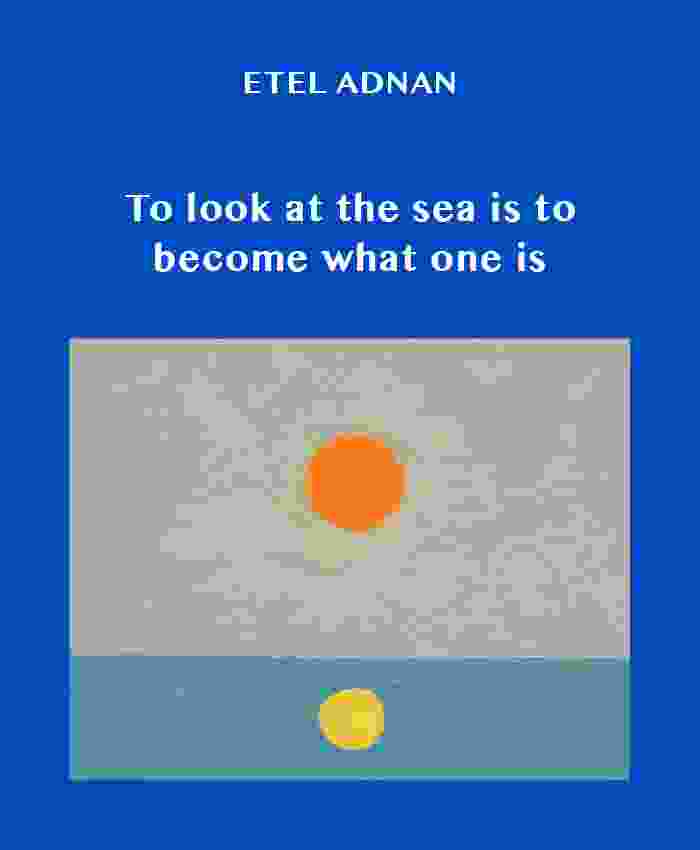
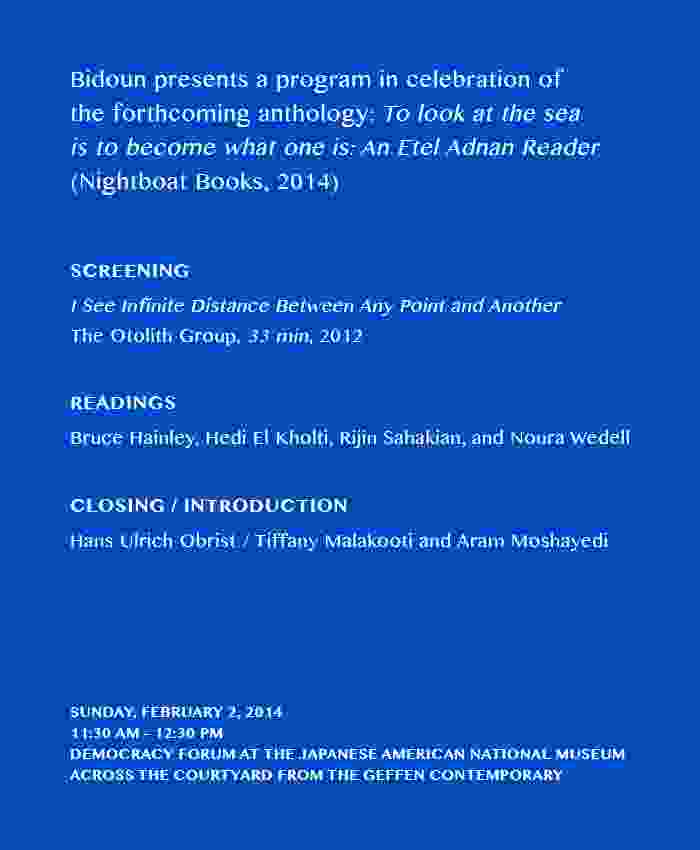
Bidoun presents Etel Adnan: To look at the sea is to become what one isSunday, February 2, 2014, 11:30 am – 12:30 pmDemocracy Forum at the Japanese American National MuseumAcross the courtyard from the Geffen Contemporary
Stop by our booth this week at the Los Angeles Art Book Fair and join us Sunday morning for a special screening and reading event to celebrate the forthcoming anthology To look at the sea is to become what one is: An Etel Adnan Reader (Nightboat Books, 2014) starring Bruce Hainley, Hedi El Kholti, Hans Ulrich Obrist, Rijin Sahakian, and Noura Wedell.
The Otolith Group‘s film I See Infinite Distance Between Any Point and Another (2012), shot largely in Adnan’s Paris apartment, centers on a reading of the first chapter of the renowned Lebanese-American artist's poem, Sea and Fog. The sound of Adnan’s gentle voice, and the quiet but ever present ambient noise in her apartment, create a powerful, meditative atmosphere. If poetry can be understood as a study in constraint, the film, I See Infinite Distance Between Any Point and Another, can be understood as an experiment in concentration and a study of gestures, that speaks of the mobility of language and the movement of the ocean.
Frieze Art FairOctober 17-20, 2013Regent's Park, London
Bidoun is back in London for the Frieze Art Fair. Come by the booth, buy rare back issues, say hello to any one of our editors in town, and learn about our exciting plans for the future!
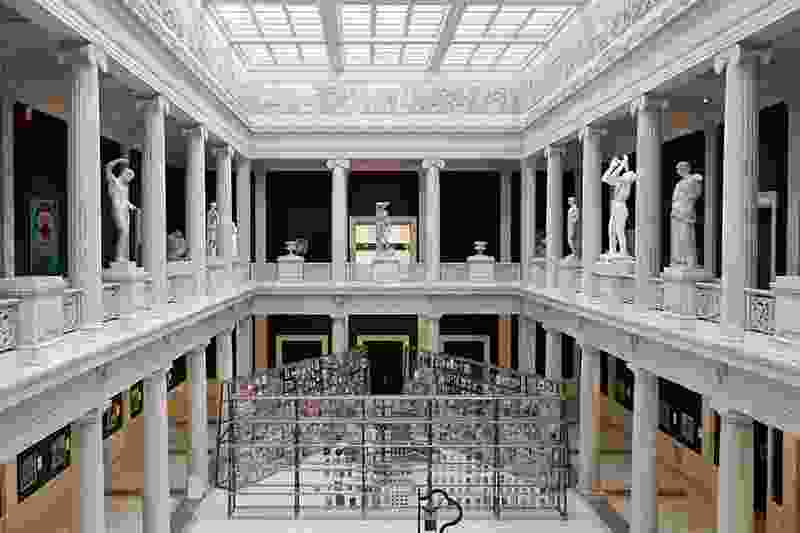
The Bidoun Library at the 2013 Carnegie InternationalOctober 5, 2013–March 16, 2014Carnegie Museum of Art, Pittsburgh
The Bidoun Library is a presentation of printed matter, carefully selected with no regard for taste or quality, that attempts to document the innumerable ways that people have depicted and defined—slandered, celebrated, obfuscated, hyperbolized, ventriloquized, photographed, surveyed, and/or exhumed—that vast, vexed, nefarious construct known as “the Middle East.” The result is banal and offensive, a parade of stereotypes, caricatures, and misunderstandings, all the trappings of the Middle East as fetish: veils, oil, fashion victims; sexy sheikhs, sex with sheikhs, Sufis, stonings; calligraphy, the caliphate, terrorism; Palestinians. We wanted to see what would happen if we put together a library without regard to aptness or excellence; to choose books not for their subjects, but their contexts; not for their authors, but their publishers; not for their qualities, but in their quantities.
THE NATURAL ORDER
"Water was the first type of drilling fluid to be used, but when it became evident that superior drilling fluids could be made when certain clays were added, the art of mud control began."
Kuwait Oil Company, Crude to Carrier, The Epic of Oil. Kuwait City: Information Department, 1967.
MARGIN OF ERROR
"The life of an immigrant family of three. Having been a violinist, the man is used to play violin when he is alone. The woman is working in an office and the eight-year-old child attends school. The man has problems with his wife. Being in a bad situation the couple can not help each other. But the child is aware of the problems."
Mohammad Aghili, Hossein Mahini, A Prospect of Iran’s Film in Exile. Gothenburg: FRI Fil, 1993.
HOME THEATER
“Choose Your Own Adventure is the best thing that has come along since books themselves.”– Alysha Beyer, age 11
“I didn’t read much before, but now I read my Choose Your Own Adventure books almost every night.”– Chris Brogan, age 13
“I love the control over what happens next.”– Kosta Efstathiou, age 17
Shannon Gilligan, Choose Your Own Adventure: The Terrorist Trap. New York: Bantam-Skylark, 1991.
A big thank you to all who joined us this past Sunday evening for the Bidoun Benefit Dinner. It was really really fun!
A special thanks to our readers: Chelsea Clinton, Stuart Comer, Lawrence Weiner, Lynne Tillman, Knight Landesman, and Orhan Pamuk & Shirin Neshat; and our host committee: Maria Baibakova, Yto Barrada, Aarthi Belani, Lisa Farjam, Dana Farouki, Coco Ferguson, Princess Firyal of Jordan, Leila Heller, Shirin Neshat, and Sheena Wagstaff.
New York Art Book FairSeptember 19–22, 2013MoMA PS1, 22-25 Jackson Ave, Queens
Bidoun is taking part in the eighth annual New York Art Book Fair at PS1 this weekend. Come visit, chat, and peruse your favorite Bidoun titles.
The fair begins this Thursday from 6-9 pm and runs through the weekend.
Also! On the final evening of the fair, Sunday the 22nd from 6-9 pm, join us for vodka, music, MFK Fisher's favorite minestrone soup, and diverse readings on and about FOOD by Bidoun's Michael C. Vazquez , who joins an illustrious cast including Gini Alhadeff , Clarissa Dalrymple , K8 Hardy , Gaby Hoffmann , Matthew Higgs , Emily Stokes , Lynne Tillman , Nicola Tyson , Wendy Yao , and more. Music by Bidoun's Tiffany Malakoobideh. Look for signs of the pop-up cafe at the new MoMA PS1 storefront. Organized by Negar Azimi and Pati Hertling.
Paper Weight — Genre-defining Magazines 2000 to NowJuly 7 – October 27, 2013Haus Der Kunst, Munich
Bidoun is pleased to be part of the exhibition 'Paper Weight — Genre-defining Magazines 2000 to Now' at Haus Der Kunst, Munich. Curated by PIN-UP editor Felix Burrichter and designed by Athens-based artist and architect [Andreas Angelidakis](http://www.angelidakis com), the exhibition features BUTT, Candy, 032c, and Sang Bleu among other publications.
Labyrinth of Passion, Pedro Almódovar, 1982Saturday July 27, 2013 at 2pmEl Charro Espanol4 Charles Street, New York
Bidoun and Dirty Looks present an afternoon screening of Pedro Almodovar's second feature film at the legendary Village restaurant El Charro Espanol. Labyrinth of Passion follows scantily disguised but heavily camped-up members of the Iranian royal family in their famous period of limbo following the revolution of 1979 as they are thrust into extravagant plot lines that weave hilariously between historical accuracy and ribald fantasy. “Toraya,” the disgruntled ex-empress is desperate to fertilize herself with royal seed via the young Crown Prince “Riza.” Riza, meanwhile, is busy attempting to cure himself of his homosexuality after falling in love with a nymphomaniac pop star named Sexilia, but his former lover Sadec (played by a young and nubile Antonio Banderas) is secretly a pro-Khomeini guerilla belonging to a group attempting to kidnap him. Plus: full body plastic surgery, doctors, laxatives, and other culturally appropriate themes.
The film's elliptical Iranian historical connection has been tragically overlooked ― at worst misunderstood to be about a fictional Arab monarchy, and at best, mentioned in passing. Bidoun and Dirty Looks are pleased to host this absolutely essential revisiting of this deliciously queer retelling of an important moment in Iranian history.
May 1, 20136:30-8:30pmNYUAD Downtown Campus, Abu DhabiFree and open to the public
Kenneth Goldsmith, founder of UbuWeb, and Bidoun's Tiffany Malakooti will be presenting an evening of experimental work from the Bidoun-o-sphere, including a variety of historical and contemporary films, music, and radio plays.
Bidoun #28 INTERVIEWS features conversations among Giorgio Agamben, Sophia Al-Maria, Hossein Amanat, Negar Azimi, Omar Berrada, Leland de la Durantaye, Jeremy Deller, Mona Eltahawy, Lisa Farjam, Yasmine El Rashidi, Larry Gagosian, Conner Habib, Yasmine Hamdan, Zahi Hawass, Michelle Kuo, Ursula Lindsey, Navid Negahban, Sukhdev Sandhu, Anna Della Subin, Benjamin Tiven, Michael C. Vazquez and Marina Warner.
A screening of Jack Kevorkian's public access television program The Door (30 min); presented by Anna Della Subin
A screening of Shridhar Bapat's video feedback fantasia Aleph Null (12 min, 1971); presented by Alexander Keefe
Sex talk and group consciousness exercises;presented by Conner Habib
Plus: Transcendental listening in the dome
Jack Kevorkian Dr. Jack Kevorkian — also known as Dr. Death — was a pathologist, euthanasia activist, poet, composer and instrumentalist. In Bidoun #27 (Diaspora), Anna Della Subin told the profoundly strange story of this child of genocide survivors through his curiously compelling paintings. Here, Subin will introduce_ The Door_, a public access TV show on the nature of consciousness and some “very hazy realms of human existence,” which Kevorkian produced, wrote, and hosted in California in the early 1980s.
Shridhar Bapat In the late 1960s Shridhar Bapat was a key figure in the emerging video scene. The first video curator at The Kitchen in its most freewheeling period and the “finest feedback camera turner in New York City,” Bapat worked on the New York Avant Garde Festivals, the first Women’s Video Festival, Shirley Clarke’s TeePee Video Space Troupe, and many of Nam June Paik’s major installations before falling out of the scene to live underground; he died, homeless, in 1990. Alexander Keefe reconstructed Bapat’s story in Bidoun #27 (Diaspora). Keefe will be presenting a rare screening of Aleph Null, one of Bapat’s original video compositions — “all these mandalas going all over the place,” in Bapat’s words — created with Charles Phillips in 1971. First shown at the Whitney Museum’s 1971 “Video Tape Special,” Aleph Null was last screened at the Mudd Club in 1981.
Conner Habib Conner Habib is a writer, philosopher, sex advice columnist, and gay porn star, based in San Francisco. An adherent of Rudolph Steiner’s Anthroposophy, Habib lectures on the Western esoteric tradition. He has been featured in such films as Man Up, Night Maneuvers, and Arabesque 2: From Tales of the Arabian Nights; his essay, “The Virtues of Being an Object,” appeared in Exploring the Edge Realms of Consciousness, edited by Daniel Pinchbeck & Ken Jordan. Anna Della Subin's conversation with Habib is forthcoming in Bidoun #28 (Interviews).
We are really pleased to announce Bidoun is the proud recipient of a generous grant from the Kindle Project Fund of the Common Council Foundation. The Kindle Project supports "creative thinkers, artists, activists, doers, and paradigm pushers." It is kind donations like this as well as gifts from individuals and the support from our subscribers that enables us to continue our work.
December 15, 2012 — February 15, 2013Point Centre for Contemporary ArtMegaron Hadjisavva,2, Evagorou Street,1057, Nicosia, Cyprus
For this Cypriot iteration of the Bidoun Library, we are presenting a thematic version of the Library built around espionage, the legacies of state-sponsored publishing, and the cultural Cold War. A site-specific subsection will be built around the assassination of the Egyptian writer Yussef el Sebai — himself the General Secretary of the Afro-Asian Peoples’ Solidarity Movement among many other roles — at the Hilton Hotel in Nicosia on February 18, 1978.
Friday Late: Record, Reframe, ResistFriday November 30, 2012 from 6:30 – 10pmVictoria and Albert MuseumCromwell Road, London SW7 2RL
This Friday evening at the V&A in London, as part of its ongoing investigation of lost and/or neglected cultural artifacts, Bidoun will be presenting a selection of trailers from the little known genre of Iranian-American “B Movies.” Produced mainly in Los Angeles in the years after the revolution, these resolutely un-canonical (and often un-watchable) low budget films feature mainly American casts with a few Iranian actors. They are the direct descendents of filmfarsi, the vernacular B Movie genre that dominated popular Iranian cinema before 1979, and which employed many of the same directors. Of course, with their new locale, language, and themes, much was lost in translation. These films — unlike their Iranian predecessors — have very limited potential for popular appeal.
And yet some of these films were exported to the Third World; others have become cult hits among pulp connoisseurs. Seen together, they shape a bizarre picture of what these diasporic directors once imagined the formula for a successful Hollywood action film to be — including confusing representations of self (ambiguous Middle Eastern villains, terrorists, and belly dancers in varying states of veiling) and hilariously outmoded and offensive representations of others (Arabs, Japanese, African Americans, women).
Directed by Tony (Mohammad) Zarindast, this film stars the undisputed leading man of Iranian film, Behrouz Vossoughi, in his first non-Iranian production. Vossoughi, whose accent must have been too thick for American audiences, is the only actor in the film to have his voice dubbed. The film co-stars Playboy cover girl Sybil Danning (August 1983) and Samson the Cat.
Another Zarindast film, this time starring himself as “Eagle,” a freedom fighter from an ahistorical Dubai who must defeat a heroic US Army Green Beret, “Claude Servan,” in order to reach the hidden desert booty he intends to barter for weapons...
Wednesday, October 24th – Sunday, November 4th, 2012Miguel Abreu Gallery36 Orchard Street, New York, NY 10002
Bidoun is pleased to be participating in Book Week II: In Translation, with Collages by Raha Raissnia, presented by Miguel Abreu Gallery and Sequence Press. The gallery floor will be arranged as a bookshop and reading room with recent titles from mostly local publishers. In addition, selections will be on hand from the Lower East Side Heritage Collection, a unique archive of specialized, noncirculating books at the Seward Park branch of the New York Public Library. Participants include:
Archipelago
Bidoun
Dalkey Archive Press
Halmos
New York Review Books
Open Letter Books
Seven Stories Press
Verso
New York Public Library’s Lower East Side Heritage Collection
**Michael Rakowitz and Robert Christgau in conversation
Launch of the record Sabreen — Live in Jerusalem 2010
Wednesday, October 17, 2012, 7pmLombard Freid Gallery518 West 19th StreetNew York, NY 10011**
Lombard Freid Gallery is pleased to present an evening with artist Michael Rakowitz and legendary rock critic Robert Christgau, discussing the breakup of The Beatles as history and as metaphor, inspired by Rakowitz’s "The Breakup"—a set of works that includes radio broadcasts, film, a live concert in Jerusalem, memorabilia, and a deluxe limited edition LP produced in conjunction with Bidoun Projects.
The evening will be hosted by Sukhdev Sandhu, director of the Colloquium for Unpopular Culture at New York University and author of the lead essay in the liner notes for Live In Jerusalem 2010, which will be on sale at the event and from Bidoun.
Michael Rakowitz’s “The Breakup” was originally commissioned for The Jerusalem Show IV by Al Ma’mal Foundation for Contemporary Art, Jerusalem.
The 45min video of The Breakup will screen at 6pm.
Longtime Village Voice writer-editor Robert Christgau has covered popular music for many publications, including Esquire, Newsday, Creem, Playboy, Rolling Stone, and Blender. His " Rock & Roll &" column appears monthly in the Barnes and Noble Review and his " Expert Witness" blog twice weekly at msn.com. Michael Rakowitz is an artist based in Chicago and New York City. His work has appeared in venues worldwide including P.S. 1, the Museum of Modern Art, MassMOCA, Tate Modern, the 10th Istanbul Biennial, Sharjah Biennial 8, Asian Art Biennial, and, most recently, dOCUMENTA (13) . His work is in many private and public collections including MoMA, UNESCO in Paris, and the Smart Museum of Art at the University of Chicago.
Find our booth at the Frieze Art Fair and check out our latest issue, subscribe, or pick up our limited edition Tehran City Guide, with very Bidounish advice about where to go and (mostly) where to eat in Iran’s capital.
Tehran City GuideTwo color risograph16pp4.25x11inNumbered edition of 100
Bidoun is an award-winning independent magazine covering the arts & culture of the Middle East and its Diaspora. It is published quarterly, under the larger umbrella of Bidoun Projects.
We are looking for an experienced advertising salesperson to oversee global advertising and business development for Bidoun.
Responsibilities• Maintain and expand advertising base.• Research and identify opportunities for growth, and prospects for new business.• Maximize revenue, while developing creative and strategic solutions for advertisers.• Conduct rate negotiations with clients, and lock in long-term advertising programs.• Track advertising performance, and measure sales goals.
Required Experience & Skills• Bachelor’s Degree.• 1-3 years experience at a print publication or in a related role.• A demonstrated understanding of media sales.• The ability to work independently, and to think strategically about growing advertising for the magazine.
Additional Skills• A motivated self-driven individual with a positive, can-do attitude.• Excellent written and verbal communications skills, with a friendly ability to engage and build relationships with prospective advertisers.• The ability to work independently and on deadline.• Fluency in Farsi or Arabic a plus but not required.• Interest in Middle Eastern culture a plus.
Please submit your resume along with a brief letter expressing your interest to: jobs@bidoun.org.
{"value":{"_key":"missing---https://images.bidoun.org/ElEco-Books.jpg","_type":"missing-image","title":"El Eco and Bidoun Collaboration"},"isInline":false,"index":0}
Una colaboración entre El Eco, Bidoun y Tomo※ Algunos ejemplos de que puedes donar/prestar: libros sobre petróleo, revistas de viajes, novelas románticas, ensayos, ...※ Las donaciones se pueden entregar en el museo dentro de sus horarios o por favor de contactarnos para solicitar que se recoja el material.※ Todos los libros, material impreso y/o revistas proporcionados serían devueltos al concluir el evento — ¡al menos que se done!
A collaboration between El Eco, Bidoun, and Tomo※ Some examples: books on oil and gas, magazines about travel, pulp romances, ...※ Donations may be delivered to the museum during opening hours or contact us to arrange for pick up.※ All books, printed material and / or magazines provided will be returned at the conclusion of the event — unless being donated!
Book launch party& “Real Talk”with Super Models contributorsBabak Radboy (Bidoun)& Andy Pressman (Rumors, Bidoun)moderated by Harry GasselThursday 12 July at 7 PMBidoun47 Orchard StreetNew York, NY 10002www.gdnyc.org/supermodels
Friday, May 18 at 7pm155 Freeman Street, Brooklyn, NY$5 suggested donation
A celebration of the publication of Bidoun #26, Soft Power, hosted by Triple Canopy at 155 Freeman
Featuring a conversation between Iman Issa and Kaelen Wilson-Goldie, readings by Anand Balakrishnan and Michael C. Vazquez, and music by Tiffany Malakooti
Join us in celebrating the twenty-sixth issue of Bidoun, which considers art and patronage, state-sponsored media, cultural diplomacy, revolution and counterrevolution, nation and/or corporate branding, and potato chips as public relations.
Artist Iman Issa will discuss monuments and mysteries, among other things, with Bidoun contributing editor Kaelen Wilson-Goldie , who writes about Issa in " Radical Subtraction." Issa's work, which was part of the recent New Museum Triennial, "The Ungovernables," creates an eloquent language of forms to address unruly questions about place, power and memory.
Writer Anand Balakrishnan will read from his story “The Serendipity of Sand,” which ponders the ultimate civilizational soft-power gambit — the monumental ruin — and what that might have to do with the zebra’s beguiling stripes.
Bidoun senior editor Michael C. Vazquez will present outtakes from his essay " The Bequest of Quest," which contemplates the curious legacy of Cold War magazines funded by the American CIA, including the Indian literary magazine Quest and the African journal Transition.
A slide show of covers of nation-state self-help books, drawn from Shumon Basar and Parag Khanna's article “Soft Readers Prefer Hard Covers,” will be shown.
Throughout the evening, Bidoun's Tiffany Malakooti will play Iranian wedding trance and Lebanese happy softcore.
Bidoun Bookshelf LaunchSunday May 6th from 6-9pm47 Orchard Street between Grand and Hester
Join us for the launch of the Bidoun Bookshelf, a micro-bookshop in our storefront space on the Lower East Side in which we present and sell unique, rare, or otherwise compelling books from across the Bidouniverse.
The new Bidoun, on newsstands in April, considers art and patronage, state-sponsored media, cultural diplomacy, revolution and counterrevolution, nation and/or corporate branding, and even potato chips as public relations.The heart of Soft Power is a suite of conversations that revolve around the question of hidden agendas. As’ad AbuKhalil, the political scientist who blogs as The Angry Arab, discusses the political economy of Al Jazeera and Qatar’s foreign policy with Babak Radboy and E. P. Licursi. Bangalore-based Achal Prabhala and Michael C. Vazquez consider the curious legacy of Cold War magazines funded by the American CIA. And nearly a dozen leading figures in the Egyptian cultural scene, including representatives of human rights organizations, art spaces, and foundations, as well as bloggers, activists, and curators, were invited to reflect on the theme of foreign funding.But there is Bidoun’s customary dose of long-form narrative, as well. In “The Marble Lawn,” Yasmine El Rashidi provides an unusual vantage onto Saudi Arabia, the Wahhabi heavy in so many stories about the rise of Islamism in post-revolutionary Egypt. Anand Balakrishnan’s “The Serendipity of Sand” considers the ultimate civilizational soft-power gambit — the monumental ruin — and what that might have to do with the zebra’s beguiling stripes. Other features consider sexual politics in the art world ( Sarah Rifky’s “Call Me Soft,”) the deification of power (Anna Della Subin’s “Occupy Godhead”), and the rarified world of globo-pundits whose airport-ready books make tidy work of explaining... more or less everything (“Soft Readers Prefer Hard Covers,” by Shumon Basar with Parag Khanna).In our arts coverage, Kaelen Wilson-Goldie profiles New York-based artist Iman Issa, we take a look at Lawrence Abu Hamdan's _Freedom of Speech Itself _at The Showroom in London, and Beiruti Franziska Pierwoss's ongoing _Toyota to Benz _project.Plus: “The Chibsi Challenge,” a taste-travel roundtable discussion of potato crisps, chips, and nation brands, inspired by Sophia Al-Maria; reviews of the archaeology show at SALT Istanbul’s new space; Iranian videos in New York; Haris Epaminonda’s “Mystery at MoMA”; the Athens Biennial in a time of austerity; and Mahmoud Darwish’s bequest.To purchase this issue — or better, to subscribe — visit our online shop.
{"value":{"_key":"Negar Azimi speaking at the Global Art Forum, Dubai","_type":"missing-image","title":"Negar Azimi speaking at the Global Art Forum, Dubai"},"isInline":false,"index":0}
Negar Azimi speaking at the Global Art Forum, Dubai
Much of team Bidoun has spent the past week in the Gulf, with Negar Azimi and Tiffany Malakooti presenting at the March Meeting in Sharjah; Kaelen Wilson-Goldie, Michael Vazquez, Alexander Provan, Yasmine El Rashidi, Sophia Al-Maria, and Negar Azimi participating in the Global Art Forum in Doha and at Art Dubai, curated by Shumon Basar; all in addition to our regular booth at the fair and screenings of two great archival documentaries on Ardeshir Mohasses and Parviz Tanavoli and his founding of the sculpture department at the University of Tehran.
Come say hello if you’re in Dubai, or follow us — or someone with superior social-networking skills — on Facebook and Twitter.
{"value":{"_key":"Ebrahim Golestan, Yek Atash (A Fire), 1961","_type":"missing-image","title":"Ebrahim Golestan, Yek Atash (A Fire), 1961"},"isInline":false,"index":0}
Ebrahim Goelstan, still from Yek Atash (A Fire), 1961
Revolution vs Revolution,March 14, 26, 28Beirut Art CenterIn the context of Beirut Art Center’s exhibition “Revolution vs Revolution,” Bidoun’s Tiffany Malakooti presents two curated film programs around Iran's Islamic Revolution of 1979 and Negar Azimi gives a talk entitled “Iran in Pictures: Social Suffering and Three Sets of Images.”Wednesday, March 14, 2012 at 8pmEbrahim Golestan,_ Yek Atash (A Fire)_, 1961, 24'Kamran Shirdel, Tehran Is the Capital of Iran, 1966, 18'Parviz Kimiavi, Ya Zamene Ahu (O Guardian of the Deer), 1970, 20'
Monday March 26, 2012 at 8pmKianoush Ayari,_ Tazeh Nafas-ha (The Newborns)_, 1979, 45'Wednesday March 28, 2012 at 8pmIran in Pictures: Social Suffering and Three Sets of Images by Negar Azimihttp://beirutartcenter.org
{"value":{"_key":"Bidoun at the Independent, 2011","_type":"missing-image","title":"Bidoun at the Independent, 2011"},"isInline":false,"index":0}
Bidoun's space at the Independent last year
The IndependentMarch 8-11th548 West 22nd StreetNew YorkBidoun is one of three publications invited to present at the Independent Art Fair this weekend. Visit our rooftop space to browse Bidoun past and present, talk to our staff and interns, and drink Persian tea.http://www.independentnewyork.com
Kianoush AyariTazeh Nafas-ha (The Newborns)197945 minIn Farsi with English subtitles
Kianoush Ayari’s documentary captures rare scenes of everyday life on the streets of Tehran in the months following the revolution of 1979 — that somewhat utopian period between revolutionary violence and the formation of a full fledged Islamic Republic when a bright future seemed possible, if not probable.
In this Tehran, we witness books carrying conflicting ideologies sold openly on the streets, laborers debating as to the wages they have been promised, and young men donning Arab garb to have their portrait taken with a Yasser Arafat backdrop. We also witness extended scenes from three different political plays, along with street theatre in a park where a performer imitates various iconic pop singers, political figures, and even the Shah himself.
Still, images from slums in the south of the city remind us of lurking problems in the background, and while the film ends on an optimistic note — with footage of youth energetically campaigning for upcoming elections — 33 years later and in light of current events, that optimism seems misplaced, if not bittersweet.
This upload is part of the BubuWeb project — a partnership between Bidoun and UbuWeb which aims to make available rare audio and visual materials from the Middle East.
Bidoun's Facebook page has been liberated from its state of limbo and is once again active. We have a lot of lost time to make up for; expect many photos and updates in the coming weeks.
{"value":{"_key":"Reza Abdoh, still from Bogeyman, 1991","_type":"missing-image","title":"Reza Abdoh, still from Bogeyman, 1991"},"isInline":false,"index":0}
Reza Abdoh, still from Bogeyman, 1991
We are very pleased to present eight rare videos from experimental theater director Reza Abdoh (b. 1963 Tehran, d. 1995 New York City) on UbuWeb. The videos include four show tapes used in theatrical performances: _ The Hip-Hop Waltz of Eurydice_ (1990), _ Bogeyman_ (1991), _ The Law of Remains_ (1992), _ Tight Right White_ (1993) and four standalone experimental videos: _ My Face_ (1986), _ Sleeping with the Devil_ (1990), _ Daddy's Girl_ (1991), _ The Weeping Song_ (1991).Reza Abdoh was an Iranian-born director and playwright known for his large-scale, experimental theatrical productions that utilized multimedia elements and violent sexual imagery. Reza Abdoh died of AIDS on May 11, 1995 in New York City at the age of 32.Reza Abdoh on UbuWeb
With special thanks to Adam Soch, Brenden Doyle, and Salar Abdoh.This program is part of the BubuWeb project — a partnership between Bidoun and UbuWeb which aims to make available rare audio and visual materials from the Middle East.
The Bidoun Library opens on January 12th at Tensta Konsthall's new space in Sweden. The Library is a long-term project surveying the territory of the Middle East through its printed matter —objects in which complex and historical facts and ambitions meet.More information here
Bidoun seeks a few good interns in its New York City offices!Interns will be assigned to one or a combination of the following areas: magazine distribution, research related to Bidoun magazine or ongoing projects (such as the Bidoun Library), archiving, production, and beyond.We seek special interns in three fields in particular:DevelopmentPublicityVisual ArtsInterns who could work for a minimum of 3 months will be privileged.Send cover letter outlining interests and CV/resume to info@bidoun.org with subject header BIDOUN INTERN.
Thursday, December 8, 2011 at 7pmNew Museum, 235 Bowery, New York
Transition: An International Review is an award-winning journal of Africa and its many diasporas — where a strikingly large number of Bidounis got their start. On December 8th, Bidoun’s Michael Vazquez and an all-star cast mark the 50th anniversary of Transition’s founding with performances, readings, and an editor’s roundtable, hosted by Kelefa Sanneh and Sharifa Rhodes-Pitts.Tickets and more information here.
Wednesday, December 7, 2011 at 6pmTheater 3, The Lewis B. and Dorothy Cullman Education and Research Building,4 West 54th Street
On December 7th Bidoun’s Negar Azimi will join William Wells, Director of Cairo’s Townhouse Gallery of Contemporary Art, and Glenn D. Lowry, Director of the Museum of Modern Art, in a sprawling conversation about the arts in the swiftly changing Middle East. Azimi will narrate the various and vexed issues related to the production of Bidoun #25, made in Cairo.
On December 6th Bidoun joins forces with New Directions and The New York Review of Books for a panel discussion on the late Egyptian novelist, Albert Cossery, whose greatest subject was laziness, and whose characters — anarchists, revolutionaries, retired philosophers — seek happiness by doing as little as possible. A scene in Tahrir Square from The Colors of Infamy, recently published by ND, appeared in Bidoun #25. The panel includes Robyn Creswell, poetry editor of The Paris Review, Cossery's translators Anna Moschovakis and Alyson Waters, and Bidoun's Anna Della Subin.
Farhad Moshiri (B. 1963) SCREAM Hand embroidered beads and glaze on canvas on board, in four parts Each: 39 3/8 x 39 3/8 in. (100 x 100 cm.) Overall: 78 ¾ x 78 ¾ in. (200 x 200 cm.) Executed in 2011 £100,000 – £150,000
The evening will begin with a conversation between the Serpentine Gallery's Hans-Ulrich Obrist and artist Etel Adnan.
Click here to browse the auction catalog.Participating Artists:Afsoon, Etel Adnan, Shirin Aliabadi, Lara Baladi, Yto Barrada, Trisha Donnelly, Fouad Elkoury, Armen Eloyan, Jeremy Deller, Elger Esser, Simone Fattal, Ramin Haerizadeh, Rokni Haerizadeh, Susan Hefuna, Pouran Jinchi, YZ Kami, Nate Lowman, Tala Madani, Haroon Mirza, Youssef Nabil, Timo Nasseri, Shirin Neshat, Paul Pfeiffer, Walid Raad, Hesam Rahmanian, Shirana Shahbazi, Slavs and Tatars, Lawrence Weiner, Andro Wekua, and Carey Young.
Auction Committee:Alia Al-Senussi, Antonia Carver, Chelsea Clinton, Maryam Eisler, Farhad Farjam, Dana Farouki, Coco Ferguson, Tony Shafrazi, Saadi Soudavar and Zeina Durra, Jimmy Traboulsi, Burkhard Varnholt, Sheena WagstaffFor more information:Isabelle de La Bruyèreidelabruyere@christies.com+971 4425 5647DubaiJulie Vialjvial@christies.com+44 207 389 2170LondonDina Nasser-Khadividnasser-khadivi@christiespartners.com+44 207 389 2170London
Featuring contributions from Gini Alhadeff, Sinan Antoon, Anand Balakrishnan, Hampton Fancher, Sophia Al-Maria, Fatima Al Qadiri, Lynne Tillman, and more.The twenty-fifth issue of Bidoun responds to the Egyptian revolution that began on the 25th of January. In April and May, a group of Bidoun editors went to Cairo in order to better understand what happened, and what did not happen, during the eighteen days of revolt and since.... Bidoun 25 is the result – the product of over fifty unique interviews in Arabic and English, along with roundtable discussions, political party platforms, TV transcriptions, overheard dialogue, dreams, tweets, and email forwards. The result is a composite portrait, at once disjointed and revealing, partial but not trivial.
The launch of Bidoun #25 at Artists Space will bring together friends from the Bidounisphere to reveal, perform, show and tell some of the things discovered in Cairo.
After-party featuring Egyptian shaabi music by Rainstick and AzizamanSantos Party House96 Lafayette Street9:30pm til late
Ahdaf Soueif in Tahrir Square. Photo by Hossam el-Hamalawy.Ahdaf Soueif comes from a family of activists and writers who have been some of the key protagonists in the recent revolution in Eygpt. She arrive in London having spent several months in Cairo reporting on the events as they unfolded. Soueif will be discussing her work and sharing her experiences of activism and writing over the past two decades, as well as connecting with colleagues in Cairo, in an exciting seminar on writings and the revolution.Based between Cairo and London, Soueif writes in both English and Arabic, and her essays and reviews have been published in numerous publications, including: Akhbar al-Adab, al-Arabi, Cosmopolitan, Granta, al-Hilal, al-Katibah, The London Magazine, The London Review of Books, New Society, Nisf al-Dunya, The Observer, Sabah al-Kheir, The Sunday Telegraph, Times Literary Supplement, Washington Post and others. .
Saturday, August 13Tales From the Bidoun Library Vol.1 Intercontinentalism: A Partial History of Magazine Diplomacy by Michael C. VazquezSackler Centre of Arts Education, 3pmSerpentine Gallery, Kensington Gardens, W2
{"value":{"_key":"Michael C Vazquez, Tiffany Malakooti, Babak Radboy","_type":"missing-image","title":"Michael C Vazquez, Tiffany Malakooti, Babak Radboy"},"isInline":false,"index":1}
Introduction and question time with Sharifa Rhodes-PittsIn the 1960s, an array of state-sponsored international magazines fought pitched battles — against imperialism or communism and/or their own governments — across the entire length of the first, second, and third worlds.Michael Vazquez presents an illustrated lecture on pivotal moments in periodical diplomacy, with especial focus on Transition (Kampala / Accra), Tricontinental (Havana), and Lotus: Afro-Asian Writing (Cairo / Beirut / Tunis).
Michael C Vazquez is Senior Editor at Bidoun and a member of the Bidoun Library group. He was formerly Executive Editor of the revived Transition (Cambridge, MA). He writes often about music and magazines for Bidoun and other venues.Sharifa Rhodes-Pitts is a writer whose work has appeared in Transition, The New York Times, Harper’s, Bidoun, and Essence among others. Her book, Harlem is Nowhere, the first volume of a trilogy on black utopias, is just out in the UK from Granta Books.
Saturday, August 6Slavs and Tatars: Molla Nasreddin, The Magazine That Woud’ve, Could’ve, Should’veSackler Centre of Arts Education, 3pmSerpentine Gallery, Kensington Gardens, W2
{"value":{"_key":"Slavs and Tatars Mola Nasreddin","_type":"missing-image","title":"Slavs and Tatars Mola Nasreddin"},"isInline":false,"index":1}
Artist collective Slavs and Tatars present Molla Nasreddin: The Magazine that Would’ve, Could’ve, Should’ve, a new book examining the history of that legendary Azeribaijani periodical, arguably the most important Muslim satirical political magazine of the 20th century. For the book’s UK launch, Slavs and Tatars will present Molla Nasreddin: Embrace Your Antithesis, including: a discussion of the book’s historical context; a case study of the complex Caucasus region; and an exploration of the issue of self-censorship, then and now. Guests will be offered their choice of red or white tea, alluding to Communism and Islam, the two major geopolitical narratives between which Molla Nasreddin — and Slavs and Tatars — navigate.
Hatem Imam, co-founder of Samandal Comics, will host this week’s Saturday Seminar about this tri-lingual quarterly comic magazine.Hatem Imam is a visual artist and designer whose work includes print media, installation, photography, video, and painting. In 2007, he co-founded Samandal comics magazine. He is board member of the 98weeks research project, the artistic director of the Annihaya record label, and a founding member of the art collective Atfal Ahdath. Since 2007, he has been teaching at the Department of Architecture and Design at the American University of Beirut.Samandal Comics is a Beirut-based magazine dedicated to comics, with contributors from all over the world. The goal of Samandal is to provide a platform on which graphic artists may experiment and display their work, generating contemporary reading material for comics fans.www.samandal.orgThe Bidoun Library Project is up at the Serpentine from 12 July – 17 September. Click here for a complete schedule of Saturday Seminars.
Friday 22 July 2011Serpentine Gallery Pavilion, Kensington Gardens, London, W28pm
Image courtesy Sarah Carr
Featuring music by Sadat, Figo, and Amr 7a7aTickets £5/£4Available from the Gallery Lobby Desk or Ticketweb.The Shaabi-Music-Wedding-Dance-Party is part of the Bidoun Library Project, up at the Serpentine Gallery until September 17th.
**Saturday 16 JulySerpentine GallerySackler Centre of Arts Education, 3pmFreeWith an introduction by Bidoun contributing editor Shumon Basar, followed by Hisham Matar in conversation with Maya Jaggi**
For the inaugural Bidoun Library Saturday Seminar author Hisham Matar will be reading from his second novel, Anatomy of a Disappearance. This will be followed by an in-conversation with cultural journalist and critic Maya Jaggi. The event will be introduced by writer, editor and curator Shumon BasarHisham Matar (born 1970) is a Libyan author. Born in New York City in 1970 to Libyan parents, Matar spent his childhood first in Tripoli and then in Cairo. He has lived in the UK since 1986. His debut novel In the Country of Men was shortlisted for the 2006 Man Booker Prize and won the 2007 Royal Society of Literature Ondaatje Prize. Matar’s essays have appeared in Asharq Alawsat, The Independent, The Guardian, The Times and The New York Times.The Bidoun Library Project is up at the Serpentine from 12 July - 17 September. Click here for more information on Saturday Seminars.
This summer, the Bidoun Library will be in residence at the Serpentine Gallery with a program of exhibitions, talks, screenings and an Egyptian shaabi wedding/dance party. Founded in 2009, the Bidoun Library is a peripatetic resource of books, periodicals and ephemera developed by Bidoun Projects, a not-for-profit publishing, curatorial and educational initiative dedicated to supporting contemporary culture from the Middle East.
In London, amid library closings and deaccessionings that have let thousands of publications loose upon the market, the Bidoun Library will address that crisis, as well as the printed aftermatter of the Egyptian revolution that began in earnest on January 25, 2011.
Months of research, purchasing and hoarding have amassed a collection of (nearly) every book printed and every newspaper and periodical founded since the revolution began — from soap-operatic novellas about Hosni Mubarak’s last days in power, to special revolution issues of teen, fitness, and in-flight magazines, as well as previously-banned political treatises. This material, along with publications obtained in London during Bidoun’s residency at the Centre for Possible Studies on Edgware Road, will be placed amongst the Library’s eclectic catalogue of guidebooks, political treatises, romance novels, comic books, travelogues, and oil company publications — a veritable cornucopia of representation.
Bidoun 25 — the issue that will launch at the Serpentine this summer — also considers the revolution in Egypt (and the volume of words it occasioned, in print and online), in what may well be the most information-dense Bidoun ever in history.
During July and August, Bidoun will host a series of events bringing together leading writers and artists:
Saturday, July 16
Hisham MatarSackler Centre of Arts Education, 3pm
Author of In the Country of Men and Anatomy of a Disappearance, Hisham Matar was born in New York City in 1970 to Libyan parents, Matar spent his childhood first in Tripoli and then in Cairo. He has lived in the UK since 1986.
Monday, July 18
**Rania Stephan: The Three Disappearances of Suad Hosni **The Gate Cinema, Notting Hill, 7pm
Former Edgware Road Project artist-in-residence Rania Stephan returns to present the UK premiere of her film The Three Disappearances of Suad Hosni (2011), which recently won the Sharjah Biennial Prize. The film’s non-fiction narrative reflects on the life and death of Egyptian actress Suad Hosni, who committed suicide while living on Edgware Road in 2001.
Bidoun Projects present an evening of loud Egyptian Shaabi music, dancing, readings, and an actual wedding, all at the Serpentine Gallery Pavilion 2011. This event is commissioned by the Serpentine Gallery as part of the Edgware Road Project.
Saturday, July 23
Nawal Al Saadawi Sackler Centre of Arts Education, 3pm
Author of over forty-seven books, Nawal Al Saadawi is a pioneering Egyptian activist, psychiatrist, feminist, and political activist. Her books include_ Women and Sex_, Memoirs from the Women’s Prison, and God Dies by the Nile. Saadawi’s life in struggle has seen her incarcerated in the 1970s for speaking out against the corruption of the Sadat regime, forced by Islamists to flee Egypt for eight years in the 1990s. She was among the protesters in Tahrir Square in 2011.
Saturday, July 30
Samandal: Picture Stories From Here and ThereSackler Centre of Arts Education, 3pm
Samandal is a Beirut-based trilingual magazine dedicated to comics, cartoons, and other picture stories. The goal of Samandal is to provide a platform on which graphic artists from Lebanon, the Middle East, and the world may experiment with various combinations of word and image for the benefit of a polyglot international audience... that loves comics.
Saturday, August 6
Slavs and Tatars: Molla Nasreddin, The Magazine That Woud’ve, Could’ve, Should’veSackler Centre of Arts Education, 3pm
Artist collective Slavs and Tatars present Molla Nasreddin: The Magazine that Would’ve, Could’ve, Should’ve, a new book examining the history of that legendary Azeribaijani periodical, arguably the most important Muslim satirical political magazine of the 20th century. For the book’s UK launch, Slavs and Tatars will present Molla Nasreddin: Embrace Your Antithesis, including: a discussion of the book's historical context; a case study of the complex Caucasus region; and an exploration of the issue of self-censorship, then and now. Guests will be offered their choice of red or white tea, alluding to Communism and Islam, the two major geopolitical narratives between which Molla Nasreddin — and Slavs and Tatars — navigate.
Saturday, August 13
Michael C. Vazquez : The Periodical Cold War: Tales from the Bidoun LibrarySackler Centre of Arts Education, 3pm
In the 1960s, an array of state-sponsored international magazines fought pitched battles — against imperialism or communism and/or their own governments — across the entire length of the first, second, and third worlds. Bidoun Senior Editor and librarian Michael C. Vazquez presents an illustrated lecture on pivotal moments in periodical diplomacy, with especial focus on Transition (Kampala, Uganda), Tricontinental (Havana, Cuba), and Lotus: Afro-Asian Writing (Cairo / Beirut / Tunis).
Saturday, August 20
Ahdaf SoueifSackler Centre of Arts Education, 3pm
Based in London and Cairo, Ahdaf Soueif is a critic, activist, translator, and novelist whose works include In the Eye of the Sun, Mezzaterra: Fragments from the Common Ground and_ The Map of Love_. Winner of the 2010 Mahmoud Darwish Award for her work on Palestine, Soueif comes from a family of activists and writers who have been some of the key protagonists of the Egyptian revolution. In this seminar on writing and the revolution, Soueif will be discussing her work and sharing her experiences of activism and authorship over the past two decades.
Saturday, August 27
UK Libraries: Struggles for the Knowledge Commons Sackler Centre of Arts Education, 3pm
A panel of leading activists reflect on the current struggles around the closing of public libraries in the UK.
Saturday, September 3
Sonallah Ibrahim Sackler Centre of Arts Education, 3pm
In 2003, Sonallah Ibrahim — the author of_ Zaat, Stealth, The Smell of It_, and_ The Committee_, among other books — publicly refused a prestigious literary award given to him by the Egyptian ministry of culture. It was only the latest inspiring outrage from this novelist and writer, who’d been imprisoned for five years under the Nasser regime for his leftist politics. Ibrahim remains an outspoken critic and force of legend in Egypt.
Centre for Possible Studies64 Seymour StreetLondon W1H 5BW
In conjunction with our residency at the Centre for Possible Studies, the Bidoun Library will present a program of two films drawn from our collaboration with the online archive UbuWeb.
The program will be introduced by Masoud Golsorkhi, editor of Tank magazine.
Bahman MaghsoudlouArdeshir Mohasses & His Caricatures ,197220 min
A short documentary about Ardeshir Mohasses (1938-2008) featuring rare footage of the Iranian artist in his studio in Iran before his self-exile in New York which was to last over thirty years. Mohasses' anti-shah and anti-Islamic Republic cartoons used settings and costumes of the Qajar dynasty of 1794 to 1925 — a misdirection that fooled nobody. The film features commentary from Iranian intellectuals of the time including Houshang Taheri, Javad Mojabi, and Fereidoun Gilani whereas Mohasses, a man of few words, is noticeably mute throughout.
Kamran ShirdelThe Night It Rained ,196735min
In northern Iran, a schoolboy from a village near Gorgan is said to have discovered that the railway had been undermined and washed away by a flood. As the story goes, when he saw the approaching train, he set fire to his jacket, ran towards the train and averted a serious and fatal accident. Kamran Shirdel's film The Night it Rained does not concentrate on the heroic deed promulgated in the newspapers, but on a caricature of social and subtle political behavior — the way in which witnesses and officials manage to insert themselves into the research into this event. Shirdel uses newspaper articles and interviews with railway employees, the governor, the chief of police, the village teacher and pupils — each of whom tell a different version of the event. In the end, they all contradict each other, while the group of possible or self-appointed heroes constantly grows. With his cinematic sleights of hand, Shirdel paints a bittersweet picture of Iranian Society in which truth, rumor, and lie can no longer be distinguished.Upon completion the film was banned and confiscated, and Shirdel was finally expelled from the Ministry. It was released seven years later in 1974 to participate in the Third Tehran International Film Festival, where it won the GRAND PRIX by a unanimous vote, only to be banned again until after the revolution.
May 22 - August 14, 2011Opening Reception: Sunday, May 22, 4-6 pmThe Big One: Live music performance by Hassan Khan, May 22, 5:15pmQueens Museum of Art
On the occasion of the opening of his video installation The Hidden Location (May 22, 4:30pm), Bidoun contributing editor Hassan Khan will perform his music set The Big One (2009), a 45 minute piece made up of oscillating juxtapositions of heavy synth-based New Wave Shaabi music with delicately wrought tonal compositions. The exhibition is curated by Queens Museum of Art Van Lier Fund Fellow — and fellow Bidoun contributing editor — Sohrab Mohebbi.
In addition, on May 20, 7-9 pm , after a screening of selected single channel videos, the artist will discuss the work on view at e-flux, 41 Essex St, New York.
 ")
Seeking Locations in Palestine for the Film "The Gospel According to Matthew" (Sopralluoghi in Palestina per il film "Il Vangelo secondo Matteo")Pier Paolo Pasolini.196352 min
In 1963, accompanied by a newsreel photographer and a Catholic priest, Piero Paolo Pasolini traveled to Palestine to investigate the possibility of filming his biblical epic The Gospel According to Matthew in its approximate historical locations. Edited by The Gospel's producer for potential funders and distributors, Seeking Locations in Palestine features semi-improvised commentary from Pasolini as its only soundtrack. As we travel from village to village, we listen to Pasolini's idiosyncratic musings on the teachings of Christ and witness his increasing disappointment with the people and landscapes he sees before him. Israel, he laments, is much too modern. The Palestinians, much too wretched; it would be impossible to believe the teachings of Jesus had reached these faces. The Gospel According to Matthew was ultimately filmed in Southern Italy. Mel Gibson would use some of the same locations forty years later for_ The Passion of the Christ_.
Amsterdam Art/Book Fair14 & 15 May 2011Bidoun presentation Sunday May 15 at 2pm
Bidoun will be on display this weekend as part of Shashin Art Bookshop's table in addition to a presentation by Tiffany Malakooti on the Bidoun Library and BubuWeb projects.
Bidoun and UbuWeb are pleased to present four of Shirdel's most renowned socio-political documentaries, films that courageously and frankly revealed the darker side of Iran's economic boom, analyzing the effects of a society flush with oil money. These films were steeped in a deep social consciousness reminiscent of the best of the Italian Neo-realist tradition, the cinema that had influenced him deeply during his studies in Italy. Shirdel's furious documentaries and cinematic language were a bone of contention both under the Shah and following his exile, because they spoke up for the underprivileged and, in doing so, exposed and criticized the corruption of the mechanism of power. Because of the severe censorship, nearly all his films were banned and confiscated, and in the end he was expelled from The Ministry and put on the blacklist. Seven years after it was made (and censored), his The Epic of the Gorgani Village Boy (The Night It Rained!), after receiving the GRAN PRIX at The Third Tehran International Film Festival (1974), was immediately banned again and remained so (like his Nedamatgah (Women's Prison, 1965), Qaleh (Women's Quarter, 1966), Tehran Is the Capital of Iran (1966), and others) until after the revolution.Visit Kamran Shirdel on UbuWeb
The Bidoun Library is seeking manifestations of the Revolution of January 25th in magazines, newspapers, books, and miscellaneous printed matter. We do not seek a complete and democratic collection of everything printed just ahead, during and after the 25th, nor of the best, most insightful, or lucid accounts in print, but printed materials which are more than anything else OBJECTS, necessitated, transformed or intervened upon by the continuing revolution.
In our experience, this approach tends to produce two types of documents: first, there are materials which are produced to meet new needs or markets among the public, or by new channels of distribution and socialization opened by an event. In general these are materials that would not have existed before these events and may not exist after. This could include newspapers and leaflets produced in, during, and for the demonstrators in Tahrir, for example, or hastily produced commemorative magazine issues or books produced directly after.
Another prime site of the material manifestation of an event often appears in the ways it is refracted in existing modes of cultural production. For example the way the revolution appears in teen and celebrity magazines, advertisements, sports papers, occult and conspiratorial pamphlets, romance novels, comic books, children's books, auto decals and stickers, trade journals, pop-political analysis, hastily produced biographies of presidential hopefuls, yellow pages, real estate and travel guides, and so on.
The Bidoun Library is a peripatetic collection of printed materials from and about the 'Middle East,' as a product and producer of printed materials. It has traveled extensively throughout the region, from Abu Dhabi to Beirut to Cairo. This summer the Library will spend several months at the Serpentine Gallery in London. All materials donated to the library will be credited and all purchases on its behalf compensated, by arrangement with its librarians. Upon request, Bidoun will return materials after documentation.
Email info@bidoun.org with queries. Though this is an ongoing project, any materials sent to us by the first week of May would be helpful as potential inclusions in the summer issue of Bidoun. Materials could be dropped off at the Townhouse Gallery in Cairo, 1st floor.
In honor of the SPORTS issue and our feature on Iranian dancercise king Mohammad Khordadian, Bidoun presents a compilation of some of our favorite early '90s Tehrangelesi pop songs that soundtrack Khordadian's videos, including:
Martik — NiloofarFataneh — NamehraboonMoein & Faezeh — Del ShekastehBijan Mortazavi — Havaye EshghBlack Cats — Rhythm of LoveMoein — TamanaHassan Shamaizadeh — Ye Dokhtar DaramSiavash — GolFataneh — Mola MamadjanBijan Mortazavi — ZendegiSamad — Hele DanShahram Shabpareh — Shabe Toye RaahehJalal Hemmati — Baba Karam
the true tale of the Naga Jolokia, the world’s hottest chili). We were more interested in the apparatus of celebrity and fandom; in the body as commodity; in the mind games and energy drinks and exercise tapes.And so we set out to find the most improbably compelling figures in the wide world of sports. Like Mohammad Khordadian, the elusive, effusive god-king of Persian dancercise, whose thirty-year career spans Tehran and Tehrangeles and Dubai. Like Omar Sharif, smoldering star of stage and screen and roving ambassador for the not-yet-Olympic sport of Bridge. Like Nada Zeidan — archeress, spokesmodel, and road-racer by day, emergency room nurse by night. Like Shah Rukh Khan, the Muslim face of Bollywood cinema and owner of his own cricket team, the Kolkata Knight Riders. Like Stephen Cherono and other Kenyan long- and middle-distance runners who have found infamy and fortune as Arabized athletes in the Gulf.Other features consider avian sports medicine, intramural three-legged racing, competitive Magic: The Gathering, and transcripts from Iranian state television’s #1 sports show.In the arts section: Neil Beloufa ’s ghosts of futures past, Alvaro Perdice s’ ruined Algerian museums, and Mathieu Kleyebe Abonnenc’s tricontinental revolutionary séance.Revews: Nicky Nodjoumi // Karthik Pandian // Mathaf: Arab Museum of Modern Art // Pouran Jinchi // Decolonizing Architecture // Walid Raad // Mounira Al Solh // Wael Shawky.Plus: Sohrab Mohebbi’s letter from an Iranian soccer pitch, Dave Tompkin’s encounter with electronic music pioneer Hashim , and red velvet cake with Yemeni-American boxer Saddam Ali.
Bidoun Projects returns for its fourth year as a project partner of Art Dubai. Our 2011 programming is built around the theme of Sports: competition, stardom, the parody of sports as labor or labor as sports, the art of losing, and sports per se. Our projects include the Art Park, an underground project space for film, video and talks, that features retrospectives of two pivotal Egyptian artists, Sherif El Azma and Wael Shawky, curated by Bidoun’s Kaelen Wilson-Goldie and Sarah Rifky of the Townhouse Gallery, respectively, as well as a sports-themed video programme featuring a variety of artists including Ziad Antar, Mahmoud Hojeij, Van Leo, and Marwa and Mirene Arsenios. The Bidoun Library returns, too, featuring ‘The Natural Order,’ a new section specially curated for the fair that focuses on printed material on the Gulf from the past five decades. ‘The Natural Order’ will include corporate and state publications, as well as magazines and lay-ethnography on the Gulf published in the mid 20th century, when the region was mostly unfamiliar in the West and was becoming a source of great interest with the discovery of oil. The collective Slavs and Tatars will also make a special appearance with a new project and publication dedicated to Molla Nasreddin. Join us at the fair on March 15th at 5 pm for a special Bidoun Show & Tell in the Art Park and on March 16th as we co-host, with The Third Line, the Sharjah Biennial After Party! Bidoun Projects thanks the Emirates Foundation for its support in making these initiatives possible.
Still from Everyday Life in a Syrian Village (1976)Legendary Syrian documentary filmmaker and activist Omar Amiralay passed away this past Saturday at age 65 of cerebral thrombosis.Just one week ago Amiralay was part of a group of Syrian activists and intellectuals who signed a statement in support of Tunisians and Egyptians in their struggle for justice. For 45 years Amiralay was dedicated to social and political activism in Syria and the greater Arab world through his cinema and beyond.
A scene from The Invincible Six directed by Jean Negulesco. Shot entirely in Iran, the film features Elke Sommer (seen here as a village vixen) along with some marginal Hollywood figures but also includes Iranian cast members (Behrouz Vossoughi) and production team (Fereydoun Hoveyda is credited as a "consultant" and Masoud Kimiai as "assistant director").
Nazlee Radboy’s contribution to Bidoun 16: KIDS is the “Best American Letter to the Editor,” according to the 2010 edition of the _ Best American Nonrequired Reading_ series, edited by Dave Eggers. Click here to read Nazlee's letter.
One again Bidoun Projects has been invited to partner with Art Dubai in bringing you a series of non-profit artist projects, screenings, and miscellaneous more with the theme of “SPORTS” — also the theme of our spring issue, to be launched at the fair.2011 Bidoun Projects include the Art Park, an underground project space for film, video and talks, that features retrospectives of the work of two pivotal Egyptian artists, Sherif El Azma and Wael Shawky, curated by Bidoun’s Kaelen Wilson-Goldie and Sarah Rifky of the Townhouse Gallery, respectively, as well as a sports-themed video programme featuring a variety of artists including Ziad Antar, Mahmoud Hojeij, Van Leo, and Marwa and Mirene Arsenios.Limited edition Bidoun trading cards will be distributed, too, and autograph sessions will be held throughout the fair featuring leading lights of the contemporary art world. Bidoun also presents a “live mural” painted and repainted each day throughout the fair by a group of distinguished artists — Dubai-based artist Rokni Haerizadeh and Tehran-based Ali Chitsaz among them — tasked with depicting the theme of “labor.”The peripatetic Bidoun Library is back, too, featuring “The Natural Order,” a new section specially curated for the fair that focuses on printed material on the Gulf from the past five decades.Also look out for a special appearance by the collective Slavs and Tatars in the Bidoun Library.Finally, Bidoun Projects will present a special “Show & Tell” evening dedicated to highlighting Bidoun’s diverse activities past and present.
Exhibition: January 11 to February 18, 2011Video Screeening and Talk: Wednesday January 12 at 6:00pmThe Delfina Foundation29 Catherine Place, Victoria, LondonThe Best of Sammy Clark by Raed YassinThe Best of Sammy Clark (2008) is a tribute to Sammy Clark, a 1980s Lebanese pop music icon and Raed Yassin's fictive mentor. The installation suggests a contrived genealogy, which links Yassin to Clark, and explores the artist's personal narrative, as well as the recent history of Lebanon, through the lens of consumer culture and mass production.
Sonic Grounds curated by Rayya BadranA series of talks and performances throughout January and February 2011. Contributors include Lawrence Abu Hamdan, Mark Fisher, Raed Yassin, and Rayya Badran, the recipient of this year's Bidoun/ Delfina New Writing Residency.Sonic Grounds explores the intersection between popular music, radio and writing. The series of events unpacks some of the thoughts that emanate from The Best of Sammy Clark, by expanding the discussion to topics of popular culture, sampling and the politics of aurality in London and Beirut.
Video Screeening: Featuring Mahmoud YassinWednesday 12 January 2011, 18:00 - 20:00, at The Delfina Foundation.Four video works by Raed Yassin followed by a conversation between the artist and Rayya Badran. Free event. Rsvp required at rspv@delfinafoundation.com
Thursday January 13, 2011 at 6:00 pmCezayir 2. Toplantı Salonu, Hayriye caddesi No:12, Galatasaray Beyoğlu(Talk will be in English)From 1969 through 1994 AA Bronson lived and worked as one of three artists who together formed the group General Idea, dividing his time between Toronto and New York. For 25 years they published a continuous stream of more than 300 low-cost multiples and publications. From 1972 through 1989 they published the artists’ magazine FILE, and in 1974 they founded Art Metropole, a distribution center and archive for artists’ books.Since his partner's deaths in 1994, AA Bronson has worked under his own name, focusing on themes of death, healing, transformation, and social justice. His solo exhibitions have included the Vienna Secession, the Museum of Contemporary Art Chicago, and the Power Plant, Toronto.As the director of Printed Matter from 2004 to 2010, AA Bronson greatly expanded the activities of this centre for artists’ books in New York. He founded the NY Art Book Fair in 2006. He has also curated many exhibitions, especially of artists’ books and other democratic editions. His exhibition “Queer Zines” was presented at the 2008 NY Art Book Fair and traveled from there to OCA in Oslo.At My Life in Books, AA will talk about the publications by General Idea, FILE magazine, Art Metropole and his recent experiences at Printed Matter, inc.
Tuesday November 30, 6:30pm20 Cooper SquareNew YorkDirected by Omar Majeed2009, 80 minutesPresented by Michael C. VazquezNYU’s Program for Asian/Pacific/American Studies presents a screening of Taqwacore as part of its program 'WRONG MUSLIM: a series on infidels.' Taqwacore is a roaring, rollicking portrait of Muhammad Knight, The Kominas, and a brown wave of riot grrl, metal, anarcho-punk and shouty-shout bands — among them Vote Hezbollah and Secret Trial Five, the latter fronted by a Pakistani lesbian from Vancouver and best known for their song ‘Middle Eastern Zombies’ — as they travel from suburban basements to Lahore. There the drugs are great, the response from locals slightly less so....
The Winter School Middle East (WSME) has announced it is to take place in Kuwait in 2011 and for the next three years. The program was previously hosted in Dubai where numerous Bidoun contributors (Antonia Carver, Sunny Rabhar, November Paynter, George Katodrytis) acted as faculty. For more information visit http://www.winterschoolmiddleeast.org. Application Deadline is January 5, 2011.
Saturday November 6, 201011:00 a.m. - 12:30 p.m.MoMA PS122-25 Jackson AveLong Island City, NY
Babak Radboy and Tiffany Malakooti will be representing the Bidoun Library this Saturday morning at a panel discussion on the theme of 'Experimental Libraries and Reading Rooms' as part of The Contemporary Artists’ Books Conference at the NY Art Book Fair. Participants include:Wendy Yao, Ooga Booga; Andrew Beccone, the Reanimation Library; Robin Cameron and Jason Polan, the Assembled Picture Library; Tiffany Malakooti and Babok Radboy, Bidoun Library. Moderated by Renaud Proch, Independent Curators International (ICI).
Starring Christopher Lopez-Thomas as "The Green Screen Ninja"
Birdwatching with Preston Chaumsilit and Dan DeNorchSome adjustmentsBidoun intern Ismaël Abdallah works itNesa Azimi anxiously awaits (socks: model's own)
**Monday, October 26th at 7pm — Free!The Kitchen: 512 W 19th St., New York, NY 10011**
Bidoun hosted an evening at The Kitchen for a second time, in commemoration of our fall 2009 issue, “INTERVIEW,” with added eclectica drawn from the world of our winter issue, “NOISE.” The evening, hosted by senior editors Negar Azimi and Michael Vazquez , featured Tony Shafrazi performing his exotic operatic epic Moogambo, an encounter between writer Gini Alhadeff and writer cum flamenco dancer Hampton Fancher , illustrated readings by Abou Farman ( "True Dub", Bidoun 19 NOISE) and Bidoun's own Lucy Raven and Tiffany Malakooti ( "The Lovers' Wind", Bidoun 19 NOISE). Musical acts included bumpers by world champion competitive whistler Steve "The Whistler" Herbst and music by $hayne Oliver and Fatima Al-Qadiri.
Bidoun is looking for a few good interns for our New York City office. Interns will be charged with tasks that will include but are not limited to: compiling information as to exhibitions around the world that fall into the Bidounisphere, tracking the literary world from Tangier to Tehran, collecting and organizing press archives, helping with magazine distribution, as well as projects at large.Bidoun is specifically looking for one intern who will assist the Senior Editor on fundraising and other matters. This intern could also work with the Senior Editor on a variety of other projects.Please submit a cover letter and CV to info@bidoun.com with subject header BIDOUN/INTERN.
Live Cinema/In the Round: Contemporary Art from the East Mediterranean curated by November Paynter features the works of Ziad Antar, Inci Eviner, Gülsün Karamustafa, Hassan Khan, Maha Maamoun, and Christodoulos Panayiotou, six artists from the Eastern Mediterranean who, in varying ways, explore how the moving image informs representations of reality.
Delfina Foundation and Bidoun are pleased to announce that Rayya Badran has been selected for the Bidoun/Delfina New Writing Residency, supported by the British Council.Rayya Badran (b. 1984) is a writer based in Beirut who focuses on the performative nature of the voice as well as on characteristics of aurality and music in film and video. In recent years, her research has explored melancholy in music. Her first publication entitled Radiophonic Voice(s) was produced in the framework of Ashkal Alwan’s Homeworks 5: A forum on cultural practices in April-May 2010, Beirut. The publication engaged two radiophonic events recorded and filmed in 2006 during the Israeli war on Lebanon. Rayya will be in residence in Winter of 2011 during which time she will research how popular culture, specifically Western music, is received, lived and later theorized among different generations in the context of Beirut.
From October 12th to November 24th, the Bidoun Library and Project Space will be hosted by the Townhouse Gallery in Cairo. Contemporaneous with the library will be a symposium devoted to archival practices, “Speak, Memory,” which brings together photographer Susan Meiselas, members of the collective Pad.ma, Claire Hsu of the Asia Art Archive, Negar Azimi and Yasmine Eid Sabbagh of the Arab Image Foundation, Vasif Kortun of Platform Garanti in Istanbul, and many others. As part of Bidoun’s program, the Bidoun Library will host talks by historian Khaled Fahmy and curator Bassem El-Baroni, co-founder of the Alexandria Contemporary Arts Forum and co-curator of Manifesta 8. The Bidoun program is curated by Contributing Editor Hassan Khan.
The Bidoun Video Project 2010 landed in Thessaloniki, Greece on September 11 through October 12, 2010. The programs were curated by Bidoun and guest curators Masoud Amralla Al Ali, Aram Moshayedi, and the duo of Özge Ersoy and Sohrab Mohebbi.Visit ArtBOX for more information
As part of our transition to not-for-profit status, bidoun.com has moved to bidoun.org. In this time of transition, we need your support more than ever — please subscribe to Bidoun. And tell your friends and family to, as well! With your support, we can make sure that Bidoun Projects is around for years to come.
September 18-19, 2010San Francisco Art institutehttp://www.iranianfilmfestival.orgIranian Film Festival (IFF) is an annual event showcasing the independent feature and short films made by or about the Iranians from around the world.
Influenced by global musical trends, Turkish pop and rock of the 60’s and 70’s, could be defined as a psychedelic outburst of multi-ethnic Anatolian culture... AnaPop sets out to get younger generations acquainted with this unique genre through a combined event of one-off concerts, workshops, seminars and documentary screenings.A full-length documentary and interdisciplinary book will subsequently support the AnaPop event featuring 4 days of concerts, performances, workshops and a range of exhibitions (including photographs, LP artworks and posters).AnaPop provides a unique opportunity to see some of the most acclaimed performers of the period playing live whilst at the same time creating the right milieu to foster new music.September 15th -16th -17th 2010: Workshops, Seminars, Documentary ScreeningsSaturday September 18th, 2010: Concerts at İ.M.Ç 6. Blok Unkapanı, IstanbulConcert day doors open: 16:00, until 00:00Visit www.anapop.org for detailed informationOnline ticket sales at www.biletix.com.
Thursday August 5, 2010 at 7 PM235 BoweryNew York, NY
To mark the opening of “Museum as Hub: Bidoun Library Project,” Bidoun will present selected readings and video clips from the Bidoun Library collection. In addition, for the opening day of the project, Bidoun has invited booksellers usually found outside the New York University library to set up shop outside the New Museum.
Join us afterward for dancing and drinks at:Sweet and Vicious5 Spring Street9pmMusic by Tim DeWitt (Gang Gang Dance)
**New Museum (5th Floor)August 4 — September 26, 2010235 BoweryNew York, NY**The Bidoun Library Project at the New Museum is a highly partial account of five decades of printed matter in, near, about, and around the Middle East. Arrayed along these shelves are pulp fictions and propaganda, monographs and guidebooks, and pamphlets and periodicals, on subjects ranging from the oil boom to the Dubai bust, the Cold War to the hot pant, Pan-Arabs to Black Muslims, revolutionaries to royals, and Orientalism to its opposites.Most of the 700-odd titles on display were acquired specifically for this exhibition. The shape of the collection was dictated primarily by search terms on the World Wide Web rather than any intrinsic notion of aptness or excellence. Searching for “Arab,” “paperback,” “1970s,” and “ The result is less a coherent group of titles or texts than an assortment of books as things, sorted roughly into four themes or units. Catalogues hang from the ceiling in front of each shelf cluster. Inside is a documentation of a selection of books from that shelf, in dialogue with excerpted texts and images from the library as a whole.The Bidoun Library includes a program of Iranian film, video, and television culled from low-fidelity DVDs and VHS tapes that circulate among Iranians in the Diaspora. The selection includes post-revolutionary variety shows, music videos, and other totems of middlebrow—unibrow?—culture. This is an Iranian cinema unlikely to be shown at Lincoln Center.
**New Museum (5th Floor)August 4 — September 26, 2010235 BoweryNew York, NY**The Bidoun Library Project at the New Museum is a highly partial account of five decades of printed matter in, near, about, and around the Middle East. Arrayed along these shelves are pulp fictions and propaganda, monographs and guidebooks, and pamphlets and periodicals, on subjects ranging from the oil boom to the Dubai bust, the Cold War to the hot pant, Pan-Arabs to Black Muslims, revolutionaries to royals, and Orientalism to its opposites.Most of the 700-odd titles on display were acquired specifically for this exhibition. The shape of the collection was dictated primarily by search terms on the World Wide Web rather than any intrinsic notion of aptness or excellence. Searching for “Arab,” “paperback,” “1970s,” and “ The result is less a coherent group of titles or texts than an assortment of books as things, sorted roughly into four themes or units. Catalogues hang from the ceiling in front of each shelf cluster. Inside is a documentation of a selection of books from that shelf, in dialogue with excerpted texts and images from the library as a whole.The Bidoun Library includes a program of Iranian film, video, and television culled from low-fidelity DVDs and VHS tapes that circulate among Iranians in the Diaspora. The selection includes post-revolutionary variety shows, music videos, and other totems of middlebrow—unibrow?—culture. This is an Iranian cinema unlikely to be shown at Lincoln Center.
Provisions II is the second volume of the catalog for Sharjah Biennial 9 co-published by Sharjah Art Foundation and Bidoun. The book features contributions in the form of artist's projects and diaries from Yazan Khalili, Doug Henders, Lawrence Weiner, Ana Vidigal, Sophia Al-Maria, Ziad Antar, Nika Oblak & Primoz Novak, Sherene Seikaly, Sophie Ernst, Shumon Basar, Fernando Jose Pereira, Kaelin Wilson-Goldie, Liliana Porter, Nida Sinnokrot, Mahmoud Abu Hashhash, Basma Al Sharif, Mona El-Mousfy, Clare Davies, Ayşe Erkmen and Isabel Carlos.Buy now for $40 or as a set with Provisions I for $60.
Bidoun wants to know more about you! Help us give you more of the content that you love and less of what you don't. Please take this brief survey, because your opinions matter to us.To show our appreciation, 5 lucky responders will win a 1-year subscription to Bidoun.
[@portabletext/react] Unknown block type "block", specify a component for it in the `components.types` prop
Robert Adanto’s new documentary Pearls on the Ocean Floor features interviews with some of the most highly regarded Iranian female artists living and working in and outside the Islamic Republic, including Shadi Ghadirian, Shirin Neshat, Parastou Forouhar, Haleh Anvari, Sara Rahbar, Leila Pazooki, Afshan Ketabchi, Malekeh Nayiny, Bahar Sabzevari, Afsoon, Gohar Dashti, Pooneh Maghazehe, Mona Hakimi-Schuler, Taravat Talepasand, and Shadi Yousefian and Negar Ahkami. This screening takes place in conjunction with LACMA's installation: Yek, Do, Se: Three Contemporary Iranian Artists , which features Yassaman Ameri, Bahman Jalali and Samira Alikhanzadeh.Los Angeles County Museum of Art; Robert Adanto; Pearls on the Ocean Floor; Free; http://www.lacma.org
**Djibril Diop Mambéty_Contras City _1968, 21 min**Djibril Diop Mambéty's earliest film, a short entitled Contras City (1968), highlights the contrasts of cosmopolitanism and unrestrained ostentation in Dakar's baroque architecture against the modest, everyday lives of the Senegalese. Mambéty's recurrent theme of hybridity—the blending of elements from precolonial Africa and the colonial West in a neocolonial African context—is already evident in Contras City, which is often considered Africa's first comedy film.Watch Contras City on UbuWeb
Exhibition curated by Carles Guerra and Thomas Keenan.The exhibition includes work by Paul Lowe, Phil Collins, Gilles Peress, Gilles Saussier, Paul Fusco, Laura Kurgan, Oliver Chanarin and Adam Broomberg, Clemente Bernad, Allan Sekula, Hito Steyerl, Kadir van Lohuizen, Goran Galic and Gian-Reto Gredig, Renzo Martens, Peter Piller, Walid Raad, and Harun Farocki; archives collected by Mauro Andrizzi, Ministry of Public Works and Housing (Gaza Strip), Ariella Azoulay, Susan Meiselas, and Sohrab Mohebbi; music videos edited by Jonathan Cavender, Robbie Wright, and Shane McDonald.
This group exhibition features New York-based artists who make work with, for, and about strangers. For each video, photograph, installation, and performance, artists cast out lines to remote neighbors who (wittingly or not) become active partners in creating the work. The resulting projects realign and sometimes undermine extant social relations and artistic intentions, engaging and confounding issues of authorship, exchange, generosity, and chance. Interactions both off site and within the gallery will continuously shape the exhibition’s content over the course of the show. The artists in the exhibition include: Einat Amir, Daniel Bozhkov, Xavier Cha, Eteam, Hope Hilton, Nancy Hwang, and Dave McKenzie.Opening Reception: Friday, June 25, 6-8pmThe Kitchen; The absolutely Other; Various; 25 June — 7 August, 2010; http://www.thekitchen.org
Our Chinatown storefront is now open to the public! Stop by to purchase new issues (we get them first), back issues, books, totes, t-shirts, posters, pencils, lenticular buttons, holographic stickers or just browse our rotating window library!**47 Orchard Street (between Hester and Grand)New York, NY, 10002Hours: Weekdays 10 – 4 (with exceptions
Christine Streuli, Timo Nasseri, Philip Taaffe. Opens 22 July, artists will be present.Galerie Sfeir-Semler; Christine Streuli, Timo Nasseri, Philip Taaffe ; 22 July — 10 August, 2010; http://www.sfeir-semler.com
Opening Reception of Beauty is Diamond at Laleh June Galerie Basel on Tuesday, June 8, 2010 4-9 PM.Laleh June; Beauty is DIamond; Ed Ruscha, Behrouz Rae, Anoush Abrar, Geogre Condo, Marc Rembold, Bruce Nauman, Joseph Kosuth, Julian Schnabel, Dexter Dalwood, Claes Oldenburg, Philippe Zumstein, Peter Zimmermann; 18 May — 31 June, 2010; http://www.lalehjune.com
Bidoun Magazine and The Delfina Foundation, with the support of the British Council, are pleased to announce the launch of a unique residency opportunity in London to support new writing from Lebanon, Syria, Egypt, and the Palestinian Territories.Click here for more information
Bidoun will miss Robert Shapazian, who passed away in June. Robert was the founding director of the Gagosian Gallery in Los Angeles, where he worked for ten years. He was also, in the time we knew him, a great supporter of Bidoun and a friend to us all. Though Robert was a fixture in the art world, he remained deeply skeptical, relentlessly ironic, and detached from its excesses. The result was the stuff of great comedy. We will miss him dearly.Read Robert Shapazian in conversation with Anna Boghiguian from Bidoun #08, Interviews.
Seven Cities1971, 15 min_The Rook_1974, 10 minMalek Khorshid1975, 16 min_Zal and Simorgh _1977, 24 min_Coalition _2004, 11 min
Four rare animations have been added to Malek Khorshid on BubuWeb. Ali Akbar Sadeghi (b. 1937) is an Iranian painter, animator and illustrator. A founding member of Kanoon, Sadeghi is most famous for his mixture of traditional miniature style with the surreal.Special thanks to Arash Sadeghi!Watch Ali Akbar Sadeghi animations on UbuWeb
Bidoun congratulates Antonia Carver, Director of Bidoun Projects and Editor-at-Large, who has just been appointed director of Art Dubai. Antonia has been with Bidoun since its inception in 2004. She led our Projects wing, from initiating workshops to launching the Bidoun Library and Project Space to managing managing bidoun's roster of performances, commissions, and video programs. We already miss Antonia, but are thrilled that she will join the board of Bidoun Projects and continue to be part of our family.
From October 2009 through January 2010, four documentary photographers—Farhad Parsa, Arash Saedinia, Parisa Taghizadeh, and Ramin Talaie—focused their lenses on second-generation Iranian-Americans of Los Angeles, the world’s largest population of expatriate Iranians.Fowler Museum at UCLA; Document: Iranian-Americans in Los Angeles; 6 June — 22 August, 2010; Farhad Parsa, Arash Saedinia, Parisa Taghizadeh, Ramin Talaie; http://www.fowler.ucla.edu
The show will feature works and acts by Dora Garcia, Sharon Hayes, Johanna Billing, Johan Svensson, Nikos Arvanitis, Sarah Pierce, Miklos Erhardt + Little Warsaw, the Complaints Choir in addition to Bidoun Video 2010 with programmes curated by Bidoun and guest curators Masoud Amralla Al Ali, Aram Moshayedi, and the duo of Özge Ersoy and Sohrab Mohebbi.More information at [Art Agenda](Invisible Publics at Townhouse Gallery)
Rayya Badran Selected for Bidoun/Delfina New Writing Residency
Delfina Foundation and Bidoun are pleased to announce that Rayya Badran has been selected for the Bidoun/Delfina New Writing Residency, supported by the British Council.
Rayya Badran (b. 1984) is a writer based in Beirut who focuses on the performative nature of the voice as well as on characteristics of aurality and music in film and video. In recent years, her research has explored melancholy in music. Her first publication entitled Radiophonic Voice(s) was produced in the framework of Ashkal Alwan’s Homeworks 5: A forum on cultural practices in April-May 2010, Beirut. The publication engaged two radiophonic events recorded and filmed in 2006 during the Israeli war on Lebanon. Rayya will be in residence in Winter of 2011 during which time she will research how popular culture, specifically Western music, is received, lived and later theorized among different generations in the context of Beirut.
About the Bidoun/Delfina New Writing Residency
Bidoun Magazine and The Delfina Foundation, with the support of the British Council, are working in partnership to provide a unique residency opportunity in London to support new writing from Lebanon, Syria, Egypt, and the Palestinian Territories.
During the residency, s/he will incubate ideas, conduct independent research, access new information, take advantage of UK cultural resources, and further his/her practice as a writer. The residency will be a platform for exploration and experimentation around the themes related to the writer’s research. Under the editorial direction of Bidoun, the resident will produce a written outcome to be published in a future issue of the magazine.
The residency will take place from mid-February to March 2011 for six weeks.
The ideal candidate will be:— A writer, artist, curator, researcher or cultural practitioner wishing to strengthen his/her practice in writing or undertake specific research for written publication and;— currently living and working in Lebanon, Syria, Egypt or the Palestinian Territories;— emerging to mid-career, at least 25 years in age;— able to demonstrate how the experience of an international residency in London may benefit their practice and career development; and available during the time period.
We welcome applications from writers who do not use English in their practice. However, the application form and additional material should be submitted in English. Applicants will also be asked to demonstrate English proficiency.
The successful applicant will be provided with:— accommodation at Delfina Foundation;— mentoring and professional development support from Bidoun; and— an enabling bursary / allowance of £2,250 to cover international flights, per diems for six weeks, and a basic living/materials allowance.Demonstrable artistic quality and development potential will be key assessment criteria.
Application process
Applications are not currently being accepted. Please check back at a later date for more information.
Mona Hatoum’s first solo show in Lebanon, ‘Witness,’ at the Beirut Arts Center from June 10 – September 9, features the products of a recent five-week residency in the country: ‘Witness’ itself is a porcelain biscuit, rendered in miniature, of the Centre Ville’s Place des Martyres. ‘Worry Beads,’ scaled-up prayer beads, calls to mind the artist’s ‘The Entire World as a Foreign Land.’Beirut Arts Center; Witness; Mona Hatoum; 10 June — 09 September, http://www.beirutartcenter.org
The Third Line Dubai stages an exhibition,‘i.u.[heart],’ on the phenomenon of Iran-USA relations, the Iranian diaspora in the Emirates, and work made by and about them. From 23 June – 29 July.The Third Line gallery, Dubai; i.u.[heart]; various; 23 June – 29 July; http://www.thethirdline.com
Beirut’s The Running Horse celebrates its tenth show—'emBODYment'—with an exhibition by Rasha Shammas, of black & white nudes focused in on tattoos. A book of works will result. From 9 June – 24 July.The Running Horse, Beirut; emBODYment; Rasha Shammas; 09 June – 24 July; http://www.therunninghorseart.com
Mediamatic, Amsterdam, invites Cairene artists—including Osama Dawod & Ayman Ramadan—to relocate from Mother Egypt to the so-called Bint al-Dunya, aka Amsterdam Noord, an impoverished yet spacious neighborhood, to make work in response to radically different urban conditions. Coordinated by Nat Muller, from September 5 – December 5.Amsterdam Noord; Bint al-Dunya; various; 05 September – 05 December; http://www.mediamatic.nl
'Al Qahira: Images of Cairo', photos by Cairene artists Youssef Nabil, Susan Hefuna, Nabil Boutros, and Sabah Naim, at Rose Issa Projects, London, April 20 – May 22.Rose Issa Projects; Al Qahira: Images of Cairo; Youssef Nabil, Susan Hefuna, Nabil Boutros and Sabah Naim; 20 April — 22 May, 2010; http://www.roseissa.com
Zoulikha Bouabdellah’s ‘Set Me Free from my Chains’ opens at Dubai gallery Isabelle van den Eynde, marked by large-scale hollow neon work(s), ‘hubb,’ in zoetropic variations. From 14 June – 15 August.Gallery Isabelle van den Eynde, Dubai; Set Me Free from my Chains; Zoulikha Bouabdellah; 14 June – 15 August; http://www.ivde.net
Emre Hüner’s first European solo show looks to build on the acclaim of his Panoptikon project with ‘The New Horizon,’ at Stroom Den Haag. Curated by Övül Durmusoglu.Stroom Den Haag; The New Horizon; Emre Hüner; 18 April — 6 June, 2010; http://www.stroom.nl
LA-based Amir Zaki’s first solo show since 2007, 'Relics,' opens at Perry Rubenstein.Perry Rubenstein gallery; Relics; Amir Zaki; 6 May — 25 June, 2010; http://www.perryrubenstein.com
Rodeo Gallery Istanbul present an intriguing pair: Can Altay and Iman Issa. The former’s interstitial post-architectural photos, slides, and occasional texts are sure to create a fine counterpoint to Issa’s politically upfront blandishments in installation, video, and photo-still.Rodeo Gallery; Can Altay & Iman Issa; 22 April — 26 June, 2010; http://www.rodeo-gallery.com
Sfeir-Semler gallery exhibiting both the delicate watercolors of Arab-American author Etel Adnan —she of Sitt Marie Rose, In the Heart of the Heart of Another Country, and Paris, When it’s Naked fame—and Tangiers-based photographer Yto Barrada’s ‘Play’ (sculpture, installation, photographs, and projections) to coincide with Homeworks V.Galerie Sfeir-Semler; Etel Adnan and Yto Barrada; 22 April — 10 July, 2010; http://www.sfeir-semler.com
A symposium surrounding the exhibition 'Where Three Dreams Cross - 150 Years of Photography from India, Pakistan, and Bangladesh' featuring talks and discussions with Dayanita Singh, Sunil Gupta, Bani Abidi and more.Fotomuseum Winterthur; Where Three Dreams Cross - 150 Years of Photography from India, Pakistan, and Bangladesch; various; 12 June — 13 June, 2010; http://www.fotomuseum.ch
Noa Lidor’s ‘This dark ceiling without a star’ opens at Green Cardamom, London, marked by various site specific installations, including ‘Field (Perseus),’ flutes embedded in concrete in the shape of the Perseus constellation.Green Cardamom; This dark ceiling without a star’; Noa Lidor; 23 April — 11 June, 2010; http://www.greencardamom.net
The town of Dinard, Bretagne, follows up the spectacle of last year’s Pinault Foundation-reliant ‘Qui a peur des artistes?’ with ‘From Giacometti to Murakami,’ a major exhibition of 50 works from leading figures including Ruscha, Serra, Boetti, Fontana, and Polke paired with works from Houshiary, Haerizadeh, Hatoum, and Moshiri. In the Palais des Arts convention centre, from 12 June – 12 September.Palais des Arts, Dinard; From Giacometti to Murakami; various; 12 June – 12 September, http://www.festivaldufilm-dinard.com
Saturday May 8th, 5:30pmBidoun Library & Project Space @ 98 WeeksJisr el Hadid, facing spoiler center, Chalhoub building, Ground floor, Beirut
Publisher (Al Furat Publishing) and collector Abboudi Abou Jaoude will present his collection of Lebanese and regional historical art and cultural magazines from the 30s to today. Examples of the discussed magazines will be available for consultation at 98weeks project space.This event is part of 98weeks' research, On publications, and coincides with the Bidoun Library on display at 98weeks until May 15.
**Bidoun Library & Project Space @ 98 WeeksOn display until May 15, 2010!98 Weeks Project Space, Ground Floor, Chalhoub Building, Off Nahr Street, Facing Spoiler Center, Before Jisr Hadid, Mar Mikhael**
The 98 Weeks Project Space is open daily from 3pm to 7pm, except on Sundays.
Bidoun Library & Project Space @ 98 WeeksApril 17 – May 15, 201098 Weeks Project Space, Ground Floor, Chalhoub Building, Off Nahr Street, Facing Spoiler Center, Before Jisr Hadid, Mar Mikhael
Opening: Saturday April 17, 5pm, with readings by Bidoun contributing editors and writers Shumon Basar and Wael Lazkani and a conversation with the comics’ collective Samandal.Debate: Saturday May 8, 5pm, with a panel including Abboudi Abou Jaoude of Al-Furat Publishers.This iteration of the library coincides with the launch of 98 Weeks’ new research project on avant-garde journals and popular magazines stemming from moments of modernity in the Arab world. 98 Weeks’ collection of publications will be on permanent display at the 98 Weeks Project Space.The 98 Weeks Project Space is open daily from 3pm to 7pm, except on Sundays.
An American in Tangier Mohamed Ulad-Mohand English, Arabic and French with French Subtitles 1993, 27 min A seldom seen portrait of an aging Paul Bowles and his life in Tangiers. Featuring Mohammed Mrabet and music by Bowles. Watch An American in Tangier on BubuWeb.
April 7, 2010, 6:30 PMNYU Abu Dhabi Institute: 19 Washington Square North, New YorkWhat does the future hold? Speculations on the political, economic and social future of the Middle East are common in many spheres. Political economists Kiren Aziz Chaudhry and Saskia Sassen join Mishaal Al Gergawi, curator and critic, for an informed discussion, building on each other's perspectives to propose potential directions for regional developments with implications for arts and education internationally.This event is part of Romanticide: Love, Loss and Co-dependency in Art and Cultural Politics, a NYU Abu Dhabi Lecture Series in New York City co-sponsored by Bidoun.
Forms of CompensationBabak Radboy or Ayman RamadanMarch 23 — April 14, 2010Townhouse Gallery: 10 Nabrawy Street, off Champollion Way, Downtown Cairo
Forms of Compensation opens this Tuesday March 23 at the Townhouse Gallery in Cairo. ‘Forms of Compensation’ is a series of 21 reproductions of iconic modern and contemporary artworks, with an emphasis on sculptures, paintings and prints by Arab and Iranian artists. The series was produced in Cairo by craftspeople and auto mechanics in the neighborhood around Townhouse Gallery, commissioned by Babak Radboy and overseen by Ayman Ramadan, working from installation shots of the original artworks, along with the instruction that each copy should differ in one small way from its referent.
Each year, Bidoun Projects presents a series of new video programs with the aim of exploring various thematic concerns and highlighting video art practice in and around the Middle East.
The programs are launched at Art Dubai (March 17–20, 2010) in the Art Park–an underground space for talks, film and video–and then travel on throughout 2010 to venues in the region and beyond.
This year’s programs are curated by Bidoun and guest curators Masoud Amralla Al Ali , Aram Moshayedi , and the duo of Özge Ersoy and Sohrab Mohebbi.
Sobhi al-Zobaidi, Red, Green, Black and White Indians, 2007
Program One: Cloudy HeadCurated by BidounRunning time: approximately 35’
Bidoun Projects’s latest video program brings together works that reference the power of collectively produced codes of communication and highlight the artist’s ability to tap into this power and make it their own. The assembled works engage the hyper-expressive, sometimes hysterical, voices born of these conditions.
The dense streets of a megalopolis are evoked in a percussive translation of street talk, while the romantic promise of YouTube as a venue for self-representation is interrogated through clips of body builders that relate to one artist’s awareness of his own agenda. The thin line between absurdist theater and political demonstration points to the failure of video itself, and Ravel's Boléro is rendered magical in the presence of a Brazilian street prophet. Somewhere between investigation and homage, polemic and testimony, these videos attest to the failure and eloquence of collective languages as well as their transformative power.
Deaf Countries — Eyad Hamam 2009, 2’; courtesy of the artist
Red, Green, Black and White Indians — Sobhi Al Zobaidi 2007, 43”; courtesy of the artist
Cloudy Head — Justine Triet 2009, 4’58”; courtesy of the artist
Camaraderie — Mahmoud Khaled 2009, 10’30”; courtesy of the artist
80 Million — Eslam Zeen El Abedeen and Mohamed Zayan 2009, 3’41”; courtesy of the artists
Nástio’s Manifesto — Nástio Mosquito 2008, 4’8”; courtesy of the artist
Arabic Home Interiors: An Introduction — Vartan Avakian 2009, 3’40”; commissioned by Tokyo Wonder Site, courtesy of the artist
Adhan — Haroon Mirza 2009 , 4’30”; courtesy of the artist and Lisson Gallery
David Lamelas and Hildegarde Duane, The Dictator, 1978
Program Two: Hollywood ElegiesCurated by Aram MoshayediRunning time: approximately 50’
“Hollywood Elegies” is the title of one of many pieces of writing Bertolt Brecht composed while living in Los Angeles, from 1941 to 1947. Brecht’s poetry from this period reflected his dissatisfaction with the social and cultural conditions of his newfound home in exile. The six stanzas that comprise this particular text describe the overwhelming presence of the Hollywood industry in the world around him. There is the sense from these passages that Hollywood existed for him less as a specific geography and more as a disorienting state we all experience, no matter the time or place.
The videos that make up this program may or may not refer directly to Hollywood as a location, but in them we find propositions that relate, in sideways or direct fashion, to the current conditions of production, exhibition, and distribution throughout cultural realms. While Hollywood is no longer regarded as a dream factory, its mechanics, for better or worse, still seem to operate.
Shoving — Hirsch Perlman 1994, 12’; courtesy of the artist and Blum & Poe, Los Angeles
Untitled (Ladera Heights) — Drew Heitzler 2007, 46”; Courtesy of the artist; Blum & Poe, Los Angeles
The Dictator — David Lamelas and Hildegarde Duane 1978, 15’; courtesy of the artists
NastyNets.com sent you a video postcard — Nasty Nets 2010, 6’; courtesy of the artists
The Cockpit — Tracey Rose 2008, 3’; courtesy of the artist and DBA Christian Haye, New York
Instructional Film — Walead Beshty 2010, 10’ (excerpt); courtesy of the artist and Wallspace, New York
Untitled — Jordan Wolfson 2007, 3’; courtesy of the artist and Johann König, Berlin
Dimples — JMS and Miljohn Ruperto 2010, screenplay (a text supplement); courtesy of the artists and Thomas Solomon Gallery, Los Angeles
Pierce Jackson and the Whitney Museum of American Art, The List: Francesco Bonami and Gary Carrion-Murayari announcing Whitney 2010 artists, 2010
Program Three: Strike a PoseCurated by Özge Ersoy and Sohrab MohebbiRunning time: approximately 35’
Support structures for the arts—biennials, art fairs, and global museums—are more ambitious these days than ever. With the unprecedented increase of interest in contemporary art and the controversial expansion of the art world into a new universal class, without essentialist boundaries or regional claims, more and more media outlets are covering art matters.
The role of the mass media on contemporary society has often been viewed with suspicion by artists. However, contemporary art now seems to adapt to mass-media semiotics without contesting their set standards and formats. Is the art community simply testifying to the invincible power of the spectacle and the regime of the visual? Or is it taking its time to shape its strategies and experimenting with newly discovered possibilities, reframing its representation for a more inclusive viewership? How can art practitioners contribute to the formation of a mass-media representational format specific to the arts? Furthermore, can they contribute to the formation of a lexicon that uses mass media in more engaging modes, as opposed to only establishing a critical distance?
This program comprises a selection of video clips in a variety of formats including news, updates, behind-the-scenes shots, artist interviews, and promotional clips; together these investigate the limits and the possibilities that the mass-media video genre can offer to the art community. The program includes—among others—Twitter with Marina Abramović; Francesco Bonami and Gary Carrion-Murayari announcing Whitney 2010 artists; Tirdad Zolghadr, Lamya Gargash and Dr. Lamees Hamdan on the UAE Pavilion in the Venice Biennale; a Vernissage report on the 11th Istanbul Biennial; and excerpts from the half-hour television shows created by Circular File and commissioned by Performa.
The List: Francesco Bonami and Gary Carrion-Murayari announcing Whitney 2010 artists — Pierce Jackson and the Whitney Museum of American Art courtesy of the Whitney Museum of American Art 2010, 1’42’’
30 Seconds at MoMA: Staff—Tamsin Nutter — Thilo Hoffmann Commissiobed by and courtesy of the Museum of Modern Art, New York 2008, 53’’Rudolf Stingel. LIVE at Neue Nationalgalerie Berlin — VernissageTVcourtesy of VernissageTV2010, 5’58’’MoMA Doug Aitken: Sleepwalkers [60-second trailer] — Doug Aitkencourtesy of the artist and the Museum of Modern Art, New York2006, 1’02’’11th International Istanbul Biennale 2009 — VernissageTVcourtesy of VernissageTV2009, 7’46’’30 Seconds at MoMA: Staff—Andy Haas — Thilo Hoffmanncourtesy of the Museum of Modern Art, New York2008, 0’59’’Twitter With... Marina Abramović — Bloomberg Tate Shotscourtesy of Tate2009, 7’ 20’’Circular File Channel, Episode 1 (2005) — Performa.commissioned by and original presented by Performa 09; courtesy of the artists and Performa2009, 4’11’’ (excerpt)
**Program Four: Exploding Nostalgia**Curated by Masoud Amralla Al Ali and Antonia Carver
Over the past decade, there has been an explosion in short filmmaking in the UAE, driven in part by initiatives such as the Emirates Film Competition and the Gulf Film Festival, both founded by curator Masoud Amralla Al Ali. Although most continue to see themselves as filmmakers rather than artists, some Emirati directors have begun pushing the medium and their subjects, often making use of surreal, experimental imagery and drawing as much on traditions of oral poetry as on existing cinematic styles in the region. The films in this program reflect early efforts as well as more recent films, and range from nostalgic, whimsical tales from the northern emirates to introspective studies, via abstract illustration; they are bound together by their combined reflection on today’s connections to the traditions and landscape of the UAE.
Haresat Al Ma'a (The Water Guard) — Waleed Al Shehhi 2007, 11’29”; courtesy of the filmmaker and Reflective Group of Art Production
Mirror — Saleh Karama Al Amri 2003, 3’12”; courtesy of the artist
Wajeh Alilq (Stuck Face) — Manal Ali Bin Amro 2007, 6’03”; courtesy of the artist
My Way — Khalil Abdulwahed Abdulrahman 2005, 6’50”; courtesy of the artist
Amal’s Cloud — Rawia Abdullah 2009, 9’18”; courtesy of the artist
Video #2 — Ahmed Mohammed Sharief 2003, 5’; courtesy of the artist
March 10, 2010 at 6:30 PMNYU Abu Dhabi Institute: 19 Washington Square North, New YorkAfter insistent vague realizations (signs of consciousness or merely the platitude of self-serving delusion?) the artist investigates: the normalizing institution and its stifling horizons; the relationship between value and aesthetics; willful misreadings by 101 critics; the charged moments of transactions and loss; and last but not least the artist's secret anger–the drama and its pleasure.This event is part of Romanticide: Love, Loss and Co-dependency in Art and Cultural Politics, a NYU Abu Dhabi Lecture Series in New York City co-sponsored by Bidoun.
Art Dubai 2010March 17–20, 2010Madinat Jumeirah, DubaiIn 2010, Bidoun Projects is the curatorial partner of Art Dubai, responsible for programming a series of non-commercial exhibitions, commissions, screenings and educational events that engage with the fabric of the fair. Our projects at the fair are kindly supported by the Emirates Foundation.
The projects range from A New Formalism, a group exhibition, including Hazem El Mestikawy , Iman Issa , Mahmoud Khaled and U5 , that looks at new and expanded formalist practices, to a series of commissions that dwell on the spectacular, temporal nature of an art fair. These include new installations by Ebtisam Abdul-Aziz and Vartan Avakian , and a set of ice sculptures designed by Farhad Moshiri. Nikolas Gambaroff and Matt Sheridan intervene at Madinat Jumeirah with Nowhere for Nothing, a stoop designed to encourage loitering.Bidoun Projects has commissioned Sophia Al Maria , Khalil Rabah and Daniel Bozhkov to act as guides, conducting narrative and performative tours of the fair. (Places are limited: please sign up in advance at the Art Projects Desk.)
Babak Radboy and Ayman Ramadan, Forms of Compensation Forms of Compensation, an exhibition situated within Art Dubai’s gallery halls, is a series of reproductions of iconic modern and contemporary artworks, with an emphasis on sculptures, paintings and prints by Arab and Iranian artists. The series was produced in Cairo by craftspeople and auto mechanics in the neighborhood around Townhouse Gallery, overseen by artists Babak Radboy and Ayman Ramadan, working from installation shots of the original artworks, along with the instruction that each copy should differ in one small way from its referent.
Alice Aycock, Sand/Fans, 1971 This year’s projects also dwell on the nature of documentation. A trio of artists and writers (Shumon Basar, Haig Aivazian and Naeem Mohaieman) are ‘in residence’ at the Global Art Forum and at the Art Park Talks, mapping the (naturally contested) conversations and moments – both those remembered and in real time. In keeping with the Global Art Forum’s theme of ‘Crucial Moments’, Alice Aycock’s seminal 1971 installation Sand/Fans, with sand sourced from the UAE desert, will be recreated. Bidoun Video in the Art Park features guest curators Sohrab Mohebbi and Özge Ersoy along with Masoud Amralla Al Ali, Aram Moshayedi, and Bidoun Projects, shown in a screening room and in the Bidoun Lounge in daily screenings hosted by the curators. A dynamic discussion programme includes talks and performances looking at the relationship between archives, art, music and film, in collaboration with the online avant-garde archive, UbuWeb. The Bidoun Library is a collection of books, catalogues, journals, music and ephemera that traces contemporary art practices as well as the evolution of the various art scenes of the Middle East. At Art Dubai 2010, the resource space features a selection of innovative artists’ and children’s books (as well as music and films) published by Kanoon, Iran’s Centre for the Intellectual Development of Children and Young Adults, founded in 1961, which was an incubator for some of the country’s most celebrated artists and filmmakers, including Abbas Kiarostami, Amir Naderi and Farshid Mesghali.
Bidoun and Cabinet co-present a screening of the film version of Bijan Mofid's lauded 1967 avant-garde play Shahr-e Gheseh (City of Tales). Set in a mythical city populated by various animals, Shahr-e Gheseh is an allegorical fable in which the fate of a visiting elephant strangely echoes the fate of Iran under the modernity espoused by its rulers in the twentieth century.Program in Farsi (film has NO SUBTITLES; discussion following also in Farsi)Ab-Dough-Khiar and other refreshments will be provided.
They Do Not Exist (Laysa lahum wujud) Abu Ali Mustafa Arabic with English subtitles 1974, 25 min Directed by Mustafa Abu Ali in 1974, They Do Not Exist takes its title from the infamous Golda Meir quote. Abu Ali, one of the first Palestinian filmmakers and founder of the PLO's film division, began making films in 1968 in Jordan, along with Sulafa Jadallah and Hani Jawhariya. After Black September, Abu Ali and the others had to leave Jordan but continued making resistance films in Lebanon. Abu Ali's contribution to Palestinian cinema is significant, as well as his contribution to international cinema. He worked with Jean-Luc Godard (who apparently has said his soul is Palestinian) on the film Ici et Ailleurs. Godard is "a great filmmaker; dedicated, creative and imaginative. We were both concerned to find the right film language appropriate to the struggle for freedom," says Abu Ali. Watch They Do Not Exist on UbuWeb
February 10, 2010 at 6:30 PMNYU Abu Dhabi Institute: 19 Washington Square North, New YorkHistorian Omnia El Shakry outlines recent trends in contemporary artistic production in and about the Middle East, while critically exploring the prevalence of binary understandings of the region as trapped between local ethno-nationalisms and global neo-liberalisms, or between politics and aesthetics.Omnia El Shakry Associate Professor of History, University of California DavisThis event is part of Romanticide: Love, Loss and Co-dependency in Art and Cultural Politics, a NYU Abu Dhabi Lecture Series in New York City co-sponsored by Bidoun.
FOXP2Wednesday, January 27th at 6:30 PMNYU Abu Dhabi Institute: 19 Washington Square North, New York
Please join Bidoun and NYU Abu Dhabi next Wednesday for FOXP2, an event moderated by Clare Davies. FOXP2 is a dérive in the spatial and mental fields usually ascribed to a lecture. Constantly shifting back and forth between the authorial voices of a politician, a naturalist, and an art historian, the lecturer drifts between the passionate and the irrational, stopping at various stations of historical, artistic, socio-political, and personal significance. This event will include performances by Bassam El Baroni, Curator, Co-Director of the Alexandria Contemporary Arts Forum and Manifesta 2010; and Kenny Muhammad, known as "the human orchestra." Space is limited. Please RSVP to 19wsn.rsvp@nyu.edu. This event is part of Romanticide: Love, Loss and Co-dependency in Art and Cultural Politics, a NYU Abu Dhabi Lecture Series in New York City co-sponsored by Bidoun.
Bidoun is sad to learn that Bahman Jalali passed away on Friday at the age of 65 in Tehran. Jalali was not only a photographer who captured the Iranian Revolution and the war that would ensue, but was also an avid and keen photo collector, as well as a beloved professor of photography whose legacy continues to be seen in the generations who followed him. We salute him and his memory.
Art Dubai 2010March 17–20, 2010Madinat Jumeirah, DubaiIn 2010, Bidoun Projects becomes the curatorial partner for Art Dubai, taking on all non-commercial programming at the art fair. The Art Park will feature video programs curated by Bidoun and guest curators Masoud Amralla Al Ali , Aram Moshayedi , and Ozge Ersoy & Sohrab Mohebbi , plus a series of talks and performances co-curated with UbuWeb; a group exhibition looks at new and expanded formalist practices; and Bidoun has commissioned new performances and sculptural works that interact with the fabric of the fair. We will update you nearer the time, but hope to see you in Dubai this March!
The Opening Ceremony of the Burj Dubai was to take place at 8pm on January 4th. I had been hearing from the always-consistent, sometimes-reliable Dubai rumor mill that the masses would so crowd the malls and courtyards surrounding the tower for the festivities that it was vital to get to the scene by 5pm. I tried to verify the validity of all this, only to get vague responses like, “You know, that’s Dubai Time for ya!”. When I asked what that meant, I got an even vaguer, “Who knows? Sometimes its on time but other times something stupid happens”. Regardless, we decided to heed the warnings and managed to get out of the house by 5ish (which is pretty admirable by general Middle Eastern standards). We had called for a taxi, but when it didn’t show, my dad came up with an abrupt and messy plan which called for all of us to stand at different points along the stretch of road and make independent taxi-hailing efforts. Despite all logic, this worked and we were soon on our way. The taxi driver had a strange laugh and my father looked at him as though insulted by his audacity. The roads weren’t as crowded as the lack of taxis or my brother’s phoned in ‘2-million-people-at-the-Dubai-Mall-already’ report would have indicated. Looking over my shoulder, I caught the silhouette of the city’s previous trophy wife, the Burj Al Arab, who’s shape now reminded me of a pregnant lady in contrast to the Burj Dubai’s slender, leggy sexiness. I was forsaking one for the other, and what made it worse was that they shared a name. I felt strangely guilty, but this is Dubai and in Dubai, we move on to bigger and better things. Looking forward, I caught a glimpse of the guest of honor, the Burj Dubai. A gleaming reverse icicle rumored to be based on the structure of a desert flower, the tower is in a word, beautiful. I’ve often thought that if I had to design the world’s largest tower, this is what I would design. This is not significant because I am an architect (because I am not), but because I feel very strongly about myself. Other people always seem to say that it reminds them of the tower from the Lord of the Rings, but I don’t know how to process that information because I haven’t seen the movie.
After a fairly smooth 20 minute taxi ride (my dad eventually gave up on trying to subconsciously regulate the driver’s laughter), we pulled up to the entrance of the Dubai Mall and caught the first hints of Burj Fever. The arriving automobile cue was lit up by intermittent red brake lights as it vomited passengers onto the curb and into the growing madness. The interior foyer of the mall (if you can call it that) was draped in appropriately nationalistic dressing and all the megatron screens were playing either images of the Burj or other images of the Burj. As crowded as the place was, it lacked the requisite sense of urgency. The giant aquarium was no less popular than any other day and the shops were being patronized in a non-recessionary manner. It was a classic Dubai crowd; they were there, but they were not in a hurry.
By the time we got to the escalators, the multi-level human bunching was beginning to take form and I had a sudden flashback of a day in the early 80’s when a visit from Muhammed Ali (in promotion for powdered milk company Nido, I believe) had jam-packed Dubai’s Al Ghurair Centre. That was almost 30 years ago now, and the two crowds were very similar, sharing the same sincerity and enthusiasm. We have always been a spectacle-loving people around these parts; the spectacles have just accelerated along with the expectations we have of them. There’s something that binds Dubai’s drastically diverse Diaspora and days like these make me realize that the distinction is in their deliberate embrace of the extraordinary.
We inched our way out of the mall exit that poured people out around the Dubai Fountain, a man-made lake that is positioned exactly where a giant puddle would be if the Burj was, in fact, a reverse icicle. It was much more crowded outside than I had expected. The density of bodies was at the level where you internally curse people who brought babies with them, and you don’t bend over to tie your shoe laces if they come undone. Despite the numbers though, the crowd demeanor was calm and cautious, almost out of respectful obedience to the behemoth that towered over all of us. Heads were tilted at unnatural angles and outstretched arms dangled digital cameras that struggled to fit the entire structure in an LCD screen that was not designed with these things in mind.
We were supposed to meet some friends at Shakespeare & Co., a restaurant across the water with an outdoor terrace that looked out onto the Burj. This required crossing a bridge which normally posed no challenge greater than being asked to take a semi-romantic photograph of a newly wed couple who found the combination of water, bridge and building too good of a backdrop to pass up. Today though, the bridge looked like a photo taken right before a disaster. My normally risk-averse parents remarkably plowed ahead despite my warnings and joined an inert group of people that seemed permanently lodged into the infrastructure of the bridge. I considered following them so that we could all die together and save on funeral costs, but a kandura-clad security dude next to me started yelling into his walkie-talkie, “We need VERY security, PLEASE!”. His tone was of the variety that you only hear on recorded emergency calls replayed in the wake of a great tragedy, so I backed off and chose life. I took one last picture of my parents’ barely visible heads (just in case). Before we embarked on the alternate route, I turned and glanced at the Burj as a plane with a trail of smoke (turned hot pink by the sunset) flew by, and I foolishly said “wow”, breaking the seal on a word that I would be grossly overusing all night. Our new mission was to walk all the way around the lake, up around The Address Hotel and around the outside of the Souq-Al-Bahar. People were scattered everywhere, aggressively filling up memory cards with identical photos of the same thing, as if it was the most natural reaction to seeing something incomprehensible. You could almost see them calculating how much of the cost of their digital cameras they were earning back just by being there. As we swung around the outside of the souq, we saw an entire promenade of palm trees draped in amazing, glittering lights. This light drenched walkway was a perfect symbolic tribute to a city that presumes that as good as nature is, there’s still room for improvement. When we finally got to the restaurant, we joined our party on a full but reasonably civil outdoor terrace. A standing row of people had already locked down the balcony area which overlooked the Burj and lake, with their torsos pressed against the railings as if they suspected the tower might moonwalk. For its part, the Burj was dark and silent, as if it were entranced in a pre-game locker room ritual. I imagined it wearing headphones listening to “Eye of the Tiger”. Ironically, at this point noone really knew what we were actually waiting for, but whatever it was we knew it wouldn’t be underwhelming. It was still an hour to showtime, but if there’s anything we know how to do in Dubai it’s kill time. We ate zaatar, smoke shisha and took pictures of one another. At 8pm sharp, the water jets of the Dubai Fountain stirred and gave life to swaying streams that shot up rhythmically to the sounds of the majestic national anthem of the UAE. When we were kids, they would play that music at the start of the limited daily television programming on Dubai Channel 33 that started around 4pm. To us, it was a signal that the cartoons were about to start. This felt very much the same. The excitement was building, and the crowds hugged the concrete barriers a little tighter, finalizing their desired positions for what could be a life highlight. Everyone loves cartoons, after all.
In the silence after the anthem, random crowd murmurs faded to the backdrop as my best friend announced, “They changed the name to Burj Khalifa”, tilting his iPhone screen towards me as if I wouldn’t believe him otherwise. People started chiming in with opinions and projected motives, offenses and defenses, “I heard”s and “I knew it”s. It seemed only polite to have invited the Dubai rumor mill to the Burj’s grand opening. As if on cue, our distraction was broken by the sounds of fireworks from around the Dubai Mall area off to the right. I ran back far enough to catch a glimpse, and caught a few final seconds of an impressive but very regular firework show. It was as if the organizers were reminding us what a normal pyrotechnic display looked like before they blew our minds. This was the control experiment. “Is that it?”, “That can’t be it, right?”. Suddenly, the lights went on in the tower. The top was glittering and each balcony partition below it was illuminated and smoke poured out of each of them like hot breath against the pitch black of the cool night. There was dead silence And then it began. Within seconds, the world’s largest tower exploded into a insane barrage of fireworks that shot off of its surface and out into the sky, running up and down the steel frame with perfect timing. It was one of those situations where you barely have time to register how amazed you were at what happened a second ago before the amazement doubles up and knocks you over again. And then that keeps happening over and over again until you’re making faces that are reserved for rollercoasters and bedrooms. In that moment, I realized how much the cost of overcoming my cynicism was, and I knew I’d probably never be able to afford it again.
[@portabletext/react] Unknown block type "block", specify a component for it in the `components.types` prop
Head 1975, 16mm, 12 minutes Yawning 1975, 16mm, 2:20 minutes Itch 1975, 16mm, 4:30 minutes Untitled 1976, 16mm, 4:25 minutes Thinker 1975-6, 16mm, 6:40 minutes Staggeringly simple films: a man itching his back, a man thinking, a man yawning, but like the works of Samuel Beckett, these minute gestures stand in as grand statements of the human condition, akin to the films of Bas Jan Ader and Marcel Broodthaers. Rarely seen, these are gems of Armenian avant-garde art and are gestures of deviance; political commentaries that positively reverse the image of isolation current among cultural pessimists, as a seizure of space in a world of standardization, of the mass society. Hamlet Hovsepian's film is not only the result of a small revolt against the deadly passivity of this society. The reduction it carries out, its silence, gives a universal turn to the meaning of emptiness, to the abstract space, and the frequently extended time. View Hamlet Hovsepian's films on UbuWeb
January 10, 2010—February 10, 2010the sheltert +971.4.434 5655p.o.box 11370Dubai, UAE
In November 2009 Bidoun launched a new, monthly exhibition project aimed at highlighting the work of art photographers based in the UAE.The Portfolio Project this month will be featuring two former students of the American University of Sharjah, Aisha Miyuki Ansari and Zeinab Hajian, both of whom were taught by AUS professor and artist Tarek Al Ghoussein. The novelty of compositional experimentation and thematic exploration that marks academic work in art photography distinguishes the January series from previous month's artists Hind Mezaina and Mohamed Somji.More information on the artists on the Portfolio Project's page
Seh Mullah Parviz Khatibi Farsi (no subtitles) 1985, 53 min Parviz Khatibi was an iconoclastic intellectual, active across countless media, who kept one foot in popular entertainment and the other in political activism. During the Shah's regime, Khatibi relentlessly published a satirical weekly named Haji Baba despite harsh censorship and several arrests. After the Islamic revolution, Khatibi continued the publication of the paper both in Iran and later in exile in New York and Los Angeles. In the realm of popular culture, he was a successful playwright, a key figure in the golden years of Radio Iran where he hosted a popular four hour morning show, an accomplished film directer (over 20 pictures under his belt) and a successful songwriter. Most notably, he penned the lyrics to Vigen and Delkash's Bordi Az Yadam - one of the most iconic songs of Persian pop history. His gift for sharp but poppy lyrics is evident in Seh Mullah (1985), a made-for-television satirical musical mocking the then leaders of the Islamic Republic. In characteristic Khatibi style, the play utilizes popular folk and joke musical tropes combined with found footage and video effects to voice fervent political commentaries. The mullahs, played by actors donning clumsy masks and fake beards, are often seen singing, dancing and being chastised by their wives. In one scene Khomeini, with a baseball bat in his lap, calls Saddam Hossein on the telephone to share his woes and suggest a war between their countries to solve all their problems. Khatibi himself appears throughout as a diegetic narrator. Watch Parviz Khatibi's Seh Mullag on UbuWeb
Curated by Negar Azimi and Babak Radboy for BidounWith Vartan Avakian, Steven Baldi, Walead Beshty, Haris Epaminonda, Media Farzin, Marwan, Yoshua Okon, Babak Radboy, Bassam Ramlawi, Mounira Al Solh, Andree Sfeir, Rayyane Tabet, Lawrence Weiner, Alessandro Balteo Yazbeck11th December 2009 - 6th February 2010
[@portabletext/react] Unknown block type "block", specify a component for it in the `components.types` prop
Sekigun-PFLP: Sekai Senso Sengen (The Red Army/PFLP: Declaration of World War) Masao Adachi & Kôji Wakamatsu Japanese and Arabic with English subtitles 1971, 70 min Co-edited by Red Army (Red Army Faction of Japan Revolutionary Communist League) and PFLP (Popular Front for the Liberation of Palestine) In 1971, Koji Wakamatsu and Masao Adachi, both having ties to the Japanese Red Army, stopped in Palestine on their way home from the Cannes festival. There they caught up with notorious JRA ex-pats Fusako Shigenobu (see "Jasmine on the Muzzle," Bidoun 17 Flowers) and Mieko Toyama in training camps to create a newsreel-style agit-prop film based off of the "landscape theory" (fûkeiron) that Adachi and Wakamatsu had developed. The theory, most evident at work in A.K.A. Serial Killer (1969), aimed to move the emphasis of film from situations to landscapes as expression of political and economical power relations. In 1974 Adachi left Japan and committed himself to the Palestinian Revolution and linked up with the Japan Red Army. His activities thereafter were not revealed until he was arrested and imprisoned in 1997 in Lebanon. In 2001 Adachi was extradited to Japan, and after two years of imprisonment, he was released and subsequently published Cinema/Revolution [Eiga/Kakumei], an auto-biographical account of his life. Watch The Red Army/PFLP: Declaration of World War on UbuWeb
January 15-16, 2010: Hassan Khan, Kevin Mitchell, Kaelen Wilson-GoldieFebruary 13: Kevin Mitchell, Shumon Basar, Antonia CarverMarch 20: Douglas McLennan, Murtaza ValiApril 16-17: Haytham El Wardany, Clare Davies, Hassan KhanMay 17: Negar Azimi, Murtaza Vali
In January 2010, Bidoun Projects, in partnership with the Dubai Culture and Arts Authority (Dubai Culture) launches a course of workshops that focus on writing about art and offer the opportunity for critical debate.
The monthly get-togethers will be led by renowned critics and curators from Egypt, Lebanon, USA, and the UAE including Hassan Khan, Kevin Mitchell, Negar Azimi, Haytham Al Wardani, Antonia Carver and Clare Davies. This “informal art school” provides an opportunity for debate about contemporary art, and facilitates links between artists, curators and editors based in the UAE, the region, and beyond.
The course launch weekend takes place January 14-17, 2010 at Shelter Dubai. Further day-long workshops take place on February 13, March 20, and on dates to be confirmed in April and May.
The call for applications has been closed but places may come available. For more information, please visit the Workshop's Facebook page.
Course Tutors
Sasha Anawalt is director of USC Annenberg Arts Journalism Programsat the University of Southern California, where she founded the Masters degree program in Specialized Journalism (The Arts). In October 2009, she directed and produced with Douglas McLennan the first-ever virtual National Summit on Arts Journalism, streamed live from USC Annenberg. She wrote the best-selling cultural biography, “The Joffrey Ballet: Robert Joffrey and the Making of an American Dance Company” (Scribner, 1996). Anawalt’s writing has appeared in The New York Times, The New York Times Magazine, Los Angeles Times, SoHo Weekly News, Wall Street Journal (WSJ.com), KUSC and MSNBC-online sites. Anawalt served on the 2006 and 2007 Pulitzer Prize Committee juries for criticism.
Negar Azimi has contributed to the New York Times Magazine, Harper’s, Artforum, and Frieze, among other art magazines and newspapers, and has been published widely in books and exhibition catalogues. A senior editor of Bidoun, Negar is based between Cairo, Beirut and New York. She is a member of the Arab Image Foundation. Recently, she and Babak Radboy curated the exhibition "NOISE," at the Sfeir-Semler Gallery, Beirut.
Shumon Basar studied architecture at Cambridge University and the Architectural Association, London. He worked for Zaha Hadid Architects, most notably as a lead designer on the acclaimed Contemporary Arts Center, Cincinnati. Since 2000, he has been Unit Master and Co-director of the Summer School programme at the Architectural Association; Co-founder of multi-disciplinary collective, sexymachinery, who make magazines, performances and exhibitions. He is architecture editor at Tank magazine; and has written for a number of publications, including Modern Painters, Blueprint and AA Files.
Antonia Carver (course organizer, with Alia Al-Sabi) is director of Bidoun Projects and editor-at-large for Bidoun magazine. She contributes to books, magazines and newspapers, primarily on contemporary art and film in the Middle East. Recent publications include PROVISIONS: Sharjah Biennial 9 (ed, with Lara Khaldi), and With/Without:Spatial Products, Practices and Politics in the Middle East (co- editor, with Shumon Basar and Markus Miessen). Antonia is a programmer for the Dubai and Edinburgh international film festivals, specializing in film from Iran and the Arab world.
Hassan Khan is an artist, musician and writer who lives and works in Cairo, Egypt, where he has instigated and directed series of “criticality workshops.” As an artist, selected solo shows include Gezira Art Center, Cairo (1999),Galerie Chantal Crousel, Paris (2004), A Space Gallery, Toronto (2005), Gasworks, London (2006) Le Plateau, Paris (2007) and Uqbar, Berlin (2008). Khan has also participated in the Istanbul (2003), Seville (2006), Sydney (2006), Thessaloniki (2007),Contour (2007),Gwangju (2008) biennales as well as the Turin (2005) and Yokohama (2008) triennalles, amongst other international group exhibitions. He has composed soundtracks for theater and performed his music in venues around the world and his album tabla dubbwas released on the 100copies label. Khan is also widely published in both Arabic and English, his latest publication Nine Lessons Learned from Sherif El-Azma was published by the Contemporary Image Collective earlier this year.
Seattle-based Douglas McLennanis an arts journalist and critic and the founder and editor of ArtsJournal.com, the leading aggregator of arts journalism on the internet. Each day ArtsJournal features an array of links to stories from more than 200 publications worldwide. Douglas has written on the arts for numerous publications, including Salon.com, Newsweek, The New York Times, The Los Angeles Times, The Wall Street Journal, and the London Evening Standard. He has won several awards for arts criticism and reporting, including a National Arts Journalism Program Fellowship at Columbia University and a Deems Taylor/ASCAP Award for music journalism. He was recently named one of 100 Outstanding Graduates of the Juilliard Schoolof Music for the school's centennial.
Kevin Mitchell is an Associate Professor of Architecture in the School of Architecture and Design and currently serves as Director of Undergraduate and Graduate Programs at the American University of Sharjah (AUS). Professor Mitchell co-chaired the 2008 conference Instant Cities: Emergent Trends in Architecture and Urbanism in the Arab Worldand co-edited a volume of selected essays published by The Center for the Study of Architecture in the Arab Region. Recent publications appear in Dubai: Growing through Architecture (Thames & Hudson, in press), The Courtyard House: Between Cultural Expression and Universal Appeal (Ashgate, in press), The Superlative City: Dubai and the Urban Condition in the Early Twenty-First Century (Harvard Graduate School of Design/Harvard University Press, in press) and Dubai: City from Nothing (Birkhaüser). An essay on architecture in the Gulf was awarded a 2009 research prize by the International Art & Architecture Research Association (IAARA) in conjunction with The United Nations Human Settlements Programme (UN-Habitat).
Murtaza Vali is a Sharjah — and Brooklyn — based critic and art historian. He is a contributing editor at ArtAsiaPacific, and was co-editor of its 2007 and 2008 Almanac issue, an encyclopedic year-end review of contemporary art across Asia. He is also a regular contributor to Bidoun and his writing has appeared in ArtReview, Art India and Nukta. He has penned catalog essays on various artists, most recently Reena Saini Kallat and Emily Jacir. Also a freelance curator, his recent exhibition “Accented,” was presented at BRIC Rotunda Gallery, Brooklyn, in early 2010, as part of their Lori Ledis Emerging Curator Program.
Haytham El-Wardany was born in Cairo 1972 and currently lives in Berlin. He works as an author and journalist, and has been involved in numerous cultural and publishing projects both in Germany and Egypt. As a writer, he has published two collections of short stories in Cairo, including Jama'at Al-Adab Al-Naqis (The League of Incomplete Literature) known for its innovative approach, covering a range of styles from reportage to formal experimentation.
Kaelen Wilson-Goldie is a writer who lives and works in Beirut. She has contributed numerous essays on contemporary art and visual culture to catalogues, anthologies, and journals, including texts on the work of Akram Zaatari and Walid Raad, experimental music, urban intervention, video, and performance art. Over the past decade, she has written for_ The New York Times_, The Times of London, and The Village Voice, among many other newspapers and magazines. Previously the arts and culture editor of The Daily Star, she is currently a contributing editor for Bidoun, a critic for Artforum, and a staff writer for_ The Review_, the weekly cultural supplement of The National. She earned a BA in English literature and international relations from the University of Virginia, an MS from the Columbia University Graduate School of Journalism, and an MA from the Center for Arab and Middle Eastern Studies at the American University of Beirut. She was a 2007 fellow in the USC Annenberg/Getty Arts Journalism Program in Los Angeles.
The Black BananaBen Hayeem1976, 71 minutes, 16mm, color
Together with Anthology Film Archives, Bidoun presented an encore screening of Ben Hayeem’s unmissable, unfathomable wonder. Born and raised in Bombay, Hayeem (1933-2004) made a number of well-regarded films and was close with experimental film pioneers Maya Deren and Slavko Vorkapich. Early in his career he joined the Living Theater group in New York and became the only Indian Jew to play a Chinese Priest with a Yiddish accent in a Brecht play. This comedic, cross-cultural experience must have set him down the path to the rather incredible and risque happenings in The Black Banana.
The original promotional notes inform us that, “In this zany, ribald Middle Eastern comedy, young Jews, Arabs and Texans revolt against the parental and conventional authority, represented by old-fashioned Jews, Arabs and Texans…Despite its message of peace and good will between Jew and Arab, The Black Banana has the distinction of being the only film ever banned in Israel because its mixture of nudity and religious satire offended the Israeli censorship board.” Hayeem protested the banning dressed only in Black Banana filmstrips until a compromise of partial magic marker censorship was reached.
The Black Banana was preceded by Ben Hayeem short films Papillote (1964, 10.5 minutes, 16mm) and Flora (1965, 6 minutes, 16mm) and introduced by Ben's sister, Vilma, who plays the role of the paper bag in Papillote.
Tuesday, December 22 at 8:00 PM Anthology Film Archives: 32 Second Avenue, New York, NY 10003
Born in Leninakan, Armenia in 1938, Artavazd Ashoti Peleshian is an influential director of poetic film-essays. His films utilize a cinematic method developed by Peleshian called "distance montage" to capture everyday life in a manner which transcends documentary. Sergei Parajanov has called him "one of the few authentic geniuses in the world of cinema." "Eisenstein's montage was linear, like a chain. Distance montage creates a magnetic field around the film... Sometimes I don't call my method "montage". I'm involved in a process of creating unity. In a sense I've eliminated montage: by creating the film through montage, I have destroyed montage. In the totality, in the wholeness of one of my films, there is no montage, no collision, so as a result montage has been destroyed. In Eisenstein every element means something. For me the individual fragments don't mean anything anymore. Only the whole film has the meaning." —Peleshian
Tuesday, December 22 at 8:00 PMAnthology Film Archives: 32 Second Avenue, New York, NY 10003
Bidoun is thrilled to co-present with Anthology Film Archives an encore screening of Ben Hayeem’s unmissable, unfathomable wonder. Born and raised in Bombay, Hayeem (1933-2004) made a number of well-regarded films and was close with experimental film pioneers Maya Deren and Slavko Vorkapich. Early in his career he joined the Living Theater group in New York and became the only Indian Jew to play a Chinese Priest with a Yiddish accent in a Brecht play. This comedic, cross-cultural experience must have set him down the path to the rather incredible and risque happenings in The Black Banana.
The original promotional notes inform us that, “In this zany, ribald Middle Eastern comedy, young Jews, Arabs and Texans revolt against the parental and conventional authority, represented by old-fashioned Jews, Arabs and Texans...Despite its message of peace and good will between Jew and Arab, The Black Banana has the distinction of being the only film ever banned in Israel because its mixture of nudity and religious satire offended the Israeli censorship board.”
The Black Banana will be preceeded by Ben Hayeem short films: Papillote (1964, 10.5 minutes, 16mm) Flora (1965, 6 minutes, 16mm) Total running time: ca. 90 minutes.
Wednesday, December 16th at 6:30 PMNYU Abu Dhabi Institute: 19 Washington Square North, New York, NY 10011Please join Bidoun and NYU Abu Dhabi for an encounter between philosopher Sadik Jalal Al-Azm, famous for his controversial and censured works on religion, politics and culture in the Middle East, and Bilal Khbeiz, an independent poet, essayist and journalist in exile, bringing both men’s personal experiences to bear on a discussion of the Arab intellectual as political, cultural and social construct.Space is limited. Please RSVP to 19wsn.rsvp@nyu.edu.
In November 2009, Bidoun launched a new, monthly exhibition project aimed at highlighting the work of art photographers based in the UAE.
A wide range of images from the selected photographer’s portfolio will be shown each month on two flatscreen lightboxes at Shelter in Al Quoz. Bidoun is selecting photographers based in the UAE, focusing on those working independently, without the support of an agency or gallery. The Portfolio Project aims to provide an outlet for the many particularly talented and dynamic artists working with photography; this will be their first solo project exhibition in the Gulf.
Hind MezainaNovember 1 – December 1, 2009
First up is the well-established Dubai-based artist Hind Mezaina, who specializes in Lomography. Hind has become known for her observational eye, whether working in the UAE or on travels abroad. In sequence or shown individually, her images tend to create surreal, compelling narratives, often from the most mundane, frequented subjects. “My photography is a combination of using low-fi analog cameras and a mission to document the world we live in,” says Hind. “My tools include cameras like the LC-A, Diana+ and Instant Cameras. The simplicity of these cameras gives me the freedom to concentrate and capture the subjects and emotions I want. I love experimenting with techniques like multiple-exposure and cross processing because the results are always surprising—the mundane can have a new and fresh look.”
Recent group exhibitions in 2009 include ‘Art Below Tokyo’, Tokyo; ‘Kalimat’, DUCTAC, Dubai; ‘Silent Conversations’, Tashkeel, Dubai; Emirati Expressions, Gallery One (Emirates Palace Hotel), Abu Dhabi; ‘Dubai Underground’, Like the Spice Gallery, New York; ‘My Name is Robot’, thejamjar, Dubai; ‘For the Love of Polaroid’; and SAANS Downtown, Salt Lake City; and ‘Pillar of Art’, Art Below, Berlin.
Leaving behind a decade of marketing and sales experience in the corporate world, Dubai-based photographer Mohamed Somji now looks at the world through a different lens in the most literal sense of the word. His transition was sparked by 9/11 and the dramatic change in world affairs that ensued thereafter, urging him to find ways to express and promote social awareness through photography. He is now working on several long-term projects with a variety of themes, one of which is the documentation of the lives of migrant workers, aiming 'to go beyond the rhetoric and controversy' and instead documenting and studying 'the everyday lives of the workers […] and what motivates them to come here and then stay here', Mohamed says.
Mohamed describes the selection of images showcased in the Shelter – 'the work I have selected as part of the Bidoun Portfolio project is derived mainly from my earlier personal and travel work. With the bulk of my photography being commercial assignments, its liberating to work on your own terms and free of any constraints. I enjoy photographing people in their natural surroundings and try to reveal a little bit about themselves and their character through their expressions or mannerisms. I enjoy the unpredictability of the street and roam the streets and alleys of cities in pursuit of those small moments.' Mohamed's work can be viewed on his website, http://www.seeingthings.ae and his photoblog, http://photoblog.mohamedsomji.com
Four years committed photographer now, Mohamed also runs Gulf Photo Plus (GPP) which is a Dubai-based community resource 'committed to promoting the value of photographic literacy' through a variety of workshops, activities and events. For more information on GPP, visit www.gulfphotoplus.com
Zeinab Hajian was born in Tehran, Iran in 1986. She studied Visual Communication Design at the American University of Sharjah and since 2006, has been mainly engaged in the study of both photography and typography to construct an all-encompassing visual communication discipline. Her photography projects revolve around photojournalism and creative photography. Zeinab believes photography is more 'like a device, which documents an event, an opinion, and a point of view worth looking at'. Her work in photojournalism is marked through the investigation of the subject matter through the development of the photographic essay, revealing with it the process with which a story unfolds. Hajian has participated in a number of group exhibitions and has held a solo exhibition called "Photo-graphic" in 2009.
Aisha Miyuki Ansari, of Japanese-Pakistani origin, was raised between Japan, the U.A.E and the U.K. She first majored in Visual Communication at the American University of Sharjah for two years before she moved to Illinois in 2008 where she currently studies Photography at the University of Illinois at Urbana-Champaign. Aisha's multi-cultural background and movement between places put her in confrontation with the notion of "home" and the elements that make it so. As someone who feels like a foreigner everywhere she goes, the conventional definition of "home" being a person's country of birth or origin seemed hollow and unrepresentative. Aisha's attraction to photography as a medium for expression developed as a reaction to 'the idea of 'becoming a foreigner' which eventually got her interested in space and its relationship to people. She describes this process saying that 'space transports a viewer into what is obvious or mysterious, and it allows us to listen to the silences while we patiently wait for it to speak. When we are ready, it gives us the opportunity to pause, linger or respond. There is no definite answer in what we create, but it provides all the necessary questions to understand or realize something that has been true or false to us. I do this with photography, and it is important that I do because I co- exist with it. It is my bread and perhaps it is my "home"'.
the shelter t +971.4.434 5655 p.o.box 11370 Dubai, UAE
The first incarnation of the traveling Bidoun Library & Project space took place this past weekend at Abu Dhabi Art. The collection features over 200 publications (and growing) selected by team Bidoun; BAS, Istanbul; and Samandal, Beirut. Listening stations were curated by Bidoun's Hassan Khan and Tiffany Malakooti. The space was design by Dubai-based Traffic with typography by the Khatt Foundation. Next stop: Art Dubai, March 2010!Downlaod a PDF of the Bidoun Library catalogue here.
NOISECurated by Negar Azimi and Babak Radboy for BidounDecember 9, 2009 – February 6, 2010
BEIRUT – From the din of cultural initiatives, exhibitions, symposia, biennials, group shows, and surveys mounted to confront, mediate, meditate, cross-pollinate, advocate, decry, valorize, deny, expose, represent, reconsider, reappraise, reify, or, better yet, to re-unveil what it means to make, show, and sell art in the Middle East, Bidoun magazine responds with NOISE, an exhibition opening December 9 at the Sfeir-Semler Gallery in Beirut.
Between the first generation of post-9/11 cultural survey shows and the reflexive gymnastics of the next generation—which aimed to problematize the legitimacy of yet another regional survey while managing, miraculously, inevitably, to deliver one—Bidoun attempts to close its eyes and tune its ears to the white noise of the white cube, wondering how much it matters which city, region, country, or peoples surround it.
As it happens, it does matter, but perhaps not in ways expected. Rather than curating works to illustrate problems plucked from a readymade critical lexicon, NOISE attempts to let these problems arise from, and give rise to, the works themselves, opening the door to the unexpected, and even to the uninvited. The exhibition's point of departure is the space itself. Its location in Beirut gives it its critical acoustics, but it retains the conceited platonic generality of any clean post-industrial art space, anywhere in the world.
Included in the show are a number of special commissions. A text piece by Lawrence Weiner runs along the gallery's windows facing the Dora Highway. On the roof, a large neon sign by Vartan Avakian spells out SFEIR-SEMLER (the gallery was previously unmarked) in Devangari script, facing the newly emigrated Asian population in the neighborhood below.
In one room of the gallery hang the unsold works of Syrian modernist painter Marwan from a retrospective earlier in the year. The room housing the modernist works is dominated by an obtrusive white cube, leaving the paintings impossible to view except at an uncomfortably close proximity. Alongside a series of photorealist paintings of exhibition catalogs from the Museum of Modern Art in New York, artist Steven Baldi has sealed off one entire side of the gallery with a glass wall, forcing visitors to retrace their steps to see the show in its entirety. Alessandro Balteo Yazbeck and Media Farzin contribute a sculptural installation that tells the story of a cultural moment born of the Cold War that continues to have eerie resonance today. And Babak Radboy has installed a section of gallery wall on loan from the Tony Shafrazi Gallery in New York, along with a photograph of the corresponding hole left by its removal.
Also included is a new series of photographs by Walead Beshty printed from film damaged as it passed through Beirut's airport security, as well as glass and copper sculptures destroyed in shipping, and a cartographic ping-pong table by Rayyane Tabet that traces the strange contours of a cultural exchange between an American drinking game and one of Lebanon's most famous explosions.
Scattered throughout the space are a series of polaroids by Haris Epaminonda taken from the insides of obscure books and magazines, alongside an enigmatic video piece.
Yoshua Okon presents one and a half videos on the state of cultural production in his native Mexico, and Mounira Al Solh and Bassam Ramlawi make their painting debuts.
Also making her exhibition debut is gallerist Andrée Sfeir , as herself.
Bidoun and Semiotext(e) presented a screening of two rarely shown works depicting outsiders' visions of Morocco, introduced by celebrated novelist Abdellah Taïa, Morocco’s first openly gay writer, who discussed the fascination that Moroccan literature, landscape and culture have exerted over American expats and travelers.
An American In Tangier, Mohamed Ulad, 1993, 27 minsLeaving the US for Tangier, Morocco in 1947 when he was 37 years old, the American writer Paul Bowles remained there until his death in 1999, immersing himself in Moroccan culture. In addition to the classic novels he is best known for, Bowles translated numerous stories by Moroccan storytellers (Mohammed Mrabet, Larbi Layachi and others) and compiled two LP recordings of traditional Moroccan music. An American in Tangier is an intimate conversation in which Bowles reflects upon his life in Morocco.Print courtesy of Cinematheque de Tanger and LACMA.
Chronicles/Morocco, Michel Auder, 1971-71, 26 minsMorocco 1972: The Real Chronicles with Viva, Michel Auder, 2002, 36 mins
Auder alternately refers to the Chronicles as video diaries or novels that are Proustian in nature. Edited almost thirty years apart, Chronicles/ Morocco and Morocco 1972: The Real Chronicles with Viva together are a study in Auder's approach to his memories. The footage is all from the same trip that was a family vacation. Tension developed between the couple and Viva left a few weeks into the trip, while Auder remained for several more months. Auder subsequently edited Viva out of the first version. He also misdated the trip by accident. It took place in 1972, not 1971. Considering Chronicles/Morocco a construct of emotional convenience unfaithful to memory, Auder decided to supplement the first version with a fuller account. The two works feature almost entirely different footage. There are, however, sections where one can see where Auder has omitted Viva. The star of the 1971 version is a young Moroccan Adonis who appoints himself tour-guide for a group of Europeans, including Michel. The camera follows his charming antics as he flaunts his nubile body and rather blunt but effective skills as a hunter. The supplement, Morocco 1972, stars Viva and Alexandra, continuing the theme of mother and child as it was poignantly established in Auder's other diaries.
Abdellah Taïa +An American In Tangier, Mohamed Ulad, 1993, 27 minsChronicles/Morocco, Michel Auder, 1971-71, 26 minsMorocco 1972: The Real Chronicles with Viva, Michel Auder, 2002, 36 minsWednesday, October 21, 2009 at Light Industry, Brooklyn7:30pm, $7More information here.
There's never been a better time to subscribe to Bidoun. Our quarterly dispatches on art & culture from the Middle East and beyond get better and better. And people are noticing: this spring we won our second Utne Independent Press Award for best cultural coverage, and were a finalist for a National Magazine Award for general excellence. Our newest issue — 18, INTERVIEWS — is chockfull of contemporary art, writing, and graphic design. Don't miss out: subscribe NOW. By subscribing, you help us ensure that we can continue to bring you the best in arts and culture for years to come.Subscribe now and get a full year of Bidoun for only $42. That's four issues, starting with INTERVIEWS. Sit rapt as pop star M.I.A. tells tall tales of her Tamil childhood in Sri Lanka. Hang out with Beirut-based comics collective Samandal as they talk shop about giant robots, graphic novels, and the games they play. Look askance as Alejandro Jodorowsky describes psycho-magic and the alchemy of refuse. Marvel at the doomed but gaga art world of 1970s Tehran with gallerist Tony Shafrazi. Plus: defacing Guernica, defaming Paul Bowles, dueling Hitchcocks, Iraqi modernism, the world's largest artist's book, the secret of beauty, and Ghida Fakhry. And that's just one issue!Warmly,The Editors
LACMA's Wallis Annenberg Photography Department, the Ralph M. Parsons Fund and Bidoun present Another Border - Films and Videos from the Cinémathèque de Tanger Archives at LACMA in Los Angeles this June. The series is co-curated by Bidoun contributor, collaborator and friend, Yto Barrada.
Bidoun hosts the screenings on Tuesday June 9 at 7PM in the Leo S.Bing Theater. Regular contributor Gary Dauphin will be presents, along with the world premiere of the Bidoun video commercial and a Bidoun hosted intermission reception.
The Cinémathèque de Tanger is a nonprofit organization based in Tangiers, Morocco devoted to the preservation and promotion of Moroccan cinema. Curated by Bouchra Khalili and Yto Barrada, Another Border showcases the vitality of contemporary Moroccan film and video alongside the richness of historic archival footage from the region. This selection of Moroccan short movies, documentaries, experimental films, and videos follows the fault lines between representation and reality, in both daily life and extraordinary circumstances. The intersection between tradition, globalization, and shifting notions of 'modernity' creates not a clash, but a fertile space for reflection. Addressing both the complex space between the West and Morocco, the program provides a platform for further dialogue on the ideas of hope and hospitality.
Tuesdays: June 9, 16, 23 & 30 | 7 pm | Bing Theater Tickets required: $7 general admission, $5 museum members, seniors (62+), students with valid ID
LACMA's Wallis Annenberg Photography Department, the Ralph M. Parsons Fund and Bidoun present Another Border - Films and Videos from the Cinémathèque de Tanger Archives at LACMA in Los Angeles this June. The series is co-curated by Bidoun contributor, collaborator and friend, Yto Barrada.
We will be hosting the screenings on Tuesday June 9 at 7PM in the Leo S.Bing Theater. Regular contributor Gary Dauphin will be presenting, along with the world premiere of the Bidoun video commercial and a Bidoun hosted intermission reception.
We hope to see you there!
Tuesdays: June 9, 16, 23 & 30 | 7 pm | Bing TheaterTickets required: $7 general admission, $5 museum members,seniors (62+), students with valid ID
The Cinémathèque de Tanger is a nonprofit organization based in Tangiers, Morocco devoted to the preservation and promotion of Moroccan cinema. Curated by Bouchra Khalili and Yto Barrada, Another Border showcases the vitality of contemporary Moroccan film and video alongside the richness of historic archival footage from the region. This selection of Moroccan short movies, documentaries, experimental films, and videos follows the fault lines between representation and reality, in both daily life and extraordinary circumstances. The intersection between tradition, globalization, and shifting notions of 'modernity' creates not a clash, but a fertile space for reflection. Addressing both the complex space between the West and Morocco, the program provides a platform for further dialogue on the ideas of hope and hospitality.
The Townhouse gallery is holding an international, contemporary art sale in the form of a live auction on Saturday 6th June 2009. Over thirty renowned artists, many from the Middle East region and with strong connections to the gallery, have donated works that will be exhibited in the Townhouse Factory space for a week in the run up to the auction.
From 7pm guests will be invited to view work and then from 8pm have the opportunity to place their bids. Those unable to attend in person can ask the gallery to bid on their behalf.
All funds raised will go towards the gallery and its outreach program which offers free workshops to adults and children, including those with special needs and from under-served communities.
All art works and details of participating artists can be viewed online from May 15th.
Auction entrance cards are 150 EGP (100EGP for Townhouse Friends) including a catalogue and bidding registration. These can be purchased by contacting fundraising@thetownhousegallery.com. Likewise, for those who would like to bid by proxy please contact the gallery directly on the above email address.
Participating Artists:
Adam Henein, Ahmed Askalany, Amre Heiba, Ala’ Younis, Anna Boghighuian, Ayman el Semary, Chant Avedissian, Damon Kowarsky, Doa Aly, Esmat Daoustachi, Essam Marouf, Farouk Hosny, George Bahgory, Huda Lutfi, John Jurayj, Khaled Hafez, Lamia Joreige, Lara Baladi, Lise Allam, Maha Maamoun, Marianne Eigenheer, Mohamed Sharkawy, Mona Hatoum, Nazli Madkour, Nermine Hammam, Rana El Nemr, Sabah Naim, Shady el Noshokaty, Swoon, Susan Hefuna, Tarek el Komi, Wael Shawky, Waheeda Malullah, Yiannis Hadjilaslanis.
Bidoun and the Migrating Forms festival presented a very rare and special screening of Parviz Kimiavi’s 1973 experimental satire, Moghollha (the Mongols).
Moghollha (The Mongols)Parviz Kimiavi16mm On Video / 92 min / 1973
Included in Jonathan Rosenbaum’s list of 1000 essential films, Parviz Kimiavi’s The Mongols (1973) is a leftfield satire and sharp commentary on the expanding presence of cinema and television in Iran. The story follows a filmmaker, played by Kimiavi himself and also named Parviz, as he struggles with both his own film and a looming assignment to oversee the installation of a television relay station in the remote province of Zahedan. Imbued by his wife’s thesis work on the Mongol invasion of Iran, Parviz’s anxieties coalesce and materialize in the form of surreal visions in which the origins of cinema are acted out by the Turkomans he hired to play Mongols in his own film. Together with Parviz, we watch as the would-be gang of Mongols wander the desert in search of their director and the answers to their pressing questions about the nature of cinema, all while the forthcoming introduction of television consumes the local village and its inhabitants. Kimiavi fashions a fantastical cinematic space rife with bizarre metaphoric imagery and Godardian references to film-making in order to draw a sarcastic parallel between the Mongol invasion and the hyper-accelerated modernization of 1970s Iran.
Bidoun once again hosted the video lounge, a space for video, talks and performances. The lounge was co-designed by Traffic, with typography by the Khatt Foundation, and kindly supported by the Emirates Foundation. Programs included FLOWERS (curated by Bidoun), ME AND HER AND OUR PUNCTUATION MARKS (curated by Christine Tohme), and THE MESSAGE (curated by Sylvia Kouvali).
YTO BARRADA AT BASTAKIYA
Bidoun Projects presented a screening of Yto Barrada's 2003 film The Magician at the Bastakiya Art Fair.
THE INHABITANTS OF IMAGES: RABIH MROUE
T_he Inhabitants of Images_, a new performance by the celebrated artist/actor Rabih Mroué, co-produced by Bidoun, Ashkal Alwan and Tanzquartier Wien, was presented in the Bidoun Lounge.
FLOWERS POSTERS
Limited edition FLOWERS posters by Yto Barrada, Babak Radboy and Shirana Shahbazi, commissioned by Bidoun and co-produced with the Dubai-based boutique S*uce.
BIDOUN PARTY!
Bidoun and The Third Line hosted a celebration of Sharjah Biennial 9 and Art Dubai week 2009 at the Golf Park at the Hyatt Regency Dubai, featuring Un-drum / strategies of surviving noise, a sound performance by Tarek Atoui (produced by Sharjah Biennial 9).
Sunday April 19th, 2009 at 4pmAnthology Film Archives32 Second Avenue, New York$8 in advance / $10 day-of-show
Bidoun and the Migrating Forms festival present a very rare and special screening of Parviz Kimiavi's 1973 experimental satire, Moghollha (the Mongols).Moghollha (The Mongols)Parviz Kimiavi16mm On Video / 92 min / 1973
Included in Jonathan Rosenbaum's list of 1000 essential films, Parviz Kimiavi's The Mongols (1973) is a leftfield satire and sharp commentary on the expanding presence of cinema and television in Iran. The story follows a filmmaker, played by Kimiavi himself and also named Parviz, as he struggles with both his own film and a looming assignment to oversee the installation of a television relay station in the remote province of Zahedan. Imbued by his wife's thesis work on the Mongol invasion of Iran, Parviz's anxieties coalesce and materialize in the form of surreal visions in which the origins of cinema are acted out by the Turkomans he hired to play Mongols in his own film. Together with Parviz, we watch as the would-be gang of Mongols wander the desert in search of their director and the answers to their pressing questions about the nature of cinema, all while the forthcoming introduction of television consumes the local village and its inhabitants. Kimiavi fashions a fantastical cinematic space rife with bizarre metaphoric imagery and Godardian references to film-making in order to draw a sarcastic parallel between the Mongol invasion and the hyper-accelerated modernization of 1970s Iran.
Bidoun is offering semester-long spring and summer internships. Applications are reviewed on a rolling basis. Send questions or cover letters and resumes to Ali Heifetz at ali@bidoun.com.
PROVISIONS is an experimental exhibition catalogue/artist’s project, co-published by Bidoun and Sharjah Biennial 9 and designed by The Khatt Foundation. It is the first in a two-book series that reflects the Sharjah Biennial’s particular focus on production and process, documenting all the new work in this year’s Biennial, from conception to realization. Part II is to be published to coincide with Art Dubai in 2010.
"Bidoun Video Lounge Art Dubai 2009")Bidoun Lounge during set-up, photo by Katrin Greiling
Basim Magdy, Maybe There is a Message, 2008, video on DVD, 6 min. 55 sec.
Bidoun once again hosted the video lounge, a space for video, talks and performances. The lounge was co-designed by Traffic, with typography by the Khatt Foundation, and kindly supported by the Emirates Foundation. Programs included FLOWERS (curated by Bidoun), ME AND HER AND OUR PUNCTUATION MARKS (curated by Christine Tohme), and THE MESSAGE (curated by Sylvia Kouvali).
YTO BARRADA AT BASTAKIYA
Yto Barrada, The Magician, 2003, Video, 18 min.
Bidoun Projects presented a screening of Yto Barrada's 2003 film The Magician at the Bastakiya Art Fair.
**THE INHABITANTS OF IMAGES: RABIH MROUE**
Photos by Katrin Greiling
The Inhabitants of Images, a new performance by the celebrated artist/actor Rabih Mroué, co-produced by Bidoun, Ashkal Alwan and Tanzquartier Wien, was presented in the Bidoun Lounge.
FLOWERS POSTERS
Limited edition FLOWERS posters by Yto Barrada, Babak Radboy and Shirana Shahbazi, commissioned by Bidoun and co-produced with the Dubai-based boutique S*uce.
BIDOUN PARTY!
Bidoun and The Third Line hosted a celebration of Sharjah Biennial 9 and Art Dubai week 2009 at the Golf Park at the Hyatt Regency Dubai, featuring Un-drum / strategies of surviving noise, a sound performance by Tarek Atoui (produced by Sharjah Biennial 9).
Curated by Bidoun's Negar Azimi, this exhibition attempts to reveal the weight of diverse histories that define the current moment - whether these be manifest in the form of national myth, ritual, architecture or pop culture. The programme includes work from Ziad Antar, Shahryrar Nashat, Rosalind Nashashibi, Yael Bartana, Iman Issa, Hassan Khan, The Atlas Group, Ahmet Ogut and Haris Epaminonda.
She doesn’t think so but she’s dressed for the h-bomb Curated by Negar Azimi Sunday 21 September, 15.00 - 16.00 Starr Auditorium, Tate Modern, £5 Information and tickets here
‘Dubai Now’, a program featuring recent work by UAE-based artists and filmmakers Ebtisam Abdulaziz, Lamya Gargash, Nawaf Al Janahi and Waleed Al Shehhi, is included as a projected installation in the exhibition ‘Dubai Next: the Face of 21st Century Culture’ at the Vitra Design Museum. Over the past decade a nascent filmmaking scene has developed in the UAE, spearheaded — in the absence of dedicated film schools and a local industry – by homegrown initiatives such as the Emirates Film Competition and Gulf Film Festival. Groups of young Emirati men and women have produced a substantial body of short films, many of which explore the nature of being ‘local’ in today’s rapidly changing society – a subject rarely debated in the public realm.
Dubai Next is presented by the Dubai Culture and Arts Authority and curated by Rem Koolhaas, Jack Persekian and Bidoun.
June 5-September 14, 2008 The Firestation, Vitra Design Museum, Weil-am-Rhine, Germany
An evening celebrating a triplet of objects culled from the pages of the spring-summer issue.
Writer, film critic and web theorist Gary Dauphin on the Cleaver Sleeve, a revolutionary trouser design (circa 1975) by the soon-to-be-ex-Black Panther Eldridge Cleaver. Bidoun Editor in Chief Lisa Farjam on the secret of her beating heart. Writer Anand Balakrishnan on castrated pop singers, American imperialism, Arab moustaches and the mystery of Naguib Mahfouz’s white linen suit…
March 15-31, 2008At the Creek Art Fair, Bastakiya, Dubai
At the CAF, Bidoun Projects presented a seminal film by Istanbul-based artist Emre Hüner, comprised of exquisitely drawn and animated landscapes that form fantastical future-retro worlds.
At Art Dubai 2008, Bidoun curated and commissioned programs of artists film for a bespoke cinema and a video lounge. Film programs curated by Bidoun, Nav Haq and Tirdad Zolghadr feature work by 20 artists, making up the largest show of video art staged in the Gulf to date. Participating artists include Haluk Akakce, Ziad Antar, Yasmeen Al Awadi, Loulou Cherinet, Chris Evans, Shahab Fotouhi, Matthew Grover, Iman Issan, Nadine Khan, David Maljkovic, Shahyrar Nashat, Rosalind Nashashibi, Yoshua Okon, Hossam El Sawah, Anna Witt, Akram Zaatari.
Located in the Art Park at Art Dubai, the Bidoun Lounge and Cinema was co-designed by local gallery Traffic and Arabic-English typography specialists the Khatt Foundation. The project was kindly supported by the Emirates Foundation.
May 27-28, 2007At the International Design Forum, Dubai
Shumon Basar, Antonia Carver and Markus Miessen, co-editors of Bidoun Book WITH/WITHOUT: Spatial Products, Practices and Politics in the Middle East, participated in a discussion with Stefano Boeri and Rem Koolhaas, followed by the launch of With/Without and sister publication Al Manakh.
At the DIFC Gulf Art Fair in 2007, Bidoun designed an outdoor lounge on Fort Island at Madinat Jumeirah, showing work by Susan Hefuna, Ala Ebtekar, and Amir H Fallah, and a specially commissioned series of cushions by Dubai-based artists Nadine Kanso, Loreta Bilinskaite, Haig Aivazian, Amna Al Zaabi and Raghda Bukhash.
A booth screened two rolling programmes of video, curated by Bidoun and the Third Line, that included work by Akram Zaatari, Wael Shawky, Ahmet Ogut, Iman Issa and Solmaz Shahbazi, among others. A library included a selection of rare books and magazines on contemporary Arab and Iranian art. Bidoun co-hosted the Collectors’ Night on the opening evening of the fair with Bloomberg.
June 29, 2006‘Fine Print: Alternative Media’ at P.S.1 at Contemporary Art Center, New YorkA series of public programs co-organized by P.S.1 with innovative publications from New York and nationwide, including The Believer, Cabinet, Clear Cut Press, Esopus, Influence, The Journal of Aesthetics & Protest, Mass Appeal, n+1, The Relay Project, and Topic, as well as Bidoun. Tracking Bidoun presented a talk by artist and geographer Trevor Paglen on the CIA’s use of civilian planes to ‘render’ and ‘disappear’ suspected terrorists. Paglen also took on his recent trip to Kabul on the trail of secret prisons, black sites in the US, as well as what unmarked airplanes can tell us, and what they cannot. Thomas Keenan, head of Bard College’s Human Rights Project, acted as respondent.
A film night curated by Bidoun member Tirdad Zolghadr, featuring works by Hito Steyerl (November), Dirk Herzog (Pelmeni/Blini), Fikret Atay (Lalo’s Story) and Giovanni Carmine and Christoph Buchel (PSYOP).With thanks to Artschool Palestine
Counter Gallery, London, and touring to The Galleries Show, Extracity, Antwerp, April 20-25, 2006
A series of week-long exhibitions curated by Bidoun in which artists were given carte blanche not only in terms of content, but are also free to behave as artists or curators in absentia.
A series of posters alongside a small number of supermarket commodities, mixing, in the words of the artists, “poetry with detergent”. The emphasis here is on the commodification of mainstream media traits of the Middle East, but also on a wry parody of the mythical hopes that are still pinned on the commodity itself as a capitalist agent for change.
Week 2: Joana Hadjithomas & Khalil Joreige: THE LOST FILM
An absorbing travel narrative recounting the search for a lost film document, alongside an extract from a video by filmmaker and researcher Akram Zaatari, This Day, which peruses persistent Orientalist patterns through the history of desert photography.
Week 3: Faouzi Rouissi
A writer born in Algiers and barely known in the West, Rouissi is appreciated in local circles for his outspoken style and undaunted prose. Living in exile in Paris since 1994, Rouissi travels widely, publishing a wide array of publications ranging from travel guidebooks to critical anthologies of land art, all in his native Kabyli. Here, Rouissi proposes a selection of paintings and drawings focusing on what he terms “the contagious poetics of envy”. His selection includes a work by the SHAHRZAD collective, from the series I Love You But I Don’t Trust You Anymore (2004), plus painter Rachid Izdaman’s Victimes d’extrêmes remords (2005), and photographic works by Solmaz Shahbazi.
With thanks to Carl Freedman and Jo Stella-Sawicka from Counter Gallery.