With our busy daily lives, most of us are merely trying to get enough hours of sleep. But at times, there is a feeling of being left out of the global party that is happening somewhere out there in the night. It’s spring, so let’s get up and go! Let’s find the spots where the nightlife is in full force, where clubs and entertainment venues are packed with booming crowds of the young and young at heart. Nightlife — it energizes with its sense of freedom, entices with its glamour and glitz, and is a prelude for love and romance. Even if its aftermath is disappointment and headaches in the morning, will we not regret it, will we have things to remember and talk about later if we don’t try? So dress up for the occasion and follow our quest around the world.
Venture with Yerevan Magazine into the night of artificial lights and synthesized sounds.
But somewhere, there is a quiet night. Let’s follow the path through Garni Gorge covered by tiny white snowdrop flowers peeking through the melting snow. The only sounds are the wind whistling through the stone arch of the bridge, the neighing of the wild horses grazing by the ancient fortress walls, and the spring night symphony of thousands of invisible birds and insects under the myriad of stars.
Whatever is your preference — partying through the night or gazing at stars, watching favorite movies or playing games with friends at home, dancing in a crowd or dining by candlelight — celebrate your life now, at this very moment.
— From the Editors of Yerevan Magazine, March/April 2012
Production shot by Aparna Jayakumar. Courtesy the artist
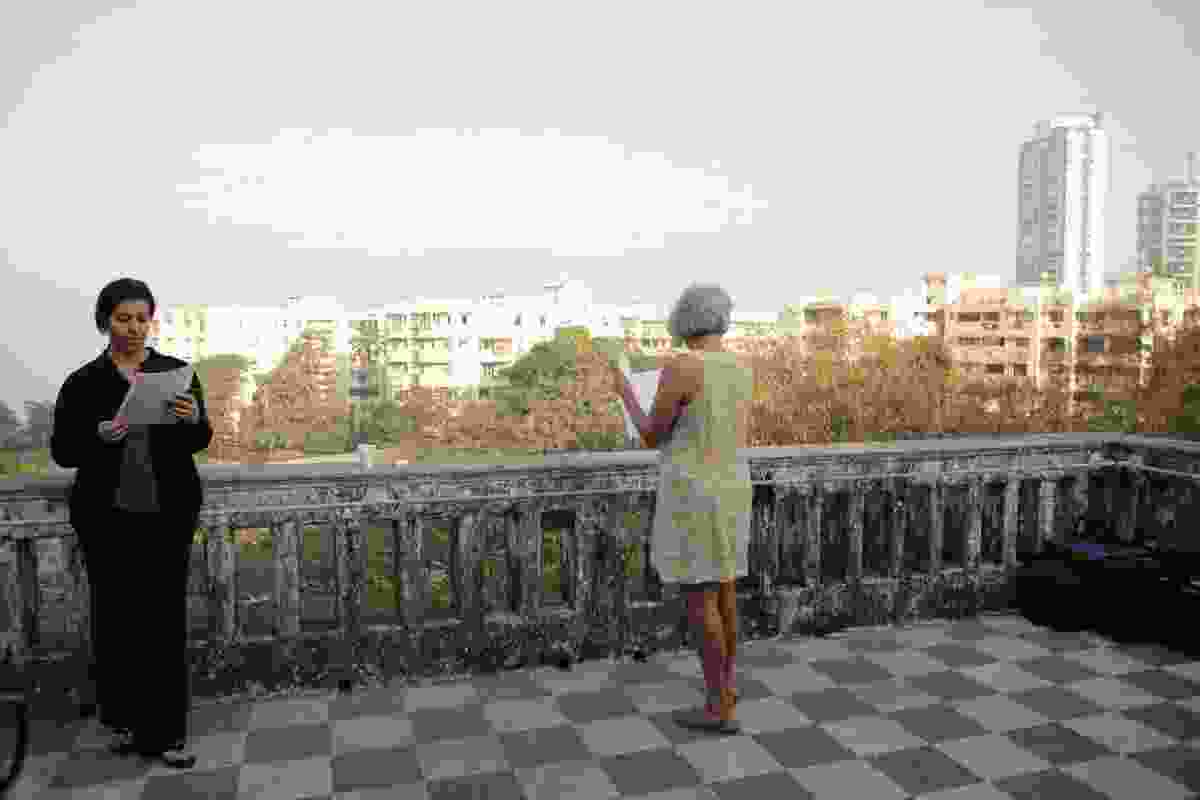
The vignettes that make up Vishal Jugdeo’s Goods Carrier (2012) take place in a large colonial-era mansion overlooking Bombay. Playing as much of a role as the five characters who inhabit the video, the setting and city frame the interactions and conflicts that unfold between the actors, who are all Indian, with the exception of one male figure — an actor named Billy Wright whose shock of red hair and white skin always feel out of place. Wright’s character floats in and out of each scene, for the most part, an observer with little narrative intent other than that of an enigmatic foreign body double. The house, in turn, acts like an evacuated stage, an architectural fragment caught between forlorn disrepair and the timeless classicism of the colonial style.
Jugdeo’s videos often hinge on the intimate relationships he develops with his actors, but the Indian actors, the on-location domestic space, and the city of Bombay in this most recent production come to represent a shift toward geographic and cultural territories far less familiar. The breakdown of intimacy — of the ability to work comfortably with actors over extended periods of time in the comfort of a controlled studio environment — is evident throughout; a distinct subtext of foreignness permeates the work, perhaps most vividly evoked in the person of Wright, and reinforced by the fact that Jugdeo is an artist who has lived almost exclusively in North America despite being of Indo-Guyanese descent. Goods Carrier may be set in India, but it tells us very little about India as a place.
Born in Saskatchewan, Canada, Jugdeo is, for better or worse, victim to an attraction that has drawn countless artists and filmmakers to India. Perhaps especially in Los Angeles, where he’s currently based, the atmosphere of Prius-driving, buffed-out yogis and extreme forms of new-age spirituality further facilitates this mythology. “I’m in need of an ashram,” says the broken screenwriter at Buzz Coffee in Mid-City, while the recovering alcoholics that congregate outside of Café Tropical in Silver Lake tend to prefer the brand of yoga known as Bikram, for the drugged-out state it induces by temperatures exceeding a hundred-degrees Fahrenheit. The yogic tradition seems to be particularly resonant among the struggling filmmakers, actors, and writers who still gravitate to Los Angeles for potential stardom. The weight of India’s place in the cultural imagination of the entertainment industry is further underlined by the success of films like Slumdog Millionaire (2008). Of course, there have been occasions in which Jugdeo (tall, dark-skinned, handsome, cinematically exotic) has been taken for an Indian actor trying to make it big in Los Angeles, like many others.
Jugdeo, who moved from one filmmaking context to another — from Vancouver, also known as “Hollywood North,” to Hollywood proper — seems particularly well-suited for life in the industry. Jugdeo’s practice, like many who live in Los Angeles, is largely determined by the ubiquity of mainstream culture and modes of production so pervasive that almost every encounter is overwrought with performative pathos. There’s no shortage of available talent in most cinema cities — actors who will work for free in hopes of gathering material for their reels — and Bombay (that other filmmaking capital) offers the same privileges. Bombay, like any city whose film industry has become a global archetype, is caught between the idea of India-as-Bollywood, and more immediate, local forms of theatrical performance. And perhaps unlike other productions made by foreigners that have assembled massive Indian casts and crew for the purposes of conveying some other deep and distant world (think of Doug Aitken’s Into the Sun, 1999, or Wes Anderson’s The Darjeeling Limited, 2007), Jugdeo’s video employs minimal means to inhabit his own outsiderness.
In watching Goods Carrier, we’re repeatedly reminded of the remoteness of the setting, and of the seemingly unmediated picture of the world it attempts to offer. A sense of “production” imbues the images and their directed nature: Jugdeo performs the role of the mediator-auteur, even though his practice has been largely determined by the conditions made available to him in this foreign place. While the performers and setting play into a desire for Indian spirituality and sage-like wisdom, they defer and deflate any ability on the part of the viewer to elicit meaning. Goods Carrier is a work that relies as much on its occasionally hyperbolic script and constructed scenarios as it does on the improvised sense of time that emerges from the actors themselves. The resulting vignettes bear a stilted musical quality without succumbing to the more finished musical tropes of Bollywood.
More than with any other video the artist has produced to date (site or context-specific) in Vancouver or Los Angeles, Jugdeo is, in this case, subject to the conditions of his immediate context and the proficiency of a local production manager who served as his guide. His ability to navigate the particularities of filmmaking in India — of making an “art video” in the staunchly professional context of Bollywood cinema — informs and shapes the outcome of his final production, a video installation on display at the Hammer Museum as part of Made in LA, the museum’s first biennial of art from Los Angeles. In this context, separated by almost 9,000 miles from its point of origin, Goods Carrier bears the burdensome task of representing a far-off place, city, and culture.
Attempts to construct a “picture of the world” have long been at the center of Jugdeo’s practice. The works inhabit the placeless microcosm of theatrical stage sets made to resemble domestic spaces for talk-show scenarios; the world outside is only hinted at as something to be subtly transposed and introduced to the foreign and insular space of the place where they are exhibited. In Goods Carrier, the occasional appearance of windows or screens within the screen (think of the box that autonomously hovers above the left shoulder of the reporter on the nightly news) points to the strategies with which we attempt to frame our experience of the world. These non-diegetic pictures, snippets of real-life events, break the completeness of the video’s otherly context — its staged theatricality — and reveal the artist’s commitment to making images that underscore their own dichotomous relationship to fact and fiction.
I would like to think of us as magicians. We, you know, we do this and we make a picture of the world. It’s not completely made up either, it’s sort of halfway in between. You follow?
A “documentary-style” image appears in the right-hand corner of the frame at the moment these words are delivered by a male Indian actor in Goods Carrier; and with it we watch ourselves play witness to the outside world in the form of a picture. The actor’s quick outward breath summons a pixelated image of a motorcycle riding through Bombay. Just as soon as it appears, it disappears again and the scene carries on. At another point, an animated bird is directed to enter the frame, linger, and disappear again. And there’s always Billy Wright, the man with the incongruous red hair dipping in and out of scenes. Each interruption that appears in Goods Carrier seeks to both undermine and emphasize the staged nature of the exchange between performers, as well as the exchange between audience and artist, who has somehow been caught up in performing the task of mediator.
There is meaning that emerges from the poetic constructions Jugdeo uses to feed his actors as triggers — references that often point to the corruption of the outside world or the fallibility of an ailing body. But meaning, in the social sense, is fueled by the activity of working in a manner that is largely improvised. As made apparent by the diverse styles of performance that run throughout Goods Carrier, Jugdeo has adapted a directorial method that is rooted both in rigid formalism and improvisation, with an indebtedness to a history of cinema that bridges the disparity of names like Fassbinder, Cassavetes, Godard, Resnais, Altman, Mike Leigh, and Satyajit Ray. Jugdeo is able to poach from these cinematic icons, all the while developing a visual language and method of working that is entirely his own and caught, in the end, between truth and a lie.
Still from The Reign of Winter, watercolor and gesso on A4 paper. Courtesy the artist
The artist Rokni Haerizadeh has been known to depict weddings, funerals, banquets, and beheadings. The setting for these often overly elaborate and coded ceremonies has been, variously, decadent and corrupt nineteenth-century Iran, the dingy margins of the contemporary European city, or even the glittering metropolis of Dubai, where Haerizadeh has made his home since 2009.
For his latest project, the thirty-three-year-old artist turns his attentions to the pomp and gaudy gaiety of last spring’s British royal wedding, starring Prince William and his pretty field hockey-playing bride, Kate Middleton. Despite the royal family’s best attempts to suggest the event would be a democratic affair (they declared it the “people’s wedding” and invited some homeless people, too) the ceremony was, of course, a spectacle that brought the country to a screeching halt as millions turned to their televisions to witness the rich in their pyramids take part in an elaborately arcane, if not outright feudal tradition.
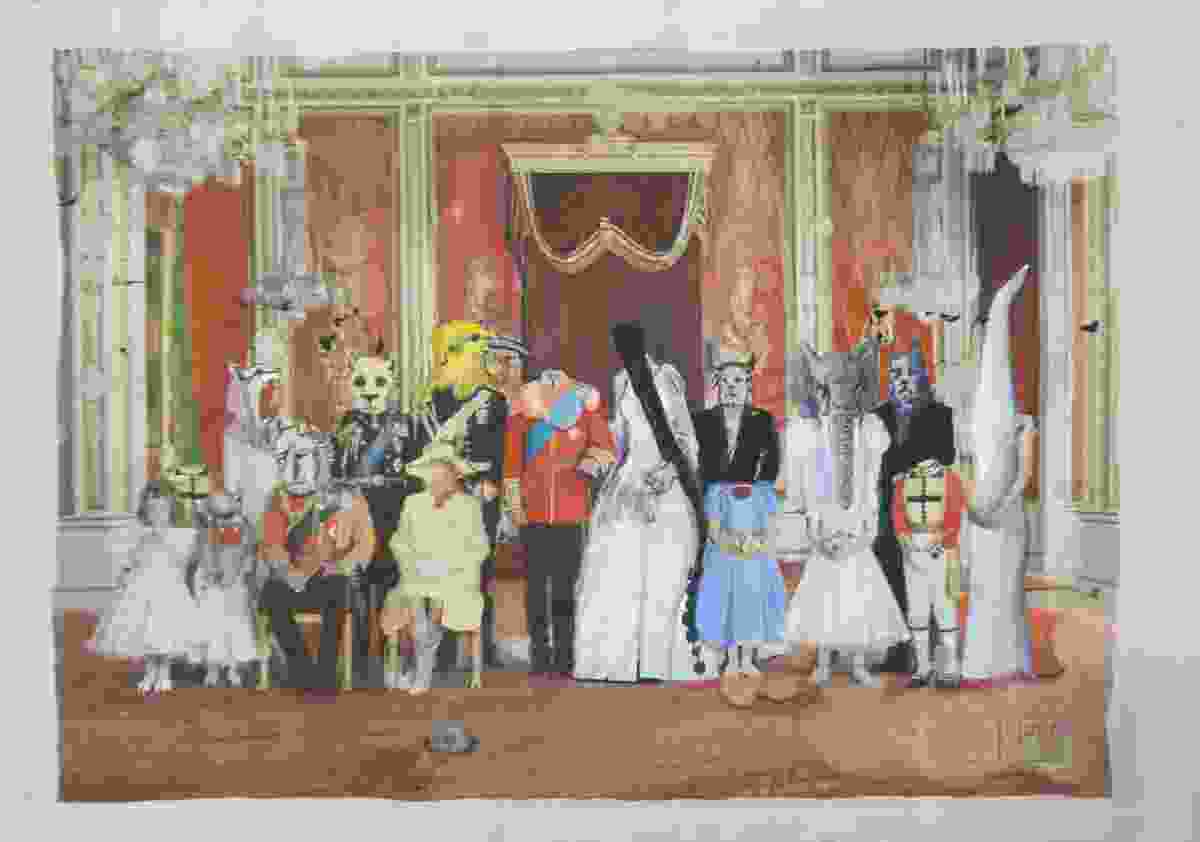
Haerizadeh, whose last animation work took as its subject another televised affair, the Iranian street demonstrations of 2009, filmed the wedding, all three hours of it, at home. After editing the already pixelated royal footage to a cut of roughly ten minutes, Haerizadeh broke up the ten minutes into thousands of frames (twelve thousand to be precise), printed each frame on A4 paper, and marked the surfaces with gesso, watercolor, and ink. When the sheets are all sewn together, the work will represent an unlikely, if not maudlin, take on this exploding piñata of privilege.
In one still from this work in progress, we see the familiar image of Mr. Middleton escorting his daughter in a grand procession. Her head is all but absent (so is his), and from her neck’s empty socket trails a set of little black balls that look like sex toys. The train of her bridal gown has morphed into an oversize human ear; and, from either side, what appears to be a river of blood emerges. In another still, a presiding priest’s entire face is absent, and has been replaced by a set of garish gaping jaws. Guards mounted atop horses are rendered as menacing centaurs. A state portrait of the royal family brings together a sad elephant, a horse, a toucan, a lion, and, of course, another headless apparition. That Mohammad-Reza Shajarian’s melancholy song “The Reign of Winter” — which narrates a man walking alone through the dead night of winter — is playing softly throughout, only adds to the creepy dissonance of what would otherwise be a carnival of good vibes.
This is not the first time that Haerizadeh has used animals in his work, as the anthropomorphic mode is a common one in many of his studies of human behavior — situations he sometimes refers to as “urban fairytales.” In Fictionville, exhibited at the Sharjah Biennial in 2011, televised images of heroic Iranian protests were modified to depict gazelles, giraffes, and other animals running hysterically through Tehran streets. Riot police were rendered as demons. Protesters were hapless clowns. The work’s title riffed on a storied Iranian avant-garde play written during the rule of the Shah, Shahre Ghese (or “City of Tales”), in which an allegorical animal land serves as a stand-in for some of the more trenchant political realities of the day.
Of course, you might say that Haerizadeh is interested in revisiting some of the more iconic moments of recent history. This is true. And yet still, these are intimate, absurd, and completely alternative readings of these histories. Psychological portraits are privileged over sweeping, official narratives. The trumpeter, the second cousin twice-removed, the accidental bystander — the real story resides in each of them. In this way, it is not entirely surprising that the artist was close to the late Iranian modernist sculptor Bahman Mohasses, who was similarly invested in the queer interior lives of people on the margins.
In conversation about the piece, Haerizadeh turns, somewhat surprisingly, to the storied Crystal Palace — erected to house marvels of the Industrial Revolution in London’s Hyde Park for the Great Exhibition of 1851. Assembled within the Palace’s bounds were endless markers of progress and travel: daguerreotypes, stereoscopes, a miniature scale model of New York City, a polar bear, dozens of dioramas, and all manner of manufacturing eclectica. Built improbably with endless sheets of glass and iron, the palace was hailed many times over as the very first manifestation of modern architecture in the world. Its blazing collapse some eighty-five years later, in 1936, marked a dramatic end to a structure that consolidated within its bounds the history of the British empire, the birth of global commercial culture, and the curious arc of bloated national aspirations.
Not unlike the shimmering Crystal Palace, the royal wedding shines like a beacon to the world, communicating, at best, history, sophistication, and tradition. Its choreography is a sort of architecture in and of itself, providing the scaffolding for the dissemination of beloved and berated national myths. And while it has not yet burned to the ground, Haerizadeh’s darkly comic and absurdly pixelated animation seems to point to a day in which yet another peculiar ritual might just crack into a million tragic pieces.
Still from The Norwegian Model, 2010. Courtesy the artist
“I’d do anything… hug them, shout at them, beat them… Anything just so they’d win.”
The muffled voice trails over the image of a male body stretched out on a dormitory bed. His muscled back swoops down into an enviable cleft, crowned by a tuft of blonde hair only just visible under the elastic band of his swimsuit. A woman in a black spandex one-piece hovers over him, holding her torso just above his in a double odalisque. She sinks an elbow first into the spaces between his ribs, then along his spine. The cameras cut to her fingers, thick and glistening with oil, driving ridges of skin up his forearm or slipping around the backs of his heels.
The sequence is saturated with an erotic charge, but the intimacy of the exercise is undercut by the massage’s overt choreography. Even in his relaxed state, the man is aware of the camera, instructing the woman as to how to use her full weight when walking across his back: “Then you can see how it looks on camera.” She mounts him carefully, then pirouettes a big toe underneath his shoulder blade. He grunts in response: “Oh, that’s good… Oh, that’s very good…”
On the next mattress over, a young man, skinny and shirtless, turns off the television and burrows under his sheets, trying not to pay heed to the soft acrobatics in the bed beside him. He isn’t sure what to make of what’s going on in this dorm room.
This exchange constitutes the bulk of Jumana Manna’s The Umpire Whispers (2010). The fifteen-minute film follows the then-twenty-two-year-old artist as she visits her former swim coach “Dima,” five years after her last competition. By his own admission, the one-time Ukrainian champion would have done “anything” to help the teenage girls swim their best; this “anything” included post-swim full-body massages, which he considered essential to improved performance. This “anything” also seems to have included knowingly harnessing the spoils of adolescent sexuality, stirring up tension with the girls only to channel it into their competitive swimming. The film opens with an unseen conversation between Manna and her former teammate. Their voices jump up an octave as they reminisce about just how fervently they coveted their coach’s attention, how he made his swimmers feel more attractive and more desirable: “That’s the thing about him — it wouldn’t feel wrong. Like, literally, he could do whatever he wanted to me… and I was fine with it. I was happy for it.”
For their reunion, Manna reconfigures the power dynamic by insisting that this time the massages be mutual. “I wanted to talk a little bit,” she begins, her tone slightly quavering. “In relation to you as a coach and me as a swimmer.” He curtly reminds her: “There is almost no talking involved in a massage.” There is in this one, however. The conversation flits ambiguously between instruction, flirtation, and confession, as in between grunts, Manna and her coach discuss the peculiarities of their intimacy. “We would obey anything you’d ask us to do,” she protests. “Yes, but that’s not exactly how it is,” he counters. He later confesses the danger of working with “younger girls,” admitting how easy it is “to make mistakes.” If he elaborates on this point, Manna doesn’t include it in the film.
The two-channel documentation of the massage contrasts with footage of a more conventional conversation on a couch. Manna is curled up coquettishly on one corner, her legs cocked and folded beneath her, while the coach sits back in his swimsuit, legs splayed, his arm draped over his lap. His body is bulky, with a tattoo around his forearm and a gold chain around his neck. The shots of this “clothed” conversation play out as a different type of courtship; Manna smiles reassuringly at him, her attempts at cultivating a feminine mystique undermined by the cloying girlishness of her voice. Dima bluntly tells her that she lacked a natural feel for the water, but that, to her credit, instead of talent, she had determination. She wanted it, and so he wanted it for her. The image switches to a swimmer working her way across the pool. Under the water, the body moves according to different rules; the swimmer pointedly makes her body available for the camera, her hips swiveling in a way that’s as much about sex as it is about sport.
Still from The Umpire Whispers, 2011. Courtesy the artist
The film’s title hails from David Foster Wallace’s Infinite Jest, in which the tennis-playing protagonist suffers from a recurring dream where he suddenly cannot understand the rules of the game that he knows best. Where there was once intimate mastery, there is only anxiety:
The court is about the size of a football field, though, maybe, it seems. It’s hard to tell. But mainly the court’s complex. The lines that bound and define play are on this court as complex and convolved as a sculpture of string. There are lines going every which way, and they run oblique or meet and form relationships and boxes and rivers and tributaries and systems inside systems: lines, corners, alleys, and angles deliquesce into a blur at the horizon of the distant net.
The protagonist stands stunned, at a loss of where to serve. At the umpire’s prodding, his body remembers what his mind cannot:
The umpire whispers “Please Play.”We sort of play. But it’s all hypothetical, somehow. Even the ‘we’ is theory: I never get quite to see the distant opponent, for all the apparatus of the game.
In understanding the apparatus of her games, Manna likewise returns to the gesture. Here, the touch of her swim coach’s hand can stand in for all the sexual slippage of a woman coming of age in water. The attention to male fingers at work is even more prominent in Blessed Blessed Oblivion (2010). In this piece, made at about the same time as The Umpire Whispers, the artist attempts to catalogue the thug culture of East Jerusalem by infiltrating its most sacred spaces — the car-body repair shop, the barbershop, the gym — with her camera. The twenty-three-minute video makes clear references to Kenneth Anger’s Scorpio Rising (1963), but departs occasionally into snatches of dialogue. Her leading men boast of mistreating the women who love them almost as proudly as they discuss the specifics of their car wash and its mysterious, better-than-wax finish. Here, as in The Umpire Whispers, Manna solicits confessions from the men by trading on her own half-formed femininity, affecting a sort of tomboyishness that structures the work even if Manna herself never appears. And so her subjects perform for her: from jokes about sex-starved old women and their toothy vaginas to sacred poems celebrating martyrdom to conspicuous bulges, resituating their tracksuits. In a nod to Anger, the various rituals — car waxes, close shaves, bicep curls — play out to a soundtrack of Syrian, Egyptian, and Lebanese pop music. Manna makes aggressive use of the camera, punctuating the images of hands at work with intrusions into the small spaces and overlooked nooks of the male body.
The erotic unpacking of constructions of masculinity is something of a ritual in itself for Manna. For her earlier body of photographs The Shabab Series (2006–2008), she snuck into boys’ bedrooms or lured them to her car window. But the artist isn’t interested in talking about this. As in, explicitly not interested. “I’m not just the girl who makes everything about masculinity and intimacy,” she argues (a claim which may or may not be influenced by her recent enrollment in the CalArts Master’s Program in Aesthetics and Politics.) “Right now, I’m actually really interested in history, in ideological narration, in finding those precise moments that alter the way we imagine things… You know?”
One of those moments just happens to revolve around another set of hand gestures from another set of men. The gestures in question derive from a widely disseminated photograph taken on September 13, 1993, in Washington, DC, on the occasion of the official signing of the Oslo Peace Accords. In the photo, Yitzhak Rabin reaches across the podium to grasp the hand of a beaming Yasser Arafat, while Bill Clinton stands in the background grinning, his arms goofily outstretched in imitation of achievement. The silliness of the staging is brought into relief by the (only recently revealed) history leading up to that moment. The agreement had not been the product of the long ongoing “official” sessions in Washington, DC, but rather, had been secretly negotiated over what political historian Deiniol Jones has famously called “the radical intimacy of the hearth,” in a secluded spot in Norway — what would become known as the Oslo Back Channel. Despite Clinton’s prominent positioning (“almost like a feudal king,” Manna muses), the United States had only been briefed on the negotiations a month or so before the signing. The picture-perfect presentation of “Peace in the Middle East” was actually just a photo-op for an interim agreement, largely symbolic.
Manna’s interest in the event was triggered by reading the articles of historian Hilde Henriksen Waage (author of articles such as “Norwegians? Who Needs Norwegians?” and — perhaps most pertinently — “How Norway Became One of Israel’s Best Friends”). The backstory to this symbolic agreement is as fraught with secrecies and insecurities as the confessions of The Umpire Whispers’s teenage swim team, with Norway trying to play BFF to Israel, the PLO, and the United States all at once.
“As a Palestinian-Israeli with American citizenship who has spent time living in Oslo, obviously this topic appeals to me on multiple levels,” Manna says. “But overall, I’ve been thinking about how you can deal with politics without just looking at the Other.”
Manna found a like-minded observer in a fellow CalArts student, the Norwegian artist Sille Storihle. Together the artists began to research the Back Channel, a particularly difficult undertaking given — as Waage discovered — most of the documentation of the proceedings has mysteriously vanished from the archives. Whatever it was that did happen, the Back Channel allowed Norway to rebrand itself as the world’s peacemaker. The artists use this idea as a starting point for a film currently in progress, which will attempt not so much to fill in the gaps around the Accords as to think through the manufacturing of a Norwegian national myth.
Prior to the Accords, Norway had existed on the fringe of the international consciousness, not just geographically, but as a generally self-sufficient nation (that pesky entanglement with the Swedes aside) without the ideological burden of a colonial past. The country had made nods toward peace activism with its Nobel Prize (though one should not forget that this award was endowed by the inventor of dynamite.) While clearly any small, independent country benefits from the peace of its neighbors, Waage also attributes the particular appeal of high-profile peacemaking to Norway’s deeper need for recognition, “a need to be actively involved in international affairs, which was built on a strong humanitarian tradition, a bulging wallet, and a self-image that cried, ‘Norway saves the world, therefore Norway exists.’”
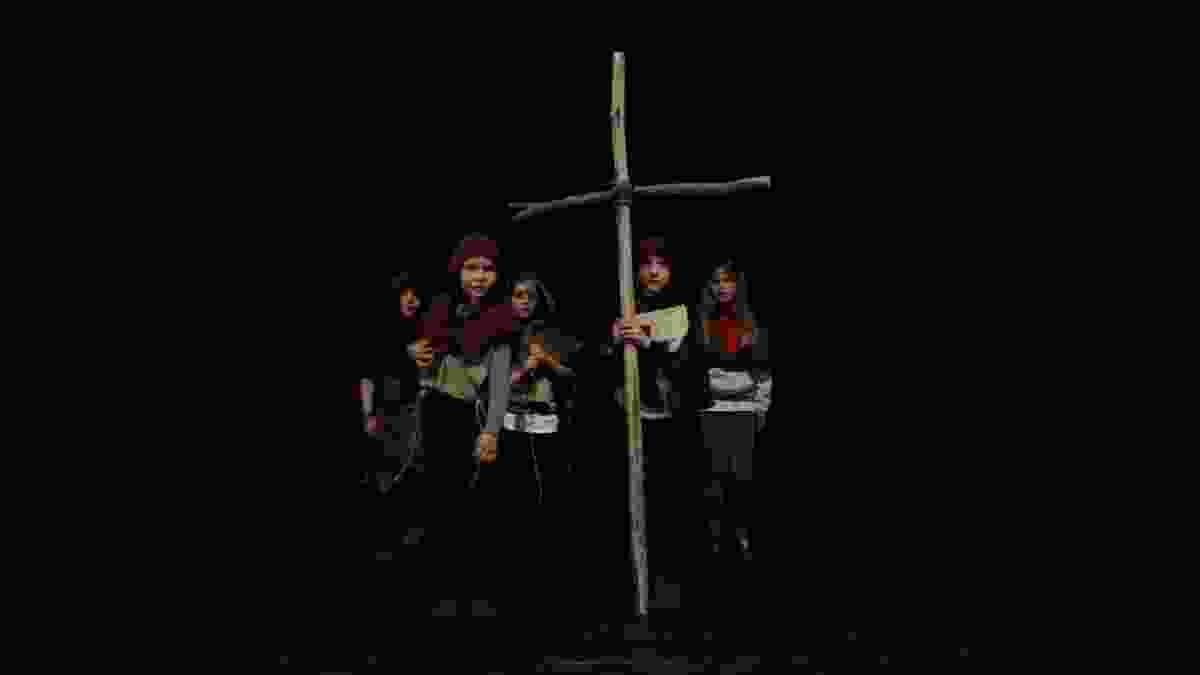
To canonize its ideological affiliation with peace, in 1938, Norway commissioned Henrik Sørensen to create colorful commemorative murals all around Oslo’s City Hall, where the Nobel Peace Prize is awarded. These murals make a mediated appearance in Manna and Storihle’s film as the inspiration for the backdrops of a children’s play that the artists stage. In stills from the play, costumed kids pose in storied moments of state-building, pointing to the historical narratives that have recently been rewritten to cement Norway’s heroic role. These are spliced with scenes of the countryside — a` la Nordic nature porn — that silence the idea of “the State” and instead allow the country to speak for itself.
While this film is still in process, the interest in staging and ideological narration carries over into another collaborative project with a CalArts connection: this time, The History of Forgetting: Los Angeles and the Erasure of Memory, by faculty member Norman Klein, which explores the social imaginary of the city. “Los Angeles is sort of the West of the West,” as Manna puts it. “A type of promised land.” In her research on the city, the artist has found some unlikely parallels with Jerusalem. “Before 1948, Jerusalem was a very different city — very cosmopolitan and multicultural. There was a bohemian and even hedonistic culture that’s all been lost.” Manna envisions the project taking the form of a script following a character who moves from Jerusalem to Los Angeles. “The starting point is looking at Los Angeles and Jerusalem as two of the most imagined and mythologized, but contrasting, cities in the world. I’m thinking, if these two cities had to meet, how would it be?”
After a moment’s pause, she adds: “I don’t just want to fetishize the lost details of history, though. Somehow, I want this to still investigate the present.” After another moment, she qualifies this statement: “But there are a lot of options I’m playing with at the moment.”
One thing is clear: Manna prefers her court complex. Please play?
Still from The Norwegian Model, 2010. Courtesy the artist
It is said that there are 6,909 living languages in the world. I can attest to nine of them, because precisely that number was represented among our gathering of Christians at the evangelical Ichthus Church in Lewisham, southeast London. I myself spoke two of the languages and was just beginning on a third, English.
One night I joined several hundred people in a crowded basement on Greenwich South Street to experience the Toronto Blessing, some kind of spirit that was moving transcontinentally, like a flu that affected only born-again Christians. Everyone seemed to agree that it was important that I see it for myself. Perhaps I would catch it, too.
The upstairs hall where the church often held meetings wasn’t big enough for the occasion, and they removed the seats in the basement to allow more people in. It was hard to tell what was going on, the room was so dark. The visiting preacher was on a little stage with a powerful microphone. From the back of the room where I stood, all I could see was his bluey silhouette moving up and down.
He began calmly by encouraging us to open our hearts to this amazing blessing. He then led us in a hymn without any instruments. As soon as the song finished he exploded into a torrent of words, like an auctioneer who had lost control of the faculty of speech. The congregation responded with clapping and shouting.
Then the preacher spoke calmly again in English, only to begin his thundering crescendo of words again. He went on like that, alternating between loud and quiet, English and whatever it was. And the congregation responded. “Respond” does not really do justice to it. People were rolling on the floor and barking like dogs. Some wept, while others laughed. One woman near me was shaking her hands uncontrollably like she had just burned herself; this went on for an hour. People I liked and respected seemed beside themselves. One tall shy man seemed to be dancing to the words. Many seemed to be speaking back to the preacher in that same strange language, and at nearly the same volume.
The person next to me told me they were speaking in tongues. Tongues, I asked? She looked at me meaningfully. “It is a spiritual language that only God understands.”
The most confusing thing about tongues was that I understood it. Some of it. Amid the rising, falling tide of gobbledygook the preacher would suddenly start to shout in Somali, KEE RABA SEEYA (give it to him who wants it) and KUUR RABA (which one does he want).
At some point the preacher began blowing heavily into the microphone, which produced a vast, shocking echo. He neighed like a holy horse: “Hrr! Hrrrrr!” Suddenly I realized he was looking at me. He spoke then in a deep, awestruck, holy voice. “If there is anyone in this hall who cannot understand what is going on,” he said. “If there is anyone in this hall who is criticizing in their hearts... and who because they cannot understand are criticizing in their hearts…” He shook his head and neighed again, “HRRRR!” He paused and then continued speaking in capital letters, “WE ASK YOU TO OPEN YOUR HEART! OR LOVINGLY LEAVE. NOW!”
I was insulted, actually — how did he know I was not even then being blessed in some silent way? And if I was being spoken to in Somali, why was I am being addressed as a boy? I made a point of sticking around for another hour before leaving, around eleven at night, some three hours after I’d arrived, the basement still convulsing with ecstatic Christians.
In the Bible there is the story of the disciples speaking to a roomful of disparate foreigners who each hear the words in their own language. Somehow that notion had evolved into a language that can be understood by no one but God. Tongues is said to be the holy spirit spilling out of a person, the physical manifestation of being born again. I wondered whether tiny bits of all the world’s languages might have made their way in there.
This was around 1995. The Toronto Blessing was a worldwide phenomenon. It was even reported on the BBC.
I spoke to my adoptive father Toni in Pakistan, who had told me repeatedly how badly he wanted me to hear the Toronto Blessing for myself. “What did you think of it?” he asked excitedly, hoping that the spirit might have spilled onto me. He was disappointed by my answer. I told him that it was mass hysteria and nothing to do with God, so far as I could see. I’d felt like I was watching people possessed, like a voodoo cult in a movie. Or back in the asylum where my sister and I used to volunteer on Thursday afternoons after school, though at least in the asylum the inmates were supposed to be crazy.
“Let’s say it is from God,” I finally said. “Why? Why would God want us to behave in this way?” Toni got quite angry with me at that. He told me I was arrogant for wanting to understand everything. I suppose he was right.
All images courtesy The Armenian Library and Museum of America, Watertown
How excruciating can nothingness be?
— Jack Kevorkian
O death, where is thy sting? O grave where is thy victory? The sting of death is sin; and the strength of sin is the law.
— Handel’s Messiah III.3.50
The elderly woman behind the reception desk of the Armenian Library and Museum of America stabs her finger onto a copy of Yerevan: Magazine with an Accent and slowly traces a diagonal across the glossy cover. She’s showing me the route of the five hundred–mile death march her father took in 1915, from his village in Central Anatolia through mountains and deserts to seek refuge outside the city of Mardin. An unblinking Andre Agassi, Yerevan’s cover model, smiles back next to the headline “CONFESSION: Over 30,000 Turks Apologize to Armenians.” I soon find myself confessing too — that I’m not Armenian — and a puzzled look clouds the old woman’s face. She thrusts a pamphlet at me. It’s titled “We Share Our Pain,” and includes a list of genocides, from the Assyrian and Greek Anatolians to the Jews and Tibetans, Burundians, East Timorese, Kurds, and Rwandans — the list goes on. “Armenians were first,” she informs me. “I don’t know why.”
The Armenian Library and Museum of America, or ALMA, is the biggest repository of Armenian artifacts outside of Armenia, with over 20,000 objects and 27,000 books in a collection that is steadily growing. In its Brutalist building on the corner of Main Street in Watertown, Massachusetts, a little outside of Boston, less than five percent of the collection is ever on display. The aged receptionist is nowhere near the end of her story — her mother, having escaped the Turks, has just arrived at a French convent school in 1920s Beirut — but I thank her and walk into the main gallery, where I am greeted by rare Bibles from the seventeenth century, elaborate wedding costumes on headless mannequins, and silver gelatin prints by Yousuf Karsh. An ancient flyswatter faces off with a baptismal dove, a warrior’s belt from 700 BC gives way to a spiked human dog-collar from the genocide years. There’s even a “Dental Oriental Rug” featuring a giant molar, woven by Armenian children in Lebanon in 1925 to encourage better oral hygiene in the orphanages. But the paintings I’ve come to see have been locked away in the vault.
A man in a coma lies on his back, with his bare, wrinkly feet sticking out of the bedcovers as he slides head first into the dark, gaping mouth of a blindingly white skeleton. On another canvas, a man reduced to raw sinews and bones is engulfed by flames, his eyes turned heavenward like Jesus on the cross. In a third, a kneeling man has had his brain and his spinal chord removed; they hang suspended by chains near him. Half his body has turned to limestone: his healthy right hand holds his shattered, dismembered left. His face — like the viewer’s — wears a shocked grimace.
The paintings are the work of none other than Jack Kevorkian, the late Armenian-American pathologist, philosopher, assisted suicide advocate, and convicted felon otherwise known as Dr. Death. They are strikingly well executed. Unlike the works of other improbable painters — Adolf Hitler’s multicolored bouquets and elegant nudes or Winston Churchill’s pastoral sceneries — Kevorkian’s canvases are markedly obvious and gruesomely, almost risibly, literal. And the man in the coma, the man on fire, and the man with the brains by his side look a lot like the auteur himself.
“They will not be orphaned,” ALMA’s former director Mariam Stepanyan announced at the opening of a Kevorkian exhibition in 2008. Those same sixteen paintings had appeared in The Doctor Is In, an ALMA show in 1999, which Kevorkian himself had to miss, having just been confined to the Thumb Correctional Facility in Lapeer, Michigan. After serving eight years on a second-degree murder conviction for euthanizing a patient on national television, Kevorkian was released for good behavior. ALMA restaged the exhibition in celebration, this time as The Doctor Is Out. When I visited the museum for the first time, in February 2011, the show was still up. It’s difficult to imagine how anyone could bear to look at Kevorkian’s macabre portraiture for so long. Yet not only was the show still going strong after three years; a few of the canvases had cloned themselves. (Replicas produced for the Al Pacino Kevorkian biopic, You Don’t Know Jack, now hung alongside the originals.) Kevorkian was a difficult figure — never married, without children or many friends, his health compromised by the hepatitis C he contracted while performing blood-transfusion experiments on himself in the late 1960s — but in the Watertown Armenian community, the Doctor had found an unlikely caretaker for his checkered legacy.
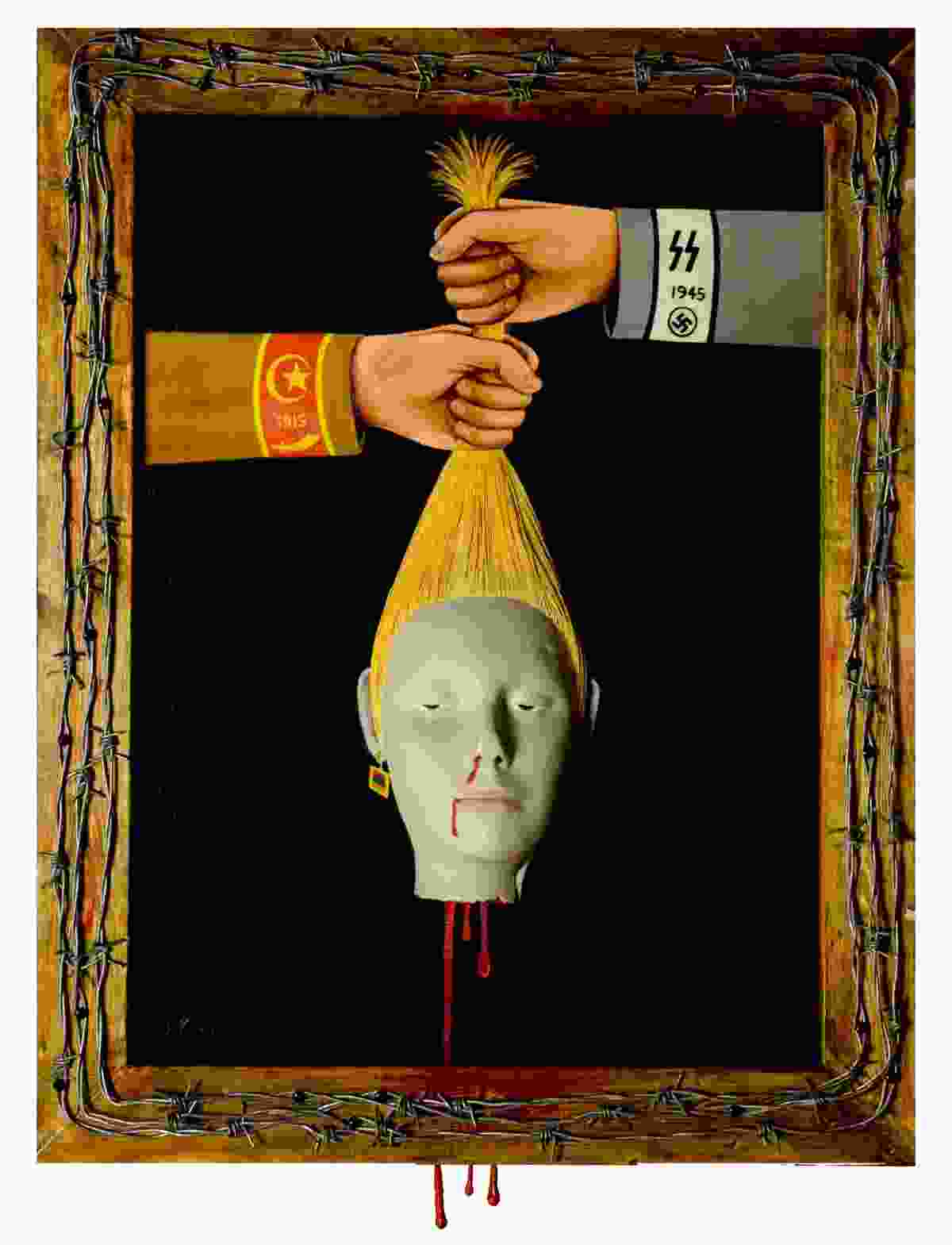
Quite at home in the museum, the severed head of a young woman dangles by her hair a few feet from the reception desk. Two hands are holding her aloft: one bears a cuff with an Ottoman crescent and the date “1915,” the other a Nazi swastika and “1945.” Kevorkian’s own blood drips from the head and spills onto the painting’s frame, which is ringed by barbed wire. In my pamphlet I read a section on “Lessons of Genocide,” and it’s as if it were written as an exegesis of the painting itself: “German military leaders were present in Turkey and saw the extermination of the Armenians take place without interceding. Hitler referred to the Armenian Genocide and said, ‘After all, who today remembers the Armenians?’ One could cynically conclude that Hitler was the only western governmental leader to learn a lesson from the Armenian Genocide.” Kevorkian in turn had titled the painting 1915 Genocide 1945, and on a plaque that hangs nearby writes of the need to commemorate the two catastrophes: “To fail to take but token interest in the whole ugly affair, to avoid making it almost hereditary memory, would be abdicating decent human responsibility and thereby assuring recurrence is happening at this very moment.”
It’s the fight against forgetting that both Kevorkian and the museum have taken up, with a slight penchant for one-upmanship. Kevorkian once told a reporter, “I wish my forefathers went through what the Jews did. The Jews were gassed. Armenians were killed in every conceivable way. Pregnant women were split open with bayonets and babies taken out. They were drowned, burned, heads were smashed in vices. They were chopped in half.” The Jews, according to Kevorkian, “had a lot of publicity, but they didn’t suffer as much.”
ALMA has a favorite quote, which it juxtaposes with majestic vistas of snowy Mount Ararat on its informational brochures: “Go ahead, destroy this race! Destroy Armenia; see if you can do it. Send them from their homes into the desert. Let them have neither bread nor water. Burn their homes and churches. Then see if they will not laugh again; see if they will not sing and pray again. For when two of them meet anywhere in the world, see if they will not create a new Armenia.” The words belong to the bard of Fresno and apostle of Armenian-American letters, William Saroyan.
In the 1620s, the first two Armenians came to America. They were silkworm-breeding experts, invited by the governor of Virginia to join the Jamestown Colony. Yet it’s unknown to history whether they created more than just worms. It wasn’t until the mid-1890s, following a series of persecutions ordered by the Red Sultan, Abdülhamid II, that the first wave of immigration began, with around 25,000 Armenians settling in the United States. The agriculturally inclined made their way to the fertile fields of Fresno, California, while others went to work in the industrial mills outside Boston, Buffalo, and Detroit, opened shoe repair shops and groceries, and ran coffee houses that soon became the centers of Armenian community life. As the Sick Man of Europe, as the Ottoman Empire was known, lay dying, many thousands more made their way to America in the early 1910s. As those travelers crossed the map, they might have been buoyed by the words of the seventh-century Armenian geographer Anania Shirakatsi, who, presaging Saroyan, wrote, “The origin of anything is at the same time the beginning of its disintegration; the disintegration of harmless contradiction, the universe obtains its continuance.”
In 1912, twenty-one-year-old Levon Kevorkian migrated to Pontiac, Michigan, to work in the auto factories and send money back to his impoverished family in their village in northeast Anatolia. Three years later his family stopped writing back. That same year, Satenig Keshigian watched most of her family die before her eyes when the entire population of her village was uprooted and marched into the Syrian dessert. Eventually she and a brother made it to Pontiac, where she met Levon.
Jacob “Jack” Kevorkian was born to Levon and Satenig one snowy day in May 1928. (The couple also called him Murad, after an Armenian guerrilla fighter.) A precocious child, Jack loved to play war games, donning paper-maché helmets and wielding potato mashers as hand grenades. An empty lot across from the local hospital became his Belleau Woods, Vimy Ridge, and Verdun — battlefields of the Great War. And the newspapers his parents read religiously were his Armenia. As he would later remember, “Growing up, I saw the Hyrenik Amsagir (Fatherland Monthly) — that was home for me.” Levon and Satenig raised Jack and his two sisters to have everything that they had lost, and in their nightly stories they kept the old ghosts alive. When not in the trenches or on the death march, Jack memorized baseball statistics, drew cartoons, invented limericks, and taught himself German and then Japanese. He stripped wood from abandoned houses to build bonfires, where he roasted potatoes until hot, black peels of charcoal flaked off of them. It was a taste that would never leave him: in later years, when Kevorkian had no fixed address, friends who put him up would notice that he would often use their fireplaces to make his dinner. He was never happy until his food had a burnt carbon shell.
The child of the genocide was to become the patron saint of assisted suicide. As he went about his tasks as a young pathology intern at Henry Ford Hospital in Detroit, Jack caught sight of a woman ravaged by cancer, her jaundiced skin hanging off her bones. Her face was frozen by pain into a sardonic smile. As he would later write in Prescription: Medicide, “It seemed as if she was pleading for help and death at the same time. Out of sheer empathy alone I could have helped her die with satisfaction.” Instead he shipped out to Seoul, where he served as an army medic in the Korean War. When not attending to injured combatants, Kevorkian would pass the time practicing Bach on his flute and teaching himself Latin and Greek.
Back in the States after the war, he found work as an autopsist at the University of Michigan Medical Center and began to pursue unorthodox research in his free time. Dr. Kevorkian would sit for hours staring into the eyes of the dead. When an electrocardiogram in the hospital ward signaled that a patient’s heart was about to stop, Kevorkian would tape open his or her eyes and snap photographs. With an almost painterly eye, the doctor captured the retina’s color over time as it shifted to a pale orange-red, then yellow, and finally gray. His findings — invaluable for medical examiners looking to determine time of death, after the fact — were published in a scholarly article in the American Journal of Pathology whose tone betrays an unnerving enthusiasm: “Let me emphasize one point: a drop or two of water or saline must be put on the exposed cornea before postmortem opthalmoscopy is ever attempted!… If this is done, one may observe leisurely and continuously for hours.”
Kevorkian’s colleagues soon took to calling him Dr. Death, though they largely ignored his bizarre if pioneering experiments. Yet if “autopsy,” from the Greek, means literally “to see for oneself,” Kevorkian was a true autopsist, obsessed with seeing Thanatos with his own eyes, and observing closely what happened in the liminal space between death and life. His research took him deep into the University of Michigan’s library, where he was thrilled to discover that thirteenth-century Armenian physicians had performed medical experiments on criminals condemned to execution. For Kevorkian, vivisection was no breach of medical ethics — on the contrary, the revelatory investigation of those condemned bodies furthered the development of medicines that would save lives in the future. In this way the convicts themselves had contributed enormously to the store of human knowledge; their deaths had not been meaningless.
Why shouldn’t criminals on death row be given the opportunity to give back to society? It wasn’t just the Armenians; Alexandrian doctors in the days of Ptolemy had performed similar experiments on sentenced criminals. Kevorkian became obsessed with the idea of adapting this ancient practice to the modern American penal system. He insisted that he was personally opposed to the death penalty, but that if the state was going to be in the business of taking human lives, costing taxpayers millions of dollars every year, those deaths ought to be in the service of life. Instead of the electric chair, the gas chamber, or the firing squad, a consenting convict on the day of execution would be put under. His body, particularly his brain, would be experimented upon; then his organs would be carefully harvested for transplant surgeries. Finally, he would be put to death by a lethal dose of anesthesia. Kevorkian invoked Ptolemaic doctors in support of the practice, but the notion carried other, less remote echoes — whispers that Turkish doctors had performed medical experiments on live Armenians, just as Nazi doctors had done to Jews.
Ever the empiricist, Kevorkian visited the Ohio Penitentiary to canvass a group of prisoners for their thoughts on his proposal. (Michigan had a moratorium on capital punishment.) Most inmates were appalled, but a few saw in his idea the possibility of atoning for the unforgivable mistakes they made. As the first man he interviewed later articulated in a letter, “It would help me think that I didn’t succeed in making a total mess of my life, that I may have helped someone, somewhere, sometime.” In 1958, Kevorkian presented his findings at a conference in Washington, DC, and was promptly fired by the University of Michigan.
The Doctor took a new job at his hometown hospital, Pontiac General, and soon resumed his quest to find ways to snatch life from death. His dreams were haunted by scenes of soldiers bleeding to death on his watch — an all-too-common event in Korea when military blood supplies ran short. Blood-bank donations were often unable to meet medical demands, at war and at home. And yet there was an alternative, especially on the battlefield: Soviet doctors, liberated from churchly taboos and inhibitions, had shown that blood from cadavers was perfectly safe for use in transfusions. Kevorkian and his friend Neal Nicol — a lab technician who would remain his lifelong sidekick and madcap medical collaborator — built upon Soviet experiments to develop a one-step process for transferring blood directly from a dead body to a patient. When the perfect test subject, a thirty-year old heart attack victim, turned up at the hospital, Neal volunteered to be Kevorkian’s guinea pig. He lay down on the floor next to the deceased while Kevorkian connected a syringe pump and a tube from the dead man’s jugular vein directly into Neal’s arm. After receiving 400cc of blood, Neal felt fine. Their next attempt went slightly awry, however. A female volunteer who received a transfusion directly from the heart of a mangled fourteen-year-old hit-and-run victim became dizzy and nauseous. It turned out the volunteer had effectively ingested a Jägerbomb — the teenager had been out drinking. On another occasion, Jack and Neal petitioned the hospital for funding to perform the first in-vitro fertilization of a man — by implanting a fetus in Neal’s belly.
Levon and Satenig loved to hear their son talk about his research, which they regarded as heroic. As Neal recalled of Levon, “He felt God saved him from the massacre to beget Jack. He escaped death to sire the death fighter.” And yet death retained its sting. Jack’s father died of a heart attack in 1960, and in the mid-sixties his mother was diagnosed with advanced abdominal cancer. Kevorkian watched as doctors simultaneously restricted the amount of morphine she received even as they fought to prolong her life. The pain, she protested, was inconceivable; her treatment amounted to torture. “It was as if she had never escaped the Turks in Armenia,” Neal would later say. Jack was overcome by grief at the loss of his parents, who often came to him at night in dreams. As a way of mourning, Kevorkian turned to oil painting, and enrolled in adult education classes at night. Ignoring the moldy still-lifes set up for the other students, Jack painted Death itself. He listened to Handel’s Messiah as he worked.
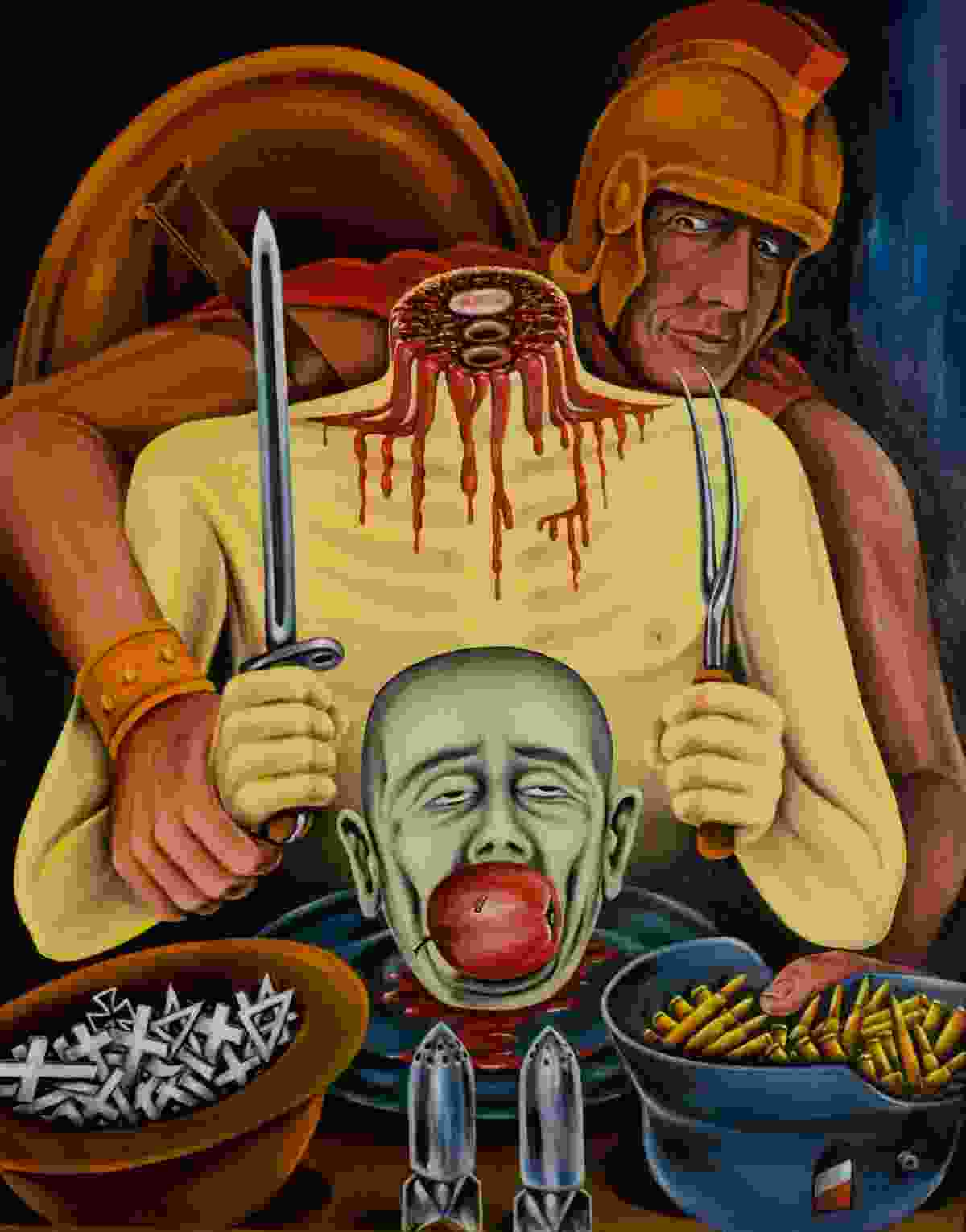
A greenish head sits on a dinner plate, a red apple in its mouth. A man’s headless torso holds a knife and fork at the ready, eager to consume his severed head. Also on the table are a pair of missile-shaped salt and pepper shakers, along with an overturned helmet that brims with metal crosses and Jewish stars. Peering excitedly over the cadaverous diner’s shoulder is the god Mars, dressed anything is in its turn the cause of a new beginning. And from this for battle in a cape and a golden shield. He too looks a lot like the young Jack Kevorkian.
During his prison years, Kevorkian published an anthology called glimmerIQs: A Florilegium, which compiled his serial limericks, philosophical manifestos and scientific treaties, reproductions of his paintings, and even handwriting samples and a natal chart, in case anyone wished to analyze him astrologically. In a chapter called “On Art,” Kevorkian rhymes:
_The subjects of art should be more
Than the aspects of life we adore;Because dark sides abound,Surreal paintings profoundMay help change a few things we abhor._
Of the painting with the gruesome dinner scene, The Gourmet (On War), Kevorkian writes, “War is the bizarre perpetually periodic metamorphosis of human nature into absolute evil resulting in mind-boggling mass suicide with human kind devouring or trying to devour itself, all orchestrated by humanity’s only true and beloved pagan God, Mars. We will not settle for less than the ‘flower of evolution’ as the main course in this insane autophagy embellished by bountiful side dishes and fanciful shakers filled with the ‘fruits’ of our marvelous hands and big starving brains.” Yet painting The Gourmet — which bears an uneasy relationship to Kevorkian’s ideas on suicide and organ harvesting — seems a curious way to press for change.
Like many of the paintings featured in The Doctor Is Out, The Gourmet is actually a re-creation of a canvas from the late 1960s; all of the paintings he did in the first decade after his parents’ death were lost by a moving company when Kevorkian moved to California in 1976. Frustrated by the hospital bureaucracy that shunned and restricted his research, Kevorkian quit medicine, broke up with his first and last girlfriend, Jane, packed up his VW van, and drove to Los Angeles, where he put his life savings into making a film of Handel’s Messiah. Inspired by Christ’s perseverance in the face of martyrdom, Kevorkian saw his Messiah as his chance at redemption. Yet lacking any experience, producers, or distributors, and with a severely limited budget, his An Abridged Screen Adaptation of the Oratorio Messiah by George Frederic Handel ended up a disaster of stock footage and badly reenacted biblical scenes. In a reel that is now lost, surrealistic images of elated shepherds juxtapose with close-ups of blinking eyes and a young boy on crutches. Kevorkian had hoped that audiences, overwhelmed by Handel’s score, might not notice the terrible quality of the film’s visuals.
Broke, the Doctor slept out of his van and picked up the odd job as a substitute pathologist. He wrote a book of poems about dieting called Slimmericks, which advocated a “demi-diet” of always leaving half the food on your plate. Otherwise, “How your masses consumed/Maybe be fitly entombed/Will weigh heavily upon the mortician.” For the contemplation of loftier matters, Kevorkian had a show on Berkeley public access cable. In an early 1980s program called The Door, he played a professorial tour guide of the mind, complete with black turtleneck. Floating visions of his head flash across trippy neon patterns amid crashing thunder, as the Doctor on the green screen promised the viewer a trip into some “very hazy realms of human existence.” One episode ended with Kevorkian discussing multiple universes and asking solemnly, “For what forms of existence are we the amoebas?”
As the death penalty crept back into fashion in America, he fantasized once more about dissecting convicts for the greater good, envisioning the struggle as a kind of civil-disobedience campaign: “The pressure [would have] to well up from the cellar of society: from a lone doctor at the bottom rung of his calling, without authority, influence, or organizational support (and ultimately even without a job) combined with the absolute lowest of the low, the condemned criminals themselves…” The only venue that would publish his musings was an Israeli journal called Medicine and Law.
In the summer of 1987, the Doctor took a trip that would change his life, and his ideas about death. Kevorkian decamped for Amsterdam, having heard rumors of rogue doctors practicing euthanasia on thousands of terminally ill patients a year in the Netherlands. He was curious about the practicalities — his death penalty project would end in the killing of the condemned men, after all, and he was interested in studying the most humane techniques. In the Netherlands he met Dr. Pieter Admiraal, a leading anesthesiologist whose underground work would later lead to the legalization of voluntary euthanasia in the Netherlands in 2000. Dr. Admiraal told Kevorkian flatly that experimenting on convicts was insane. Yet he also convinced him that the best way to cheat death was to help people take control of their own endings. Not long after, advertisements for death-counseling services began appearing in Detroit newspapers.
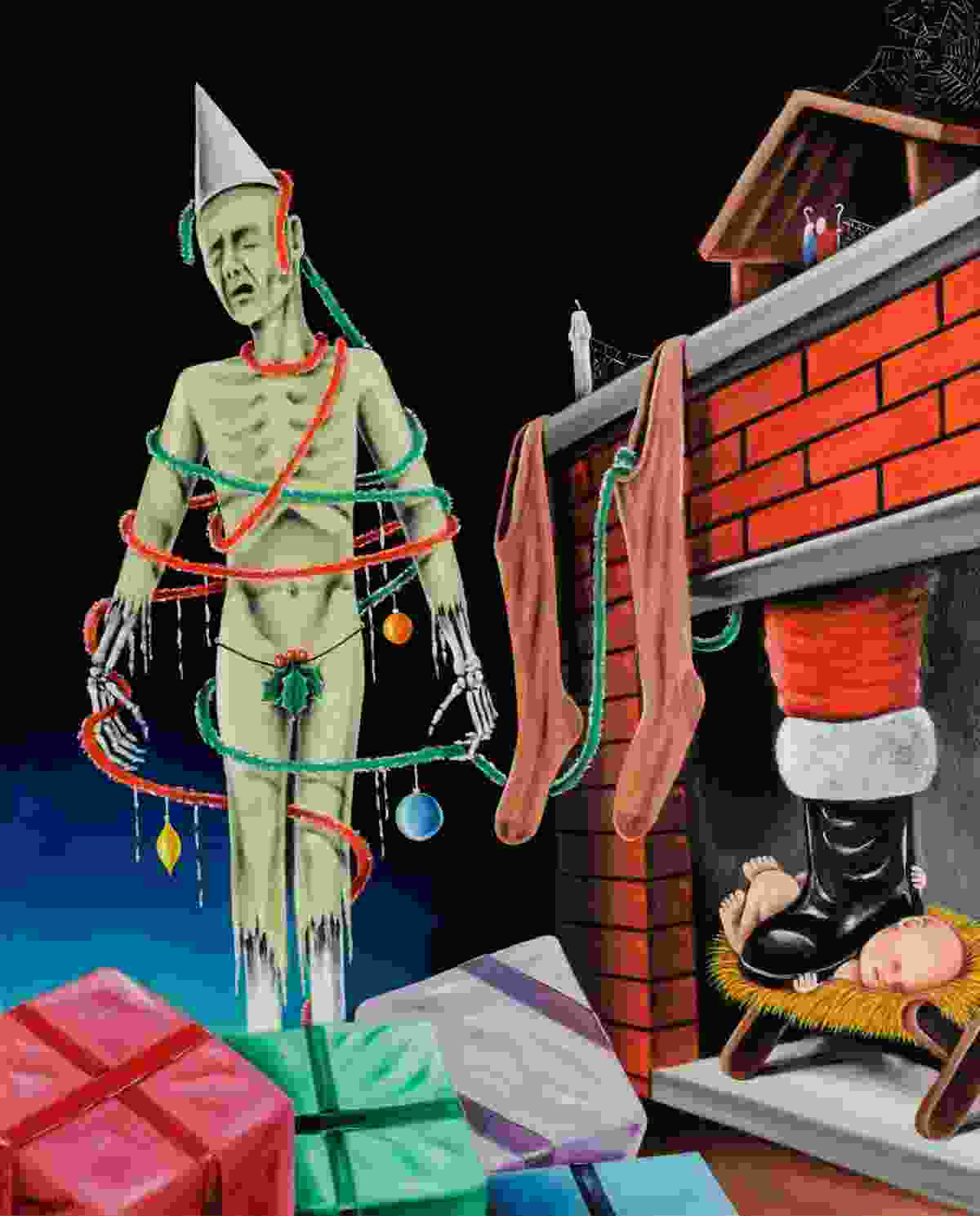
The greenish corpse of a man in a crucified position is draped with red and green tinsel. This human Christmas tree stands amid a mound of presents beside a fireplace hung with stockings. There is an infant in a manger in the fireplace, but Santa has come crashing down the chimney and crushed the baby with his big, black boot. Kevorkian titled it Fa La La La La, — La La, — La, — LA! The scene might have given the Grinch himself nightmares. Yet in the winter of 1992, Hugh Gale, a seventy-year-old man suffering from emphysema, told his wife that all he wanted for Christmas was a visit from Dr. Death.
A few years earlier, Kevorkian had come out of a Salvation Army depot with $30 of random parts. From a discarded Erector Set, various old toys, and bits of jewelry, he jury-rigged a machine he called the Thanatron. (Later he renamed it the Mercitron.) Three bottles were suspended from a rickety beam, one filled with a saline solution to open a patient’s veins, another with barbiturates for sedation, and a third with potassium chloride to stop the heart. After the Doctor connected the patient to an IV, he or she would pull a chain on the device to start the lethal medications flowing. He called it his “Rube Goldberg suicide device.” In an article published in the American Journal of Forensic Psychiatry, Kevorkian outlined guidelines for assisted suicide — eligibility limited to those who are mentally sound and unwavering, incurably ill and unbearably suffering — using placeholder names like “Wanda Endittal” and “Will B Reddy.” In June 1990, in the back of his VW van, the Doctor assisted his first patient, Janet Adkins, a fifty-four-year-old woman with Alzheimer’s who decided not to allow the disease that was robbing her of her mind to progress any farther.
Soon there were others. Kevorkian began receiving hundreds of inquiries from people desperate to end their lives. He had finally found his calling — a cause that people were not only willing to engage with but desperate to embrace. At first it was a Kevorkian family affair: his sisters, Flora and Margo, assisted him with the logistics. Until her own death in 1994, Margo acted as secretary, videographer, advocate, chauffeur, and nurse, often holding a patient’s hand through the procedure. Between 1990 and 1998, Kevorkian led over 130 terminally ill patients into the great beyond, often in state parks or vacant apartments. For each client, he tried to orchestrate a poignant, graceful passing. In the summer of 1993, Kevorkian assisted Thomas Hyde, a thirty-year-old man with advanced Lou Gehrig’s disease, in a particularly beautiful spot on Belle Isle, a wooded haven on the Detroit River. Hyde, who loved to hunt, wanted to die in the open air.
When Michigan revoked his medical license and he could no longer obtain barbiturates, he devised a second machine that used carbon monoxide. Arrested dozens of times, Kevorkian was tried repeatedly for murder. Yet he was always acquitted; his hawkish lawyer Geoffrey Fieger would play videotapes the Doctor had recorded of his consultations with desperate patients. Juries wept.
As he pressed on in his fight to legalize assisted suicide, Kevorkian again turned to art as a means to communicate his message, as a solace, and as a way to fund his crusade. He played smooth, spooky jazz on the flute with a group called the Morpheus Quintet, and produced an album called A Very Still Life. He hand-painted hundreds of novelty sun visors with the logos of major sports teams to sell at games. And he recreated his old paintings from memory, sometimes giving them new titles. (The Gourmet (On War) was a reworking of a late-sixties work called Genocide.) In perhaps his most harrowing canvas, a terrified, sickly man is sliding down a long, dark tunnel, scratching at the stone walls in a vain effort to slow his fall — his fingers worn down to ripped flesh and exposed bone. Below him, skeletal faces peer up out of the abyss. He titled it_ Nearer My God to Thee_.
“It really isn’t art,” Kevorkian said at the ALMA opening. “I call it pictorial philosophy.” In his exegesis of the painting, Kevorkian writes: “Most of us will do anything to thwart the inevitable victory of biological death… How forbidding that dark abyss. How stupendous the yearning to dodge its gaping orifice. How inevitable the engulfment. Yet, below are the disintegrating hulks of those who have gone before; they have made the insensible transition and wonder what the fuss is all about. After all, how excruciating can nothingness be?” It was like a dreamless sleep, Kevorkian surmised. (For the Doctor, whose dreams often kept him awake, this must have seemed a relief.) In a 1966 publication titled Beyond Any Kind of God, he writes, “Dreamless sleep entails absolute nothingness which we crave and know to be indispensable. It is an experience which affords us the unique opportunity to begin to ‘know’ the inscrutable essence of absolute nonexistence… which rules out any implication of transfer or transformation or transition from this world to any other world or to anywhere, anything, or anyone else. There could be no heaven, hell, purgatory, paradise, nirvana, moksha, or reincarnation — and no god.”
Kevorkian painted and repainted such works as Nearer My God to Thee in an attempt to shock the public into a new way of thinking. Death is an inevitable, natural nothingness. All humans should have the right to choose not to go on living if existence becomes unbearable. Everyone should have the right to die a “good death,” with dignity and planning. End-of-life treatment, hospice care, do-not-resuscitate orders — all should be openly discussed. And yet the Doctor’s death portraiture is so morbid that it seems to lead us away from the calm, dispassionate contemplation of death and into abject horror.
He may have been light years ahead of his time, but he was terrible at marketing. On one occasion Kevorkian harvested the kidneys from one of his assisted suicide patients and went on television, pleading for a transplant surgeon to take them and save a life. No one did. His house was constantly surrounded by angry bands of Right-to-Lifers chanting, confusingly, “Kill Kevorkian!” In 1999, he was convicted on second-degree murder charges after he euthanized a patient so paralyzed by Lou Gehrig’s disease that he was unable to start the Mercitron himself. Kevorkian filmed the death, mailed the tape to CBS, and dared the Supreme Court to charge him — to try to force the issue of assisted suicide onto the national stage. Yet the issue could never be disentangled from Kevorkian’s off-putting persona. On 60 Minutes, Mike Wallace asked a series of leading questions.
“You were engaged in a political, medical, macabre publicity venture, right?”
“Probably.”
“And in watching these tapes, I get the feeling there’s something almost ghoulish in your desire to see the deed done.”
“Well, that could be.”
In the debacle of a trial that ensued, Kevorkian fired his ace lawyer and insisted on representing himself. He was convicted after a day and a half.
From prison in 2004, Jack wrote, “Look at the forces against me — the government, the American Medical Association, pharmaceutical companies, and religion. Is there anything more powerful than these four?” In his cell, prisoner #284797 continued to write poetry and to compose minuets for flute and organ fughettas. He imagined an international, eBay-style auction site for organ trafficking, for which he bought the domain www.viscus.org. He worked on refining a new table of measurements for extremely small and extremely large magnitudes. (The number of atoms in all life on earth should be called a “Pynu or Pinu,” he wrote, without terribly much by way of explanation.) He plotted a campaign to run for Congress — and then, when he got out, ran as an independent in the 2008 elections. (He received 2.6% of the vote.) As he once told an interviewer, “I failed in securing my options for the choice [to die] for myself, but I succeeded in verifying the Dark Ages is still with us… When history looks back, it will prove what I’ll die knowing.”
In the fall of 2011, photographs began appearing on the internet of Ava Janus, Kevorkian’s niece and sole surviving heir, posing with the Mercitron. She was advertising an upcoming auction of Kevorkiana: empty prescription vials, a white bulletproof vest, a paintbox, his flute, the death machine. “There is no stop button,” Janus coyly told reporters. No one bought it. No one bought any of Kevorkian’s paintings, either, which Janus had offered for sale despite their presence in ALMA’s permanent collection. In a lawsuit that is yet unresolved, Janus disputes the claim that Kevorkian donated the works to the museum. At the auction, photographs of the paintings stood in for the originals, which are currently locked away in the first circle of ALMA’s vault.
In their place, the museum’s third-floor gallery features an exhibition commemorating Stalin’s Ukrainian victims, sponsored by the Connecticut Holodomor Awareness Committee. Visitors will find it curiously minimalist — there are no yellowing letters or relics of clothing, not a single artifact, just glossy Photoshopped posters of elderly, hunched-over peasants and emaciated children with eyewitness testimonials printed in bold, in-your-face type. And the headline, a hope dressed up like a promise — “We Must Not Forget!”
I turn back to my list of “Genocides that follow the Armenian Genocide.” Ukrainians were the third, after the Jews. The list ends with Darfur, and then an ominous “…Who Is Next?”
Perhaps it’s the silent question posed by all memorials, some more memorably than others. In the Spring 2010 issue of Yerevan — the one with Andre Agassi on the cover — there is a list of the top Armenian-genocide monuments worldwide, ranked by emotional impact. Number one is Tsitsernakaberd in Yerevan, a stele so tall and pointy it could make a kebab out of the moon. There are blank slates in Lyon, a skeleton of a church in Montebello California, an abstract winged creature in Cyprus, a modernist shrine in Sydney. Like the Doctor himself, the memorials at once deliver and soothe the sting of death. They are a sharp reminder to those who forgot and a salve to those who have always remembered, but need some surface onto which to draw the map of memory. The way they are photographed reminds me of a line from an Elizabeth Bishop poem, about an enigmatic monument: The view is geared (that is, the view’s perspective) so low there is no “far away,” and we are far away within the view.
It was only in his most delirious hours that Kevorkian linked his fight to legalize assisted suicide with redemption for Armenia. On one occasion in which he was incarcerated, pending an appeal, the Doctor went on hunger strike for eighteen days. He nearly died. In his cell, a hallucinating, disoriented Kevorkian told Hugh Gale’s widow, “I will not be a slave. My people were slaves, and they were slaughtered.” Moving beyond the commemoration of tragedy in its exceptionality, Kevorkian memorialized the universality of death itself. His monument was the fight for dignity and self-determination — in a world in which we are all just somebody else’s amoebas. After he was freed, his lawyer brought him a slice of apple pie, but Kevorkian refused it. Too much sugar, too much fat.
“Bet you never knew,” the Doctor once wrote, “that the swing tune ‘Celery Stalks at Midnight’ can always be counted on to make me smile.” It’s a Doris Day song, recorded during World War II. “Celery stalks at midnight/Looking at the moonlight/What’s this funny nightmare all about?”
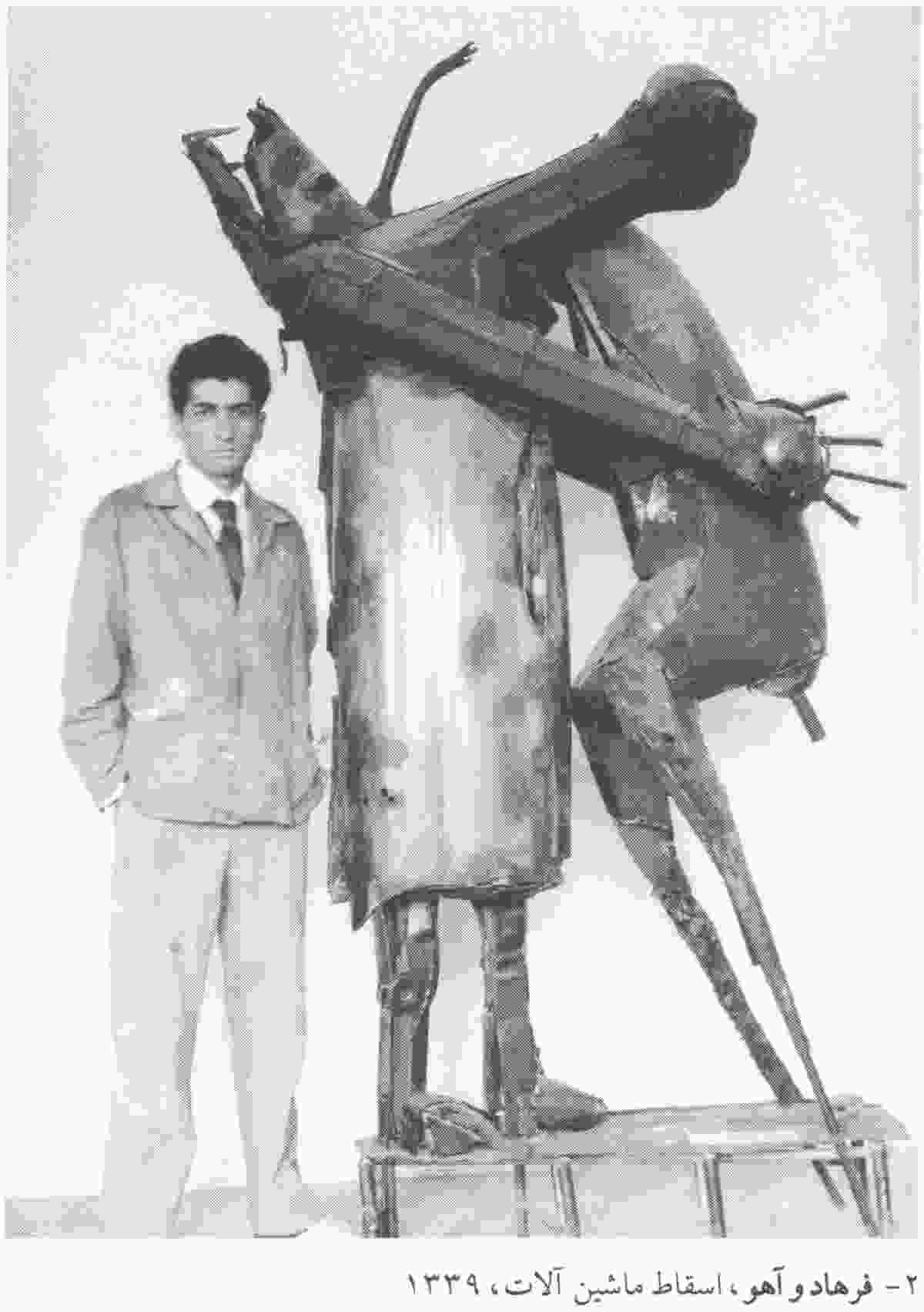
Parviz Tanavoli, Farhad and the Deer, 1960. From Atelier Kaboud, Bongah Publications, 2005
Tucked away behind the gleaming showcases of the Metropolitan Museum’s recently renovated Islamic art galleries, a smaller space hosts a handful of contemporary Iranian artworks.
Parviz Tanavoli’s bronze Poet Turning Into Heech presides in phallic glory over a glittering constellation of familiar names: grande dames Shirin Neshat and Monir Farmanfarmaian and rising stars Ali Banisadr and Afruz Amighi are rounded out by Y Z Kami, a painter of quiet but steady repute. All of the works were made in the last two decades, but this seems to be the only thing they have in common; each work takes up a different medium, theme, and stylistic approach. The artists themselves share neither generational concerns nor, as implied by their location in the museum, religious references. And yet there is another, unremarked, commonality to the works of these highly acclaimed artists — the obliqueness of their relationship to the country whose history and traditions they take up in their work.
Tanavoli, a major figure in Iran since the 1960s, became an international name when a monumental 1975 bronze sculpture broke auction house records at Christie’s Dubai in 2008 (to the tune of $2.8 million); he has lived in Vancouver since 1989. Farmanfarmaian, who first moved to New York in the 1950s, has been between continents ever since (more so in the past decade, after the rediscovery of her work by the new Middle Eastern art markets). Kami, Banisadr, Amighi, and Neshat all live and exhibit in New York. Neshat is arguably the most visible Iranian representative of what we might call the Imaginary Elsewhere. Her work was central to the Museum of Modern Art’s 2006 show Without Boundary, one of the first major attempts to assemble a canon of Middle Eastern contemporary art. The Asia Society, currently planning a large exhibition of Iranian art, inaugurated the project with a lecture each by Farmanfarmaian and Tanavoli.
Shows of this sort may do little to reconfigure the way we think of Middle Eastern art: the mainstream art press duly registers their tokenistic praise, sending out ripples of envy and/or contempt among artists not included, and pats on the backs of those involved. But these shows and their high-gloss museum catalogs are, in the long run, the authors of art’s history. All the hopes pinned on new Arab museums, plucky journals, and gallery monographs notwithstanding, institutions like the Met and the MoMA have inherited institutional privileges that could take several generations to unseat. They are the aristocracy of the art world: dignified, antiquated, conservative, and imbued with generations of legitimacy. Their high-powered exhibitions of “non-Western” art conveniently erase the tangle of class, education, and circumstance that is the peculiar if common predicament of living in a cultural diaspora.
Consider, by way of contrast, the 2009 exhibition Modernism and Iraq — a carefully curated and thoughtfully presented show of painting, sculpture, assemblage, and even video from twentieth-century Iraq, organized at Columbia University by two established historians of ancient and modern Iraqi art. The work on view was idiosyncratic, vibrant, and occasionally dreadful; it was, in any case, unconcerned with explaining itself to the viewer. It spoke to local themes and pedagogic lineages. Some of the (living) artists were still based in Iraq, but not many of them would have been capable of representing Elsewhere in the manner of the artists at the Met; their work was simply too insular. Heroically itself, Modernism and Iraq slipped seamlessly from view, and few of its artists have turned up in New York galleries or museum collections since. For an artist to make it into a museum, her work must anticipate its ambassadorial function, representing whatever is happening Over There — say, in the region situated in gold lettering above the Met’s gallery entrance as “The Arab Lands, Turkey, Iran, Central Asia, and Later South Asia.” (Just don’t call it Islamic.)
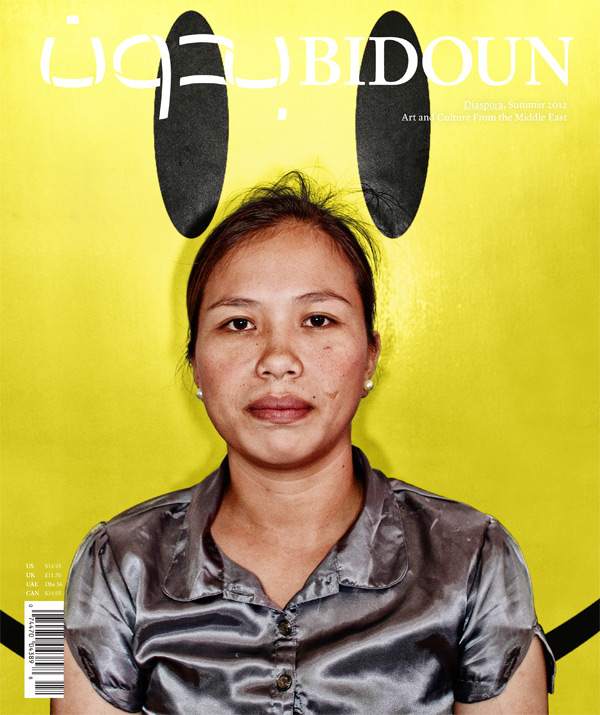
The situation is a familiar one for the Bidoun reader. Much ink has been spilled scrutinizing the problems inherent in representing difference (or… anything at all) in museum settings. We love to complain about the potholes and dead ends of this road paved with good intentions. We’ve called it neo-colonialism, ethnic marketing, postmodernism or cosmopolitanism or hybridity, bourgeois-ethno-chic, opportunism. We have attributed this system of value to the commercial imperatives of auction houses and galleries. Despite routine protestations, we seem incapable of changing the terms of the conversation, and the backstage dynamics remain invisible to all but privy insiders with critical leanings.
But what is being rendered invisible here is more than institutional opportunism or fortuitous professional circumstances. For the diaspora artist — I use the term the way I would use “disappearing artist” or “trapeze artist” — the conditions of living or belonging Elsewhere have been skillfully translated into the poetics of representation. Hers is a distanced, self-conscious yet self-effacing belonging. Identity becomes emphasized because it is never a given. Not only must she construct her point of reference, she also needs to evoke a community that is too dispersed to be easily recognized. What the work of the diaspora artist represents is primarily its own diasporic condition. It performs public gestures of belonging, staging its loss so as to overcome it through visual pleasure. The diasporic artwork brings out the viewer’s deep desires — for roots, for poetic depth, for historic and political relevance — and then resolves the traumatic backstory with a neat visual twist. Its self-fulfilling premise and very public narcissism are precisely what appeals to collectors, curators, and museum audiences (and authors of art history textbooks).
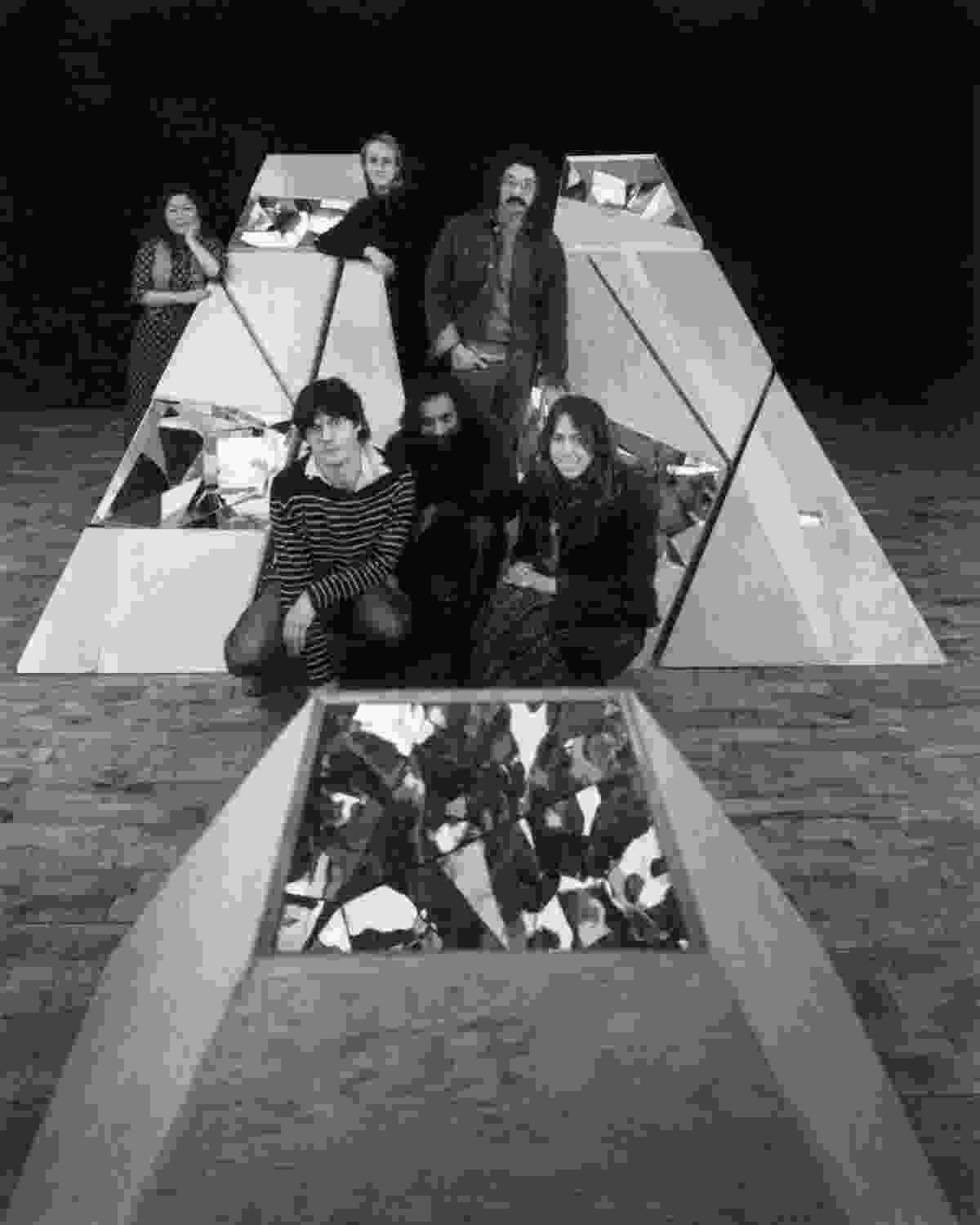
The success of a diaspora artist depends less on subject matter than on the accessibility of their work. The true diasporic artwork can’t be too complicated. The sensory experience it invites must be available to all kinds of viewers. Allusions to biography, current events, or mystic philosophy are always good. Tanavoli enshrines “nothing” (the literal translation of heech); Farmanfarmaian shatters the viewer’s self-image with fragments of artisanal mirrorwork; Amighi gives us flitting shadows of abstract pattern to “represent… her native country’s turmoil.” Neshat simply gives us an icon: the chador-clad woman with a gun. Her black and white photographs are also self-portraits, though the artist herself does not wear a chador (nor, it seems safe to say, pray with a gun by her side). Neshat’s Woman of Allah is less an emblem of “Iranian women’s involvement in the Iran-Iraq war” than it is a rehearsal of viewerly expectations, partaking of stereotypes (or better yet, anti-stereotypes) of an Elsewhere that is more mysterious and relevant that our banal Here and Now. More importantly, the work stages the fulfillment of the diaspora artist’s wishes — for belonging and for cultural and political relevance.
This is not an attempt to draw lines in the sand between those who “authentically” belong and those who lack some essential cultural rootedness. True, the diaspora artist is often driven by the desire to reunite with, speak for, support, and/or extend the cultural Imaginary of the homeland. (In contrast, say, to the scores of young artists lined up outside European embassies in Tehran, Dubai, and Damascus who will only look back to the deep poetry of their homeland once they are safely ensconced in an MFA program abroad.) In fact, the diaspora artist often protests her representative status quite vehemently, sometimes parlaying it productively into the work itself (as with Emily Jacir’s 2001–03 Where We Come From, where the Palestinian artist uses her American passport to traverse borders otherwise closed to her.) I wish rather to introduce a new basis for understanding what I am calling the diasporic artwork: our deep attraction to the psychological pleasures of a substitute belonging.
Of course, there is already a word in our critical terminology for this pathological process: the fetish. In Fetishism (1927), Freud described the mechanism by which we ward off loss and protect ourselves from future trauma through fetish objects. “The subject’s interest comes to a halt halfway,” he wrote. “[I]t is as though the last impression before the uncanny and traumatic one is retained as a fetish.” Think of the cottage industry of tragic autobiographies by Middle Eastern women “in exile.” (Farmanfarmaian’s own charming tome, A Mirror Garden, is one of the better examples.) Child psychologist Donald Winnicott’s “transitional object” is another apt take on the diasporic artwork: it produces an illusion of the satisfaction that used to be provided by the now-absent mother (or motherland). Nineteenth-century psychologist Alfred Binet, one of the first to use the term “fetish” in a sexual context, liked to distinguish between “normal love” and “plastic love,” the latter consisting of a devotion to objects rather than people, to the part rather than the whole. “The love of the perverted is a play in which a minor character steps into the limelight and takes the place of the main character.” The story of loss is perverted and subverted in order to ward off future loss and give satisfaction through what Freud called “disavowal.”
Of course, “fetishism” is usually taken to be pejorative. And yet a fetish is also one of the most powerful examples of a social object, a material occasion for an individual to relate to the values of a collective Imaginary in a deeply personal way. Historian William Pietz gives an inventory of such occasions: “a flag, monument, or landmark; a talisman, medicine-bundle, or sacramental object; an earring, tattoo, or cockade; a city, village, or nation; a shoe, lock of hair, or phallus; a Giacometti sculpture or Duchamp’s Large Glass.” Our diaspora artist is in good company. Her fetish objects use personal disavowals as tools to create figures of collective history out of chaos and contingency. While there is some sleight of hand in what she does, in the best tradition of the historic fetish object — the Portuguese word feitiçio meant “magical practice” or “witchcraft” — there is also a great deal of personal truth.
Acknowledging that the Elsewhere we encounter in the work of the diaspora artist is a complicated personal construction restores long-hidden nuances to their work. Talk of the fetish sweeps aside the dignified rhetoric that reigns in the thickly carpeted precincts of museums the world over. Parviz Tanavoli is celebrated for his bronze walls of illegible calligraphy — soaring monoliths of a lost culture, complete with high-cultural references and a twinge of pathos — which would fit in nicely in most any corporate lobby. But in the late 1950s, the young Tanavoli rebelled against both his conservative artistic training in Iran and the precious lessons of a residency at Carrara’s marble studios. He returned from trips to Europe and America — his first encounter with Elsewhere and its representation — ready to go it alone, using bits of scrap metal to make perverse robotic couples rife with sexual allusions, genitalia that curved out as spigots, and scatological references that summoned all the crude force of south Tehran. He is certainly worthy of inclusion in the both local and global canons — just not as a banal sculptor of decorative bronzes. Tanavoli recognized the logic of the fetish early on, and his monumental phallic bronzes need to be understood in relation to the larger iconoclasm legible in his whole body of work.
The diaspora artist produces a kind of collective statement that is even more valuable if understood for what it is: artwork that emerges primarily out of the conflict of individual desires. Art must be uncoupled from journalism: the Elsewhere the artist engages within her work is not a real geographical location; it is an imaginary place. The political import of these works has less to do with representation than with the pleasures and perils of storytelling, the effort to recast the everyday into mythical structures that speak to universal desires.
“They cannot represent themselves; they must be represented.” The epigraph of Edward Said’s Orientalism (a regrettable quote from Marx) springs to mind here, not only because the temporary exhibitions room at the Met is located near a small gallery of Orientalist paintings — dark-skinned men, bazaar and kitchen scenes, the occasional tiger in the wild — but also because Said’s ghost seems to be pacing these hallways, not quite sure of what to make of the turn of events. These exhibitions seem to offer a long-awaited shift in the power dynamic, as though the subjects of the paintings have emerged to speak for themselves. To denigrate their ability to represent their own reality would seem to be complicit with age-old histories written by the imperialist victors. Is it not time that “they represent themselves?” That is precisely my point here. If the Orient was a European construct, the subjects in Orientalist paintings mere imaginary screens for the projection of European desires, then turning the tapestries will result in portraits no less imaginary or constructed. And it is precisely this artificial, fantastical quality that needs to be discerned, and presented, clearing the way for a less coherent set of voices to emerge amid the museum hush.
Two Clarkes walk onto the roof of the Chelsea Hotel with a laser: it sounds like the start of a bad joke, and in a sense it was: a cosmic joke, a stoned prank, a sad story, really, with not many laughs. But if you’re looking for laughter, Shirley and Arthur on the roof with the laser beam may be your last chance.
Shirley Clarke was an indie film auteur and video trickster who ran something called the TeePee Video Space Troupe out of her home at the Chelsea, a trial run for what she called “the Pleasure Palace Theaters of the Future,” labyrinthine multimedia spaces that would be both liberated and liberating. The Chelsea Hotel was the prototype: the whole building was wired. The Troupe’s preferred medium was video, but they didn’t make tapes. They held rituals, live, in front of flickering effigies made of video monitors as dawn broke over the city; they communed in the pyramidal structure that Shirley called the TeePee, and spread out through the elevators and hallways, intent on Rimbauldian derangements of the senses.
It wasn’t the kind of scene that left very much behind, anything except stories, like the night the science fiction writer Arthur C. Clarke showed up at the TeePee with a long rectangular box containing a laser beam projector loaned to him by a techie fan of 2001: A Space Odyssey. “Shirley and Arthur giggled like kids phoning in bogus pizza orders,” DeeDee Halleck, a Trouper and media activist who went on to found Paper Tiger Television, remembers. Arthur was an irregular but welcome presence at Shirley’s rooftop salon-cum-laboratory, which convened more or less continuously from 1971 to 1975; video held a utopian appeal for him, too, as a herald of the new technological epoch just around the corner, along with orbital satellites, robots, and manned spaceships. At the Chelsea, the technofuturist and the performance-art prankster came together — not for the first time — to bedevil the man and woman on the street. Passersby kept trying to pick up the bright red object on the ground, and “both Clarkes roared with laughter as they made it jump five feet out of reach.”
But it would never have happened without Shridhar.
This first-generation laser pointer was too bulky, too heavy, to be wielded by hand, particularly the hands of the TeePee’s regulars. Shridhar improvised a mount out of a tripod, then fixed the tripod to the roof ’s edge, allowing the laser beam to swing freely according to the whims of the Clarkes. Shridhar Bapat was Shirley’s assistant, the tech guy at the pleasure palace; he’d joined the Troupe after leaving The Kitchen, where his official position was Director (if you believe the paperwork) and unofficial position was factotum and dogsbody. He was an expert at managing what they used to call Spaghetti City — the mess of wires that connected cameras to monitors, early video synthesizers and recorders, tape to reel. It wasn’t easy in the first place, and almost everyone was stoned, anyway. But Shridhar could keep the video cameras from jamming, the tapes from spooling off the open reels; he could rig up monitors and cameras into complex machines for the production of video feedback.
Even Shirley Clarke is almost forgotten now, and Shridhar doubly so, way more than five feet out of reach. But back then he was always there, behind the scenes, making things work. John Hanhardt, senior curator for media arts at the Smithsonian American Art Museum, put it to me like this: “He was a major player. How many people have worked with the range of artists he worked with?” Nam June Paik’s tremendous grasp of television’s potential as an art medium required technically adept assistants like Shridhar, who worked for him off-and-on for a decade. He helped Shirley Clarke realize her most far-fetched ideas — and Woody and Steina Vasulka, and Al Robbins, and every other major videographer east of the Mississippi. Sound artist Liz Phillips, whose first show at The Kitchen included a complex multimedia piece called “TV Dinner,” remembers that Shridhar made it possible. “He was really, really good. Before I knew it he was taking the image from the table and bouncing it all over the room. He had the sense of how to take what we were doing and turn it into a viable installation.”
He could even manage just fine when he was drunk.
1. The Aleph
I am a cybernetic guerilla fighting perceptual imperialism… VT is not TV. Video tape is TV flipped into itself… [Tape is metatheater…] Tape is feedback.
— Chloe Aaron, “The Video Underground,” Art in America May/June 1971
People remember Shridhar Bapat fondly because they remember themselves fondly, remember those years fondly, when the first flowers of the videotape underground bloomed in the smoky air of Lower Manhattan, in burnt-out basements and moldering once-grand hotels, in unheated lofts and screening rooms. They were by turns infantile, mind-bending, self-obsessed and eerily prescient, a motley tribe of longhairs and losers, communitarians and Uptown-gallery poseurs, attended by a coterie of tech-heads armed with duct tape, Q-tips, and obscure expertise acquired the hard way. And they were busy: recording hipsters and their sidewalk raps and Hells Angels chopping their bikes before a big ride; Panthers brooding and women’s libbers on the march; fabulously furry freaks fucking, stoned, on quilts, illuminated by the strobing low-fi emissions of a wall of TV sets. But the recording wasn’t the point, not yet; they thought they were laying the foundations for a better global village, peopled by citizen-transmitters and citizen-receivers. In the new “media ecology,” the art world would soon cease to exist, along with the banking system, broadcast television, rent, antiperspirant, and the military-industrial complex.
The revolutionary weapon that made all of this possible was the Sony Portapak, a Japanese invention that arrived on American shores in 1967. Eleven hundred dollars would get you a bulky open-reel videotape recorder, a separate camera unit with a built-in mic, a battery pack, and a power adapter. A twenty-minute reel of tape set you back fifteen bucks — and unlike film, required no further developing or processing. It could be played back right away, or you could just erase it and start over. With the Portapak, suddenly the first generation raised on broadcast television had acquired the means to create stations of their own.
For Shridhar and for scores of others, this medium that barely existed became a way of life. He’d learned the basics of video at the New School, in a class taught by Global Village, the first of the city’s video collectives. Its name derived from Marshall McLuhan, whose thinking about media and consciousness made an outsized impression on the video scene, and who’d arrived in New York in 1967 to teach at Fordham University. His students included Paul Ryan, cofounder of another collective, the Raindance Corporation (a riff on the RAND Corporation, itself an acronym for Research ANd Development), and its offshoot journal Radical Software. A third group that called itself Videofreex would go on to launch the world’s first pirate TV station. By 1971, videotapes, including Shridhar’s, were being shown at the Whitney and at The (brand-new) Kitchen, and the number of videotape auteurs went from dozens to thousands. Collectives and alternative distribution systems, ’zines and screening rooms, sprang up across the globe.
It was a milieu in which the old media seemed exhausted, wrung dry after two decades of successive -isms and movements. In the first edition of the influential Video Art: An Anthology, published in 1976, Hermine Freed described how video had arrived “just when pure formalism had run its course; just when it became politically embarrassing to make objects, but ludicrous to make nothing; just when many artists were doing performance works but had nowhere to perform, or felt the need to keep a record of their performances.” At a time when the status of the art object was an open question as never before, the process-orientation and the immediacy of the low-fi videotape felt like the answer.
But the immediate target of the early video activists wasn’t the art gallery or the museum — it was the mass media, especially television. In his influential Expanded Cinema, first published in 1970, Buckminster Fuller acolyte Gene Youngblood called television “a powerful extension of man’s central nervous system. Just as the human nervous system is the analogue of the brain, television in symbiosis with the computer becomes the analogue of the total brain of world man.” The new age, the cybernetic age, would combine “the primitive potential associated with Paleolithic” with the “transcendental integrities” of the Cybernetic, producing a new man, an ideal figure whom Youngblood envisaged as “a hairy, buckskinned, barefooted atomic physicist with a brain full of mescaline and logarithms, working out the heuristics of computer-generated holograms or krypton laser interferometry. It’s the dawn of man: for the first time in history we’ll soon be free enough to discover who we are.” Gnostic truth and feedback loops: the visual analogue of the sound of Hendrix at Woodstock was the tripped-out pattern made by a camera turned back in on itself. Woody Vasulka says that when he first saw video feedback, “I knew I had seen the cave fire.”
Courtesy Bob Harris
Early video exploited video feedback both as a tool for creating utopian communications systems and as a source for psychedelic pattern-making. In the most influential early multi-monitor video installations, you could watch yourself watching yourself; cameras could be pointed at each other, at monitors, generating pure electronic signals in the tube, a videospace pulsing with feedback’s overflow and excess. This was Shridhar’s element. He boasted to his friend Bob Harris that he was “the best feedback camera turner” in New York. A night watching — or making — videotapes with Shridhar was a trip to the other side. The titles in a handbill advertising a “video mix” by Shridhar Bapat at The Kitchen in 1971 hint at the cocktail of noisy electronic abstraction and metaphysics that intrepid viewers could expect to take in:
Om
SerendipityR.f.House of the Horizontal SynchStar Drive
Shridhar’s early videotapes are invisible now, like so much else, the only copies sequestered, unseen and unseeable in Northwestern University’s Special Collections. (Early videotapes are extremely fragile; the policy at many collections, including Northwestern’s, is that a tape cannot be screened even once until it is digitized.) The one I’d love to see is Aleph Null, a tape inspired, I take it, by Jorge Luis Borges’s 1945 short story “El Aleph.” Shridhar, for all his love of the image, was rarely seen without a book.
“El Aleph” is the story of a writer — also named Borges — who finds himself flat on his back in a cramped Buenos Aires cellar, staring into the darkness and contemplating whether his nemesis, the fatuous poet Carlos Argentino Daneri, might have buried him alive to prevent him from disclosing the madness at the heart of Daneri’s megalomaniacal project: a complete description of the world and everything in it, in verse. Daneri lured him there with talk of an otherworldly object, part secret weapon, part muse: an Aleph, “the only place on earth where all places are — seen from every angle, each standing clear, without any confusion or blending.” As Borges lies in a panic, convinced of his doom, the Aleph suddenly appears to him, and what it reveals seems very much like the realization of video’s spectacular promises:
I saw a small iridescent sphere of almost unbearable brilliance. At first I thought it was revolving; then I realized that this movement was an illusion created by the dizzying world it bounded. The Aleph’s diameter was probably little more than an inch, but all space was there, actual and undiminished. Each thing (a mirror’s face, let us say) was infinite things, since I distinctly saw it from every angle of the universe.
Overwhelmed by the desire to describe the endless simultaneity before him — this infinite, recursive net of self-reflecting mirrors — Borges’s sense of time and space collapse, abandoning him to a mock-epic catalog of things, a spaghetti city of words, the ranting of a subterranean, self-loathing Whitman manqué. At last the Aleph’s technological sublime blows his mind like a four-faced God in heavy, holy spate:
I saw the Aleph from every point and angle, and in the Aleph I saw the earth and in the earth the Aleph and in the Aleph the earth; I saw my own face and my own bowels; I saw your face; and I felt dizzy and wept, for my eyes had seen that secret and conjectured object whose name is common to all men but which no man has looked upon — the unimaginable universe.I felt infinite wonder, infinite pity.
Shridhar Bapat and Nam June Paik, mid-1970s
2. Infinite Wonder
“He was the first and only salaried person at The Kitchen,” Steina Vasulka told me. She spoke to me on a video chat from the home she shares with her husband Woody Vasulka in New Mexico, remembering The Kitchen’s earliest days, from 1971 to 1973, when it was still located in the former kitchen of the Broadway Central Hotel, in the Mercer Arts Center. “He had hair that I thought was too long. He had these eyes, this dark brown color, and kind of a beautiful, interesting face. A very low voice that he never raised.”
At one point some French video artists came wanting to do a show at The Kitchen but they spoke only French. “Shridhar was there working in the back in his quiet way. He came out and said, ‘Maybe I can help.’ That was how we found out that he went to the finest schools in Switzerland… this tiny Brahmin who spoke perfect French.” The trajectory that had brought Shridhar to the new medium was unique, but so was most everybody’s. Steina and Woody Vasulka had come to New York from Iceland and what is now the Czech Republic, respectively; Shigeko Kubota from Japan; Nam June Paik from Seoul via Hong Kong, Tokyo, and Darmstadt. Their milieu — the whole New York avant-garde at the time, really — was full of outsiders and expatriates.
Shridhar’s journey had begun in India, sometime around 1948. He may not have been one of Rushdie’s “midnight children,” born during Nehru’s famous speech marking India’s independence from Britain at the stroke of midnight, August 14, 1947, but Shridhar was definitely a child of the morning after. His father, Shriram C. Bapat, was a high-ranking diplomat in Nehru’s government, and the family left India for Japan as part of a UN delegation sent to assess the long-term effects of the atomic bomb. Shridhar was two. Soon thereafter they moved to New York, where his father was a key member of India’s delegation to the UN. Shridhar spent most of his childhood in suburban Westchester. He was a small, slight kid who liked to play in the parks, learning to speak with what his high-school friend Bob Lewis called a “New York cadence” — a boy invested with all the bright prospects of an elite Indian family, swimming at the high-water mark of an optimistic age.
His Westchester idyll came to an end in 1962 when his father was transferred to Ghana. They sent Shridhar to Geneva, to the bilingual Ecole Internationale du Genève. Better known as Ecolint, it is the oldest operating “international school” in the world, a deeply cosmopolitan institution with students from across the globe, many of them from diplomatic families like the Bapats. Nehru’s own daughter, the future Prime Minister of India Indira Gandhi, had attended Ecolint for a year in 1926.
Shridhar graduated from Ecolint in 1968. According to his yearbook page, Shridhar Bapat, India (“not one for apathy”) had risen to the rank of Head Monitor (“that Indian guy”), Intern Senior Prefect, President of the Finance Committee, United States delegate to the school’s model UN, chairman of the Political Seminar, Bridge Club member; a student whose “fond souvenir” consisted of “growing up in L’internat, Genève.” A handwritten note on Bob Lewis’s yearbook reads: “Louieee: Zo, ve haf reached the end of the Ecolint milk run. As I go out into the big bad world, leaving behind me this womb to beat all wombs, I wish you success in whatever you end up doing. Fate, mystical inner knowledge et al. Ciao.” Shridar’s plans were twofold: “University in England; Career in govt.; to plumb the depths of human conceit.” With hindsight, we might say he got it about half right.
1968 was either a great year to arrive at the London School of Economics or a terrible one, depending on your ambitions. It was a hotbed for highly factionalized ultra-Left politics: fired up by the antiwar protest-turned-riot in front of the American embassy on Grosvenor Square in March of that year, stoked by Paris’s revolutionary month of May, and abetted by charismatic student leaders like Tariq Ali and radical chic icons like Vanessa Redgrave, some three thousand students at the LSE occupied its administration buildings in October of that year. When the dust finally settled, many were expelled, Shridhar among them. From London he made it back to New York and somehow found his way downtown, quickly becoming the quintessential video scenester.
I first encountered Shridhar’s name while looking through archived documents from The Kitchen’s earliest days for traces of another of New York’s avant-garde Indians, Pandit Pran Nath. “Shridhar Bapat” was listed everywhere, as director of video programming, as program director, as curator. Seeing him there next to names that were famous (or at least, recognizable), I wondered who he was and why I had never heard of him. I thought at first that it might have been some kind of prank, a “Mahatma Kane Jeeves” buried in the paperwork. But I asked around, and before long my inbox was inundated with emails, solicited and not, from artists and TV people, public-access activists and professors, all of whom wanted me to know something about Shridhar.
Courtesy Beryl Korot
I spent the next year interviewing dozens of them. But even then, his story was full of holes — lies, too — and it ended in the biggest, blackest hole of them all. His history was itself a kind of cipher, an almost imperceptible gap in the now-accepted narrative of video history, one that opened up onto an alternate recension of that history. Last year, when The Kitchen celebrated its fortieth anniversary with The View from a Volcano, an exhibition of artifacts and photographs documenting its development, Shridhar appeared just once, a small face in a group shot on a wall near the door, hardly visible amid all the famous lava bombs going off in the other parts of the room.
His years at The Kitchen were the high point of Shridhar’s professional life. He was part of the first generation there in 1971, along with his friend Susan Milano, another young long-hair named Dimitri Devyatkin, and Rhys Chatham, the seventeen-year-old director of music programming. Video artist Shalom Gorewitz, who wrote a monthly column about video for a magazine called Changes in the Arts and was at The Kitchen “practically every night” in those days, saw Shridhar “as the glue that held all the things there together.” When he was there, Shalom told me, things ran smoothly; when he was not, things fell apart.
He was a highly effective curator — though in those days they disdained the term, with its exclusivist connotations. With Milano he organized the first Women’s Video Festival at The Kitchen in 1972. Many of video’s earliest and most enthusiastic adopters were artists associated with the feminist movement. (By Steina Vasulka’s estimate at least a third of the people making video in the early seventies in New York were women.) It’s no small measure of Shridhar’s diplomatic instincts that he was intimately involved in creating a visionary feminist institution at a moment when the culture wars around women’s rights were erupting in full force.
It helped that Shridhar was more at home behind the scenes — more interested in rigging the equipment, setting up screenings, and soliciting others to contribute than in putting himself forward as an artist or figurehead. He played a similar role for Charlotte Moorman’s New York Avant Garde Festival from 1971 until at least 1977, including the 1972 festival, held on a Hudson River excursion boat, its wheelhouse transformed by Shirley Clarke into a futuristic I Ching fortune booth. Liz Phillips served spaghetti on an amplified tabletop while Yoko and John circulated among the artists, asking questions. (Liz claims she answered a few of John’s, thought they were very intelligent questions, and then asked him who he was.) Elsewhere visitors took turns on Nam June Paik’s TV Bed, a sculpture comprising a mattress made from six television sets facing up and covered with glass, with two more sets making up the headboard. A camera above the bed captured and transmitted the face of anyone who lay down on it to all the TVs. It’s safe to say that the intricate tech work required to pull all this off was Shridhar’s.
These were tumultuous, formative years. His parents had left for India, leaving him an apartment on West 103rd Street that he shared with an old high-school friend named Conrad Sheff. He transferred from the New School to Columbia and then flunked out, losing his student visa in the process. He managed to get a clerical job at the UN with his parents’ connections, but when that went south he became, technically, an illegal immigrant; to get a new visa he would have to go to India and begin the immigration process from there. Shridhar never made the trip. Then one late night in October 1971 he was mugged on his way back uptown and severely beaten. Sometime afterward Shridhar lost or left his place on 103rd and moved to an apartment in the Village, from which he was evicted — he told friends for health code violations — and eventually wound up sharing yet another apartment with Conrad Sheff, this time on the Bowery.
In December of 1971, Shridhar’s Aleph Null was shown as part of the second night of video programming ever done at the Whitney, a Special Videotape Show curated by David Bienstock as part of his influential New American Filmmaker Series. Roger Greenspun, in a review in the New York Times, described it as “visually stunning,” but complained that it didn’t “escape the tendency toward trivia that characteristically haunts attempts to confer actual movement upon forms that, if still, would suggest nothing so much as the potential for movement… for all their vigorous ingenuity, the tapes seem to channel rather than to free ways of seeing.”
Greenspun’s comment sticks in my mind when I think about Shridhar at The Kitchen: the tape’s failure to live up to its own aspirations seems like a reflection of other sets of contradictions that were taking shape around Shridhar, and a harbinger for more failures to come. Among Shridhar’s close friends from that period there is a lingering sense that, for all of his indispensability, Shridhar was being exploited. Dimitri Devyatkin thinks that “he was beloved, but he was also used. People took advantage of him.” He was the kind of guy who would work all night and didn’t care about money — a good guy to have around. “In the two years I worked at The Kitchen,” Dimitri told me, “I saw a real change. We were getting overpowered by artists and people who could get grants. There turned out to be a lot of egos in that anti-ego culture.” Bob Lewis, a friend of Shridhar’s from Ecolint in Geneva who had reconnected with him in New York pushes back against any nostalgia: “I left the scene because I was fed up with the culture. I found it massively distasteful, self-regarding, self-involved… at some point the focus on fine art became its death-knell.” Another of Shridhar’s old friends, Victor Han, agrees: “there was a lot of infighting, people started splintering.” But Shridhar “was like this magical cog. Well respected, well liked.”
He may have been well liked, but he wasn’t well remembered. In 1973 The Kitchen moved to Wooster Street in SoHo, with an accompanying upgrade in style. After the Vasulkas left for teaching gigs in Buffalo in 1974, Carlotta Schoolman took over video programming. The locks were changed, Shridhar was gone, and for many of The Kitchen’s earliest habitués, so was its charm — its informality and open-endedness, its anti-curatorial ethos and focus on process over product. Shridhar went to work with Shirley Clarke and the TeePee Video Space Troupe, and his seminal role in establishing The Kitchen was forgotten. Or was it erased? DeeDee Halleck was convinced that Woody and Steina Vasulka had wronged him. When I spoke with her by phone, she was still angry, saying that she had confronted the Vasulkas about Shridhar some years ago, at a presentation about The Kitchen’s early days, accusing them of disappearing Shridhar from the institution’s history. At the time, she says, she sensed “a racism that was palpable.”
It wasn’t palpable any longer, at least in my own conversation with Steina Vasulka. She remembered him with great fondness, tinged with a sense of failure. “We started to find bottles here and there. That’s how we figured out slowly that he was drinking. Now I know exactly what it means, then I didn’t…”
One of the few completely uncontroversial things you can say about Shridhar: the man loved to drink. By the mid-1970s, it was becoming a big problem.
Was it the booze that made him lose his footing? Did the Portapak invent video art?
These are not dissimilar questions.
3. Infinite Pity
People remember Shridhar with regret because that’s how they remember themselves — their disillusionments and disappointments, their selling out or failing to sell, their settling down and surviving. That whole electro-cybernetic loop and its magic? The salvific promise of feedback? Long since gone. In an instantly famous essay for the inaugural issue of October, published in the spring of 1976, Rosalind Krauss argued that video would save no one. “Reflexiveness in modern art,” she wrote, “is a doubling back in order to locate the object,” whereas the “mirror-reflection of absolute feedback is a process of bracketing out the object.” Video depicted “a psychological situation, the very terms of which are to withdraw attention from an external object — an Other — and invest it in the Self.” The real “medium of video is narcissism.” In the well-looped prison of self-surveillance, the ghost in the machine is Narcissus, with his infinite self-regard; the snake eating its own tail is Onan.
Dear Alex,Before you build up too much expectation, be prepared for a sad story, with little to show. The devils that tormented Shridhar included his upper-class diplomat parents, their plans for Shridhar, his revolt against his family, his battle with alcohol, loneliness, homelessness, the art world, the gallery and foundation world. There is not much to glorify. I would question what it is you really expect to find and what your motivation is in writing this article. I expect readers to wonder why you decide to write about him. I send you my warmest wishes and hopes for success.All the best,Dimitri
At Northwestern University’s McCormick Library I met Scott Krafft, curator of special collections, to look for evidence of Shridhar’s life and movements in the library’s Charlotte Moorman Archive. Moorman, the performer and model for Nam June Paik’s 1969 TV Bra for Living Sculpture, was a cellist, performance artist, and impresario; Shridhar was deeply involved with her New York Avant Garde Festival in the 1970s. There were all sorts of scraps, notes, and postcards with his name on them in the archive. One caught my eye immediately: an unopened letter from the alcoholism clinic at St. Vincent’s Hospital in Greenwich Village, postmarked December 1975, addressed to Shridhar care of Moorman. From the documents at Northwestern it is clear that he was doing a lot of couch surfing, crashing intermittently at Moorman’s apartment up on West 46th Street, sometimes staying with friends.
Krafft suggested we open the letter and see what’s inside, though it’s easy enough to guess — it’s a letter from St. Vincent’s asking him why he’s been missing appointments. There are many notes to Charlotte: promises to clean up, to stop hurting people, to “be better.” His handwriting varies dramatically. There is a hastily scrawled message on the back of a flyer advertising a midnight screening of Ben Hayeem’s The Black Banana: “Finally got my money and am getting a room on a weekly basis. Will give you the no. when I find it out. Thank god this week is almost over! Sorry about all those weird messages.” Another letter, written in an extremely precise hand and arrayed in bullet points, mentions that he is going to Alcoholics Anonymous and apologizes for his role in a “psychodrama” at Charlotte’s house. “I am trying to change,” he says, thanking her for having “helped me in some pretty dicey times… Excuse all the cliches, but sometimes they are true, and I am grateful for everything from the bottom of my heart. I hope I can continue to help with the Festival in any way you find appropriate in the coming year.”
One letter from September 1977 lays out his whereabouts for the next week and how to reach him, including an answering machine and a “live human who pretends that it is my ‘office’ during business hours only.”
Shridhar was a legendary drinker and prone to binges. He got high too, although in the early days that wasn’t really his thing. Leanne Mella, a public-access television activist and frequent visitor to the Whitney’s film and video department in the seventies, remembered a drunken Shridhar falling off a radiator at a party there. Almost everyone I talked to had a story about him getting wasted or getting them wasted or both. “One night Shridhar took me on a tour of where to drink on the Bowery, and how to drink,” Liz Phillips recalled. “I think it was 1973. I would never drink that much again in my life.” Shridhar’s high-school friend Victor Han remembers that he “was the first guy to take me to CBGB. He knew the Village better than anyone I ever knew. He knew the bars, the cheap restaurants.”
1975 was an especially bad year. A world away, Indira Gandhi declared the Emergency and India fell into darkness; Shridhar’s family became unreachable. He had already fallen into a state of emergency of his own, with his closest friends leaving New York or already long gone, taking jobs at television networks or universities. That year Shirley Clarke took a teaching job at UCLA, and disbanded the TeePee Video Space Troupe before she left. The rag-tag, free-spirited atmosphere of the early video scene was professionalizing and institutionalizing.
At a certain point, Liz Phillips told me, “Shridhar started to live in places where he wasn’t easy to find.”
One such place was Anthology Film Archives on Wooster Street, which had finally established a video department and hired Shigeko Kubota to run it. (Anthology founder Jonas Mekas was famously dismissive of video.) Shridhar worked there part-time and sometimes slept in the basement. His mastery of early video machines was becoming obsolete as the technology changed, and his always fragile career was increasingly hitched to Kubota’s star, and that of her husband Nam June Paik. Shridhar made common cause with Bob Harris, a buddy who remained close to him — as close as anyone could be — for the rest of his life, and with another once-ubiquitous video scenester and East Village rambler, the irascible dreadlocked poet, drunk, and video-shaman Al Robbins.
In a posthumous tribute, Paul Ryan celebrated Al Robbins as “a warrior artist… a samurai.” He was a violently bad-tempered man with a penchant for droney, druggy landscapes, complexly interlocking prismatic multi-monitor installations, and glitchy in-camera edits that lent his now-forgotten videos a Brechtian edge. “For Al the beauty of the video signal was its lack of stability,” Bob Harris told me, which goes some way toward explaining what he looked for in people, as well.
Al and Shridhar loved to talk video, and there was more than ever to talk about. The counter-culture that had grooved on the first Portapak transmissions had “enrolled in graduate school,” as historian Jon Burris puts it, and “video history” was being written as a triumphant march of major artists, with a lot of bit players dragging along behind. The canonization had begun with 1976’s Video Art: An Anthology, accelerated with the Bronx Museum’s 1981 Video Classics show (featuring works by Vito Acconci, Dan Graham, Shigeko Kubota, and Nam June Paik), and culminated in the Whitney’s retrospective of Nam June Paik, “the first video artist,” in 1982, which Shridhar was still around to help with. Robert Haller called Shridhar and Al Robbins “dinosaurs.” At the very least, no one could accuse them of selling out.
The two of them were often seen together, hanging out, making video, arguing, drinking, and fighting — not necessarily in that order. “They were both kind of bipolar,” Bob Harris remembers. “Shridhar would be yelling at Al” — the janky edits Robbins favored used to drive Shridhar crazy — “and it would be like a cartoon, except it was tragicomic.” Shridhar and Al sometimes rolled on the floor in half-serious drunken wrestling matches, and it seems like they remained interlocked in that way up to the point that Shridhar’s trail becomes nearly impossible to track.
Conrad Sheff moved to Massachusetts for med school in 1978. “I rarely saw him after I moved to Boston,” he wrote in an email. “He owed everyone, talked crazy so everything he said had only the value of background noise, and he was in and out of Bellevue Hospital for cirrhosis and non-compliant treatment of resistant tuberculosis.” Shridhar had become “a pathological liar.” By the early eighties he was homeless, hopelessly addicted, pissing off his friends, living in the streets. He was spotted here and there, a wino on the East Side, just north of the UN. He leaves the barest of traces: a handbill advertising a screening of Aleph Null at the Mudd Club in the early eighties; another thanking him for assisting on a series of Al Robbins video installations at Anthology and the Brooklyn Museum.
Then he went underground.
Photograph by Jeff Goodwin
4. Null
The giving up of activities that are based on material desire is what great learned men call the renounced order of life [sannyasa]. And giving up the results of all activities is what the wise call renunciation [tyaga].
— Bhagavad Gita, 18.2
“Burma Road” is the name given — no one knows by whom — to a wide tunnel beneath Grand Central Terminal, where a labyrinth of steam pipes created an artificially warm, humid atmosphere. Before Grand Central’s renovations began in 1994, it was one of New York City’s best-known refuges for homeless people.
What they called Burma Road was a disused track beneath Grand Central’s lower level, formerly used for baggage. A 1980 article in the New York Times profiled one man who had had been living there on-and-off for thirty years, whenever things got tight. Times were tight then, what with rising rents and unemployment, and more and more people were sleeping on subways or in homeless shelters, or taking their chances living rough in jerry-rigged tunnel spaces. “To tell you the truth, you know, you get on a drunk and things happen,” one underground man told the reporter.
We don’t know exactly when Shridhar went below. We don’t know how long he lived down there, or when precisely he got sick. We know that the steam pipes that made Burma Road and non-places like it attractive to homeless people during New York winters were insulated with asbestos, and that fans installed to mitigate the heat for maintenance workers ensured that the air in the tunnels was shot through with asbestos particles. (Pipefitters who worked in the tunnels were known as “the Snowmen of Grand Central” because of the white powdery dust that adhered to their clothing.) Burma Road may have been a refuge, but it was no place to live.
Leanne Mella had known Shridhar from film and video screenings in the 1970s. They fell out of touch when she left the city, but she saw him once more, in the mid-1980s, when she was back and working at the Whitney. Shigeko Kubota told her that Shridhar was in the hospital. She found him in the psych ward at Roosevelt Hospital on 9th Avenue. He looked awful, but there was something about him that made her believe him, despite his reputation for tall tales and outright lies. “He had an astonishing clarity about him,” she told me, “an immense self-awareness.” He said that he had been drinking heavily and that he had become involved with a woman who made it seem not only plausible but even preferable to live on the streets. So he became homeless, and then he moved in with this woman who lived beneath Grand Central. And there he stayed, for years. Then one day he got sick or hurt or both and had to resurface. That Leanne was there at his bedside at all was a kind of miracle — when he arrived at the hospital he’d told them, “Nam June Paik. Nam June will pay,” and by pure chance the social worker assigned to him was Peggy Gorewitz, whose husband Shalom was a video artist from The Kitchen’s heyday. She called Paik, and he and Shigeko called people like Leanne. It was not easy to see him, or for him to be seen. Shalom Gorewitz went to see Shridhar at Roosevelt, too, and remembered that “he seemed ashamed.”
Shridhar’s homelessness was a product of his drinking. It was result of the booze in the same way that video art was the result of the Portapak. Both are easy to explain yet difficult to understand, and both have a kind of prehistory, as well: scrying aids like crystal balls, magic lanterns, Merlin’s universal mirror, Maya Deren; nirgranthis and anagarikas, sannyasins and aghorins, a host of Indian holy wanderers, dreadful un-dreadfuls living outside society, and beneath it.
At the risk of romanticizing something with very little room for it, it seems to me that Shridhar’s homelessness and his contrarianism, his assiduous avoidance of gainful employment and his unshakeable anomie, amount to a kind of sadsack postmodern sannyasa. In the dharmasastra texts it is a duty of the twice-born — of Brahmins like Shridhar, who mentioned his caste background often — to end their lives with an act of renunciation and a period of wandering. Sannyasins abandon their hearth-fires, perform their own death-ceremonies, and renounce the world. Shridhar was proud to be a Brahmin, and the storybook ending of a Brahmin’s life is homelessness.
The genealogy of Shridhar’s destitution has the sannyasin on one side and Duchamp on the other. In a famous lecture called “Where Do We Go From Here,” delivered to a symposium at the Philadelphia Museum College of Art in March 1961, Duchamp predicted that the “artist of the future,” in order to mount a real rebellion against the status quo, would be forced “underground,” rejecting the economic, the mediocre, and the bourgeois “exoteric” in pursuit of more difficult esoteric truths. Shridhar was, at his best, most charitably, a failed Duchampian underground man, a video sannyasin without fixed address, income, or family ties. He was all process and no product, abiding in an oneiric videospace, in the “vast ventriloquism / Of sleep’s faded papier-mâché,” somewhere in the video-aleph’s radical simultaneity of worlds. Borges’s short story ends with the author’s opinion that for all of its spectacular power, Daneri’s Aleph was false. So was Shridhar’s. It wasn’t the Aleph any more than Shirley Clarke’s wired-up Chelsea Hotel — its rooms labeled “Paris,” “Tokyo,” “New York” — was the global village. And Shridhar’s trip into the subway catacombs, while on some level voluntary, was the falsest Aleph of all: the deadly dream of a drunkard cut off from history, trapped in a lonesome and recursive hall of black mirrors, a landscape of dripping drainpipes, drugs, diseases, and beatings: the Aleph Null. Rosalind Krauss had decried video’s “prison of the collapsed present.”
“Everyone tried to save him.” “Everyone failed him.” “There was nothing anyone could do.” Tragic choruses never sing new songs. Following Shridhar through the 1980s, through the tunnels, is impossible: a succession of sightings, awkward chance meetings, glimpses of him picking up cans on the Lower East Side, “skulking about” near the UN building where his father once worked, riding the subways on cold days in winter, sometimes coming up to crash-land on a sofa, to try and clean up, to sort out his immigration status, to get a job — at one point he entered a training program to become a copier repairman — and then disappearing again. By 1990, he was dead.
Nam June Paik arranged a memorial service for him at Anthology Film Archives, in the room named for Maya Deren — another Ecolint alum, and an artist Shridhar was obsessed with. Victor Han remembers there being about forty people there. Nam June asked everyone to come up and say a few words, and afterward, his ashes were scattered in a park in Westchester where he liked to play as a child.
“Single channel is the easy way to write video history,” Andrew Gurian told me, pointedly. He was referring to Electronic Arts Intermix’s early decision to archive only single-channel video pieces, eschewing the complex installations and multi-channel works that were considered, at the beginning, the state of the art. But he may as well have been talking about the ease with which Shridhar was elided from that history.
“He was a beautiful person,” Shigeko Kubota told me by phone from Florida, where she spends most of her time now. “But he could not control his mind. I think of him a lot. I miss him.”
Whenever I met Abu Hamza at the immigration detention center in Lukavica, on the outskirts of Sarajevo, he carried a brown diary with him, filled with notes neatly inked in Arabic and the language formerly known as Serbo-Croatian. One day, as we sat in a small meeting room with the door open, I noticed that he had written “THE ABYSS” in English across the top of one of the pages of his diary.
Perhaps he was rehearsing some new human-rights slogan to raise awareness about the plight of people like himself, Islamists from the Arab world who had fought alongside the Sarajevo government during the 1992–1995 Bosnian war. Or maybe it was a sardonic reference to his ongoing predicament: being indefinitely detained without charge as a “threat to national security,” backed up only by secret evidence. It turned out to be simpler than all that. The Abyss, James Cameron’s 1989 sci-fi disaster thriller about a deep-sea alien encounter, had been playing on the TV in the rec room the other night. It intrigued him. “I love fantasy films,” he said. “As a believer, I know that we are not alone in the universe. There must be other forms of life.”
Abu Hamza’s interest in fantasy films wasn’t terribly surprising. Over the years, he and I had talked regularly about miraculous happenings during the war: bodies of martyrs that smelled of musk, angels intervening on the side of the Muslim bodies of martyrs that smelled of musk, angels intervening on the side of the Muslims. During a mujahid assault on a Serb-held hilltop, the opposing forces inexplicably aimed their artillery upward and fired into the sky. In captivity, the Serbs reportedly told the mujahideen that they had been shooting at horsemen in white attacking them from the air. The Balkan landscape lent itself to some enchantment: even mujahideen with little time for miracle tales were enthralled by the white-capped mountains and lush forests; one Saudi journalist titled a wartime travelogue “The Journey of Fire and Ice.”
At the end of the war, most of the Arab mujahideen — seen as mythical figures by some, reviled as monsters by others — left Bosnia. Many returned to ordinary lives, some pursued jihad in other besieged Muslim lands, while others turned against Arab regimes and their superpower sponsor. In contrast, Abu Hamza and a few dozen of his mujahid brothers took Bosnian wives and settled in a formerly Serb village called Bočinja, where they tried to create a proper Islamic community. Many of the Arab volunteers, especially those from the Gulf, had been disappointed by the discovery of openly pork-eating, alcohol-drinking Bosnian Muslims. So Bočinja was intended to be an oasis of sorts, a self-sufficient, right-living polity, with a health clinic, a radio station, and a mosque of its own, outside the country’s official Islamic institutions. They even experimented with communal agricultural work. Many families were started.
There were tensions, of course — not only among the Serbs left in the village, but also among the Muslims. Relations between one Egyptian ex-fighter and his German convert wife broke down after he took an Albanian woman as a second spouse in hopes of conceiving a child. The ensuing drama was the talk of the town. Both the man and his ex-wife are back in Germany now. He was interrogated by the CIA in Indonesia on suspicions of Al Qaeda ties but never charged; she published a tell-all memoir about being married to a mujahid.
There was also the battle of the satellite dish. Abu Hamza possessed the only private satellite dish in the community. Some of the brothers questioned why he got to have something expressly forbidden to the rest of them. But Abu Hamza insisted that his case was special. Unlike most of the others, Abu Hamza spoke the local language fluently; the satellite dish was important for knowing what was being said about them in the media and to expose his children to the wider world. In the end, he had to put his foot down: “It’s either me or the satellite dish.”
It turned out that what was being said about them was largely hostile. Debate, such as it was, centered on whether this odd Islamic commune was a terrorist training camp or merely a backward fundamentalist enclave. Bosnia may have a Muslim plurality, but after decades of socialism, Islam is as much an identity as a prescription for religious practice. And in any case, postwar Bosnia and Herzegovina is officially a multi-ethnic state with a labyrinthine and redundant set of governors and institutions — presidents, prime ministers, parliaments, ministries — representing the nation’s Bosniak (Muslim), Croat, and Serb populations. It is all supervised by a mélange of Euro-American acronyms (NATO, the EU, the OSCE, OHR, EUFOR, and more). One of the supposed bright spots in this dismal scene has been the hope of one day being welcomed into Europe, as neighboring Slovenia and Croatia have. The existence of Bočinja, full of men with huge beards and prayer caps and women in niqabs, did not seem likely to enhance those prospects.
In the summer of 2000, NATO peacekeepers evicted nearly all the mujahideen from the village, returning their homes to the original owners. The Arabs of Bočinja scattered. Some left the country while others, like Abu Hamza, found new homes and girded themselves for the struggles to come. (As a prominent ex-mujahid, Abu Hamza would have been imprisoned and tortured if he returned to Syria.) September 11 came not too long after, and the campaign against Arabs intensified. Another Egyptian, the self-styled mufti of Bočinja, was arrested and shipped off to Hosni Mubarak’s torture chambers. Six Algerians were sent to Guantánamo even after a Bosnian court cleared them of charges of plotting to attack the US and UK embassies. (The famous US Supreme Court decision granting habeas corpus to Guantánamo detainees bears one of their names, Boumediene.)
Abu Hamza became an internationally famous symbol of “radicalism” lurking in Bosnia. In 2008, the State Department’s annual terrorism report claimed he was on a UN list of Al Qaeda and Taliban affiliates, though it turned out they had confused him with another Abu Hamza, a convicted Egyptian terrorist in the UK (who, unlike the Syrian Abu Hamza, is missing two hands and one eye). The facts were off, but no matter: Washington’s preferences were clear. Within months, Bosnia’s highest court upheld a decision stripping Abu Hamza of his Bosnian citizenship. The immigration police took him away two days later.
Abu Hamza was the very first inmate at Lukavica. He was already in custody when the prison had its official ribbon-cutting ceremony. Soon he was joined by others, some of them people he knew from Bočinja or from the mujahideen battalion; others were Arabs who had never fought. None of the long-term inmates had come to the Bosnian war directly from their home countries, so their itineraries were more telling than their origins. One Algerian I met had made the hajj to Saudi Arabia in the early nineties to flee the civil war in his country, then overstayed his visa and found work with Islamic charities. His job took him to Peshawar and then to the Balkans, where he was compelled to quit (something about money and his Saudi bosses) and ended up joining the Bosnian army. Foreigners in the army could easily obtain citizenship — but as with Abu Hamza, a special multinational commission working from secret evidence revoked his citizenship. A few months after we met in the detention center, a court restored the Algerian’s citizenship and he left the prison. Refugee turned pilgrim turned humanitarian turned mujahid turned prisoner — by now we should just call him an immigrant, right? His story was hardly atypical.
As far as Bosnia and its Western sponsors were concerned, the detention center was supposed to be a last pit stop on the Arabs’ way back home. But human rights groups, citing the likelihood that the Arabs would experience imprisonment and torture (or worse) upon returning, have fought the efforts to deport these men and challenged their indefinite detention. Abu Hamza has spent more than three and a half years behind bars. Despite winning his case in the European Court of Human Rights in Strasbourg in February, no end appears in sight.
To dramatize his plight, Abu Hamza took to wearing a long jalabiya and a baseball cap, both dyed bright jumpsuit-orange and both emblazoned with the word “Bosnatanamo” — an odd mash-up of Bosnia and Guantánamo. During the 2010 elections, his family released a photo of him in full Bosnatanamo regalia, captioned: “After two years in prison in the immigration center, we have nothing to say: THE PEOPLE KNOW!” “The people know” was the campaign slogan of the SDA, the largest Bosnian Muslim nationalist party; Abu Hamza’s family spun the trite phrase into an uncomfortable reminder of debts unpaid, suggesting that the selling out of the Arab mujahideen who helped Bosnia during the war would be remembered, and perhaps punished, by the Bosnian electorate.
The response to the Bosnatanamo campaign — and to the plight of the Arab detainees generally — has been a collective shrug. Even for Bosnian Muslim nationalists, the issue has dragged on for so long and seems so trifling in comparison with the country’s problems that it’s hard to muster anything more than vague sympathy. Abu Hamza and his comrades are a reminder of a time when Europe turned a blind eye as Bosnians were slaughtered, when Muslims of conscience came to fight on their behalf. But that was nearly two decades ago, and in light of everything that has happened since, it’s a memory many Bosnians would prefer to leave behind.
It so happens that Abu Hamza is an inconvenient reminder of more than one ideological era. Born Imad al-Husin in Damascus in 1963 (everyone calls him Abu Hamza, after Hamza, his first-born son), he arrived in 1983 to study medicine at the University of Belgrade, one of thousands of such students from young postcolonial states who flocked to what was still one of the great capitals of the Non-Aligned Movement. The most famous of them was the writer Abdelrahman Munif, whose Cities of Salt quintet charted the rise of the contemporary petrostate; Munif did a doctorate in economics on a Ba’ath party scholarship in the late 1950s. Decades later, the Ba’ath party had branches in nearly every university town in Yugoslavia. Abu Hamza remembers an “election” organized by the Ba’ath for a few dozen Syrian students in the Adriatic port city of Rijeka that resulted in a defeat for Hafez al-Assad; the stunned embassy in Belgrade immediately dispatched an official to reeducate them.
Marshal Josip Broz Tito died in 1980, but the nation he had championed remained a beacon for international students until 1991, when Yugoslavia fell apart and the world of Non-Alignment was turned inside out. While pursuing the project of a greater Serbia, Slobodan Milošević continued to claim the mantle of Yugoslav internationalism, making common cause with Saddam Hussein and Muammar Qaddafi. Yet it was bilingual students from socialist-leaning Arab states like Abu Hamza who played crucial roles as translators and intermediaries for Islamist aid workers and volunteer fighters arriving from the Middle East. These old Non-Aligned ties never totally vanished: during last year’s uprising in Libya, ex-Yugoslav workers flooded out of the country, only to be replaced by the arrival of ex-Yugoslav mercenaries to fight in Qaddafi’s forces. As NATO bombs fell on Libya, a right-wing Serbian nationalist party held a rally in Belgrade to show its support for its erstwhile ally.
Banners like Non-Alignment and Islam can be taken down and rolled up as circumstances dictate, but people often get left behind. “Foreigners” have been playing increasingly prominent roles in many of the post-socialist states. Bosnia’s first ambassador to Japan was a Ghanaian doctor; in 2010, a Palestinian ran for parliament on the ticket of media tycoon and political upstart Fahrudin Radončić’s party. Two half-Palestinian brothers play for one of Croatia’s top football clubs. In the streets of Bucharest earlier this year, protesters chanted, “Arafat!” — not Yasser but Raed, a Romanian doctor of Palestinian birth who led the opposition to efforts to privatize the country’s healthcare system.
All this history — spliced and remixed into strangely labeled eras like “post–Cold War,” “post–9/11,” and now “pre–Arab Spring” — may now seem as quaint and disorienting as reruns of old fantasy films on TV. As Abu Hamza languishes in prison, the world seems to have moved on; just look at how much satellite television has changed. Years after Abu Hamza put up his dish in Bočinja, one of his daughters got a job with Al Jazeera’s new Balkan channel. The Qatari media juggernaut is all about regional integration: its multi-ethnic staff is drawn from across most of the former Yugoslavia and broadcasts to more than sixteen million people who share the same language — or, as we are required to say so as not to offend nationalist sensibilities, three different languages that happen to be mutually intelligible. It’s not exactly a brave new world, but it is at least more interesting and unpredictable than a future filled with new James Cameron films and all the other blandishments of finally belonging to the West.
Firoza is a staff nurse at the government hospital in Riyadh, Saudi Arabia. Firoza moved there from Malappuram in South India over ten years ago, and she loves her job; or at least, having a job in the Gulf, where she makes much more than she would at home.
Once her shift is over, she heads back to her quarters in the women’s hostel. At home she prays, she reads, and she watches movies. The movies come from a shop close by which stocks a good selection of titles in Malayalam, the language spoken in her native state, Kerala.
Recently, Firoza watched a movie called Olappurakkenthinu Irumbu (“Why This Iron Door for a Hut?”), by her favorite director, a former schoolteacher and aspiring actor-turned-playwright-turned-filmmaker named Salam Kodiyathur. The movie is about three wayward sons and their long-suffering mother, and the travails of elderly neglect. The movie startled her into thinking of her own mother, enough to make her phone home. Then she rang up her friends and recommended the movie enthusiastically. Finally, she called the director — his cell phone number was listed on the back cover. She told him that she had enjoyed the movie very much and that its message had got her thinking. But she also had a few concerns. Why were there no other women in the movie? Where were the neighbors, the relatives? Firoza was certain that they would have come to her rescue — or at least said something?
Kodiyathur apologized. There should have been more about the social landscape in the story. “Next time,” he promised.
It’s difficult to imagine this kind of conversation happening between a viewer and a director. But the movies that Kodiyathur makes, that Firoza loves, are not your standard Hollywood hit or Bollywood blockbuster; they are unusual even for films produced in Kerala. Firoza is a fan of what is called Home Cinema — movies made on extremely low budgets, shot in record time, and released only on Video Compact Disk (VCD). And they are sold in the tens of thousands, mostly to people like Firoza — migrants from Kerala, South India, now living in the Gulf.
Western visitors often wonder about the lives of South Asians on the Arabian Peninsula, who constitute nearly half of the population of the United Arab Emirates and more than half of the foreign population living in Saudi. Where do they go? What do they do in their spare time? The answer, for many, is: they go home after a long day of work and consume media in their own languages. And somehow, amid the vast array of television channels, not to mention endless quantities of Internet media, there is still a place for artisanal cinema — the kind of down-to-earth, unvarnished, and unpretentious film that makes up in heart what it lacks in hype.
Salam Kodiyathur is a middle-aged man, instantly identifiable by accent as Malayali, and dressed like a schoolteacher — which he was, more or less agreeably, until one day in the year 2000, when he had an epiphany at a friend’s wedding. Kodiyathur, also an amateur thespian, had formed a drama troupe called Sarga Sangama (Art Fusion) a few years earlier with some friends. On weekends they would travel from village to village, performing plays he’d written — simple family dramas, mostly. But at that wedding Kodiyathur happened to pay attention to the wedding videographer. Wedding videos in Kerala (as elsewhere in South Asia) are a kind of marital aid — what the bride and groom and their assembled families cannot choreograph in reality is produced for them in the studio, complete with jump cuts, psychedelic dissolves, theme music, and back-lit, soft-focus endings. They are also an art form in their own right. Why not hire the wedding videographer to shoot one of his plays?
“I didn’t know anything about films, then,” Kodiyathur confesses to me. I met him at a hotel in Kozhikode, the seaside city on the Malabar Coast that is the heart of the Kerala Home Cinema industry. Kozhikode is very old — when Vasco da Gama arrived in the City of Spices in 1498, he found a trade network between Arabs and the locals that had been thriving for over five hundred years. Like most people here, Kodiyathur is a Mappila Muslim, part of a community whose distant ancestors adopted Islam from Arab traders and which has developed a culture and a dialect that infuses Malayalam with a smattering of Arabic.
His first movie was a father-son drama called Ningalenne (“You Made Me Mad”), and he came to Kozhikode to finish it. “I looked around for someone with two VCRs. We played the cassette on one, and recorded the good takes on the other — that was how I edited the film. Then I wrote copies of it to VCD.” It sold moderately well, so he found a producer to back him and made two more, including the spryly titled Varane Vilkanund (“Husband for Sale”). That producer, Razak Vazhiyoram, who had business overseas, had an epiphany of his own. Why not make a movie about Keralites in the Gulf? Vazhiyoram was willing to pay for travel to Qatar to shoot, and he had the inklings of a story. Kodiyathur turned that story into a screenplay, which ultimately became Parethan Thirichu Varunnu (“Dead Man’s Return”). “Like The Mummy Returns,” Kodiyathur grins, except not terrible. A man goes to a Gulf country to find a job, and as he begins to send remittances home, his family’s expectations balloon. He makes a triumphant return only to find his family ungrateful and unwelcoming, and he is forced to emigrate again to keep them in the style they have become accustomed to. Back in Doha, broken, he dies alone.
Parethan proved that there was a market for Malayalam home cinema in the Gulf; it proved there was a market for it, period, and spawned a clutch of imitators. Salam Kodiyathur may have been the first, but today there are about a dozen directors making Home Cinema in the Kozhikode district alone, and a successful film in the genre can sell close to a hundred thousand copies. Mind you, successful films in the big-budget Malayalam film industry, which is centered in Kochi further south and get released theatrically, can sell as much or more, although the entire scale of Kerala’s film production still pales in comparison to its Southern counterparts, the Tamil and Telugu film industries.
Despite Malayalam cinema’s reputation for realism (often linked to Kerala’s five-odd decades of democratically-elected communist rule), movie theaters show blockbuster action films, historical dramas, slapstick comedies, and murder mysteries. But for many Muslims in North Kerala, going out to the movies is forbidden, anyway. Home Cinema films focus on social issues of particular interest to the Mappila Muslim community — the travails of the common man, family, and traditions. “When people want to see action, or special effects, or musicals, they watch the theater movies, or rent Hollywood movies,” Kodiyathur says. “When they’re nostalgic for home, they watch my movies.” (Home can signify anything from women in headscarves and extravagantly mustached men to lush green hills, coconut trees, and white-sand beaches.) His storylines resonate with his audience more than any mass-produced film ever could; you might call him the bard of the Mappila Muslim. He does not bother to add subtitles to his movies, on the assumption that no one who does not understand the language would possibly be interested in them.
Parethan Thirichu Varunnu, the movie that started it all, feels astonishingly polished for its low-budget roots. There are no big sets, and most of the Gulf scenes are shot indoors, but the story makes deft use of flashbacks and jumps; plot points are brought out economically; the dialogue is effective. An early scene in which the protagonist talks to a visa agent about getting to the Gulf is shot as they walk through a paddy field.
In fact, Parethan looks and feels like a Nollywood film; specifically, Osuofia in London, a 2003 blockbuster that is still to this day the highest grossing film ever made in Nigeria. The films share themes and motifs: the idyllic village versus the big bad otherworld; home and away; the journey from impoverished but happy innocence to the difficult lives of the rich and the want-to-be rich. Both films moralize about the depredations of over-there, communicating the vicarious pleasures (and dangers) of travel to viewers back home — and the vicarious comfort of home to viewers abroad.
As with Nollywood, Home Cinema films are made on a shoestring budget — 10 lakh rupees or less (about $20,000). (Kodiyathur made his first movie for 2 lakh rupees.) In this, Malayalam Home Cinema films also resemble an artisanal film industry closer to home. The Malegaon phenomenon, vividly captured in Faiza Khan’s 2008 documentary, Supermen of Malegaon, largely consists of rough, homemade versions of popular Bollywood and Hollywood hits, like Malegaon ke Sholay and Malegaon Ka Superman. Malegaon films are made largely for Malegaon, and bring home the lure of elsewhere, whereas Malayalam Home Cinema offers a distinctly different fantasy — the fantasy of home.
The typical timeframe for creating a Home Cinema movie is radically compressed. The script takes a month or so; then the cast is assembled, and the shooting is completed in under two weeks. Kodiyathur has a formula, and it works. “All the big budget movies go to all these fancy locations to shoot their songs — North India or Singapore or Europe. My movies are all shot in one small village around here.”
I watched Olappurakkenthinu Irumbu, his latest film, the one Firoza called him up to complain about. The movie is almost entirely shot in two locations — the lead characters’ home (with the metaphorical iron door) and a nearby hut belonging to an Ayurvedic physician, peppered with shots of village streets and tea plantations. Kodiyathur himself plays the son who would like to be dutiful, but whose efforts to take care of his mother are undermined by his selfish wife, played by Dolly Phillip, a well-known actress from Kerala TV serials. (Phillip plays most of the female leads in Kodiyathur’s films, and it is not entirely an accident that she is a Christian actress from out-of-town; many local Muslim families discourage women from working.)
The promotional materials for the film are dominated by a man in a saffron robe, with nerd glasses and sandalwood on his forehead. The man is Sidhique Kodiyathur — he and Salam are from the same village — and Salam considers him “the secret ingredient” in his success. “He’s a comedian, and he appears in all my films. People want to come see him.” In Parethan, Sidhique Kodiyathur played a buck-toothed household servant who bears silent witness to the family’s fortunes; in this most recent film, he plays the Ayurvedic physician, who cures patients by giving them a phenomenally bitter medicine. The google-eyed guy with the wavy hair and the cruel mouth gets nearly as much airtime as the lead character, their two stories intersecting at the end. He does seem to have achieved an independent celebrity — in the shops in Kozhikode, you can buy compilations of ”comedy scenes” of Sidhique Kodiyathur.
Salam took me to visit a sound recording studio in Kozhikode where I met Saiju, a young sound engineer who has worked on several Home Cinemas. “It usually takes me seven days to complete the dubbing and mixing,” he says. “Four or five days for all the actors to come in and dub their lines, two or three more to level off the volumes, add sound effects, and mix in the background music.” The studio where Saiju works features professional mixing consoles and Macs, along with a number of soundproofed rooms. “For a theatrical release I’d have to do the full 5.1 surround sound, but since these movies go direct to VCD, simple stereo is enough. And Home Cinema dubbing goes very fast because everyone knows everyone else — all the actors have come here before, the music directors and musicians, too. So it doesn’t require that many takes to get it right.”
Salam nods. “The music is very simple — just three or four instruments. And most of the actors in my movies are regulars — some of them were even members of my drama troupe from before! That speeds up the whole process considerably.”
The economics of the business are interesting. The director and producer strike deals with a variety of distributors, who effectively license the right to produce the discs. The covers and stickers are printed in Kerala and shipped to the distributor, along with the film on miniDV, who then makes copies of the movies, packages them, and gets them into shops and libraries. Marketing is handled by Kodiyathur and his producer. They print poster-sized versions of the DVD covers, which can be hung in the shops. They also take out ads in the Malayalam-language press. Kodiyathur shows me a copy of a Malayalam paper published in Saudi Arabia. “There are about 25 lakhs Indians in the Gulf countries, of which about 20 lakh are Malayalis alone. They have everything there.”
Kodiyathur has one excellent trick up his sleeve, publicity-wise. “I announce the name of my next movie at the end of my current movie — even if I haven’t written the script for it yet,” he told me. “That way the audience knows to look out for the next one by name, in about eight to ten months.”
The next morning, I spend some time with K. T. Mansoor, whose visiting card describes him as a timber merchant. Mansoor is dressed in a white shirt and spotless white lungi, and he almost shyly mentions that besides timber, he is interested in getting into politics. But we’re meeting for another reason.
Mansoor was the producer on Kudumba Kalaham Nooram Divasam (“Family Quarrel, 100th Day”), Salam Kodiyathur’s fifth movie. He contacted him after the success of Parethan. “There’s almost a queue to produce his movies, now, because they always make their money back. I wouldn’t mind doing it again, but then there are many more, waiting.” He smiled. “Our photo appears on the back of the VCD cover, along with the director.”
It’s not hard to see why Mansoor and others would find producing Kodiyathur’s films such an attractive option. The movies I found in Kozhikode were being sold for between 80 and 100 rupees; prices are higher in the Gulf. If a film sold a hundred thousand copies, that would mean a gross income of 80 to 100 lakhs. There is income, too, from advertising. There are tiny logos on the back covers: a visa consultant, a hotel, a brand of electronics. Similar advertisements for businesses on both sides of the Arabian Sea are interspersed in the movie itself. Between direct sales, licensing, and advertising, everyone stands to make pretty good money.
Somewhat unusually for a filmmaker whose films are massively pirated, Kodiyathur seems not especially worried about piracy. “I know that people in the US and Indonesia and other places see my movies on YouTube or buy pirated discs. I know I’m probably losing some money, but then again I know that I’m gaining new customers — in the long run. At the moment, I’m earning enough.”
I ask him about his future plans. He’s made thirteen films in as many years, four of them shot in the Gulf. [Besides Parethan, there was Aliyanu Oru Free Visa (“Free Visa for Brother-in-Law”), set in Kuwait; Paathiyaathrakkoru Ticket (“Half-way Ticket”), in Qatar again; and Oru Dhirham Koodi (“One More Dirham”), in Dubai.] He insists he is not interested in launching a production house. “If I let others direct, I lose control,” he said, shaking his head. “But after making these movies, I am now well-known to the film and television community.” He plans to do a TV serial set in Malappuram. “Later, maybe a proper movie, who knows?”
Kodiyathur is a modest visionary, his canniness and humility both emblematized by his one-cell-phone customer service line. He is almost stoically matter-of-fact. But on one occasion he confided that the Arabs he met abroad always say that South Asians have no culture. It was an odd charge to hear from a parvenu country that spends millions of dollars to coax cultural products out its citizens, whose film festivals are full of European and American films. But it was ironic, too. For there is a body of cinema about life in the Gulf, that is consumed by the majority of the population of the Gulf, that requires no special pleading or state subsidy to exist. Call it Gulfiwood: the popular culture of the Arab working class, most of whom happen to be Indian.
For the past two decades, the US State Department has sponsored an American pavilion at the International Cairo Biennale. The American participation has been variously wrongheadedly PC, expensive, beautiful, boring, or, in the case of one California-based artist named Lita Albuquerque, outright controversial. (She planned to build a hexagonal honeycomb structure at the pyramids; some detractors claimed it was the Star of David.)
In making each selection, the State Department would announce an open call for American curators to propose artists and projects. For the most part, the American selections have included a smattering of fine and pointedly principled artists — from conceptual artist Fred Wilson in the event’s inaugural year to feminist Nancy Spero in 1998 (it is said that traces of her installation of Pharaonic stamps remain on the walls of Cairo’s Palace of Arts) to the quietly powerful Daniel Joseph Martinez in 2005, who built a human-size android that would periodically erupt into epileptic fits.
For the 2010 iteration of the Biennale, the State Department took the unusual step of awarding the curatorial platform not to an individual curator but to an American museum. Founded in 2005, the Arab American National Museum, in Dearborn, Michigan, is the first and only museum in the United States devoted to Arab American history and culture. Its website reads, “By bringing the voices and faces of Arab Americans to mainstream audiences, we continue our commitment to dispel misconceptions about Arab Americans and other minorities. The Museum brings to light the shared experiences of immigrants and ethnic groups, paying tribute to the diversity of our nation.”
The museum, in turn, commissioned independent curator Ranya Husami to tend to the selection, which she did, working with four Arab American artists — Rheim Alkadhi, Nadia Ayari, Annabel Daou, and Dahlia Elsayed — and a highly articulated (in the catalog, anyway) rubric of “Orienteering.” The State Department’s press release declared, vaguely, that the four artists would “exhibit work that examines issues of time, place, and identity.” In the exhibition catalog, Arab American National Museum director Anan Ameri declares that the arts are “a powerful tool that empowers people, instills community pride, and bridges some of the racial, ethnic, and global divisions that have separated communities and nations for too long.” In this cheerily formulated gesture, the Arab Americans would be going “home.”
On December 11, the day after the Biennale opened, the American embassy and the State Department organized a talk at the Townhouse Gallery in Cairo to address that year’s American representation. Daou and Husami were joined by curator Sarah Rifky and Alexandria-based artist Mahmoud Khaled. Ayari, in the meantime, was in the audience, along with Ameri and a representative from the State Department. What was initially conceived of as a one-hour discussion ended up extending into two or more, as the very basis of the selection — the Arab American meme — inspired impassioned debate, if not outright vitriol, on the part of some of the local artists present in the room.
As it happens, Daou took the Biennale’s top prize. And some weeks later, revolution would come.
Nadia Ayari: The discussion at Townhouse has become mythic in our experience, a myth of an experience.
Mahmoud Khaled: Frankly, we were surprised when we saw the selection. We had a pretty established idea about the American pavilion at the Cairo Biennale. They used to send over big names, people like Daniel Martinez or Paul Pfeiffer. So this was a surprise. I mean, the Biennale is a professional international event that hopefully brings with it a new language. We expected a certain quality, especially coming from the American pavilion.
Ranya Husami: When I got the invitation to curate the pavilion, I thought about whether I should walk away. It was a difficult position to be in. I sought the advice of a lot of people. A lot of them said forget it, it’s too political, don’t do it. I do have an allergic reaction to the Arab American category. Maybe that’s what eventually made it more interesting to me — to have the chance to throw myself into this thing I felt totally uncomfortable with and find out why. I wasn’t fond of the museum, but I did think the Biennale could be an important platform.
NA: I consider myself an Arab and an American. I grew up in Tunisia and moved to the US when I was eighteen. I know the experience of being an Arab in America is very different from being an Arab living in the Arab world. And as identity politics–based as it is, there is validity to the category. But sure, the pigeonholing is a problem.
Annabel Daou: What is an Arab American anyway? I mean, it’s complicated. I lived in Lebanon for the first nineteen years of my life. I consider myself Lebanese, probably, before I consider myself American. Given the war, you’re living in an intense place and inevitably your childhood is marked by that. At the same time, I’ve lived in America and Europe for fourteen or fifteen years now, so I don’t really know where that leaves me. I’ve always been hesitant about the category. And in terms of my work, I don’t consider myself an Arab American artist or a Lebanese artist at all.
RH: So they asked me to suggest an Arab American artist, and that’s when I approached Annabel. A lot of people had suggested [the artist] Diana Al-Hadid, but I guess I was hoping for someone who was a little more under the radar. We went ahead with Annabel’s proposal, thinking it was a long shot.
AD: I put together a proposal for a project that was meant to explore the ambiguities of social and geographic, but also personal or emotional, location. The plan was to travel from New York to Beirut and ask people, “Where are you going?” and “Where are you coming from?” en route. The answers were sometimes complex, sometimes enigmatic, sometimes straightforward.
It became a sound piece accompanying a visual work in which I charted my own locations. It seemed to resonate with the premise of the invitation, the fact that we’re all in between places…
RH: The museum kept reminding me they wanted something that would resonate with their mission.
MK: When I Googled the museum, I noticed that it was more like a cultural center. I totally understand that it’s important to have such a place in a city like Dearborn to promote and represent the Arab culture, but when it comes to international contemporary art shows, it’s really problematic for a cultural center to commission work to put in the context of an art museum.
RH: It turned out that having Annabel wasn’t enough. The museum wanted several artists that would address Arab Americanness — like four! It was ludicrous. I had something like four days to get three new artists. They said okay, we’ll send you a catalog from an exhibition that [curator] Salwa Mikdadi had curated to look at, as if it would be quick and easy to add a few more people into the mix. I approached others. Some artists said no, understandably.
AD: I don’t really know what happened behind the scenes. We went through different phases in this process. At one point the museum wanted to make a bigger show, so they asked Ranya to add artists, but they claimed it was the State Department that wanted that. They made all sorts of demands. I withdrew at one point… I had a lot of hesitations. You felt you were always making a concession to some sort of position or agenda.
RH: When I had originally called each of the artists about the project, I was honest about the situation and the difficulties involved. It was more like, Are you game? And most were and found it an interesting paradigm. We said, collectively, what could we do with this situation? The problem became part of the work itself.
NA: Sure, we all had qualms about being grouped together in this Arab American woman thing. In the end you had one Iraqi, one North African, one Lebanese… That was heavy. It had always been a one-person pavilion and suddenly you needed four women? Why? It didn’t make any sense.
AD: A pragmatic way to think about it for me, maybe, was that you’re surrounded by cages no matter what you do. Being in New York is a sort of cage, being an artist from the Arab world is another cage… It’s something you just have to learn how to negotiate.
RH: It was discussions like that one that left us with the title of the exhibition, this Orienteering concept. We liked that it played on the words “Orient” and “disorientation” and also had nothing to do with them. It’s a reference to this Swedish land navigation sport from the nineteenth century in which you negotiate unfamiliar terrain in trying to locate defined checkpoints before going back to where you came from. These artists were “orienteers” in their own way — and the checkpoints of the game are a metaphor for all sorts of institutional pressure. Rather than having a structured counter-narrative, it was about destructuring things. It allowed us to be very free and very loose.
AD: I guess the conversation between us leading up to the Biennale was, like, why should we pussyfoot around this? We’re four Arab American women who come from very different places. It’s complicated to put all these people together and we thought the Orienteering framework would allow us to play around with it… take the piss out of the circumstances of being grouped together under this very limiting label.
RH: We weren’t prepared for the talk at all. I don’t know if you spoke to William Wells and Sarah Rifky about it, but I think it’s safe to say they had zero expectations. Or they expected we would be horrible Americans. They were ready to roll their eyes and I knew it.
NA: We realized immediately that people at Townhouse hadn’t actually seen the show. I felt they didn’t want to deal with it, but just wanted to focus on the Orienteering bit.
RH: I don’t even remember what the official topic of the discussion was to be, because we moved away from it so quickly. It started off with us explaining what Orienteering was, and then Sarah spoke. If I recall correctly, she had a major allergic reaction to the title and also had a big sensitivity to us working with the Arab American Museum in the first place.
AD: It’s funny; we thought it would be this quiet thing — the discussion. They really had it in for us. They had it in for Ranya especially, even though, in the end, it was me and Nadia who pulled that title together. We thought that the Egyptian art scene — and this is where we got it wrong — would recognize that this was a strategic response to a set of circumstances, an attempt to create something productive out of the reality of the situation. But then this would have required them to have looked at the work first or at least to have read the catalog essay. Little did we expect that they would come at us with: “How dare you use that word?”
SR: It worried me vis-à-vis art in general. The preceding question should have been, What is this museum of Arab American art? What is this particular tradition that isn’t coming from a tradition of art? Is it an ethnographic museum? What does it mean when this museum commissions contemporary art? The discourses and the questions being raised weren’t finding any resonance from the commissioner. They found this Arab Americanism something to be celebrated rather than critically conceived. There was no consideration of the artist’s work beyond birthright or origin.
MK: The fact that it was organized by an Arab American museum raises important questions about the difference between art and culture.
AD: I don’t think we were trying to do anything subversive as such, but something authentic to us. There was a certain amount of realism about our work and what it represented rather than us trying to come up with some clever idea. The title came after a lot of thought about what could possibly hold us all together. Nadia and I had been joking about how the idea of mapping always seems to come up in relation to work by Arab artists. In the end you could say our work was pulled together in a map-like way. We were finding our way, finding spots that were sometimes disparate, sometimes cohesive.
MK: We talked about this — the fact that they kept saying they were “playing.” Like they were being in the game and playing with it, too. But you can’t be in it and be critical, too. It doesn’t work: you’re already instrumentalized.
SR: In Egypt these issues hit a sore spot. It was all framed as an opportunity to “play.” This kind of thing makes us crazy. And it makes Edward Said turn in his grave.
MK: Yeah, we’re very sensitive about this kind of stuff. We always face this dilemma of identity and how it relates to our practices. I personally was surprised that art institutions and cultural-funding bodies in the States are still waiting to hear the same old identity-based narratives and not looking for a new language. Also the fact that they were all women: It felt like art as a form of helping minorities or something.
SR: It goes back to 2002 and 2003 and the very first topographic shows, like Contemporary Arab Representations by Catherine David or Fault Lines by Gilane Tawadros. It’s an issue that’s been tackled extensively since then by people like Tirdad Zolghadr, with his Ethnic Marketing project. The curator seemed unaware of a long history of problematizing these platforms.
RH: I tried to explain, if you read the essay, that we’re actually critiquing these ideas, that we’re aware of the problems related to this kind of representation. They said, “Don’t even address them at all,” “You’re playing into it by even naming it as such,” and “You’re reinforcing these identities.” Which is true in some ways. Sure, sometimes by talking about the “Arab American” in the first place, you might be reinforcing a myth you’re trying to dispel.
MK: For me this identity stuff has been one of the biggest challenges of my career. It even informs my work. It’s always a question in the Egyptian scene. How do you deal with it? National representations are already problematic in a place like the Cairo Biennale.
NA: It got so heated — this question of representing a place or a culture. At one point during the discussion, Annabel turned to one of the local artists, I think it was Mahmoud, and said, “Would you represent Egypt in Venice?” and he said something like, “Venice is different.” What? How is it different? And what would it have meant to accept a commission from Farouk Hosny? To each their own at that point.
RH: No one really turned it around. Every one of these artists occasionally takes part in a loosely Arab show. No matter who you are, whether you’re Hassan Khan or you’re placed in a Christie’s Dubai show. You can’t say you’re above and beyond these issues… . You can’t possibly be immune to these cultural categories as an artist.
AD: Townhouse is also a very Western place. It’s where every visitor goes when they come to Egypt. It’s as much an extension of the international art community as it is a local institution. So there were all sorts of ironies with respect to their own positions.
RH: You can’t push these things away and say these issues are so ’90s, or so ten years ago, which is what I kept hearing. Everyone is involved in a multicultural experience, whether you’re an Egyptian or an Arab American. All these issues are real. I mean there’s some truth to the Arab American stuff. You know, when I was a kid I had a hummus sandwich and everyone else had a peanut butter and jelly sandwich. It’s a silly example, but I mean to say there’s something there that needs to be addressed.
MK: Culture is specific to a place, a land, a minority, an ethnicity, etc., while art’s job is to go beyond all these things.
NA: It’s true — we were stand-ins for what America does best, which is the melting pot. And sure, that is a powerful part of the US’s identity… but it’s complicated. I felt as if there was a need for me to present a very lovely face of my experience as an Arab American. I wish the encounter were more complex and nuanced. I wish it had been reflected on a little more on their part.
SR: To be apologetic about the framing is not enough. There are many constituents involved in such an invitation. It starts with the State Department and the commissioning museum. These discomforts are best addressed through the framework that hosts these artists and with the curator, who is the arbiter between these different constituents. It’s one thing to use this opportunity for a real critical encounter in some prolific way that speaks truth to power from the position of the artists, but that didn’t really happen here. The agency of the artists was completely lost.
NA: I think it was the fact that we were funded by the State Department in December of 2010 in Cairo — that was the real problem. I don’t think I really understood that until later.
AD: There are times when I’m uncomfortable representing the US, but it also comes down to individuals and relationships with them. It turns out the person from the State Department — her name was Maura Pally — was great.
RH: At some point someone said, “Why would the State Department give the commission to the Arab American Museum?” implying that it was because of political interests and it would serve to make them look good. Maura from the State Department was in the audience and got up and said, “I would like to introduce myself as deputy secretary of the cultural department, and I could say with one-hundred percent honesty that we gave it to the museum because they had the best proposal.” She kind of shut everyone up with that. In the end, I think the problem was the Arab American Museum.
AD: It was the museum.
NA: I mean, there were so many cooks involved. At one point the museum told us that my work was “jarring.” I think it was a combination of the psychosexual quality of large pink flowers that look like tongues as well as the political undertones of the piece, which is about two politicians.
RH: Basically, I think the museum was doing anything it could to get this grant from the State Department. I think for them it was a big deal. It was a quarter-million dollars or something, so they wanted to give the State Department what they thought it wanted to see. A lot of it was mental laziness. They weren’t willing to dig deeper. They just wanted to get a grant and put their logo on it.
SR: You can’t really expect much from the State Department or even the museum, but you could expect more from their critical counterparts — the curator, the artist, and so on.
RH: Throughout this whole discussion I was thinking, Has anyone read the catalog? Will anyone talk about the work? They got so caught up about the labels attached to the exhibition that no one bothered to look at the work. Rheim stood up at one point, frustrated, and said, “No one has seen the work! Why don’t you go see the work and then we have this talk again?”
SR: Regardless of what I think about the artwork, these issues irk me because they represent a much broader condition for art. When art becomes a stand-in for cultural performance, it completely co-opts the artwork and overrides the agency of the artist. Not to be aware of these things raises questions for me about the role of the curator in this context.
NA: I’m not sure how much we interacted with the Biennale. That’s why we talk about the talk at the Townhouse as mythic. Everyone was screaming! It was meant to be one hour, but it became a two-hour back-and-forth questioning why the US State Department would fund a pavilion of four “Arab American” artists in Cairo. Outside of that and the awards ceremony, there wasn’t that much engaging with what we were doing as a group.
AD: You know, a lot of us don’t like the contexts in which we may work, and the fact is, this is the world we live in. We thought we were doing the best thing we could do given the context. And if we said no to the platform, they would have just done it with a different set of artists.
NA: I don’t know if we were changed by seeing the work there. I think that everyone saw — how can I put this? — everyone was satisfied with what they accomplished given all the constraints. I don’t want to misspeak or offend anyone, so I’ll be careful, but I think everyone saw what they wanted to see. There was no real epiphany, but the entire experience was profound.
AD: In the end, it was a very precious experience on all kinds of levels. On the level of language, for example, a lot has happened to my work since. The important thing is what these encounters do in the long run, whether good or bad.
NA: I would do it again, in retrospect. Even with all the drama. Simply because the work really carried the pavilion. It created this relationship between Annabel and I and Rheim and I and Ranya that’s more important than being seen as perhaps placating these agendas or these institutional identity politics. Whenever you take on these projects, the risks are big. You know how that is.
MK: All in all, it was problematic for the [Egyptian] scene. It raised a lot of issues that we struggle with as is. And the American pavilion? It once had a reputation and it was destroyed.
SR: If art is the last zone of autonomous expression, it should also be a place where one could respond critically to these platforms.
RH: I thought, Let’s see if we could play with the platform and get away with it. I understand we may have failed. In the end, it may have just have been our fault. It turns out that the Arab American Museum wanted a happy Arab American show. And I thought we could manage to work with an institution and do whatever we wanted. In retrospect, that may have been a bit overambitious…
In life, Reza Abdoh inspired all manner of fantastical tales. He'd been a child actor at the Shiraz Arts Festival, delivering flowers to the great American theater director Robert Wilson. He made a movie at the age of eleven; directed a play at the National Youth Theatre in London at fifteen; published a book of poetry at sixteen. He graduated from college; he never graduated from college. He was deeply influenced by Persian literature; he read Farsi at a grade-school level. He sold his body for money to eat. His father owned a bowling alley. His father was friends with the Shah. His father used to beat him. Oh, and his mother was Italian.
Some of these things are true.
What seems never to have been in doubt is that Abdoh, who was born in Tehran in 1963, was a prodigy. He was already one of the most compelling figures in American avant-garde theater when he died of AIDS in 1995 at the age of thirty-two.
“The confrontational theater and operatic director whose casts mooned audiences, became slaves under torture, and hung nude and upside down in fish tanks, died Thursday,” began his obituary in the LA Times. Over the years his detractors (and some of his fans) have had trouble getting past the dark spectacle.“There are moments of complete mayhem,” Abdoh once admitted. “Unforgiving and relentless violence, passions that are like excrement.” But there were other moments, memorably evoked by a reviewer of Bogeyman (1991): the play “is de Sade and Hieronymous Bosch meet the Frog Prince and American popular song in a massive effort to knock the wind out of a complacent society.” Another reviewer of his last play, Quotations from a Ruined City, described that work as an “apocalyptic follies.” There were almost always dance sequences — folk dances, like Brazilian Capoeira, the Viennese waltz, the Jewish wedding dance — and songs and advertising catchphrases and jokes, racist and otherwise. (“Why did Jeffrey Dahmer come out the way he did? When he was young his mother gave him the cold shoulder.”)
His aesthetic language borrowed from BDSM, raves, talk shows, and the history of avant-garde theater. It was all about borrowing, actually, about cutting up and recombining, à la Burroughs, but it had to engage the senses. “I think of my work as popular entertainment,” he told one interviewer. “I believe in really physicalizing difficult ideas.” His model, he said, was popular music, in which “you can drown yourself in sound, like a trance. In ancient cultures, they didn't practice theory in their dances; they wanted to arrive at a state of trance, and I think that's an appropriate approach for the arts: to create a work that is entrancing.”
In 1991, after more than a decade in Los Angeles, Abdoh moved to New York. He reunited with his brother Salar, who had studied Persian literature at Berkeley, and together they wrote the script for Quotations from a Ruined City, which premiered in New York in 1994. They had finished another play, A Story of Infamy, which was due to begin rehearsals the day Reza was placed on life support. It was never produced.
Daniel Mufson, a writer and translator now based in Berlin, wrote a PhD dissertation on Abdoh. He spoke to Salar Abdoh twice as part of his research. We at Bidoun found the interviews with Salar, an accomplished novelist who teaches at CUNY, especially poignant as we considered the vicissitudes of life in diaspora — catastrophic loss, identity politics, and the opportunity for self-reinvention.
We also found ourselves falling in love with the idea of Reza Abdoh, some decades too late.
What follows is a slightly cut up and recombined and considerably abridged version of those two conversations from 1998. For more, please see “The Abdoh Files” at www.danielmufson.com and the Rezah Abdoh page on BubuWeb.
— The Editors
Daniel Mufson: I thought I would ask you a little bit about the importance of Iranian literature and performance traditions. John Bell wrote an essay where he talked about the influence of Ta’ziyeh and talked about Háfiz and Rumi. Because I don’t really see the Iranian influence much.
Salar Abdoh: Well, I think you’re on the right track. I mean, even when he was alive people were talking about Persian literature and all that. Reza didn’t dissuade people from thinking that way. To be honest with you, I wish I could say Persian literature or even Persian tradition had a lot of influence on his work. But I knew him too well. I knew his knowledge of Persian literature… I got a degree in Persian literature. But Reza could hardly read Persian literature. He couldn’t read Háfiz. But like any artist, he thought it would be a good idea to be influenced by it.
DM: What do you mean, it would be a good idea?
SA: Well, why not? Why not be influenced by Rumi or Háfiz, you know? It just adds more layers, texture to your work. I would’ve done the same thing. But I’ve always thought people, especially Americans, just unconsciously read these things into somebody’s body of work without realizing they do that. And one reason they’re doing it wrong, I think, is because they don’t know Persian tradition at all. What do they know of Rumi — some translations? The translations of Rumi have nothing to do with the original. Not even one million-millionth of it. And I just always thought that whole aspect of reading Persian influences into Reza’s work was bogus. At one of the memorial services, a couple of people were elaborating on that and I even thought about writing something about it, for future critics or whoever. But you know, you should be careful about reading too much into these things. Just because Reza brings a couple of Persian calligraphies in one of his plays and displays them? That’s means he’s influenced by Háfiz? He hasn’t been influenced by Háfiz. He’s been influenced by Shakespeare more than anybody. He’s been influenced by Proust. He’s been influenced by Gertrude Stein. He’s been influenced by William Burroughs. Me and him, we didn’t agree on literature a lot. He loved William Burroughs and I hated him. But we both loved Shakespeare.
Anyway he was much, much more influenced by the Western tradition. And, besides the classics of English literature — by America itself. Far, far more than anything Iranian. All these vastly different people coming here and living together and racism and generosity and ugliness and crime. It was all here. And that’s why he was so attracted to the idea of America and to American folk culture. I never saw anybody watch television as much as Reza. But he didn’t just watch it like a couch potato; he was absorbing that huge culture. He was trying to see what it’s all about and how it could help him in his theater.
But people just emphasized that Persian aspect of him because they always do that with artists from other parts of the world. It’s just the thing to do. Why should he stand up and say, “Oh, no, that’s not true.” Let them say what they want to say.
DM: When I saw A Taste of Cherry, it did remind me a little bit of The Blind Owl. Not that is seemed particularly Persian, I don’t think, but rather in terms of the way it was cut, how it drew attention to itself as a film. Did you see the movie?
SA: Of course, yes. This is a good example. Here’s another case of people reading into things, reading something into something that doesn’t exist. The Blind Owl, as you may know, is the title of quite an awful Persian novel, written around the mid-century, which for some reason is taken to be on the caliber of the best modern Persian novel. Anyway — Reza took the name The Blind Owl because he liked that title. It had nothing to do with that book. It was just a good title to his ear. The same way when he did “Rusty Sat on a something-or-other.”
DM:Rusty Sat on a Hill One Dawn and Watched the Moon Go Down.
SA: One of the Persian actresses in that play recited a Rumi poem in Persian. So does that mean Reza was influenced by Rumi? No. He just chose a Rumi poem and recited it because it felt like the right thing to do, an interesting thing to do, at that particular point in the play. You know what I mean? This aspect of Reza’s work — it’s not that it’s nonexistent, but I think people, critics, should really be more careful about reading too much into something. We left Iran at an early age. Reza had maybe the reading abilities of an eighth grader, seventh grader, in Persian.
DM: I would like to know a little bit more about the family and how much time you spent in Iran and how many kids there were.
SA: It was three brothers and one sister. I was the second. He was the oldest. Yeah. And then we came here and our mother was divorced. People seem to think our mother was Italian. I don’t know why, our mother is not Italian. You know, at the time of the hostage crisis, we were very young. I was about fifteen. Reza and I were already in England when the revolution happened.
DM: How did you end up coming to America, then? If you were already in the UK? What difference does it make whether you’re in England or the US if there’s a revolution…
SA: First of all, our father was an American citizen. And so obviously he had a lot more opportunities here. Especially because he had just lost all his wealth in Iran. So we knew America much better. We knew England, too, but why stay in England when you can come to America?
DM: And what was the age difference between you and Reza?
SA: Two years and ten months. He might have been seventeen. But there was a lot of anti-Iranian feeling. Especially in California where there are so many Persians. So he just… he just tried to soften the image of the Iranian by saying our mother was Italian. Which — I don’t know why he chose Italian. I mean our mother… . You know, she grew up in Switzerland. Her first language is French. He should’ve said French at least, you know? Why did he choose Italian, a language she can’t even speak? Later on, as the years wore on, I had people saying, “Oh, so your mother’s Italian? Ah, that’s great.” As if, you know, that would have made his work more interesting because he had a European in his blood. Very strange. But anyway, so we came here with our father.
DM: When was that?
SA: That was like very early 1980. But then our father died right away. He’d basically lost everything he had in Iran, and he had a lot. From then on we were on our own. It was a rough few years. Reza was at USC at that time, he had just started USC in the literature department.
DM: So you guys had no guardian.
SA: No. We lived on the streets, basically. Not Reza, Reza had an apartment in West Hollywood.
DM: What do you mean, you lived on the streets?
SA: We didn’t have a place to stay, my younger brother and me. I was on my own since I was fifteen. I literally had nowhere to stay. I lived in abandoned houses. I had a very interesting life. Sometimes I stayed with Reza. But Reza had to really labor to make it. He was ambitious. But he busted his butt to make it in the world of theater. He scrounged his way up.
He basically did everything to make a living. I remember he was like a night manager in a hotel for a while. I think he was a manager in a restaurant for a while. And I don’t know — I hate to sound sensational, but he’s passed away now and we’re just talking — but I think he sold his body for a while, too, to make a living. And I think he might’ve contracted HIV at that point. At a very early time. He was very heavily involved in the whole West Hollywood gay scene. He was very active sexually. And he just… . He did whatever he had to. It was very hard for all of us to just get by, you know.
DM: Did he have a scholarship to USC?
SA: Yeah. He was a very good student. He got a scholarship.
DM: Did he finish?
SA: Yes, he did.
DM: He did? Because I called USC and they said that he’d only been there for a semester.
SA: I’m pretty sure he finished college at USC. I’m pretty sure about that. He wouldn’t have just gone for one semester. Because I would come visit him from the Bay area years later and I remember his still doing stuff at USC. Doing plays there and things like that.
DM: Do you think it could’ve been possible that he attended classes and directed shows there, but without registering?
SA: I don’t know. Anything is possible with Reza. That’s something I really don’t know. But he was a very, very well-respected student.
He was a poet before he was a playwright. In England he published a book of poems, The Sound of a Poet Breathing in an Imprisoned Air. And nobody has seen it. It’s a weighty poem, but he was barely fifteen when he published it. He was a great poet. I always thought that he should have stuck to poetry. He just stopped doing it.
Anyway, I lost contact with him for many years because I started roaming the country, and then I went to school at Berkeley. I would see him once in a while. It was only the last three or four years of his life, after I moved to New York, that we saw a lot of each other. I worked with him on a couple of last plays. But his Los Angeles years are foreign to me. I’d just see him once in a while. I can’t help you much about what he did there.
DM: So another thing that gets said very often is that Bogeyman is a fairly autobiographical work.
SA: I’m sure it’s autobiographical. But then again, every time I talk to Diane [White, Reza’s producer], she’s like, “Oh, that’s your mother. That’s your father.” You know, whatever. That’s reading too much into things. Okay, it is autobiographical. Something is either autobiographical or it isn’t, so I guess it was, it is, autobiographical. But to say, “Oh, that’s his cathartic crying out of the soul about his mother and father and family,” it’s too much. Okay? It’s autobiographical, but it’s only one aspect of the family. He was a maker of images. He orchestrated emotions, feelings, sins. And he used many different pieces of his life and the world outside of him to do that. No one particular thing in any of his plays should take priority.
DM: Well, it does seem like the figure of the authoritarian father, the concern about the patriarchy and the oppressiveness of the patriarchy — that does seem recurrent. Or do you think that was more of an intellectual concern?
SA: No. I think Reza was a very strong character. If you met him, you would know he had an amazing command of himself and other people. And then our father. He was a total man’s man, you know. Ex-boxer. Macho. Really big. Always fighting people, beating them up. Even into his fifties. I mean the guy was machismo incarnate. And Reza was his eldest son who was gay, you know.
Bogeyman, 1990. Produced by Diane White. Photo by Jan Deen
DM: So your father knew that before he died?
SA: I think he found out just before he died. But even if he didn’t suspect it, Reza did not satisfy any ideas he had about how the oldest son should be. When Reza was a child, he wanted to learn how to play the violin. Our mom supported that. But of course, tell a macho Middle Eastern man that your oldest son wants to play the violin… . Well, he almost gave Reza a good whacking just for that. So there was a lot of tension between them. That was definitely a love/hate relationship.
DM: But your father allowed Reza to go off to England at a fairly early age.
SA: Well, to go to boarding school.
DM: At the National Youth Theatre?
SA: No, Reza was never at the National Youth Theatre.
DM: Where’d that come from?
SA: He just made it up. Reza made some things up. But his Peer Gynt, he did that in our boarding school. Wellington. The nearest town is called Taunton. It’s in Somerset County. One thing about Reza that’s amazing is… he was an incredible creative artist. He didn’t need to exaggerate his accomplishments. And I don’t know why he did. Even in boarding school, he was only sixteen when he graduated, and he won the English literature prize in this very tough English prep school amongst all these upper class English kids. He won the highest prize. And when he left Iran three years before he could barely speak English, right? He could’ve gone to Oxford or Cambridge on a full scholarship. He could’ve done anything. Why do you need to exaggerate your accomplishments? I never understood that. He was totally respected by all his teachers from a very young age. Treated like a god, almost. I remember, I think in the beginning of his career in LA, he was really afraid of not making it. Of drifting in this ocean, in this American continent, without family, without money. We really didn’t have any money. Reza couldn’t even afford food to eat a lot of times. I think, psychologically, he was really afraid of not making it. And he wanted to climb up the ladder of success in theater and he did what everybody else does — he fattened the résumé. And who could check on it? I didn’t find out he’d done these things until the last couple of years of his life. And to me it was just funny. And I didn’t understand why people bothered to keep this lie going. What is this bullshit about the National Youth Theatre? The guy was amazing as it was. But it was like the thing about our Italian mom.
DM: Did he study Kathakali in India?
SA: No.
DM: Was the street show, Vazz Pazz, a fiction?
SA: The what?
DM: I thought he did a Kathakali show called Vazz Pazz, or something to that effect.
SA: Reza never went to India. This is the first time I heard about that. I mean, I read some French article about how Reza was the kid who was present to give Bob Wilson his bouquet of flowers when Wilson came to Iran for the Shiraz Festival in the 1970s. That’s bullshit.
DM: So he wasn’t in the Wilson show either.
SA: He was too young to be there. He was this tall! [Gestures] What would he be doing there? It’s so crazy. And the thing is, as he became more and more successful — and my God, had he lived, he would’ve been massively successful. People are already beginning to treat him like some sort of a prophet. But they came to haunt him, these little lies. Lies just compound themselves. You can never get away from them. And our poor mom — when she came for his funeral here, and the memorial in LA, she didn’t know what to do. People tried to speak Italian with her and… it was like a joke. I felt sorry for her. I think in a way he… I mean it didn’t bother him that much, but he kind of regretted having said that. At a very, very early part of his life he said these things and then he couldn’t take them back. Things like that, how can you take it back? How could he come back when he’s thirty, thirty-one, thirty-three and say, “Oh, by the way, my mother’s not Italian. She still lives in Iran.” Little stuff like that. It always made me uncomfortable.
DM: Do you think he saw — was he in London in 1970 to see the Peter Brook production of A Midsummer Night’s Dream? He said that he saw that show when he was seven and that had a very large impact on him.
SA: Now that could’ve been possible, because our family, my mother’s side of the family, was very deeply involved in the arts in Iran. And they did all go to the festivals and things like that, the Shiraz Festival. It’s possible that my mother took him. But whether it’s true or not, I don’t know. Reza definitely had a melodramatic fantasy when he wanted to. But from my own experience — when I was six, seven years old, my cousin, Kami [YZ Kami, now a painter represented by the Gagosian Gallery] took me to a production of The Cherry Orchard in London. I didn’t know what the hell it was, but I went. And it’s very possible that Reza went, too. Our family was like that. The elders, especially our mom, would go to these things and take us. So it’s possible, but whether it’s verifiable? It’s not verifiable.
DM: It does seem like his interest in theater started from a very early age.
SA: Absolutely. A couple of years ago, I was looking through my younger brother’s picture book and I ran into these images. I remember the occasion, we were in London, Reza must’ve been eleven years old. We always brought one of the maids with us to London, to do the cooking and stuff — this poor villager from somewhere in Iran. And Reza would create these weird costumes and put them on the servant and then take pictures of her. And then give it some title, “The Wandering Spirit” or something. I think he was really destined to do this. And then when he realized by the time he was, let’s say, eighteen, nineteen: “No, I can’t write the next great novel of the twentieth century.” He’d tried to write a novel a couple of times but he just didn’t have it in him. And slowly he gravitated toward the theater. He’d always loved it. And then he zoomed in on what he could do, what he was really good at.
Photograph by Jan Deen
DM: Your collaboration with him was most intense on Quotations from a Ruined City, right?
SA: Yeah. It was beginning to look like from that point on I was going to write all his plays. And I wrote the last play, I actually finished it. But then he got sick.
DM:A Story of Infamy?
SA: Yeah. For me, writing for that sort of theater, I would’ve only done it for Reza. It’s not like something I’d pursue. But I knew Reza had a very keen eye, and especially an ear, for text and images. He wouldn’t ask me for a story, but for words. And he had a very high sense of detection of crap.
DM: Detection of…
SA: Bullshit. You know, text and framework. He would look at it and say, “This is crap. Take it out.” So I knew I was in good hands. That’s why I agreed to work with him and write plays. I’m not used or even inclined to writing things that have no plot. But I did it for him and I did it very willingly because I knew I was in good hands.
DM: So he would give you a framework?
SA: He would give me an idea.
DM: Because there’s a trajectory to Quotations.
SA: Oh, absolutely. The way Quotations came about is, many years ago, when I was very young, I had written this novel that I threw away, called Quotations from a Ruined City. He had read that manuscript and he remembered certain things from it, so he said, “I want to use that text to do this play.” I’d taken the idea of the title from an old ancient Chinese poem called “The Ruined City.” A beautiful poem from, I guess, about two thousand years ago. So I had taken that title and I had written this free-floating idea on what ruins are all about. With Iran in mind, and all the ruins around the world. That’s at the same time Bosnia was happening. And the whole Bosnia part of Quotations is Reza’s thing, most of it. So he took that idea of ruins and some of the
text I had and expanded on it and mixed it with ideas about Bosnia and the killings and all that and created Quotations from—
DM: What about the puritan figures?
SA: The puritan figures?
DM: The entrepreneurial pilgrims.
SA: It wasn’t necessarily integral to the whole thing. However, it was an image of grossness, of capitalism gone to its greediest. And it was synthesizing and putting it all together with the idea of death and all that stuff you know. It was a parallel theme moving along. For Reza, I think, if you look at all his plays, the theme of power is so important. And powerlessness. And justice and injustice. Whether it was Quotations or Tight Right White.
DM: That’s always been a concern of his?
SA: Absolutely. I think his suffering from such a young age, being here, being on his own, and having to really scrounge a living from scratch with no support at all.
DM: This scrounging started, though, in ’79 after the revolution?
SA: In 1980, yeah. I think it created a huge undercurrent of rage. You have to remember, he’d been raised in a very wealthy atmosphere. Just a year prior to the revolution he would be chauffeured around town in a Rolls-Royce in London if he wanted to. And now he didn’t have anything. There was a lot of rage in Reza and it manifested itself in his plays. His creative output was the manifestation of that rage. But as the years passed and he was in America — he read a lot, he studied people a lot. And he saw that injustice exists and there are those who have power and those who don’t have power. It just became a very important issue with him. It became the central issue of his theater in many ways. Injustice just destroyed him. He would watch TV and see and hear about another atrocity in Bosnia and it would just drive him insane. He felt like he wanted to say something about it, and he did through his art.
And the last play, I’ll tell you what it was all about. It was about capital punishment and illness. “A story of infamy.” He was moving toward these topics more and more. And he would’ve continued to do so. Now and then people have asked me what that play was all about. While I was writing, Reza would continually remind me to keep these things in mind: death, redemption, illness, and capital punishment. The last year of his life, he read every book he could get his hands on capital punishment. He wanted to go inside the mind of the guy or woman condemned to die. He wanted to do a play about that. At the same time, he wanted to do a play about a sick man who was also condemned to death. So that was what A Story of Infamy was all about, these two individuals condemned to death.
I think that’s why his theater to me is so poignant. Because he really felt things. He really felt it in his guts, you know. When you saw his plays you felt like, “Here is someone who’s really trying to say something.” I’ve seen a lot of people doing theater that have obviously been influenced by him. And to be honest, to this day, none of them has made any impact on me. I think a lot of people just take certain elements — somebody taking all their clothes off, somebody whipping somebody else, or just being loud or with a certain kind of music. That’s the only part they pick out. And it’s kind of sad. It was so much more than that. It had a core, it had a heart. It was that seed that he built out from and he gathered from everything he could find. Whether it was from watching TV, or from the works of a philosopher, or a poem a friend had written that suited his purpose for that play. He took what he could because the kernel was inside him. And he just built outward.
DM: Did your parents see any of his stuff that he tried to do when he was a kid? Has your mother ever seen any of his productions?
SA: Oh, yeah, absolutely. She would come to Europe. She came to Europe and she saw The Hip-Hop Waltz of Eurydice. I think she saw Quotations. Certainly she saw — actually this will come as another shock to you, but when he was like thirteen, before we left Iran, he directed a film about a boy who had to repeat everything twice. Everything he said, he had to say twice. But I have to call my mom and ask about that. I even remember my dad talking about it.
DM: So then he must have had some kind of technical proficiency with film apparatuses?
SA: No, no. Absolutely not. Even if he did it when he was a young kid, he wouldn’t
have been behind the camera or anything like that. He would’ve just been telling people what to do. He had a natural ability to direct. Even as an eleven-year-old. He could’ve stood there and told grown adults three times his age what to do and they would’ve done it without any argument. He just had that bearing about him. He knew what he was doing. And it was the right thing to do. He was that intelligent.
DM: One of the people I spoke with, I can’t remember who it was now, sort of compared the way he directed to the way he cooked. That he sort of had an instinctive, impulsive way of putting things together in the kitchen.
SA: Whoever told you that said a beautiful thing. It is absolutely right. I don’t know where he learned how to cook, but he was one of the best cooks I’ve ever eaten out of the hands from. And he would create this elaborate… Persian food is very difficult to make. Because it’s not spicy, so you can’t hide the taste through pepper and things like that. You have to just do it exactly right. And he knew how to do it. Yeah, exactly! His theater was like that. With cooking, he knew the taste he was trying to get. And with his theater, he knew the feeling he wanted to get, even more than the image. The image was an extension of that feeling.
DM: What was your mom’s reaction to the work then? A lot of people have focused on the degree to which the work is shocking. I guess some people get a little bit more freaked out than others about a certain level of profanity or graphic violence or what have you. Which for me
has never really been what the work is about. I thought of that when you said he would never try to conceal the true flavor of things with spice. It seems like you can make an analogy between that and the use of shock and simply being incendiary for the sake of being incendiary, which I don’t think he was doing.
SA: No. No, he didn’t.
DM: So did your mother see past the shock?
SA: Oh, yeah. Yeah. She saw it.
DM: She saw what he was trying to do?
SA: No. I mean… I think she saw the plays and she loved them, because they were Reza’s plays. She really didn’t have it in her to see this play and say, “My God, that is so incredible.” You know what I’m saying? She just loved them. Loved him. And we shouldn’t read into it more than what it was. This mother who loves her oldest son, and he’s doing this play, and he’s kind of famous, and his company is touring through Europe, and she’s come to Paris to see his play. And she sees it and she’s amazed. Not necessarily by just the play, but the whole hullabaloo. It’s “My son, the famous director.” When we were much younger she would take us to museums and such. She was less interested in culture per se than the idea of culture, the idea of going to a museum and seeing a Rembrandt. Because that’s the kind of person she is. She’s like a little girl, you know. “Let’s go to a museum and see a Rembrandt,” or a… whatever.
But of course she loved it. If there’s one thing she’s not, it’s a prude. Three weeks after Reza died, I took her to a male strip show in Times Square. She had just come from Iran and she was bent on seeing a male strip show and I took her to it. With my girlfriend. The three of us sat there and saw these guys strip. And I thought it was beautiful. I thought it was the most beautiful homage we could pay to Reza, to go and do this. You know? I mean, how many people can do that? With their mother, three weeks after one of their brothers is dead.
Still from I See Infinite Distance Between Any Point and Another. Courtesy LUX
“2012 is the year of Etel Adnan,” declared Hans Ulrich Obrist at Art Dubai this past March. She is “one of the great visionaries of our time,” he enthused, adding — in case anyone might accuse him of underselling the French-Lebanese artist — “The twenty-first century is an Adnan century.” At Documenta (13) she’s everywhere: premiering Motion (2012), a Super-8 collage feature; author of The Cost For Love We Are Not Willing To Pay in the exhibition’s 100 Notes — 100 Thoughts publication series; talking about the new German translation of her book-length poem Arab Apocalypse (1989).
Perhaps the most intriguing example of contemporary Adnania is I See Infinite Distance Between Any Point And Another (2012), a 33-minute film by the Otolith Group (Kodwo Eshun and Anjalika Sagar) in which the poet — occasionally punctuated by archival images of nature photography from the 1920s and 1930s, and bookended by a quite remarkable aerial shot of ice floating across the River Danube — reads aloud from her poem “Sea” (from Sea And Fog, also 2012) while sitting at a table in her Paris apartment.
One might naturally fear for a film that can be described as a half-hour-long poetry reading. But what transpires during I See Infinite Distance bears little relation to the happenings at dust-dry evenings in local bookstores, watching authors stutter through recitations of their work. The film shoots the poet mostly from behind the shoulder, such that the nape of her neck and her liver-spotted hands are more visible than her face; it also deploys meticulously recorded ambient noise, which makes the space of the room as nearly palpable a presence as the maritime landscapes invoked by the verse. For all the film’s exquisite framings and chromatisms, it’s tempting to think of it more as a sonic artifact than a visual one.
Tempting, but wrong. Eshun, who had invited Adnan to read her 2004 poem “Jenin” during an Otolith Group show at Bétonsalon, Paris in 2011, recalls being struck “by the difficulty she had reading it. I realized it wasn’t poetry to be intoned or read out loud. When I read Sea and Fog, it was just astonishingly discontinuous. To me that implied something very cinematic: she jump cuts from one sentence to another and then within the sentence. Sea and Fog is just full of astonishing non-images, images which have no visual correlative at all, purely syntactical images.” As Sagar says, “Etel for me is a mystic as well as a poet. She uses a meta-language which has the ability to restructure time and memory. She does this by casting spells.” The empiricist crowd may decry that kind of language, but the wonder of the Otolith Group’s film lies in its successful positing of Adnan as a strange force field, an eldritch signifying system, whose messages compel because, rather than in spite of, their opacity.
For Eshun, the appeal of “Sea” lay in its difficulty: “It’s a harrowing experience, not easy at all. It exists on a continuum between poetry, philosophy, and prose — like some of Michel Serres’ texts. There’s an untethering of words from the common ground that they’re stabilized by; they just take off from the ground and float off. Nothing keeps the words together except the structure and your determination.”
I See Infinite Distance is the second film in the Otolith Group’s “hydropolitics trilogy,” in which water is used as a conceptual tool to think about history, memory, and globalization. The first, Hydra Decapita (2010), looked to the sonic fictions of Detroit electronica act Drexciya to explore the intersection between Middle Passage slavery and contemporary finance capitalism. The third, called The Radiant (2012), takes as its starting point last year’s Japanese tsunami and the partial meltdown of the Fukushima Daiichi nuclear power plant. Adnan’s poem “Sea” broaches themes that arise throughout. “Etel uses ideas from science and from philosophy that deal with the turbulence of water, the elusiveness and instability of water, its dangers, the difficulty of capturing it at the level of language or the image.”
Constriction is the film’s weapon, its gamble and its affront. The porousness and expansiveness of Adnan’s poetry are deferred — but also intensified — by constricting not just space, but volume too. “What is Etel whispering? What is she saying? As soon as you ask that we’ve got you,” Eshun says.
If the Otolith Group’s interest in the auditory aspects of Adnan’s work makes sense (they take their name from a part of the inner ear), so, as artists drawn to speculative fiction, does their fascination in its more non-terrestrial dimensions. Much of Adnan’s writing is published by Post-Apollo Press (think: space flight) and is studded with cosmic or UFO-logical metaphors. It might be said to express a weariness with the gravity of history, as well. Certainly I See Infinite Distance can be seen as a collaborative film that complicates any reading of Adnan that prizes her exclusively for her concern with Lebanon and the political traumas of war.
“Inverted astronomy. Opening up the perspective from earth to moon, and moon to earth: Etel’s very interested in that,” notes Eshun. “She thinks the calendar should be named after Neil Armstrong, that the calendar should have begun again after the moon landing. She believes that artists still need to grapple with the profound dimensions of space that were opened up after that. She’s interested in art that is astronomical, de-anthropological, de-anthropomorphising. An art that decenters the human. I sympathize with that very much.”
I’ve lived in Oxford for eleven years. I’ve been cutting hair since I was a kid but that’s not what brought me to this country. I came here to study law — to bring justice to my nation, Palestine. I’ve never lost sight of that goal but the road to justice is steep and paved with obstacles. My family are all in business; they’re hard-working, and they taught me to value education above all else.
The hairdressing started as a hobby. I used to experiment on my friends, my family — they were my first victims. I liked the feeling of being in control; I could transform someone’s look, make them look wonderful — or I could chop their ears off! It was up to me. I liked the boldness of it. I think I get it from my father — he really prized creativity. I was a fearful kid, too scared to climb trees, but he always pushed me to be more adventurous. He taught me the important things: to learn from whatever you do, to try to love and be loved, and never be a slave to a book. Before I left home my father said: “Make me proud of you wherever you go.” So I try. With every step I take I think of my family first.
When I worked in an office, my colleagues would get me to cut their hair. They trusted me; I could play around with different styles. Then a friend suggested I go professional; I’d fallen in with a crowd of hairdressers and they encouraged me to make the move. Eventually I quit my office job and started working in a salon. The first day was terrible; I was so nervous that I kept spraying the customer with what I thought was hair lacquer but turned out to be the product we used to clean mirrors! It got better after that — I spent my days observing, learning from the other hairdressers, and I gained in confidence.
In the meantime I continued to study law. That’s another thing my father taught me: the importance of education. “It’s your capital,” he would say, “invest in it.” He had eight children and educated them all. He said: “I would die for your education.” He wanted us to be united, without ever having to depend on each other, so he made sure we were all self-reliant. Of course, you don’t realize this as a teenager — it’s only later that you understand. Now I appreciate why my father was so concerned with our education. I understand why he devoted his life to spreading peace and knowledge; and it makes me want to kiss his feet in gratitude. We respected him but it was a kind of respect mixed with fear. Isn’t that always the way with fathers? Your mother’s your ally — she covers your back. But I know my father is proud of me. I know it when we’re out together and he introduces me to his friends. “My son the lawyer,” he says.
After I graduated, the job offers started coming. My friends all went to earn money in Saudi Arabia and urged me to follow them. But I learned from my father not to rely on anyone, not to be an employee. We’re all born to follow a certain path and I feel I was born a businessman. It’s inside me. Wherever I travel, I’m always looking for business ideas to bring them to Oxford. But you know, if I were to lose everything tomorrow, I wouldn’t care. I have my education — I could start again. You know that Umm Kulthum song? “Wathiq al-khutwa, yimshi malaka—” Trust in your step and you’ll walk like an angel. As a Palestinian, that’s important to me. We are known for our knowledge, for the scholars and prophets we have produced. I came from Gaza and I ended up in Jericho, Oxford — named after the oldest city in the world. I’m settled here now; I have the right to be in this country, to exist as a human being. I am protected by the law.
The secret of my success has always been to rely on myself and not on others. I try not to give anyone the evil eye.
Italy is my passion; I go ten, maybe fifteen times a year. I did a course in artisanal gelato making. You have to learn from the experts. The secret is the quality of ingredients — but that’s no secret. For instance, we import pistachios from Turkey because they’re the best in the world. Everything is authentic, organic, low-fat. Two scoops of sorbet — that’s one of your five-a-day! We’ve also started making ice cream for diabetics: chocolate and vanilla.
I always felt Oxford was missing a gelateria café. I wanted to create something unique, somewhere you could hang out in the evening, not too expensive, with an Italian atmosphere. It really fills up after dark, and the clientele changes — it becomes more Mediterranean. They’re the dedicated ice cream eaters; they buy it by the box! We’re also serious about our coffee. The brand we use is from Trieste. Because of its name, Hausbrandt, and because the founder lived in Austria for a while, people try to claim it’s not Italian. But it is; we care about authenticity. They’ve been making coffee since 1892. Somewhere like Oxford needs that kind of tradition, that expertise.
I like to employ other Palestinians — they’re my friends, they understand the field. I also sell baklava made by a friend who has a factory in London.
It took a long time to decide on a name for the café. I wanted to call it Pistachio — it’s my favorite flavor — I even opened a business account under that name. Look; I kept the credit card as a souvenir. But names are hard — you have to capture the world you’re trying to create in a single word. My colleagues kept coming up with traditional Italian names: “Delezia,” “Casa del Gelato,” things like that. But those seemed a bit bland. I wanted something sillier, something dream-like — a name that would reflect my personality and my conception of ice cream. It never occurred to me at first to use my own name. My real name, Mu’ath, is too complicated for English-speakers — especially the ‘ayn. So my friends call me Mumu. As we were still discussing names for the café people just called it Mumu’s and the name stuck. It’s catchy. I don’t know if it attracts people or not, but at least they’ll remember it. I had to call the manager to tell her we’d changed the name from Pistachio to Mumu’s. It was a difficult conversation. We had to open a new account, look — [He pulls out another Barclaycard, this one embossed with MUMU’S].
I spend my days between the gelateria and the barbershop. It’s not just a barbershop though; we also sell leather bags. There are mirrors everywhere and stainless steel — I love stainless steel, I don’t know why — so everything is reflected. When you’re sitting and waiting for your haircut, you can see the bags in the mirror. People like to shop while they wait. They buy gym bags for their wives. Sometimes they even bring their wives with them, but then they regret it. And sometimes the women come on their own, just to shop! “Tell my husband I want this one,” they say.
The ice cream takes up a lot of time but I still cut hair on occasion. I can’t cut women’s hair though — they’re too sweet, I’d melt.
Writing, 1983. 7 mounted photos and a sketch. Courtesy Sfeir-Semler Gallery
BeirutHassan Sharif: Works 1980–2012Sfeir-Semler GalleryMarch 29–July 21, 2012
It is not entirely uncommon to hear critics assert that there was no art in the Gulf before abundant petro dollars made the billion-dollar Saadiyat Island and newly acquired art collections possible. Born in the early 1950s, the artist Hassan Sharif just might destabilize that idea. Variously heralded as Gulf, Arab, modern, or firmly international, the ways in which Sharif has been branded, circulated, and finally, exhibited tell us a story about the art world’s insistence on provenance. Still, it might be more pertinent to consider the complex conditions and multiple geographies that made his work possible in the first place. When wandering through his decades-spanning retrospective at the Sfeir-Semler Gallery in Beirut, one can’t help but think intently about lineage, influence, and imitation. What contexts and progression of ideas led to the formation of particular periods in the work? What are the conditions that made this work possible?
In the early 1980s, Sharif studied at Warwick College and the Byam Shaw School of Art in England. Upon return to his native Dubai, he founded Group of Five, the Al Marija Art Atelier in Sharjah, and the Dubai Atelier for Youth with students and like-minded artists — the first platforms of their kind dedicated to experimental art practice in the Emirates. Influenced by chance and order theory, and the pregnant desolation of the desert in which he often worked, Sharif began drawing, making objects, and carrying out performative experiments. While his early work undoubtedly benefited from the absence of institutional structures in the Emirates, formally it appears to owe much to, say, the documented performance experiments of Vito Acconci, British Constructivism, and the Fluxus movement. In other words, Sharif is of the Gulf, but he hasn’t existed in a historical vacuum either.
Carefully walking around his very uneven Beirut show, more a mix-and-match of diverse works than a focused presentation of particular periods or practices, one has the distinct feeling of being in the presence of an artist — in perhaps the most basic, artisanal sense of the word. Between the 1980s and the 2000s, Sharif engaged in all manner of projects: documenting, assembling, weaving, collecting, painting, and, perhaps most compellingly, inventing intricate systems and methodologies. Take for instance his sculptural and multimedia objects. Although some were made in the last few years, such as Spoons no. 1 (2012), Fleur de Lys, Mirror, Weave, and Four Bright and Three Fine, (all from 2008), these metallic assemblages of spoons, bullets, steel wires, duralumin, aluminum and copper pots, spare faucet parts, mugs, fishing nets, and more sometimes look and feel like the raw, “unworthy” materials and primitive, modest play of Arte Povera. Though his theory-inflected writing is said to play an integral role in his work, these objects, familiar as they are, do seem to arise from a genuine (albeit inconsequential) interest in the materials themselves — in plasticity and the multiple arrangements and unfixed molecular identities of objects that go on to produce other uses. This is also evident in everyday objects he has wrapped in iron and copper. A literal blurring of art and life, these semi-wrapped sculptural objects (ashtray, hammer, toilet brush) are at once a comment on those objects themselves and on the labor or commoditization they imply, but also exist as banal, everyday objects turned into sculptures. In these works, Sharif communicates that even the most mundane workings of life can yield works of art — even if they’re sometimes an eyesore.
Sharif ’s work in the 1980s, in the meantime, reveals an obsessive focus on process and formulation, and the ways in which they may lead to shape and abstraction. One might well coin this the artist’s “algorithmic period,” or what Catherine David and others have referred to as systemic works or “Semi Systems.” In the works One, Two, Three, System 01, System 02, and Movement of Square’s Side, all from 1983, in pencil, pen, or ink on paper, Sharif sets up personal games, procedures, and rules of repetition and calculation in grids and columns so that through them he generates geometric shapes and a series of permutations. As if to say that abstraction, the geometry of movement, or artistic creation altogether, is arbitrary or simply the product of these sets of instructions, inputs, and computations. Although vaguely arranged on a grid, the result is sometimes a beautiful, delicate dance of lines; a geometry in movement of small pencil squares opening and closing from different sides, of pentagonal shapes mutating, of lines rising and falling. The method of the 1980s was picked up again in 2009 in several works titled One Two Part 3, which include heavy, black acrylic lines on canvas, along with elaborate algorithmic notes to self and sketches. The latter seem to act as a how-to manual of sorts (a common modus operandi in much scientific experimentation done for the sake of replication), which then meticulously charts the process by which series of shapes or works are arrived at, chipping away at the idea that there lies epiphany or genius behind art, artists, and art-making.
This manner of producing work, through repetition or an emphasis on the trivial, was also evident in Sharif ’s early career in the form of the documented research-based works he roughly summarized as “Experiments” and “Performances.” Quite possibly influenced by the experimental and minimalist-inspired art practices of the 1960s and 1970s, the modest, everyday performances that Sharif carried out in the 1980s, sometimes by himself, sometimes accompanied by a friend, included jumping, dragging a rope in the desert, swinging from a swing, digging, or walking — most often in the desert or in his studio. Shown in the gallery as a series of small photographs, sketches, and meticulous notes mounted on cardboard, they exist as little human feats, delicate and precise challenges the artist set for himself that not only become discrete systems of their own, but also increasingly seem to blur art, chance, and life.
CairoThe Downtown Contemporary Arts FestivalVarious venuesMarch 29–April 13, 2012
In 2002, the economist Richard Florida published The Rise of the Creative Class, an over-the-counter prescription for urban planning inspired by trends of the nineties dot-com boom. Florida’s pop manifesto called for cultivating a previously undervalued (if not unlikely) demographic — artists, intellectuals, and “knowledge workers” — to bring about the economic renewal of post-industrial cities. Using census and economic data, Florida laid out a blueprint for a prosperous city in the age of cognitive labor, where street life would be marked by a “teeming blend of cafes, sidewalk musicians, and small galleries and bistros, where it is hard to draw the line between participant and observer, or between creativity and its creator.” Florida’s cheerfully accessible theses, also disseminated in follow-ups like The Flight of the Creative Class and the more recent Who’s Your City?, along with speaking engagements priced upwards of $35,000, have been embraced by cities from Pittsburgh to Auckland to Nairobi. Ten years have passed since The Rise of the Creative Class was published, and while it has inspired a bounty of criticism (not least that Florida’s data has been shown to be deeply flawed), it continues to exercise a magical power over cities struggling to renew their urban core.
In Cairo, at least one real-estate consortium seems to point to the lasting appeal of Florida’s model. Al-Ismaelia for Real Estate Investments was founded in 2008 by entrepreneur Karim el-Shafei, a company called Beltone Private Equity, and a group of Egyptian and Saudi investors. Since then, Ismaelia has been purchasing Belle Époque and Modernist buildings in downtown Cairo — from the 1924 Kodak building, where the company is headquartered, across from the historic Adly Street synagogue, to the 1916 Art Deco Gharib-Morcos building on Abdel Khalek Tharwat Street — with a long-term plan of converting them into high-priced apartments, offices, and luxury stores. Within one year of its founding, Ismaelia owned twenty buildings downtown, with an as-yet-unfulfilled plan to acquire a total of fifty strategically located properties covering one million square meters.
With its central location right on the Nile, broad Haussmannian boulevards, and picturesque colonial architecture, the neighborhood is a developer’s dream. And yet, there are obstacles. The phenomenon of rent-controlled apartments (a leftover from the Nasser era) has made it difficult to turn profits on rent. Meanwhile, the influx of car mechanics, hardware shops, and sidewalk vendors over the past three decades has been a turnoff for Ismaelia’s well-heeled target demographic, which has increasingly fled to the gated perimeters of the city. It’s this flight of the upper end of the tax bracket that Shafei hopes to address and, ultimately, reverse.
Ismaelia, in the meantime, is well aware that it could become a magnet for accusations of violent gentrification. Since the beginning, the company has stressed that its revitalization efforts are an example of “good” gentrifying forces, making downtown friendlier to wealthier tenants, but not unfriendly to lower-rent consumers. “Creating a space for A and B doesn’t mean we don’t want C,” Shafei told Al-Masry Al-Youm back in 2010; they simply don’t want C to “harass the girls coming out of cinemas.” Although Ismaelia hopes to remove the neighborhood’s sidewalk-clogging informal industries, in a company profile in the April 2012 Business Egypt, Shafei claimed that the group would invite inexpensive retailers of a more law-abiding, “sanitary” type to move in — Walmart being an example of that kind of retailer, Shafei said (that multimillion-dollar bribery scandal notwithstanding). Through measures like these, Ismaelia explains in its corporate literature, it hopes to restore some of the fabled Parisian charm of Farouq-era Cairo to the neighborhood.
This is where Florida’s model comes in. Culture has been central to Ismaelia’s campaign, which follows not only Florida’s maxims, but three decades’ worth of lessons from urban planners who have plotted to use the arts (however nebulously defined) as a magic gentrifying wand — from the European Capitals of Culture’s initiative targeting post-industrial cities, to the McGuggenheim effect in cities like Bilbao. Ismaelia is landlord to downtown’s major art and culture spaces, including the Townhouse Gallery, the Contemporary Image Collective, and Studio Emad Eddin, and the group also regularly donates its unused buildings to host temporary exhibitions. One property in particular, the beautifully creepy Viennoise Hotel, has become a regular home for arts events throughout the year.
Young artists and collectives looking for cheap temporary spaces know that Ismaelia is a good place to start looking. While new commercial galleries have been popping up in wealthy neighborhoods like Zamalek and Maadi (from the traditional white cube model of Mohammed Talat’s Gallery Misr to bland concept stores like Anthropologie), downtown has long been considered a wellspring of critical, experimental cultural production, and holds a strong romantic lure for those with more nonprofit ambitions. Given that at least half of all buildings downtown are owned by the Egyptian government, Ismaelia is the easiest landlord to approach when looking for a space. The company, in turn, has received good press for these partnerships, not just for the ways they support the arts community, but for how they creatively reappropriate abandoned spaces that would otherwise become derelict.
The Downtown Contemporary Arts Festival, held from March 29 to April 14, is Ismaelia’s most ambitious cultural gesture to date. D-CAF (an unfortunate acronym that also stands for the Dalmatian Club of America Foundation, as many of us discovered when we typed it into our web browsers) was conceived of back in 2010. The festival was initially billed as a revival of Nitaq, the storied downtown festival of independent contemporary art held in 2000 and 2001 that first brought Shafei to the neighborhood to begin with. Postponed due to the revolution, D-CAF was stealthily repackaged with obligatory “new Egypt” buzzwords (like “freedom” and “openness”) for the spring of 2012. The curatorial team behind the project ended up being Ismaelia’s own tenants: Ahmed El Attar from Studio Emad Eddin was brought in as the festival’s artistic director, and head of the performing arts section. Mahmoud Refaat, of the independent electronic music label 100 Copies, curated the music portion, and Mia Jankowicz, director of the Contemporary Image Collective, was responsible for the visual arts.
When it came to the programming itself, there were some admirable moments in those two and a half weeks, though admittedly nothing that isn’t normally attainable in Cairo. Refaat’s electronic music program at Radio Theater was particularly noteworthy, with deservedly hyped performances by Hassan Khan (who played a retrospective set of his electro-shaabi music) and Kareem Lotfy (in only his third time on stage in Cairo, for which he mixed his own “astropical dub” with a DJ set). Meanwhile, a few blocks away at the cushy Falaki Theater in the American University of Cairo’s old Tahrir campus was the Cairo debut of Omar Ghayat’s abstracted multimedia theater piece If I Weren’t Egyptian, a highlight of the performance art programming, which also included experimental interactive theater pieces by Ant Hampton and contemporary dance choreographed by Mohamed Shafiq.
In stark contradistinction to those events, Jankowicz’s exhibition I am Not There in the Townhouse Factory Space was boldly unspectacular, defying the inherent imperative of the festival format to give people something flashy to look at. The catalog-like show consisted of a maze of wall texts narrating different instances in which a mixture of censorship and logistics complicated, prevented, or compromised showing work by regional artists, including Huda Lutfi, Ayman Ramadan, and Magdi Mostafa.
The festival was received enthusiastically (timing, of course, was key — D-CAF offered an appealingly packed program after months of events being postponed or cancelled due to violent clashes). But there was also some grumbling; audiences complained about ticket prices that were as high as 40 LE, while those who had been around for the Nitaq festival made unfavorable comparisons to D-CAF, suggesting that this semi-corporate, pre-fab festival lacked the experimental spirit of the earlier initiative.
At the same time, some cultural workers were exasperated by D-CAF’s consumption of a too-small pool of resources. Ismaelia provided a couple of its spaces to host various events, but otherwise stepped back from the project in terms of material support. The festival instead raised money from the same foundations (the EU, the British Council, the Arab Fund for Arts and Culture)
that small spaces depend on to support their activities.
Ismaelia’s real-estate activities have engendered no shortage of unfounded suspicion and scandalous rumor (including a favored scapegoat for anything out of the ordinary: Israel is behind it), but its relationship to the arts remains a real cause for concern. Although arts workers are mostly happy to partner with the company, they are also, for the most part, aware of a trade-off. Ismaelia typically offers space for free or dramatically reduced rent on a short-term basis. The tenant is responsible for rehabilitating the property with his or her own resources, therefore turning what would have been an abandoned, unusable space into a spiffed-up, ready-to-rent one, with no effort required by the consortium. Once the hard work has been done, those artists or groups most likely won’t be able to afford the rent when it’s raised back up to market prices.
It’s a risk for Ismaelia, too; their alliances with cultural initiatives may never translate into attracting the high-rent tenants they seek. Case studies on the cooperation between arts initiatives and urban regeneration tell an uneven story. The multimillion dollar “cool cities” campaign in Michigan presents one particularly notorious flop; the creative industries campaign in Liverpool, following that city’s stint as a European Capital of Culture, is another. By banking on these speculative theories, Ismaelia may just end up driving out these arts initiatives from the neighborhood, without attracting tenants to replace them.
Ismaelia has often been compared to Solidere, the Lebanese government’s private partner in the rehabilitation of downtown Beirut in the aftermath of the civil war. As we’ve since come to know, Solidere swiftly and radically altered the character of the neighborhood, turning it into a soulless center of high-end retailers and Disneyfied souks. Their urban revitalization efforts included building a waterfront exhibition space, designating a special arts quarter, forging a so-called “Heritage Trail,” and most recently, subsidizing the launch of a new arts magazine called Portal 9.
Ismaelia denies that it even aspires to become a Cairo version of Solidere, and it’s unlikely that this model could be reproduced here anyway. Ismaelia is not partnering with the state, and it simply can’t afford to buy any more buildings at the moment. The global market crisis and over a year of violent clashes just down the road from many of their buildings has made the project less profitable than hoped. Instead, Ismaelia is invested in a speculative waiting game, sitting tight on its properties until the market improves, counting on events like D-CAF to provide downtown with the cultural cache needed to drive up market values.
But even if the company isn’t poised to radically alter downtown Cairo any time in the foreseeable future, its mission and tactics should be scrutinized. Critiques of the abundant public-private development in the desert, and of the government’s power over urban-planning decisions within the city limits (and its abuse and misuse thereof) abound in the cultural sector. The blog Cairobserver, run by Mohamed Elshahed, has become an especially animated mouthpiece for this criticism, while the architectural hub Megawra, founded by conservationist May al-Ibrashy, has ignited interest in small-scale, grassroots urban interventions that address state policies. But at least in public discourse, we, as in culture workers, have largely kept silent on the neoliberal reshaping of the city’s core by private groups like Ismaelia. Arts workers seem to have settled into an uneasy complicity with these gentrification efforts. It might be worth it in the short term. But like most things in Egypt right now, the long-term viability of this peculiar relationship is anyone’s guess.
Adrián Villar Rojas, A Person Loved Me, 2012. Clay, wood, metal, cement, Styrofoam, burlap, sand, paint. Courtesy the artist and kurimanzutto, Mexico City. Photo by Benoit Pailley
New YorkNew Museum Triennial: The UngovernablesThe New MuseumFebruary 15–April 22, 2012
I was in town only briefly and our window of opportunity was closing fast. We arranged to meet in a hotel. It was evening. A place I could never afford. She called, seemed nervous and said don’t be late. If all of this sounds like the start of a furtive affair, then let it be known that we never left the lobby. Moreover, we were never alone. There was a heavy security presence, very heavy, far heavier than necessary for the Tribeca Grand. Not only were there half a dozen bulky security guards, but they had also set up a system of checkpoints — metal detectors, bag searches, ID checks, attitude — that was weirdly familiar yet totally incongruous. I was drilled with restrictions. No photographs, no notes, and no recordings of any kind. It was as if this date I’d made with the Tel Aviv–based artists’ group Public Movement had turned into a parody of back-channel diplomacy.
And that, of course, was the game being played here. Public Movement’s Final Action for New York City — the last in a series of performances organized as part of the New Museum Triennial this past spring — was an off-site, one-on-one debriefing session on the inevitably sensitive subject of “Birthright Palestine.” Throughout March and April, the group had staged five public “salons” to debate, among other things, this wisdom of creating a Palestinian answer to Birthright Israel, a program that has to date sent some 300,000 Jewish teenagers on trips to Israel for free.
The salons had adhered to specific forms — congressional session, summit meeting, diplomatic consultation, secret gathering, demonstration — and the debriefing session was just as contrived. I was guided to a table and made to sit (and keep my mouth shut) beside Dana Yahalomi, Public Movement’s cofounder and current director. Yahalomi does very serious very well. She didn’t bat
an eyelid when I veered off script and cried, “Oh! You’re the actress in Yael Bartana’s film,” in reference to Bartana’s trilogy And Europe Will Be Stunned. Instead Yahalomi took out a pen and a piece of paper and began sketching out the web of political complications that were both caused and made visible by the “Birthright Palestine” project, explaining how the process implicated not only the usual suspects — lobbies, political action committees, organized boycotts — but also arts-funding bodies, museum patrons and trustees, artists, activists, and the inner workings of the triennial itself. It was a beautiful drawing, filled with innuendos and ultimatums. I remember almost none of the details except that I hoped I would manage to keep it. When Yahalomi was finished, she tucked the drawing into a folder and sent me away.
Much has been made about how international the second edition of the triennial was, and how few of the artists were born in the United States or based in New York. Much has also been made about how good or how bad the show was at filling the New Museum’s almost comically unforgiving space, an interior as cruel to working curators as the exterior is pleasing to leisurely viewers. All of this flirts with but ultimately falls beside the point — or a possible point — which is that the impact of curator Eungie Joo’s exhibition was felt most forcefully outside of the museum, in the spaces of encounter like those orchestrated by Public Movement, or in the concerns shared by artists whose works may travel but whose lives are so clearly elsewhere. Perhaps the exhibition as installed was really only one small culminating part of the project. Perhaps 'The Ungovernables,' Joo’s resonant exhibition title, was an exercise in embodying, consolidating, and extending the network she’s been building as the person responsible for directing “Museum as Hub,” an initiative that links the New Museum to six partner institutions in Cairo, Mexico City, Eindhoven, and Seoul.
Consider, for example, the performances (Wu Tsang), works installed off-site (Adrián Villar Rojas), pedagogical workshops (Nicolás Paris) and the series of “propositions” for debating ideas half-formed (Slavs and Tatars on the Shiite propensity for protest; David McKenzie on the body between technology and religion); or the artists’ residencies that generated their own talks, screenings and debates as well as the production of new works; or the twin to the catalog, itself notable for the literary bent of its contributions, a directory of more than four hundred independent art spaces in close to one hundred countries around the world, which is rife with interviews and essays on the building of flexible infrastructures and nimble institutions. Sure, one would be hard-pressed to find an institutional exhibition without these add-ons, but for 'The Ungovernables,' organizers sampled from an already fairly coherent system.
Seen in this light, the exhibition in the museum was less a survey of “young art now” and more an occasion to materialize the “Museum as Hub” network — and to see the art that accounts for the project’s existence. Not for nothing did 'The Ungovernables' look somehow more familiar to foreigners than it did to New Yorkers, who, as a number of curators and critics remarked, preferred the comforts of the concurrent Whitney Biennial (though to compare them at all seemed a little unfair). Joo’s triennial wasn’t just making an argument about art that had emanated from situations of economic uncertainty and developmental upheaval — where democratic transitions had more often than not been stalled, thwarted, or hopelessly corrupted. It also shared years of accumulated research into artistic strategies and institutional alternatives arising from such contexts, which may have accounted for the sensation that politics, as such, was forever drifting in and out of focus throughout the exhibition, retreating and advancing into different spaces of metaphor, memory, history, domesticity, collectivity, material implosion, and dainty museological display.
That said, as an exhibition maker, Joo did pull off a number of inspired pairings. Rayyane Tabet’s 1989 (2012), an installation of an elevated doorframe and billowing fabric to materialize a dream about a child waking to find that his bedroom has disappeared (either the work of a war or an overactive imagination), was placed in perfect dialogue with Cinthia Marcelle’s video O Século (The Century), from 2011, of construction materials, hard hats, vegetable crates, trash bins, and tires flying from one side of the screen to the other. It was as if Marcelle’s video had sucked all the contents from Tabet’s room and crashed them into a wall somewhere just out of sight.
The politics of Amalia Pica’s evocations of Argentinean autocracy in the 1970s may have been a little thin, but the delicacy of her water glasses to the wall in Eavesdropping (2011) felt totally right in a room with Adrián Villar Rojas’ monumental cracked clay sculpture, A Person Loved Me (2012). In a very different way, Pilvi Takala’s riveting installation of The Trainee (2008), a series of videos documenting her month as an employee of the accounting firm Deloitte — during which time she refused to work, sat still, stared into space, and spent an entire day riding the elevator up and down the building — gains depth of meaning from its proximity to CAMP’s mesmerizing body of work on the Radia Tapes. Based on the leakage of some three hundred days of tapped and transcribed telephone calls between the Indian lobbyist Niira Radia and a host of politicians, journalists and other power brokers, CAMP’s Act I: Swearing in Whispers (2011–2012) and Act II: Hum Logos (2012) are pure melodrama set amid an epic sweep of corruption and political consequence. Taken together, the two works throw typical understandings of time, talk, labor, money, being productive, and doing harm into complete disarray.
Nonetheless, and despite a trim and judicious lineup of just thirty-four artists (whether alone or in groups), the show was still uncomfortably tight, crammed as it was into corners and crevices. Conceptually, this worked — to be ungovernable is nothing if not ill fitting and wrongly constrained in a given context. But with the considerable exception of Hassan Khan’s video installation Jewel — which, with its driving soundtrack, mesmerizing choreography and riddle refusing to be solved, was by far the most magnetic piece in the exhibition — the sense that an unruly show had been wrestled into a space too polite to accommodate its ambitions did, on occasion, mask the fact that Joo really was showing some of the artists at their best. Doa Aly has made a number of very interesting videos, but her paintings and drawings of pelvic bones are brilliant. It was a shame to see them so incidentally hung on the ground floor as part of Ala Younis’ temporary collective exploring militarism and childhood memory. Iman Issa’s terrific conclusion of her Material series, quietly reflective as it was, was a little overwhelmed by Khan’s work. Mounira al-Solh’s wall of tremulous watercolors made by her alter ego Bassam Ramlawi looked, for once, like a full-blooded project. But the display lacked the intimacy to encourage viewers to explore the artist’s curious relationship to her double.
Setting aside the politics and schedule of the triennial, was a conventional exhibition in a New York museum the best way to show all this work? Certainly it endeared audiences very far away to the New Museum, at a time when many western arts institutions are trying to make themselves known in so-called emerging markets, and where there is just enough art to justify the search for as-yet-untapped funding. But maybe the point isn’t to answer that question yes or no, but to imagine the ways in which the underlying project might carry on and evolve — either as fantasy, in the case of “Birthright Palestine,” or as something more tangible and concrete.
Mounira Al Solh, Bassam Ramlawi, From Waiting Blue to Lingering Yellow (Or Vice Versa), 2010–ongoing. Watercolor, India ink, pencil, pen, acrylic, and tape on beige and colored transparent paper. Courtesy the artist and Galerie Sfeir-Semler. Photo by Benoit Pailley
Seher Shah, Object Relic (Unite d'habitation), 2011. Graphite and gouache on paper, 183cm x 269cm. Courtesy Green Art Gallery
DubaiBrute OrnamentGreen Art GalleryMarch 19–May 5, 2012
Kamrooz Aram’s paintings are as gorgeous and gooey as Seher Shah’s drawings are prim and precise, and yet there is something unexpectedly sinister about them both. A black geometric form appears ready to fall like the blade of a guillotine in Shah’s graphite and gouache on paper Object Relic (Unite d’Habitation), from 2011, all delicate urban grids and dancing flames below. Paint drips like blood from a wound in Aram’s Palimpsest (for Beirut) and Palimpsest (for Twombly), both 2011, except the source here is a smattering of almost sickly floral blooms. Both artists evoke violence in purely formal terms — through slicing or intruding shapes, the appearance of bruised or punctured or pressurized surfaces, or compositional spaces that seem unsettled or knocked out of balance or on the verge of collapse.
It is to curator Murtaza Vali’s great credit that he paired up Aram and Shah in the exhibition, 'Brute Ornament,' for no other obvious reason than to propose an idea — that meaningful tensions arise from the meeting of modernity and tradition when it is cast as a conversation between abstraction and decoration. Vali upends the assumption that modernism simply purged itself of ornament because the decorative was useless and had no function. In the curatorial statement accompanying the show, he argues instead that ornament played an essential part “in the move towards pure abstraction that was modernism’s endgame.”
For Vali, without overdoing it on the biographical or geographical fronts, this allows for a far more complicated, twenty-first century way past postcolonial reading of the art historical relationship between East and West. Both artists have their research and their references down. They knowingly delve into different histories of Western modernity — Abstract Expressionism, Cy Twombly, and Frank Stella for Aram; Brutalist architecture, failed utopias, and Le Corbusier’s Unité d’Habitation housing project in Marseilles for Shah. At the same time, they coax those histories into the same space as decorative traditions that are “culturally specific,” to borrow Vali’s overcautious phrase, Eastern in their allusions to Islamic art and architecture, and, perhaps most importantly, part of a daily practice that is repetitive, labor-intensive, singularly focused, and effectively ritualistic. The old East-West divide thus becomes a mix of back-and-forth movements and migrations, a kind of cross-fader sliding between different approaches to addressing a subject, making a mark, passing the time, and reaching an artistic end.
Indeed, there is a compelling push-me, pull-me quality to the work of Aram and Shah alike. Aram’s oft-repeated pattern of black and white diamonds and triangles appears to fluctuate between foreground and background, forever switching places with flowers, plants, expressive brushstrokes, pools of color, and gestures of erasure, begging the questions, which elements are merely ornamental and which are capable of generating meaning, and could they be one and the same? Shah’s drawings likewise play with the order and breakdown of pale grids, which seem to advance and retreat around bold planes of solid black. Shah counterbalances the heaviness of those forms with the delicacy of her thousands of tiny flagor flame-like shapes, all strung together and swirling alongside curvy lines, suggesting either cloud formations or an explosion’s smoke (described as such, her work sounds like Julie Mehretu’s, but stand in front of Shah’s Emergent Structures triptych or Unit Object series and there’s much more that holds you and sticks in your mind).
With ten drawings by Shah and six paintings by Aram, 'Brute Ornament' not only pursued a commendable theme and raised a vexatious set of questions that go to the heart of modernity’s anxieties about ornament, but it also caught both artists at crucial moments in the development of their respective practices. Shah’s earlier work was as black and white as her current series but the compositions were all crammed and busy, with a surfeit of crosses and crescents and references to the crusades (ongoing, architectural, psychological, and spectacular). Aram’s work, by contrast, has developed a fullness and lushness that was missing from his previous paintings and collages on paper, such as the series 7000 Years, from 2010, which was punchy and graphic and a touch too didactic. Somehow, between Shah paring down and Aram building up, Vali brought them together at exactly the right time.
What, then, of the place? What does it mean for two artists from New York, and before that from Pakistan and Iran, to have a joint show in Dubai? In a way, of course, it was perfect, emblematic of the city’s many diasporic communities crossing paths. Or maybe it was a sign of Dubai’s status as a tangled knot in the threads of travel, trade, asylum, and economic migration that people follow, not without pain or suffering, from one place to another. The faint but deep-sounding resonance between Shah’s pencil-drawn skyscrapers and Shumon Basar’s contribution to the catalogue, an excerpt from his forthcoming novel about Dubai, suggested a sub-theme concerning the city itself, heaped as it is with all manner of East-West, tradition-modernity, pastfuture, and generic-specific anxieties.
More practically, though, 'Brute Ornament' announced the arrival of the Green Art Gallery 2.0. Possibly the oldest of the current crop of commercial art spaces in Dubai — established back in 1995 — Green is, in effect, the Emirati outpost of the Atassi family art business. (The original Atassi Gallery opened in Homs in the 1980s, moved to Damascus in the 1990s, and stood apart from the dubious market creep that characterized the Syrian art scene before the uprisings began in 2011. Run by Mona Atassi, it is still open but for the time being barely functional.) Yasmin Atassi, Green’s current director and daughter of the gallery’s late cofounder, Mayla Atassi, is very second-generation in both her business acumen — first she moved the gallery to the postindustrial Al Serkal Avenue complex; then she took it to Art Basel this year — and her aesthetic vision. 'Brute Ornament' was the first show organized by an outside curator, and it marked the start of a promising new publications program. Dynastic, yes, but it’s not a bad way to draw upon history to create something new.
Kamrooz Aram, Palimpsest (for Twombly), 2011. Oil on canvas, 213cm x 152cm
The title of the third Paris Triennale is intended to evoke the cultural antagonisms of a world that its artistic director Okwui Enwezor declares to be “traumatized by the collapse of distance.” This is standard-issue catalogue-essay rhetoric, but 'Intense Proximity' is also a curatorial schema that brings works from near and far, from the past and today, up against one another — an organizing principle that emphasizes tensions rather than any happy smoothing out of difference c/o globalization. La Triennale’s ambition resides in Enwezor’s elaboration of what he calls a “layered interaction” between art and ethnography. The prolific Haus der Kunst director’s point of departure is the seminal work of French anthropologists of the first half of the twentieth century: photographs by Marcel Griaule and films by Jean Rouch, among other ethnographers, mingle with and sometimes antagonize the art on display. Juxtapositions are harsh, fractures insisted upon.
The first two editions of the Paris Triennale were more or less forgettable. Anachronistically nationalist affairs, their stated ambition was to promote work produced in France or by French artists. As you’ll guess from the title (La force de l’art) and venue (the Grand Palais) of these shows, subtlety wasn’t their MO. With a taste for the large-scale and the mostly male, the second edition sparked an artist-penned petition titled “La faiblesse de l’art,” later published in Le Monde, decrying the sorry fact that only seven of the forty-two participating artists were women.
Abandoning the parochial boosterism of his predecessors, Enwezor’s Triennale is an international show that hopes to pick at “the contradictions inherent in the idea of a national exhibition.” Claude Lévi-Strauss, whose photographs and drawings are included in 'Intense Proximity,' once called anthropology “the handmaiden of colonialism,” and the curator here is of course also invoking the ghosts of French imperialism. Whether considered according to geography or gender, media or age, La Triennale is as balanced a large-scale exhibition as I’ve seen; Documenta and Venice aside, it’s also one of the biggest. The main venue has switched from the Grand Palais to the newly renovated Palais de Tokyo, where well over one hundred artists are included in what is the expanded institution’s inaugural exhibition. While the press material suggests that it’s now one of the largest contemporary art spaces in Europe, this is coy. I’m struggling to think of anywhere, in Europe or beyond, that is similar in size: the refurbishment, which opens up two previously closed floors, roughly triples the exhibition space. Furthermore, away from the Palais de Tokyo, La Triennale also comprises some smartly conceived collaborations with a number of vibrant nonprofits around Paris, including Le Crédac, Les Laboratoires d’Aubervilliers, and Bétonsalon (one stand-out is the latter’s botanical history of colonialism, Tropicomania: The Social Life of Plants).
Initially true to its promise of conflict-as-curatorial-strategy, the early stages of 'Intense Proximity' are closely hung, proceeding via a series of jarring pairings. A bombastic gallery of Sarkis’ works about the bloodied spoils of war is quietly interrupted by Geta Brătescu's delicate works on paper; a gallery of Wifredo Lam drawings from the 1940s is unexpectedly punctuated by some narrative-laden readymades from Jason Dodge. But these sometimes curious, sometimes perverse couplings are pretty much abandoned over the course of the lower gallery. The middle floor, where most of the younger artists are corralled, and the anthropological work forgotten, is — aside from interesting pieces by artists including Walid Sadek, Karthik Pandian, and Lili Reynaud-Dewar — dull and scrappy. In fact, it feels only glancingly connected to the broader thesis of Triennale. The bottom floor, where many of the films are shown, has plenty of strong works — by Clemens von Wedemeyer, Hassan Khan, Ziad Antar, and Jochen Lempert, among others — but proves a challenging space: crumbling concrete, undulating floors. At the same time, the inclusion of around fifteen French artists often seems dutiful rather than necessary: a new installation by Annette Messager is comically out of place, while the selection of her younger compatriots feels only grudging. And while many biennial habits are avoided, there are the apparently prerequisite inclusions: Dan Perjovschi, Rirkrit Tiravanija, Thomas Hirschhorn, Alfredo Jaar — all are in attendance. I’m trying to think of a biennial of recent years that didn’t feature at least one of them.
'Intense Proximity' revisits the troubled fascination between what Enwezor calls “ethnographic poetics” and modern and contemporary art practices. The two most notorious instances of this vexed encounter are of course MoMA’s “Primitivism” in 20th-Century Art: Affinity of the Tribal and the Modern (1984) and Jean-Hubert Martin’s Magiciens de la terre at the Centre Pompidou (1989). Of the former, Thomas McEvilley’s scabrous review-essay, published in Artforum, concluded that “the Museum pretends to confront the Third World while really co-opting it and using it to consolidate Western notions of quality and feelings of superiority.” Perhaps the ensuing controversies meant that this contested terrain remained little explored, even as those two surveys cleared space for shows with their own pointed relationships to “the international,” like Catherine David’s Documenta 10 (1997) and Enwezor’s own Documenta 12 (2002).
In recent years, though, there has been a second wave of critical reassessment of “Primitivism” and Magiciens de la terre (a book on the latter is forthcoming from Afterall), not to mention a renewed engagement with questions of ethnographic poetics and “The Artist as Ethnographer” (the title of Hal Foster’s much-anthologized 1996 essay). For example, Anselm Franke’s 2009 essay “Across the Rationalist Veil,” published in e-flux, considered the “fieldwork” of practicing artists in tandem with the writing of Michael Taussig and Bruno Latour, an enquiry that Franke has since developed into an impressive touring exhibition, Animism (2011–12). Also running concurrently with La Triennale is Les maîtres du désordre at the Musée du Quai Branly (the museum of indigenous art that lies just across the Seine from the Palais de Tokyo), which traces chaos and shamanism from tribal masks to contemporary art. Everyone’s an anthropologist these days.
Enwezor’s catalog essay treads notably similar ground to that of Franke’s essay, though he also flirts with the possibility of aligning contemporary curatorial (rather than artistic) practice with anthropology. He wonders: “Is the curator a co-traveller with the ethnographer in the same procedures of contact and exploration?” Well, not exactly. Flying in for studio visits is hardly the same as trekking from Djibouti to Dakar (as Michel Leiris and Marcel Griaule, both included in La Triennale, did in the 1930s). Enwezor knows this of course, though his question stops short of explicitly criticizing the contemporary curator’s potential entanglement in a quasi-colonial web of exploration, showing, and telling. Like any good anthropologist, he acknowledges the structural asymmetries of his endeavor only to forge right ahead. And the risks of what Enwezor is suggesting are clear: reading anthropological fieldwork as art could mean taking its social facts as speculative forms, and vice versa. While it may be the case that artistic practice has in recent decades aspired to the condition of fieldwork (Lothar Baumgarten’s paradigmatic Fragmento Brasil, 1997–2005, is included here), and that anthropologists are susceptible to what Foster diagnosed as “art envy,” the practical implications of Enwezor’s blurring of the lines between different fields is sometimes ill-considered.
The most awkward example of this comes early on at the Palais de Tokyo, when Tim Asch’s renowned 1975 film of an axe fight in a Yanomami village is installed next to a mirror-plinthed Monica Bonvicini sculpture and a beautiful selection of Ivan Kožarić’s work from the 1970s. The Ax Fight comprises a series of Rashomon-style retellings, whereby the unedited footage is followed by a structural-functionalist analysis followed by a slickly edited final cut (as Asch himself has noted, his deconstructive approach was “a harbinger of postmodernism”). It would be useful to know that Asch’s footage was shot in 1971 (it was specifically produced as a teaching aid for undergrads in New York), the year of the Croatian Spring in Kožarić’s hometown of Zagreb, but the wall labels give zero contextual information. It is difficult to understand how this can be claimed as a “layered interaction” — provocative, perhaps, though only in so much that a violence was done to the assembled artworks. When I visited in May, general reactions to Asch’s film were so visceral that few viewers noticed any of the surrounding art works, and the way in which Enwezor articulates ‘Intense Proximity’ as a curatorial schema often obviates actual critical distance.
After the politeness and curatorial dead-ends of the last editions of the Istanbul and Venice Biennials, such in-built tensions are not unwelcome. But the way in which Enwezor maps his agonistic framework onto the art/ethnography divide often hews close to the mistakes of earlier exhibitions, even as it acknowledges them. This shouldn’t detract from the passages of 'Intense Proximity' that are thrilling, even virtuosic, though the Palais de Tokyo exhibition often wavers between a provisional reassessment and a knowing problematization of past debates. Writing of the opening of the Palais de Tokyo a decade ago, Caroline A. Jones presciently noted that the “exotic amusement” of Paris’s 1900 Exposition Universelle was sublimated into the world’s fair of 1937 — of which the current building is a remnant — “only to return again as the marketing of difference… for twenty-first century subjects of biennial culture.”
Whether the Palais remains true to an ethnographic lineage while trying to disown it is certainly a question for debate. But regardless, many questions are left hanging here, not least: What are the differences between the nomadic anthropologist and the curator or artist that are worth retaining? And what would a committed critique of the contemporary-curator-as-colonial-era-ethnographer entail? Enwezor only flirts with the idea. Susan Sontag, in her 1963 essay on Lévi-Strauss, “The Anthropologist as Hero,” describes a figure who “acts out a heroic, diligent and complex modern pessimism.” In its pessimism, 'Intense Proximity' can feel unusually — even complexly — heroic, but it lacks the tempering trait of diligence.
On ground: Monica Bonvicini, Deflated, 2009. Courtesy the artist and Galerie Max Hetzler, Berlin. On wall: Iva Kožaric, The Blowing Out of Energy, 1977. Collection MSU / Muzej suvremene umjetnosti – Museum of Contemporary Art, Zagreb
In the final room of Yto Barrada’s first London solo exhibition, a small book rests unassumingly on a table. Clothbound, undated, A Guide to Trees for Governors and Gardeners presents itself as a historical primer in sprucing up — or, given the tree it advocates using, palming up — Tangier in anticipation of official visits. Self-described as “humbly submitted by a concerned citizen,” the Guide turns out to be thoroughly Machiavellian. Reduce labor costs by hiring from prisons and a large pool of the unemployed and desperate, it advises. Don’t waste resources on cleaning up back-streets, and, in order to impress visiting kings and dignitaries, transplant full-grown palms along all ceremonial routes.
The room in which the book sits is hung with large C-prints of quite another Morocco, taken between 2002 and 2011, the images variously sour, indicting, and wistful: old-growth forests, disintegrating restaurants, a fragile tree-house sanctuary in a strangler fig tree, a “disused survey site for a Morocco-Spain connection,” the historical holdout against colonialism that is the Rif mountains. Perhaps it’s not necessary to be aware of the Paris-born, Tangier-based Barrada’s avowed admiration for Jonathan Swift to see the Guide as her own Modest Proposal. Or to recognize that the vexed, saddened, never resigned Mobilier Urbain — for whose structure her book was the starting point and which, elsewhere, restrainedly fuses the traditional exhibition format with aspects of theatrical mise-en-scéne that echo the propositional Décors of Marcel Broodthaers — is spoken in the same voice.
The palm, nonnative to Morocco, is the show’s leitmotif: “a symbol of wealth, elegance, fertility, exoticism, and order,” as the book says — introduced in the early twentieth century for transformative purposes, standing for changes made in the present. A lollipop-like graphic of the tree, rising in thin regiments, adorns omnipresent colored wallpaper. Any cracks have been papered over, the visiting dignitary (or tourist) is you, and facing you as you walk into the first main room is a pair of near life-size palm trees — although these trees, in the sardonic form of Twin Palm Island (2012), are made of galvanized sheet metal, covered with illuminated colored lightbulbs, and emphatically mobile, sat upon wheeled trays: nature turned garish, fake, cynically instrumentalized, and recalling hotel lights (hotel building being big business in Tangier now). In the next room, following the Guide’s advice that it “is highly recommended to create a tabletop model on the scale of a children’s train set, showing the route of the motorcade and the placement of all elements,” is Gran Royal Turismo (2003), which is exactly that. As a motorized three-car motorcade trundles around a circular track through a miniaturized landscape, palm trees pop out of holes in the ground, the dirty facades of buildings spin around and are replaced by clean ones, street lamps go on, and Moroccan flags blow stiffly in the wind. Once the cars have passed through this Potemkin set, everything reverses.
The sociological backdrop — that vested interests are unmaking and remaking Morocco for tourism at the cost of anything indigenous — would be downbeat enough, but the defining plaint of Barrada’s art is that the traffic is one-way. Testament to this, facing Gran Royal Turismo is a quartet of photographs, Autocar (2004): oblique evidence of a less classy convoy. They initially look like abstract graphics on white backgrounds: green and yellow triangles, a stack of variously blue lines. Only the last one, an orange indicator light in its lower-left corner, makes plain that these are designs on vehicles. The patterns are ideograms of a sort, known by children and teens who stow themselves in the undercarriages of tourist buses in attempts to cross the Strait of Gibraltar, aiming — with a high failure rate — to subvert the massive restrictions on passage from North Africa to Europe.
Barrada, indeed, establishes at the outset of her show that her work is multifariously concerned with the gap between appearance and reality, that the symbolic can be used by both the dominant and the dominated. On the walls across from the metal palm trees is The Telephone Books (or The Recipe Books) (2010), a touching testament to human ingenuity: its ten large C-prints document the notebooks that Barrada’s illiterate grandmother kept to record her various children and grandchildren’s phone numbers, a system of lines and images that would summon up each family member (circles for spectacles, and so on). Barrada’s work, whether approaching the speedy modernization of Tangier or the clandestine operations of its people, is attentive to what lies behind and beneath: understanding it is an analogous process of decocting its densities, cracking its codes.
Once one has done so, the power of Mobilier Urbain resides in Barrada’s sardonic counterpointing layout, constantly arranging showdowns between how vested interests envisage Tangier and the daily operations of its populace. (One can hardly complain, incidentally, if this is only an establishing sampling of her work, since the lengthily touring survey Riffs offers the larger experience, including her films.) What thrums through the show mostly doesn’t come from any one image but sparks intangibly between them, between the embodied language of power and the embodied language of resistance, claim and counter-claim. There’s only one person pictured in the whole exhibition, a child of indeterminate gender in the slow heartbreaker of a photograph Libellule blue (Blue Dragonfly) (Aeshna Cyanea) (2009/11), who raptly observes a big, iridescent insect. Both, under the circumstances, appear threatened — one by decreasing biodiversity in a country remade for moneyed guests, the other by narrowing options. Dragonflies, we’re invited to extrapolate, are on their way out of Tangier and this kid — wearing, not coincidentally, a Moroccan tourist T-shirt — probably isn’t, though he or she may someday be learning the colorful cryptography on the sides of buses. It takes a special situation for such a dismaying thought to also feel like a hopeful one.
Yto Barrada, Gran Royal Turismo, 2003. Courtesy the artistYto Barrada, The Telephone Books (or The Recipe Books), 2010. Courtesy the artist
Haj to Utopia: How the Ghadar Movement Charted Global Radicalism and Attempted to Overthrow the British EmpireBy Maia RamnathUniversity of California Press, 2012
On the 15th of June, 1914, an obscure Egyptian newspaper based in Geneva printed a rousing call-to-arms:
To you, my fellow men and fellow Orientals, I address these few words of advice and appeal... The western races of the world... have made a religion of color. They fancy that all other races must serve them... Europe has subjugated India... she casts long eyes on other lands. She is slowly strangling Muslim Asia and Africa... Teach imperialist to stay at home and be happy, like the Swiss and the Scandinavious [sic], instead of roaming about the whole earth like wolves and hyenas... Read the history of European Nationalist movements in the nineteenth century. The Orient is destined to follow the same path in the twentieth century... Make common cause with all who are undermining and combating the British Empire.
Its author was a mysterious, and by all accounts brilliant, Indian student of Sanskrit at Oxford. He wore a dhoti and a homespun shirt that shocked his prim Edwardian professors. Just months before graduation, he bewildered them further by dropping out. He defended his decision in a letter condemning the English government and denouncing its presence in India as illegal. Disgusted by Europe, he moved to Algeria to live the life of an ascetic but soon found himself drawn to Waikiki Beach, in Hawaii. There, Japanese fishermen mistook him for a Buddhist sage, fed him, and awaited his teachings. Yet his mind was filled — though his disciples could not know it — not with the sermons of the Enlightened Prince, but with Kant, Hegel, and Marx.
The barefooted scholar’s name was Har Dayal. Sometime later, he reappeared in California, where he landed a teaching job at Stanford and joined an ashram of Sikh farmers, Berkeley students, and Hindu laborers. On a rickety press, he printed a small newspaper that would become a beacon not just for Indians, but for Persians, Turks, Russians, Egyptians, and Irishmen the world over. He called it Ghadar, “Mutiny.” Its aims, inscribed on the page by an amateurish lithographer, were unapologetic:
Pay: death! ; Price: martyrdom! ; Pension: liberty! ; Field of battle: India!
On any day in 1914 or 1915, at the height of the newspaper’s circulation, you could pick up a copy, if you knew the right people, in Astoria or Panama, in Bombay, Marseilles, even Rangoon. As it tapped into a generation of radical wanderers, or one might call them, progressive pilgrims, Ghadar counted over six thousand recruits, and innumerable allies. They were drawn from a seemingly incoherent mix of -isms: pan-Islamism, Irish republicanism, and Bolshevism. Yet what bound them was a single mission: the destruction of the British Empire, and the capitalist world system that it so violently upheld. (The imperialists, the newspaper reported, ate both pig and cow!)
In Tokyo, there was Barakatullah, an Indian Muslim professor who took over the editorship of a minor pan-Islamist newspaper called Islamic Fraternity from its Egyptian founder. In Cairo — if we are to believe the paranoid British spies — a Maldivian scholar-prince was agitating to block the imperialists from sailing through Suez. And in Moscow there was Rafiq Ahmad, an impoverished Indian who was on a pilgrimage to Imam Ali’s tomb in Afghanistan when he was lured to Russia by Bolsheviks, who promised him a scholarship.
If the world of the Ghadarites was as large as the earth itself, Moscow was Mecca, as Maia Ramnath writes in her recent book, Haj to Utopia. Since a 1920 conference in Baku had declared the Prophet Muhammad and Lenin twin commandos in the struggle against injustice, the Soviets began sponsoring scholarships for Muslim students at their newly founded Communist University of the Toiling Masses of the Eastern Autonomous and Associated Republics. There, Rafiq might have met Ho Chi Minh or heard Nazim Hikmet recite his poetry. Both of them were students at the time.
As she charts her pilgrims’ peregrinations, Ramnath tries to show how they came to think and act outside the carefully patrolled borders of the nation. She strives to wrest the lives of Har Dayal and the Ghadarites away from nationalist historians who have straitjacketed the messy lives and legacies of these individuals into neat bundles intelligible to nations and their agendas. The heroes of her pages are treated as eclectic and exotic, with emphasis not on their position as nationals but as a part of a celebrated “global.” And yet, the book reads like an extensive catalog of curiosities — in which ideas are treated as trinkets or souvenirs accumulated along her travelers’ transcontinental journeys.
Though Ramnath’s cartography of anarchist intellectuals is impressive, the book never alights on what was truly novel about the period in time she describes. This peculiar era of world history is lodged between the age of empire before it and the age of nation after it. Why did the ideas espoused by the Ghadarites have such global currency that they could be read with equal enthusiasm in Panama, France, or Japan? What was it about the early twentieth century that made these ideas useful tools for apprehending the world? And what made them valuable — in a way that they had never been before, and would not become thereafter — to people so divided by class, race or religion? Ramnath might have done well to consider how new technologies of travel and large-scale displacement — so characteristic of the age of empire, or capital — made possible new kinds of personal relationships and antagonisms, domestic arrangements and modes of living. She leaves us wanting to hear of our heroes’ hearts, and what was in them, rather than the hyperbolic rhetoric of the newsprint they produced.
In this vein, though Ramnath titles her work Haj, she ignores the pervasive piety of her protagonists. Her title instead derives from the world of sci-fi — from Mars trilogy author Kim Stanley Robinson, who wrote, “History is the Haj to Utopia.” With the exception of a nod to Pan-Islamism in the two final chapters, Ramnath succumbs to a tired Leftist tendency to reduce religion to, at best, strategy, and at worst, metaphor. And yet, in America for instance, the vast (silent) majority of Har Dayal’s followers were deeply religious Punjabis. Ignoring this, Ramnath strains to find in the Ghadar movement an authentic secular core, which deploys religion for instrumental reasons alone.
But this tells us more about Ramnath than it does about Har Dayal and his acolytes. An anarchist-activist herself, Ramnath clearly admires these figures in her own life — and yet in her valorization she might be misrepresenting her heroes. In her attempt to embed Har Dayal’s generation in the genealogy of international anarchism (further elaborated in a second book, entitled Decolonizing Anarchism) much of the complexity of this movement is lost. At times, it is obscured simply by the jarring tension between Ramnath-the-academic and Ramnath-the-activist, often palpable in the writing itself, which oscillates between the tone of a scholar and that of an advocate, punctuated with indignation.
Without pushing it, there was indeed plenty that was radical about the Ghadar movement. When they reappeared on the radar of the British, the Ghadarites were tried for treason and charged (not unfairly) with inciting violence, by endorsing the assassination of colonial officials. Their accusers described them as “terrorists,” a word largely used in the past — with a capital T — to describe Jacobins in the French revolution. Har Dayal and his comrades were the first for whom terror became a tool of political action. This in turn led to the first imperial legislation that was written against “terrorism.” Around the same time, a number of Har Dayal’s colleagues were executed.
For the Mutineers, terror was a new path of action. The globalizing Ghadarites increasingly began to conceive of the world as partitioned between East and West, a division that desperately and delicately needed to be balanced. It is from them, as well as from other “anti-westernist” movements contemporary to it, that we owe in part such nefarious ideas as “the clash of civilizations” and the “world order.” The afterlives of such concepts continue to reverberate all too clearly.
And as free roaming as Har Dayal was, the legacy of his “terrorism” was unequivocally constraining for his “oriental” descendants today. One wonders if it was our Mutineer’s spirit that the poet Agha Shahid Ali sought to channel in his poem, “Barcelona Airport.” Subjected to racial-profiling, in a post 9/11 world, the poet is aggressively interrogated at the Spanish border: “Are you carrying anything that could be dangerous for the other passengers?” Shahid replies, O just my heart — first terrorist.
The ColonelBy Mahmoud DowlatabadiTranslated from Farsi by Tom PatterdaleMelville House, 2012
In 2006, I was asked to address an audience in Tehran on the novels of Orhan Pamuk. He had been the recipient of that year’s Nobel Prize for Literature, an award that his detractors in Turkey denounced as being tainted with politics. There was also unease among my audience in Tehran — for reasons of national pride. Many Iranians regard Turkey’s written culture as inferior to their own. Some of my listeners that evening resisted the idea that Pamuk’s qualities as a writer might somehow have qualified him for the prize. “Why,” asked one man, hinting at conspiracy, “has the Nobel Committee never honored an Iranian writer? What has Pamuk got that Dowlatabadi hasn’t?”
With his domed pate, knotted brows and mustaches heavy with foreboding, Mahmoud Dowlatabadi is the instantly recognizable dean of Iranian novelists. His vast oeuvre — his longest book, Kelidar, is three thousand pages long — aims to restate in poetic terms the agonies of Iran’s modern history. He has been a pioneer in the use of vernacular language in his books, and has consistently shined a penetrating light on the suffering of the marginalized, rural poor in his more than half-century of writing. Despite refusing to emigrate or to remain silent — the lot of many other creative souls — he has survived.
For all that, as the man at my Pamuk talk implied, Dowlatabadi is curiously underappreciated. The conditions under which he works partly explain this. Iran’s politics, recent history, and cultural temperature militate strongly against literary output of any kind. The book-buying public is small; there is censorship, capriciously applied; financial returns are a joke. In an interview in 2008 with the BBC’s Persian service, Dowlatabadi advised his fellow novelists to set aside all hopes of worldly reward. The novelist’s life, he said, is one of “pure idealism.”
In the same interview, Dowlatabadi spoke bitterly of the near-silence that had greeted another of his big novels, The Vanished Lives of the Old, published in installments a couple of decades ago. “Fifteen years — the time of a child’s life until adolescence — I spent on this book, and I waited two or three years for the permit to publish it, and even then it was as if nothing had happened. What is this place? A bog? A swamp? I put my maturity as a writer into this book. And I’m sure I acquitted myself well enough. Where’s the result?”
Dowlatabadi’s perspectives as a writer are too deliberately cramped and his characters too ethereal for him to be called a historical novelist. But his new book, The Colonel, nonetheless gives imaginative shape to one of the seminal events of the last century, the Islamic Revolution of 1979. Dowlatabadi started his career writing for the stage in the turbulent mid-1970s (when he himself was jailed for his activism), and one can imagine The Colonel being dramatized — with its dramatically highlighted central figure, the eponymous colonel, soliloquizing mordantly amid the ruins of his family life.
Dowlatabadi directs all the violence of revolution onto a single family, starting with the corpse of the colonel’s counterrevolutionary daughter, whose laborious burial forms the main action, and going on to two more children, one killed during the uprising that toppled the Shah, the other at the front in the Iran-Iraq war. Just two offspring survive: Amir, a leftist who has been released from prison and leads a troglodyte existence in his father’s basement; and a girl, Farzaneh, who is protected by her opportunistic husband, an Iranian vicar of Bray. Death first touched the colonel when he killed his adulterous wife years before. By the end of the novel, it will consume him, too. No particle of humor lightens Dowlatabadi’s depiction of the totalitarian nightmare. The tone is phantasmagorical, reminiscent of the father of the modern Iranian novel, Sadegh Hedayat. Putrefaction and obscenity reflect the moral malaise; no one is exempt. A familiar archetype, the secret policeman, haunts the family home in a rainswept provincial town, parasitical, by turns domineering and wheedling, adopting the cause of whoever happens to be in power. All this is well rendered in Tom Patterdale’s sensible translation.
The Colonel is also a funeral for history — from which lessons might be drawn, and “what if’s” asked. Revolutions like a tabula rasa, so, at the end of the book, in the colonel’s fevered mind, there is a show trial of honest patriots who tried to reform Iran. Among the defendants is Muhammad Mossadegh, who nationalized the oil industry in 1951 and was overthrown in a coup organized by the CIA and MI6, and an earlier modernizing prime minister, Amir Kabir, murdered by the autocratic Nasser El Din Shah in 1852.
The colonel feels closest to his namesake, Colonel Muhammad-Taqi Pesyan, whose portrait he has kept for the past half-century, and whose combination of culture and political will seemed briefly, in 1921, to offer an alternative to absolutism. (In the event, Pesyan was killed at the behest of his political enemies). The verdict of the trial is, of course, foregone. One by one, Iran’s finest sons are sentenced to death.
In The Colonel, Dowlatabadi has left an important memorial to the early years of the revolution — and, perhaps, another clue as to why he himself is more respected than loved. “Whatever we might or might not have done,” the colonel’s son Amir observes, “the end result is that we are all to blame.” The bleakness of this vision pervades The Colonel. Some readers may yearn for signs of redemption.
Dowlatabadi’s book is unlikely to be the subject of much debate in the land of its birth. Rarely has the revolution been so brutally dissected by an artist working in Iran. Publication there seems a distant prospect. As the translator notes, “the manuscript remains in the hands of the censor, who has demanded a number of deletions and revisions, which the author has refused to make.”
Notes On a Century: Reflections of a Middle East HistorianBy Bernard Lewis with Buntzie Ellis ChurchillViking, 2012
There are a few things that Bernard Lewis wants you to know. First, he is proud not only of being a historian of record, but an uncommonly prolific one who launched the first modern Middle East history course in a British university back in 1938. Second, he laments the current state of Middle Eastern studies and academia more generally, and in particular has it out for the lasting influence of the late Edward Said, whom he considers nothing short of an intellectual fraud. Third, he knows a lot of rich and powerful people and has had his picture taken with a number of them. Fourth, don’t call him “Bernie” — although he’ll tolerate, just, the American pronunciation “Ber-naaard,” even if he prefers the British “Behr-nerd.” Fifth, his backing of the 2003 invasion of Iraq is much exaggerated. He always thought the real threat was Iran, and told Dick Cheney just as much.
Let us cut to the chase. Bernard Lewis is a founding father of the field of Middle Eastern Studies and has written some of the best-selling popular histories of the region — used variously in the academy, the policy world, and lay circles alike. His reputation as a historian of the Ottoman Empire and the Turkish republic, in particular, is noteworthy. Lewis’s scholarship is based in good part on reading source materials in the original language. He has learned Turkish (both modern and the Ottoman-era version) Arabic and Hebrew, as well as at least five European languages, and spent considerable time in musty archives in Europe and the Middle East. In doing so, he has brought rare historical texts to new publics, often translating them from their originals into a trademark Lewisian limpid, succinct prose. And he has at least one book, The Emergence of Modern Turkey, that is considered a classic.
Alongside these formidable accomplishments, there is a Bernard Lewis who is reviled by leftish academia and who is surrounded by dubious sycophants, many of whom are rabidly pro-Israel intellectuals (Martin Kramer and Daniel Pipes chief among them) who use his writings to go much further than he has in bashing the pensée unique of contemporary Middle Eastern Studies. Lewis has served as an intellectual lapdog in the Bush administration’s war in Iraq, lent his name to a right-wing attack on Middle East academia, and has published best-selling books on the Middle East and Islam with frustratingly fey titles such as What Went Wrong? His writings have been invoked repeatedly in post-9/11 debates on the Middle East, and even used to take up the vexed question of “What is to be done?” Lewis has extended his reach to the shores of Europe as well, vocalizing fears about Muslim immigration and the terrifying possibility of a Muslim majority emerging there.
In Notes On A Century, Lewis offers vignettes from a long, and in many respects, fascinating life and reflections on issues close to his heart. It is highly readable, though one might shy away from calling it well-written — perhaps because at the age of ninety-five Lewis likely did not write it entirely himself. (The name of his partner, Buntzie Ellis Churchill, also graces the cover.) Its structure, fragmented into a series of reminiscences, sometimes feel like a painfully long evening spent politely listening to an old professor’s sherry-lubricated ramblings. However there are, it should be said, some great moments, on his life (he served as an intelligence officer during World War II), on his various encounters, and on his worldview — whether one agrees with him or not.
Lewis takes pride in being a teacher as well as a writer, yet his accounts of his former students, particularly those from the Middle East, are at times bewildering. An Iraqi student, afraid of what would await him back home after he lost his scholarship, shoots himself. A young woman with a promising career ahead of her leaves university because she gets married (which, strangely, prompts Lewis to declare himself a feminist). And there’s the time the nephew of the Mufti of Jerusalem, having escaped Britain to join his uncle at Hitler’s side, comes back to swap war stories with his old professor. There’s also a colorful anecdote about how, a day before meeting the Shah of Iran, he intervenes to save the ruler’s granddaughter — a girl who “regarded her courses as something to be fitted into her program of social engagements” — from being kicked out of Princeton, the seat of his own kingly throne for some decades.
And then there is Edward Said. A whole chapter is devoted to his distaste for the late Palestinian scholar. In “Orientalism and the Cult of Right Thinking,” Lewis writes of “a current school of thought which says that history can only be written by insiders.” He calls this “intellectual protectionism,” and laments, more or less rightly, that the term “Orientalist” was “abandoned by its practitioners as obsolete and inaccurate, was scavenged by Said and others and recycled as a term of abuse.” The entirety of the book is peppered with bitter allusions and grumblings about “academic fads” and “new schools of epistemology.”
Whereas others have legitimately seen in Said’s work an overreach by a man outside of his element (Said was a professor of English literature, not Middle Eastern historiography, and has been convincingly shown by the likes of Robert Irwin to be highly selective in his takedown of European Orientalists), Lewis has made Said his personal bugbear. But — perhaps because he was specifically highlighted in Said’s Orientalism as a peddler of bias, generalizations and prejudice — he is tiresomely conspiratorial about Said’s long shadow. “The Saidians now control appointments, promotions, publications, and even book reviews with a degree of enforcement unknown in Western universities since the eighteenth century,” Lewis warns. He goes on to mention that he accepted the chairmanship of the Association for the Study of the Middle East and Africa (ASMEA) in 2007 to escape the “straightjackets” of the Middle East Studies Association (MESA) and its “currently enforced orthodoxy.” ASMEA has thus far largely attracted conservative scholars, many of whom, like Lewis, have been passionate supporters of the Bush administration’s Middle East policy.
Perhaps the most dishonest aspect of Lewis’ memoirs is that he is never quite straightforward when it comes to his conservative views. The Lewisian view is one that holds the West and its achievements in high regard, minimizes its crimes (at one point, he dismisses complaints of British imperialism in India by comparing it, favorably of course, to German imperialism under Hitler and concluding it was not so bad!), and perceives dishonesty in Muslim and Arab approaches to the West. He is also silent when it comes to his own well-documented Zionism, refraining from commenting on the creation of the state of Israel, but making it plain that he had close ties with and admiration for Israeli leaders such as Golda Meir, Moshe Dayan, and Teddy Kollek. While he is candid about his assimilated British Judaism and has many interesting reflections on anti-Semitism (notably its pervasiveness in 1960s America), the question of Israel is barely raised save to say that it made his initial area of academic focus, the Arab world, largely off-limits to him as a Jew (hence the subsequent focus on Turkey).
Speaking of political correctness, Lewis will not be accused of it when he writes of the historian’s need for distance as well as empathy for the cultures he studies. After a barb aimed at the Saidians — “at the present time it is more fashionable to assume that everything Western is bad” — he makes a startling case for the superiority of Western empathy. “I will make what may appear to be a blatantly chauvinistic statement and say that this capacity for empathy, vicariously experiencing the feelings of others, is a peculiar Western feature.” The irony here is that particularly in the last decade, Lewis has been especially prone to making sweeping statements about the Muslim world or Arab culture that are founded on the primacy of grand, but ultimately marginal Muslim historical narratives found in dusty texts and in revanchist statements by the likes of Osama bin Laden. Lewis is also prone to routinely trotting out popular, but stale, clichés, such as ones related to how young Arab men’s sexual frustrations might lead them to become suicide bombers (so that they may have access to the seventy-two virgins offered in paradise). Or the notion that the leaders of the Islamic Republic of Iran will not answer to normal deterrence strategies because they “seem to be preparing for a final apocalyptic battle between the forces of God [themselves] and of the Devil [the Great Satan — the United States].” It is frightening to think that this last sentence, reproduced in the book, is lifted directly from emails Lewis exchanged with National Security Advisor Stephen Hadley in 2006.
All of which is to say, in the current American moment, Lewis remains a dangerous man. Here and in other writings, he articulates a view of “Islam” and “the West” as locked in a clash of civilizations. He also propagates the idea of an Arab rejection of modernity that shows little awareness of — never mind empathy with — ordinary Muslim peoples today. And when it deals with scholarly matters, Notes on a Century is painfully out of date with more recent intellectual production from the region (such as his assertion that slavery in Muslim lands is not an object of academic study there). He is made all the more dangerous by the pretense that his choice of friends in politics — Richard Perle, Dick Cheney, various Jordanian royals — is innocent and that his proximity to power is incidental and accidental. The selection of pictures that accompany the book ends with two snapshots that shed inevitable light into just how much Lewis enjoys his status as the conservative establishment’s favored scholar of the Middle East: one shows him in conversation with Cheney (whom he defends as the subject of “willful vilification” by the liberal media), and another, featuring he and his wife in a picturesque Idaho setting, is captioned, blandly, as from “an annual retreat for Hollywood moguls and Wall Street tycoons.” Nice one, Bernie.
Dr. Raj Gopal, who, in the early 1970s envisioned a temple for all Hindus in Pittsburgh when the very idea of Hindu immigrants building a temple in the US with their own resources was considered a fantasy, died on March 16 in Coimatore, India. He died suddenly while working on his project for helping tribal people near Ooty. Gopal was born in Coimbatore to a middle-class family. After his BE degree in PSG College of Engineering, he came to the US in 1955 and earned his PhD from RPI in electrical engineering in 1961. Returning to India and getting frustrated, he came back to join Westinghouse’s technology center in Churchill, where his work was filed for many patents.
In mid-1970s the euphoria among Indian immigrants for building an inclusive temple for all Hindus, and Sikhs and Jains evaporated soon after groundbreaking with disagreements over the scope of the project and the nuts & bolts of running the temple. A few mainstream Americans and several non-Hindu Indians, it is noteworthy, were active in this project. Raj Gopal and several others coming from southern India broke away to build a temple of their own. This split culminated in building the Sri Venkateswara Temple. Gopal’s go-getting dynamism was instrumental in getting the bare temple with only the shrines dedicated for worship in record time in Fall 1976. He, with a group of South Indian volunteer friends, worked with the Tirupati temple in India, raised funds under trying circumstances, worked with Penn Hills’ city halls convincing them for a permit for a Hindu temple, and on many other details.
Gopal was also an ambitious entrepreneur. He saw the potential for Indians in the IT industry a decade before its boom in the 1990s. However his business ventures did not take off, partly because he was ahead of the time. In recent years, he went back to Coimbatore where he was active in the construction projects of Amrtanandamayi’s ashram and in guiding students at the PSG Institute of Management. G. Manoharan, who worked with Raj Gopal in the early days of the temple, recalled: “Dr. Gopal was a legend of many dimensions. A brilliant student and a successful engineering manager. He conceived and spearheaded a project establishing a traditional Hindu Temple in the US. A visionary entrepreneur and humanitarian. Loving husband and father of three admirable daughters. A role model.”
**MANOHAR JOSHI, CARDIOLOGIST
1933 to October 24, 2007**
With deep sadness, we record the death of Manohar J. Joshi, 74, cardiologist, of Squirrel Hill, and one of the earliest immigrants from India here. He died on October 24, 2007, after complications from congestive heart problems. Known to his friends and family as Balasaheb, he was born in Sankeshwar, Karnataka, India. He attended the Baroda Medical College in Gujarat. He was fluent in Kannada, Marathi, and Gujarati. Joshi married Shubha Goray in 1962 and came to Pittsburgh in 1965 as a resident at West Penn Hospital. In the mid ’60s, as his father in India was terminally ill, Joshi returned to India to care for his father. He also had a practice in Pune. In 1974, he returned to Pittsburgh as chief resident at Shadyside Hospital. He was highly regarded by his patients and peers alike.
The Joshis were active in the formative years of the Indians’ life here through the India Association of Pittsburgh. Before the community Diwali events became the norm, for over ten years, they hosted a Diwali party for about a hundred people at their home. Shubha Joshi fondly remembers, “… friends and graduate students, many of them from Maharashtra, gathered in our home and celebrated Diwali with sparklers and good food, after which we had music sessions.” Joshi took interest in keeping the Marathi language alive in the US. He and Shubha with others were the founding members of EKATA, the Marathi quarterly, distributed in the US and Canada. Shubha recalled, “The decision to publish this magazine was made in our home.” A longtime friend of the Joshis, Mahendra Mathur of Squirrel Hill, said, “Balasaheb was well-read and well-informed on many topics beyond medicine. It was always a pleasure to talk to him whether it was on history, politics, or economics.” On many occasions, this writer enjoyed the warmth of Joshi and his sense of subtle humor in the company of his friends in his home.
Towards the end, Joshi went back to his spiritual roots and read in the original Jnaneshwari, the twelfth-century Marathi classic on philosophy. Listening to Bhisen Joshi’s Abhangvani gave him immense joy. He enjoyed spending time with his grandsons, Vishal and Kishor. Manohar Joshi is survived by his wife of forty-five years, Shubha, and his daughters, Jui and Saily, both lawyers. Jui lives in Pittsburgh, and Saily in Chicago with her husband, Rajiv and two sons, Vishal and Kishor. A large number of friends and relatives from many parts of the US attended the funeral for Manohar Joshi. The cremation services following Hindu rites were in a brief private ceremony at the Allegheny Cemetery on October 29.
**J BADRI NARAYAN, METALLURGICAL ENGINEER WITH A DISTINGUISHED CAREER
July 18, 1939, to March 3, 2011**
With great sadness, I record the sudden death of J. Badri Narayan, my friend and a longtime resident in the Pittsburgh area, due to cardiac arrest. He died on Thursday March 3, 2011, while working out on a treadmill when he suddenly collapsed and fell down. Born in Chennai, India, Badri was schooled in the Ramakrishna Mission School, and later earned his BS in physics in 1962 from the University of Madras through Loyola College, Chennai. After briefly working in Bangalore, Badri came to Detroit to pursue his engineering education at Wayne State University where he received BS and MS degrees in metallurgy in 1969. Badri was a key player in the early days of Westinghouse Electric Company’s Specialty Metals Plant as it transitioned from Inconel (an alloy of nickel, chromium, iron, molybdenum, and other elements) to Zircaloy (based on zirconium with small amounts of tin and niobium) for making tubes needed for power generation. He worked with customers from all over the world, but his main role was serving customers in Korea and Japan.
Outside of his love for work, Badri was interested in music, theater, and enjoyed walking the dogs in parks in and around Pittsburgh, and volunteering at Sri Venkateswara Temple. He also served as president of the Delmont Lions Club. In a memorial service on Sunday, March 20, 2011, at Sri Venkateswara Temple, a large number of friends and acquaintances gathered reminiscing their interactions with Badri, recalling his helpful nature and his unperturbed and balanced approach to life. Badri is survived by his beloved wife, Vatsala, and his son, Manu, a well known singer and actor.
**JACK KEVORKIAN, TRAILBLAZER ON END-OF-LIFE ISSUES
May 26, 1928, to June 3, 2011**
Dr. Jack Kevorkian, who, by his in-your-face approach brought to the forefront the plight of terminally ill patients’ right to die in dignity when they have no options to live with dignity and autonomy, died in June. He was 83. In the 1990s he brought to the fore the inability (or is it unwillingness?) of our society at large — the medical establishment, the legislature, the clergy, law-enforcement authorities, and the judiciary — to come to grips with the agony of not only terminally ill people, but also their caregivers. Given our compartmentalized lifestyle, people cannot comprehend the sense of deprivation and the deeply personal pain the terminally ill suffer, and the agony of those closely living with the terminally ill taking care of them 24/7. We admire modern medicine for coming up with new procedures, medicines, and gadgets for finding cures for scores of illnesses and extending our productive lives; but in the end, these marvels also simply prolong life without addressing the issues on the basic human dignity and autonomy of patients, and the associated cost. So, it was necessary that Kevorkian used unorthodox approaches to bring the central issues of terminally ill in public discourse. Indeed, his approach was very effective.
As the New York Times said in its obituary to Kevorkian, “In arguing for the right of the terminally ill to choose how they die, Dr. Kevorkian challenged social taboos about disease and dying while defying prosecutors and the courts.” He helped 130 terminally ill people to end their lives. His critics called him Dr. Death. He was convicted of second-degree murder in the death of his last patient. Sentenced to 10 to 25 years in a maximum-security prison, Kevorkian was released after spending eight years in prison after agreeing not to help others to end their lives.
Jack Lessenberry, the Michigan journalist who covered Dr. Kevorkian, wrote in the Detroit Metro Times: “Jack Kevorkian, faults and all, was a major force for good in this society. He forced us to pay attention to one of the biggest elephants in society’s living room: the fact that today vast numbers of people are alive who would rather be dead, who have lives not worth living.” The central issue for which Kevorkian fought is only going to become more acute in the years ahead, with an even more aging population, and reduced government resources available for Medicare for the elderly and Medicaid for the poor. One day, society will even thank Kevorkian for bringing to the forefront the dilemmas and challenges faced by the terminally ill. We are honored to do it today itself. Thank you, Dr Kevorkian.
—K. S. Venkataraman, Editor and Publisher. From The Pittsburgh Patrika: The Quarterly Magazine for the Indian Diaspora since 1995